A French Word to Live By
How to Conjugate Orchestrer in French
/ɔʁ.kɛs.tʁe/
Orchestrer means to orchestrate — to score music for an orchestra, or to arrange an event piece by piece.
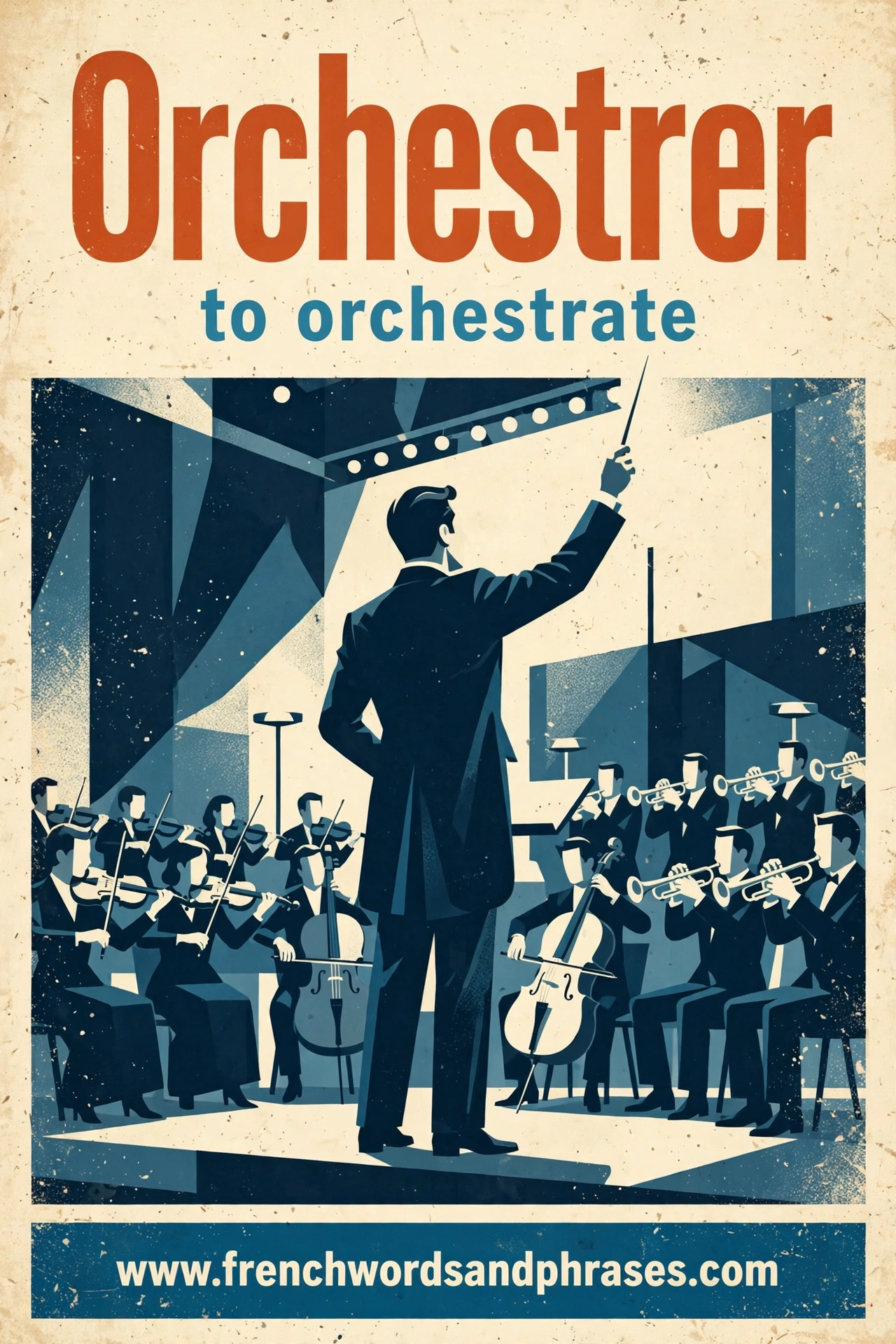
A hundred musicians, one raised baton — orchestrer is the verb of arranging many parts into one whole, whether the parts are violins and trumpets or caterers, speeches and fireworks.
In this guide, you’ll learn how to conjugate orchestrer in all the major French tenses and moods. Explore complete conjugation tables, French examples, English translations, and practice quizzes.
Understanding the French Verb Orchestrer
Orchestrer is a regular French verb belonging to the first group of verbs, those ending in -er.
It means to orchestrate. It is commonly used in music for scoring a work for orchestra, and everywhere else for carefully stage-managing campaigns, events, launches and even scandals — whenever many pieces move because one person planned it.
Verb classification: First group (-er)
Auxiliary verb: Avoir
Past participle: orchestré
Present participle: orchestrant
English equivalents: To orchestrate, to score for orchestra; orchestrer une campagne — to orchestrate a campaign; orchestrer une rencontre — to stage-manage a meeting.
One important detail: orchestrer begins with a vowel, so je becomes j’: j’orchestre, j’ai orchestré. The word comes from un orchestre, an orchestra — to orchestrate a piece of music is to decide which instrument plays what, and the figurative sense keeps that idea of one mind arranging many parts.
Experience the Word
Orchestrer is the verb of the hidden hand — many parts, one plan.
Imagine a wedding planned to the minute. The flowers arrive as the band tunes up, the cake appears just as the speeches end — nothing is luck. Someone, quietly, a tout orchestré.
The guests see only a perfect evening. Behind it, everything was orchestrated.
How to Conjugate Orchestrer: Complete French Conjugation Guide
Let’s explore every major conjugation of orchestrer, beginning with the indicative mood.
How to Conjugate Orchestrer in the Indicative Mood
The indicative mood is used to express facts, observations, actions, and events.
How to Conjugate Orchestrer in the Present Tense (Présent)
Used for actions happening now, habitual actions, and general truths.
| Subject | Conjugation |
|---|---|
| je | orchestre |
| tu | orchestres |
| il / elle | orchestre |
| nous | orchestrons |
| vous | orchestrez |
| ils / elles | orchestrent |
Example
Le compositeur orchestre sa symphonie pour cent musiciens.
The composer orchestrates his symphony for a hundred musicians.
Quick Quiz 1
Complete the sentence:
Elle ______ la campagne depuis des mois.
Reveal the answer
orchestre
Elle orchestre la campagne depuis des mois.
She has been orchestrating the campaign for months.
How to Conjugate Orchestrer in the Passé Composé
Used for completed actions in the past. Orchestrer takes the auxiliary verb avoir.
| Subject | Conjugation |
|---|---|
| j’ | ai orchestré |
| tu | as orchestré |
| il / elle | a orchestré |
| nous | avons orchestré |
| vous | avez orchestré |
| ils / elles | ont orchestré |
Example
Ils ont orchestré une fuite dans la presse.
They orchestrated a leak to the press.
How to Conjugate Orchestrer in the Imparfait (Imperfect Tense)
Used for habitual past actions, descriptions, and ongoing situations in the past.
| Subject | Conjugation |
|---|---|
| je | orchestrais |
| tu | orchestrais |
| il / elle | orchestrait |
| nous | orchestrions |
| vous | orchestriez |
| ils / elles | orchestraient |
Example
Le metteur en scène orchestrait chaque détail du spectacle.
The director orchestrated every detail of the show.
Quick Quiz 2
Choose the correct form:
He orchestrated the evening.
Il ______ la soirée. (a orchestré / est orchestré)
Reveal the answer
a orchestré
Il a orchestré la soirée.
Orchestrer takes avoir.
How to Conjugate Orchestrer in the Plus-que-parfait
Used to describe an action that had already been completed before another past event.
| Subject | Conjugation |
|---|---|
| j’ | avais orchestré |
| tu | avais orchestré |
| il / elle | avait orchestré |
| nous | avions orchestré |
| vous | aviez orchestré |
| ils / elles | avaient orchestré |
Example
Elle avait orchestré toute la cérémonie avant l’arrivée des invités.
She had orchestrated the whole ceremony before the guests arrived.
How to Conjugate Orchestrer in the Passé Simple
Primarily used in formal writing, literature, and historical narratives. It is rarely used in everyday conversation.
| Subject | Conjugation |
|---|---|
| je | orchestrai |
| tu | orchestras |
| il / elle | orchestra |
| nous | orchestrâmes |
| vous | orchestrâtes |
| ils / elles | orchestrèrent |
Example
Ravel orchestra la partition en quelques semaines.
Ravel orchestrated the score in a few weeks.
How to Conjugate Orchestrer in the Passé Antérieur
A literary tense used to express an action completed immediately before another past action, generally in the passé simple.
| Subject | Conjugation |
|---|---|
| j’ | eus orchestré |
| tu | eus orchestré |
| il / elle | eut orchestré |
| nous | eûmes orchestré |
| vous | eûtes orchestré |
| ils / elles | eurent orchestré |
Example
Quand il eut orchestré le final, il posa sa plume.
When he had orchestrated the finale, he laid down his pen.
How to Conjugate Orchestrer in the Future Tense (Futur Simple)
Used to describe actions that will take place in the future.
| Subject | Conjugation |
|---|---|
| je | orchestrerai |
| tu | orchestreras |
| il / elle | orchestrera |
| nous | orchestrerons |
| vous | orchestrerez |
| ils / elles | orchestreront |
Example
Demain, elle orchestrera la réunion des deux équipes.
Tomorrow, she will orchestrate the meeting of the two teams.
How to Conjugate Orchestrer in the Futur Antérieur (Future Perfect)
Used for an action that will have been completed before a particular point in the future.
| Subject | Conjugation |
|---|---|
| j’ | aurai orchestré |
| tu | auras orchestré |
| il / elle | aura orchestré |
| nous | aurons orchestré |
| vous | aurez orchestré |
| ils / elles | auront orchestré |
Example
À la fin du mois, il aura orchestré toute la tournée.
By the end of the month, he will have orchestrated the whole tour.
How to Conjugate Orchestrer in the Near Future (Futur Proche)
Used to describe something that is going to happen soon. Formed with aller + infinitive.
| Subject | Conjugation |
|---|---|
| je | vais orchestrer |
| tu | vas orchestrer |
| il / elle | va orchestrer |
| nous | allons orchestrer |
| vous | allez orchestrer |
| ils / elles | vont orchestrer |
Example
Je vais orchestrer l’ouverture du magasin.
I am going to orchestrate the opening of the shop.
How to Conjugate Orchestrer in the Conditional Mood
The conditional mood expresses what would happen under certain circumstances. It is also frequently used to make polite requests or express wishes.
How to Conjugate Orchestrer in the Present Conditional
| Subject | Conjugation |
|---|---|
| je | orchestrerais |
| tu | orchestrerais |
| il / elle | orchestrerait |
| nous | orchestrerions |
| vous | orchestreriez |
| ils / elles | orchestreraient |
Example
Un bon organisateur orchestrerait la fête sans effort.
A good organizer would orchestrate the party effortlessly.
How to Conjugate Orchestrer in the Past Conditional
| Subject | Conjugation |
|---|---|
| j’ | aurais orchestré |
| tu | aurais orchestré |
| il / elle | aurait orchestré |
| nous | aurions orchestré |
| vous | auriez orchestré |
| ils / elles | auraient orchestré |
Example
Elle aurait orchestré la campagne si on lui avait donné les moyens.
She would have orchestrated the campaign if she had been given the means.
Orchestrer in the Literary Past Conditional Form
This less common literary form uses the imperfect subjunctive of avoir.
| Subject | Conjugation |
|---|---|
| j’ | eusse orchestré |
| tu | eusses orchestré |
| il / elle | eût orchestré |
| nous | eussions orchestré |
| vous | eussiez orchestré |
| ils / elles | eussent orchestré |
Example
Le ministre eût orchestré la réforme avant les élections.
The minister would have orchestrated the reform before the elections.
How to Conjugate Orchestrer in the Subjunctive Mood
The subjunctive is used to express wishes, emotions, doubts, necessity, and uncertainty. It frequently follows expressions such as il faut que (it is necessary that) or bien que (although).
How to Conjugate Orchestrer in the Present Subjunctive
| Subject | Conjugation |
|---|---|
| que je | orchestre |
| que tu | orchestres |
| qu’il / qu’elle | orchestre |
| que nous | orchestrions |
| que vous | orchestriez |
| qu’ils / qu’elles | orchestrent |
Example
Il faut que tu orchestres le concert de fin d’année.
You must orchestrate the end-of-year concert.
Quick Quiz 3
Complete the sentence using the subjunctive:
Il faut que vous ______ le lancement en secret.
Reveal the answer
orchestriez
Il faut que vous orchestriez le lancement en secret.
You must orchestrate the launch in secret.
How to Conjugate Orchestrer in the Imperfect Subjunctive
A literary tense, rarely encountered in modern spoken French.
| Subject | Conjugation |
|---|---|
| que je | orchestrasse |
| que tu | orchestrasses |
| qu’il / qu’elle | orchestrât |
| que nous | orchestrassions |
| que vous | orchestrassiez |
| qu’ils / qu’elles | orchestrassent |
Example
Le directeur voulait que l’équipe orchestrât le lancement en secret.
The director wanted the team to orchestrate the launch in secret.
How to Conjugate Orchestrer in the Pluperfect Subjunctive
A literary construction used to express an action completed before another past action.
| Subject | Conjugation |
|---|---|
| que j’ | eusse orchestré |
| que tu | eusses orchestré |
| qu’il / qu’elle | eût orchestré |
| que nous | eussions orchestré |
| que vous | eussiez orchestré |
| qu’ils / qu’elles | eussent orchestré |
Example
On disait qu’il eût orchestré toute l’affaire depuis l’ombre.
People said he had orchestrated the whole affair from the shadows.
How to Conjugate Orchestrer in the Past Subjunctive
| Subject | Conjugation |
|---|---|
| que j’ | aie orchestré |
| que tu | aies orchestré |
| qu’il / qu’elle | ait orchestré |
| que nous | ayons orchestré |
| que vous | ayez orchestré |
| qu’ils / qu’elles | aient orchestré |
Example
Je suis impressionné que vous ayez orchestré un tel événement.
I am impressed that you orchestrated such an event.
How to Conjugate Orchestrer in the Imperative
The imperative is used to give commands, instructions, invitations, or suggestions. Subject pronouns are omitted.
How to Conjugate Orchestrer in the Present Imperative
| Person | Conjugation |
|---|---|
| (tu) | orchestre |
| (nous) | orchestrons |
| (vous) | orchestrez |
Example
Orchestre la soirée, et laisse-moi m’occuper des invités !
Orchestrate the evening, and let me take care of the guests!
Quick Quiz 4
How would you say Orchestrate the party (tu form)?
Reveal the answer
Orchestre la fête !
French Participles of Orchestrer
Participles are verb forms that can be used in compound tenses and other grammatical constructions.
Present Participle of Orchestrer
orchestrant
En orchestrant chaque étape, elle a évité le chaos.
By orchestrating every step, she avoided chaos.
Past Participle of Orchestrer
orchestré
Orchestrée avec soin, la cérémonie s’est déroulée sans accroc.
Orchestrated with care, the ceremony went off without a hitch.
Orchestrer in Everyday French: Real-Life Examples
Now that you know the conjugations, let’s see how orchestrer appears in everyday French.
Example 1 — Present
J’orchestre la fête d’anniversaire de ma sœur.
I am orchestrating my sister’s birthday party.
Example 2 — Passé composé
Ils ont orchestré une belle surprise.
They orchestrated a lovely surprise.
Example 3 — Imparfait
Le chef orchestrait chaque détail du concert.
The conductor used to orchestrate every detail of the concert.
Example 4 — Future
Nous orchestrerons le déménagement ensemble.
We will orchestrate the move together.
Example 5 — Conditional
Tu orchestrerais mieux la soirée avec une liste.
You would orchestrate the evening better with a list.
Example 6 — Imperative
Orchestre ce morceau pour les cuivres !
Orchestrate this piece for the brass!
Beyond Translation: The Meaning of Orchestrer
English borrowed orchestrate with both its senses intact — music first, then any carefully arranged affair.
One mind, many instruments.
In French the figurative sense often carries a hint of manipulation: orchestrer une campagne de rumeurs is to orchestrate a whispering campaign, not merely to organize one.
How to Remember the French Verb Orchestrer
Remember it this way: Orchestrer is about one hidden hand arranging many parts.
- Un orchestre is an orchestra; orchestrer is to arrange the parts — musical or otherwise.
- Vowel start: j’orchestre, j’ai orchestré.
- Regular -er: nous orchestrons, past participle orchestré.
The key idea is one hidden hand arranging many parts.
Test Your Knowledge of Orchestrer
Let’s see how much you’ve learned. Try answering these questions before revealing the answers.
Question 1
How do you say to orchestrate in French?
Reveal the answer
Orchestrer.
Question 2
How do you say She orchestrates the campaign in French?
Reveal the answer
Elle orchestre la campagne.
Question 3
Translate: They orchestrated a leak to the press.
Reveal the answer
Ils ont orchestré une fuite dans la presse.
Question 4
What is the past participle of orchestrer?
Reveal the answer
Orchestré.
Question 5
Complete the sentence:
Il faut que tu ______ le concert de fin d’année.
Reveal the answer
orchestres
Il faut que tu orchestres le concert de fin d’année.
You must orchestrate the end-of-year concert.
Your Final Challenge
Can You Use It?
How would you say this in French?
She orchestrated the whole evening, and the guests noticed nothing.
Reveal the answer
Elle a orchestré toute la soirée, et les invités n’ont rien remarqué.
She orchestrated the whole evening, and the guests noticed nothing.
A little French. A little curiosity. A richer everyday life.
LEARN FRENCH ONE WORD AT A TIME