
A French Word to Live By
How to Conjugate Orbiter in French
/ɔʁ.bi.te/
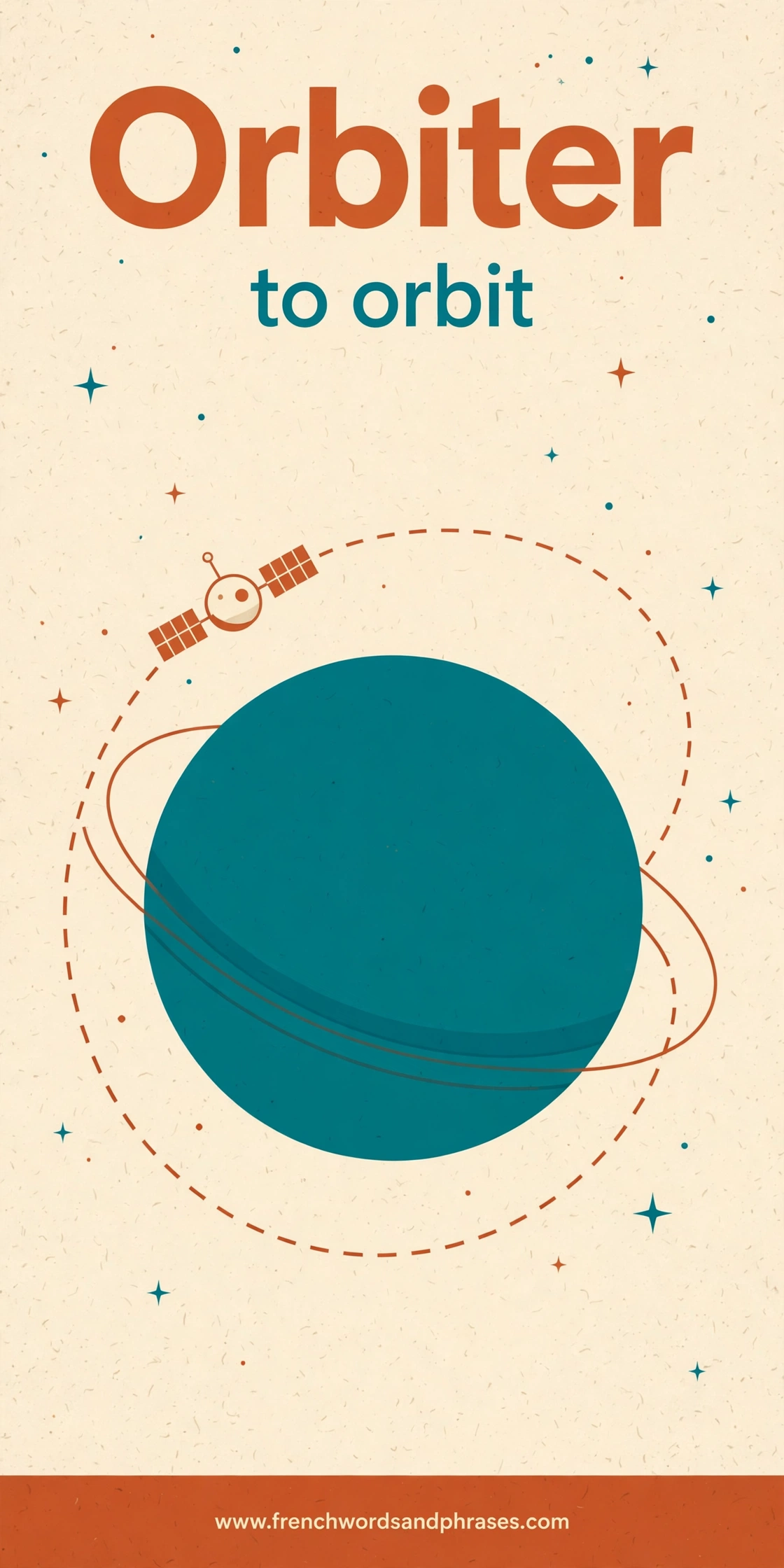
Orbiter means to orbit — to travel in a circle around a planet or a star.
Four hundred kilometres above the Earth, a station circles the planet every ninety minutes, sunrise after sunrise — orbiter is the verb of that endless, silent circling.
In this guide, you’ll learn how to conjugate orbiter in all the major French tenses and moods. Explore complete conjugation tables, French examples, English translations, and practice quizzes.
Understanding the French Verb Orbiter
Orbiter is a regular French verb belonging to the first group of verbs, those ending in -er.
It means to orbit. It is commonly used in space and astronomy for moons, planets, satellites and space stations circling a larger body, and in the news whenever a new probe reaches its planet.
Verb classification: First group (-er)
Auxiliary verb: Avoir
Past participle: orbité
Present participle: orbitant
English equivalents: To orbit, to go round; orbiter autour de la Terre — to orbit the Earth; un satellite en orbite — a satellite in orbit.
One important detail: orbiter is a perfectly regular -er verb built on the noun une orbite, an orbit. French almost always says orbiter autour de — the satellite orbite autour de la Terre, it orbits around the Earth. The family is small and tidy: orbital (orbital) and un orbiteur, an orbiter spacecraft.
Experience the Word
Orbiter is the verb of the endless circle — falling forever around a planet without ever landing.
Imagine the space station passing overhead at dawn. It circles the Earth in ninety minutes, and the crew watches sixteen sunrises a day as their home orbite around the blue planet.
They never arrive and never leave. They simply orbite — round and round, held by gravity.
How to Conjugate Orbiter: Complete French Conjugation Guide
Let’s explore every major conjugation of orbiter, beginning with the indicative mood.
How to Conjugate Orbiter in the Indicative Mood
The indicative mood is used to express facts, observations, actions, and events.
How to Conjugate Orbiter in the Present Tense (Présent)
Used for actions happening now, habitual actions, and general truths.
| Subject | Conjugation |
|---|---|
| je | orbite |
| tu | orbites |
| il / elle | orbite |
| nous | orbitons |
| vous | orbitez |
| ils / elles | orbitent |
Example
La Lune orbite autour de la Terre.
The Moon orbits around the Earth.
Quick Quiz 1
Complete the sentence:
La station ______ autour de la Terre.
Reveal the answer
orbite
La station orbite autour de la Terre.
The station orbits the Earth.
How to Conjugate Orbiter in the Passé Composé
Used for completed actions in the past. Orbiter takes the auxiliary verb avoir.
| Subject | Conjugation |
|---|---|
| j’ | ai orbité |
| tu | as orbité |
| il / elle | a orbité |
| nous | avons orbité |
| vous | avez orbité |
| ils / elles | ont orbité |
Example
Le satellite a orbité autour de Mars pendant deux ans.
The satellite orbited Mars for two years.
How to Conjugate Orbiter in the Imparfait (Imperfect Tense)
Used for habitual past actions, descriptions, and ongoing situations in the past.
| Subject | Conjugation |
|---|---|
| je | orbitais |
| tu | orbitais |
| il / elle | orbitait |
| nous | orbitions |
| vous | orbitiez |
| ils / elles | orbitaient |
Example
La station orbitait à quatre cents kilomètres d’altitude.
The station used to orbit at an altitude of four hundred kilometres.
Quick Quiz 2
Choose the correct form:
The probe orbited Mars.
La sonde ______ Mars. (a orbité / est orbitée)
Reveal the answer
a orbité
La sonde a orbité autour de Mars.
Orbiter takes avoir — and note autour de in the full sentence.
How to Conjugate Orbiter in the Plus-que-parfait
Used to describe an action that had already been completed before another past event.
| Subject | Conjugation |
|---|---|
| j’ | avais orbité |
| tu | avais orbité |
| il / elle | avait orbité |
| nous | avions orbité |
| vous | aviez orbité |
| ils / elles | avaient orbité |
Example
La sonde avait orbité autour de Jupiter avant de poursuivre sa route.
The probe had orbited Jupiter before continuing on its way.
How to Conjugate Orbiter in the Passé Simple
Primarily used in formal writing, literature, and historical narratives. It is rarely used in everyday conversation.
| Subject | Conjugation |
|---|---|
| je | orbitai |
| tu | orbitas |
| il / elle | orbita |
| nous | orbitâmes |
| vous | orbitâtes |
| ils / elles | orbitèrent |
Example
Le satellite orbita trois fois autour de la planète.
The satellite orbited the planet three times.
How to Conjugate Orbiter in the Passé Antérieur
A literary tense used to express an action completed immediately before another past action, generally in the passé simple.
| Subject | Conjugation |
|---|---|
| j’ | eus orbité |
| tu | eus orbité |
| il / elle | eut orbité |
| nous | eûmes orbité |
| vous | eûtes orbité |
| ils / elles | eurent orbité |
Example
Quand la capsule eut orbité deux fois, elle prépara sa rentrée.
When the capsule had completed two orbits, it prepared for re-entry.
How to Conjugate Orbiter in the Future Tense (Futur Simple)
Used to describe actions that will take place in the future.
| Subject | Conjugation |
|---|---|
| je | orbiterai |
| tu | orbiteras |
| il / elle | orbitera |
| nous | orbiterons |
| vous | orbiterez |
| ils / elles | orbiteront |
Example
Demain, la comète orbitera au plus près du Soleil.
Tomorrow, the comet will orbit closest to the Sun.
How to Conjugate Orbiter in the Futur Antérieur (Future Perfect)
Used for an action that will have been completed before a particular point in the future.
| Subject | Conjugation |
|---|---|
| j’ | aurai orbité |
| tu | auras orbité |
| il / elle | aura orbité |
| nous | aurons orbité |
| vous | aurez orbité |
| ils / elles | auront orbité |
Example
En 2030, la sonde aura orbité autour d’Europe pendant un an.
By 2030, the probe will have orbited Europa for a year.
How to Conjugate Orbiter in the Near Future (Futur Proche)
Used to describe something that is going to happen soon. Formed with aller + infinitive.
| Subject | Conjugation |
|---|---|
| je | vais orbiter |
| tu | vas orbiter |
| il / elle | va orbiter |
| nous | allons orbiter |
| vous | allez orbiter |
| ils / elles | vont orbiter |
Example
Le nouveau satellite va orbiter au-dessus de l’Atlantique.
The new satellite is going to orbit above the Atlantic.
How to Conjugate Orbiter in the Conditional Mood
The conditional mood expresses what would happen under certain circumstances. It is also frequently used to make polite requests or express wishes.
How to Conjugate Orbiter in the Present Conditional
| Subject | Conjugation |
|---|---|
| je | orbiterais |
| tu | orbiterais |
| il / elle | orbiterait |
| nous | orbiterions |
| vous | orbiteriez |
| ils / elles | orbiteraient |
Example
Une planète plus légère orbiterait plus lentement.
A lighter planet would orbit more slowly.
How to Conjugate Orbiter in the Past Conditional
| Subject | Conjugation |
|---|---|
| j’ | aurais orbité |
| tu | aurais orbité |
| il / elle | aurait orbité |
| nous | aurions orbité |
| vous | auriez orbité |
| ils / elles | auraient orbité |
Example
La sonde aurait orbité plus longtemps si ses panneaux avaient tenu.
The probe would have orbited longer if its panels had held.
Orbiter in the Literary Past Conditional Form
This less common literary form uses the imperfect subjunctive of avoir.
| Subject | Conjugation |
|---|---|
| j’ | eusse orbité |
| tu | eusses orbité |
| il / elle | eût orbité |
| nous | eussions orbité |
| vous | eussiez orbité |
| ils / elles | eussent orbité |
Example
La comète eût orbité près du Soleil sans jamais le toucher.
The comet would have orbited near the Sun without ever touching it.
How to Conjugate Orbiter in the Subjunctive Mood
The subjunctive is used to express wishes, emotions, doubts, necessity, and uncertainty. It frequently follows expressions such as il faut que (it is necessary that) or bien que (although).
How to Conjugate Orbiter in the Present Subjunctive
| Subject | Conjugation |
|---|---|
| que je | orbite |
| que tu | orbites |
| qu’il / qu’elle | orbite |
| que nous | orbitions |
| que vous | orbitiez |
| qu’ils / qu’elles | orbitent |
Example
Il faut que le satellite orbite exactement sur cette trajectoire.
The satellite must orbit exactly on this trajectory.
Quick Quiz 3
Complete the sentence using the subjunctive:
Il faut que la sonde ______ autour de Mars.
Reveal the answer
orbite
Il faut que la sonde orbite autour de Mars.
The probe must orbit Mars.
How to Conjugate Orbiter in the Imperfect Subjunctive
A literary tense, rarely encountered in modern spoken French.
| Subject | Conjugation |
|---|---|
| que je | orbitasse |
| que tu | orbitasses |
| qu’il / qu’elle | orbitât |
| que nous | orbitassions |
| que vous | orbitassiez |
| qu’ils / qu’elles | orbitassent |
Example
Les ingénieurs voulaient que la sonde orbitât autour de Mars.
The engineers wanted the probe to orbit Mars.
How to Conjugate Orbiter in the Pluperfect Subjunctive
A literary construction used to express an action completed before another past action.
| Subject | Conjugation |
|---|---|
| que j’ | eusse orbité |
| que tu | eusses orbité |
| qu’il / qu’elle | eût orbité |
| que nous | eussions orbité |
| que vous | eussiez orbité |
| qu’ils / qu’elles | eussent orbité |
Example
On racontait que la capsule eût orbité en secret autour de la Lune.
People told how the capsule had orbited secretly around the Moon.
How to Conjugate Orbiter in the Past Subjunctive
| Subject | Conjugation |
|---|---|
| que j’ | aie orbité |
| que tu | aies orbité |
| qu’il / qu’elle | ait orbité |
| que nous | ayons orbité |
| que vous | ayez orbité |
| qu’ils / qu’elles | aient orbité |
Example
Je suis content que le satellite ait orbité sans incident.
I am glad the satellite orbited without incident.
How to Conjugate Orbiter in the Imperative
The imperative is used to give commands, instructions, invitations, or suggestions. Subject pronouns are omitted.
How to Conjugate Orbiter in the Present Imperative
| Person | Conjugation |
|---|---|
| (tu) | orbite |
| (nous) | orbitons |
| (vous) | orbitez |
Example
Orbite autour de la station et attends le signal !
Orbit around the station and wait for the signal!
Quick Quiz 4
How would you say Orbit around the station (tu form)?
Reveal the answer
Orbite autour de la station !
French Participles of Orbiter
Participles are verb forms that can be used in compound tenses and other grammatical constructions.
Present Participle of Orbiter
orbitant
En orbitant autour de la Terre, l’équipage voit seize levers de soleil par jour.
While orbiting the Earth, the crew sees sixteen sunrises a day.
Past Participle of Orbiter
orbité
Une planète orbitée par trois lunes apparaît dans le télescope.
A planet orbited by three moons appears in the telescope.
Orbiter in Everyday French: Real-Life Examples
Now that you know the conjugations, let’s see how orbiter appears in everyday French.
Example 1 — Present
La Lune orbite autour de la Terre.
The Moon orbits the Earth.
Example 2 — Passé composé
Le satellite a orbité pendant deux ans.
The satellite orbited for two years.
Example 3 — Imparfait
La station orbitait au-dessus de l’océan.
The station used to orbit above the ocean.
Example 4 — Future
La sonde orbitera autour de Mars.
The probe will orbit Mars.
Example 5 — Conditional
Sans gravité, elle orbiterait au loin.
Without gravity, it would orbit far away.
Example 6 — Imperative
Orbitez autour de la station, puis approchez lentement !
Orbit around the station, then approach slowly!
Beyond Translation: The Meaning of Orbiter
English orbit works as both noun and verb; French splits the jobs: une orbite is the path, orbiter is the travelling.
Around, always around.
French adds autour de where English can drop it: la Lune orbite autour de la Terre — the Moon orbits (around) the Earth.
How to Remember the French Verb Orbiter
Remember it this way: Orbiter is about circling a planet forever without landing.
- Une orbite is the path; orbiter is travelling along it.
- Always with autour de: orbiter autour de la Terre.
- Regular -er: j’orbite, nous orbitons, past participle orbité.
The key idea is circling a planet forever without landing.
Test Your Knowledge of Orbiter
Let’s see how much you’ve learned. Try answering these questions before revealing the answers.
Question 1
How do you say to orbit in French?
Reveal the answer
Orbiter.
Question 2
How do you say The Moon orbits the Earth in French?
Reveal the answer
La Lune orbite autour de la Terre.
Question 3
Translate: The satellite orbited for two years.
Reveal the answer
Le satellite a orbité pendant deux ans.
Question 4
What is the past participle of orbiter?
Reveal the answer
Orbité.
Question 5
Complete the sentence:
Il faut que le satellite ______ sur cette trajectoire.
Reveal the answer
orbite
Il faut que le satellite orbite sur cette trajectoire.
The satellite must orbit on this trajectory.
Your Final Challenge
Can You Use It?
How would you say this in French?
The Moon has been orbiting the Earth for billions of years.
Reveal the answer
La Lune orbite autour de la Terre depuis des milliards d’années.
The Moon has been orbiting the Earth for billions of years.
A little French. A little curiosity. A richer everyday life.
LEARN FRENCH ONE WORD AT A TIME




