
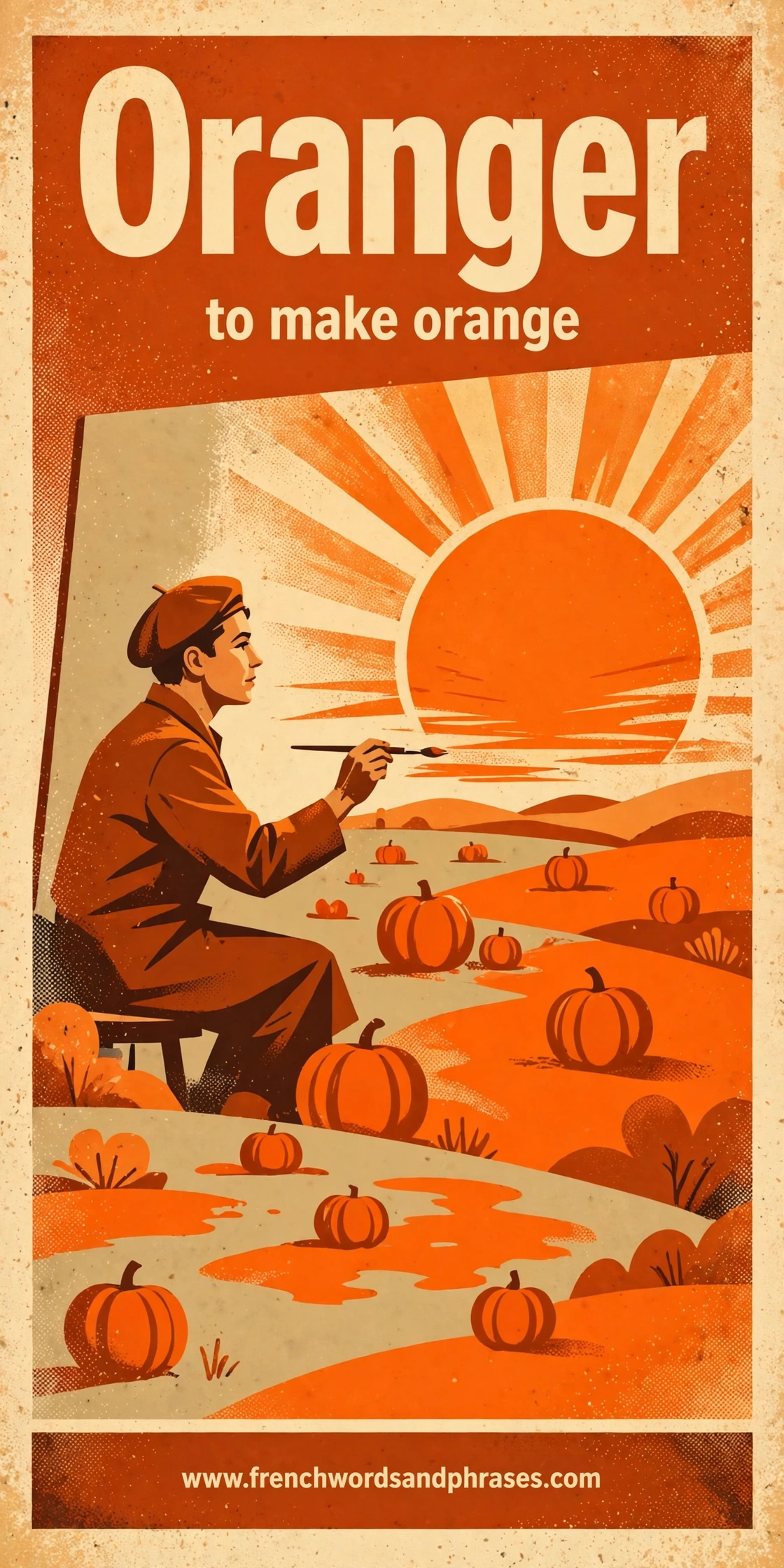
A French Word to Live By
How to Conjugate Oranger in French
/ɔ.ʁɑ̃.ʒe/
Oranger means to make orange — to colour or dye something orange.
A brush loaded with pigment, a dyer’s vat, a sunset over the port — oranger is the verb of the colour orange arriving somewhere it was not before, laid on by a hand or by the evening sky.
In this guide, you’ll learn how to conjugate oranger in all the major French tenses and moods. Explore complete conjugation tables, French examples, English translations, and practice quizzes.
Understanding the French Verb Oranger
Oranger is a regular French verb belonging to the first group of verbs, those ending in -er.
It means to make orange. It is commonly used of the setting sun colouring the sky, of painters tinting a background, and of dyeing hair, wool or fabric orange — anywhere a surface takes on the colour of the fruit.
Verb classification: First group (-er)
Auxiliary verb: Avoir
Past participle: orangé
Present participle: orangeant
English equivalents: To make orange, to colour orange, to dye orange; oranger le ciel (of the setting sun) — to turn the sky orange; se faire oranger les cheveux — to have one’s hair dyed orange.
One important detail: oranger is a -ger verb, so it keeps its e before a and o to protect the soft g sound: nous orangeons, j’orangeais, en orangeant. Without that extra e, the g would turn hard. Note the noun hiding inside it: une orange is the fruit, and un oranger — spelled exactly the same — is the orange tree.
Experience the Word
Oranger is the verb of the golden hour — the moment the world is dipped in orange.
Imagine a harbour in Provence at seven in the evening. The boats come in, the masts black against the light, and slowly the sun oranges the whole sky, the water, even the white walls of the port.
Nothing has been painted. The evening itself has done it — everything has been oranged by the light.
How to Conjugate Oranger: Complete French Conjugation Guide
Let’s explore every major conjugation of oranger, beginning with the indicative mood.
How to Conjugate Oranger in the Indicative Mood
The indicative mood is used to express facts, observations, actions, and events.
How to Conjugate Oranger in the Present Tense (Présent)
Used for actions happening now, habitual actions, and general truths.
| Subject | Conjugation |
|---|---|
| je | orange |
| tu | oranges |
| il / elle | orange |
| nous | orangeons |
| vous | orangez |
| ils / elles | orangent |
Example
Le soleil couchant orange le ciel au-dessus du port.
The setting sun turns the sky orange above the harbour.
Quick Quiz 1
Complete the sentence:
Le couchant ______ la baie.
Reveal the answer
orange
Le couchant orange la baie.
The sunset turns the bay orange.
How to Conjugate Oranger in the Passé Composé
Used for completed actions in the past. Oranger takes the auxiliary verb avoir.
| Subject | Conjugation |
|---|---|
| j’ | ai orangé |
| tu | as orangé |
| il / elle | a orangé |
| nous | avons orangé |
| vous | avez orangé |
| ils / elles | ont orangé |
Example
Elle a orangé ses cheveux avec du henné.
She dyed her hair orange with henna.
How to Conjugate Oranger in the Imparfait (Imperfect Tense)
Used for habitual past actions, descriptions, and ongoing situations in the past.
| Subject | Conjugation |
|---|---|
| je | orangeais |
| tu | orangeais |
| il / elle | orangeait |
| nous | orangions |
| vous | orangiez |
| ils / elles | orangeaient |
Example
Chaque soir, le soleil orangeait les nuages au-dessus de la vallée.
Every evening, the sun used to turn the clouds orange above the valley.
Quick Quiz 2
Choose the correct form:
She dyed her hair orange.
Elle ______ ses cheveux. (a orangé / est orangée)
Reveal the answer
a orangé
Elle a orangé ses cheveux.
Oranger takes avoir.
How to Conjugate Oranger in the Plus-que-parfait
Used to describe an action that had already been completed before another past event.
| Subject | Conjugation |
|---|---|
| j’ | avais orangé |
| tu | avais orangé |
| il / elle | avait orangé |
| nous | avions orangé |
| vous | aviez orangé |
| ils / elles | avaient orangé |
Example
Il avait orangé le ciel de son tableau avant d’ajouter la mer.
He had coloured the sky of his painting orange before adding the sea.
How to Conjugate Oranger in the Passé Simple
Primarily used in formal writing, literature, and historical narratives. It is rarely used in everyday conversation.
| Subject | Conjugation |
|---|---|
| je | orangeai |
| tu | orangeas |
| il / elle | orangea |
| nous | orangeâmes |
| vous | orangeâtes |
| ils / elles | orangeèrent |
Example
Le crépuscule orangea lentement l’horizon.
The dusk slowly turned the horizon orange.
How to Conjugate Oranger in the Passé Antérieur
A literary tense used to express an action completed immediately before another past action, generally in the passé simple.
| Subject | Conjugation |
|---|---|
| j’ | eus orangé |
| tu | eus orangé |
| il / elle | eut orangé |
| nous | eûmes orangé |
| vous | eûtes orangé |
| ils / elles | eurent orangé |
Example
Quand le peintre eut orangé le fond, il commença les ombres.
When the painter had coloured the background orange, he began the shadows.
How to Conjugate Oranger in the Future Tense (Futur Simple)
Used to describe actions that will take place in the future.
| Subject | Conjugation |
|---|---|
| je | orangerai |
| tu | orangeras |
| il / elle | orangera |
| nous | orangerons |
| vous | orangerez |
| ils / elles | orangeront |
Example
Au coucher du soleil, la lumière orangera les façades de la vieille ville.
At sunset, the light will turn the façades of the old town orange.
How to Conjugate Oranger in the Futur Antérieur (Future Perfect)
Used for an action that will have been completed before a particular point in the future.
| Subject | Conjugation |
|---|---|
| j’ | aurai orangé |
| tu | auras orangé |
| il / elle | aura orangé |
| nous | aurons orangé |
| vous | aurez orangé |
| ils / elles | auront orangé |
Example
À la tombée de la nuit, le soleil aura orangé tout l’horizon.
By nightfall, the sun will have turned the whole horizon orange.
How to Conjugate Oranger in the Near Future (Futur Proche)
Used to describe something that is going to happen soon. Formed with aller + infinitive.
| Subject | Conjugation |
|---|---|
| je | vais oranger |
| tu | vas oranger |
| il / elle | va oranger |
| nous | allons oranger |
| vous | allez oranger |
| ils / elles | vont oranger |
Example
Regarde, le ciel va oranger dans quelques minutes.
Look, the sky is going to turn orange in a few minutes.
How to Conjugate Oranger in the Conditional Mood
The conditional mood expresses what would happen under certain circumstances. It is also frequently used to make polite requests or express wishes.
How to Conjugate Oranger in the Present Conditional
| Subject | Conjugation |
|---|---|
| je | orangerais |
| tu | orangerais |
| il / elle | orangerait |
| nous | orangerions |
| vous | orangeriez |
| ils / elles | orangeraient |
Example
Sans les nuages, le couchant orangerait la baie entière.
Without the clouds, the sunset would turn the whole bay orange.
How to Conjugate Oranger in the Past Conditional
| Subject | Conjugation |
|---|---|
| j’ | aurais orangé |
| tu | aurais orangé |
| il / elle | aurait orangé |
| nous | aurions orangé |
| vous | auriez orangé |
| ils / elles | auraient orangé |
Example
Le peintre aurait orangé le ciel si la lumière avait été plus chaude.
The painter would have coloured the sky orange if the light had been warmer.
Oranger in the Literary Past Conditional Form
This less common literary form uses the imperfect subjunctive of avoir.
| Subject | Conjugation |
|---|---|
| j’ | eusse orangé |
| tu | eusses orangé |
| il / elle | eût orangé |
| nous | eussions orangé |
| vous | eussiez orangé |
| ils / elles | eussent orangé |
Example
Le soleil eût orangé les collines avant la pluie.
The sun would have turned the hills orange before the rain.
How to Conjugate Oranger in the Subjunctive Mood
The subjunctive is used to express wishes, emotions, doubts, necessity, and uncertainty. It frequently follows expressions such as il faut que (it is necessary that) or bien que (although).
How to Conjugate Oranger in the Present Subjunctive
| Subject | Conjugation |
|---|---|
| que je | orange |
| que tu | oranges |
| qu’il / qu’elle | orange |
| que nous | orangions |
| que vous | orangiez |
| qu’ils / qu’elles | orangent |
Example
Il faut que tu oranges doucement le fond du tableau.
You must colour the background of the painting orange, gently.
Quick Quiz 3
Complete the sentence using the subjunctive:
Il faut que tu ______ le ciel doucement.
Reveal the answer
oranges
Il faut que tu oranges le ciel doucement.
You must colour the sky orange gently.
How to Conjugate Oranger in the Imperfect Subjunctive
A literary tense, rarely encountered in modern spoken French.
| Subject | Conjugation |
|---|---|
| que je | orangasse |
| que tu | orangasses |
| qu’il / qu’elle | orangât |
| que nous | orangassions |
| que vous | orangassiez |
| qu’ils / qu’elles | orangassent |
Example
Elle voulait que le soleil orangeât la vallée une dernière fois.
She wanted the sun to turn the valley orange one last time.
How to Conjugate Oranger in the Pluperfect Subjunctive
A literary construction used to express an action completed before another past action.
| Subject | Conjugation |
|---|---|
| que j’ | eusse orangé |
| que tu | eusses orangé |
| qu’il / qu’elle | eût orangé |
| que nous | eussions orangé |
| que vous | eussiez orangé |
| qu’ils / qu’elles | eussent orangé |
Example
On racontait que le peintre eût orangé le ciel avant l’orage.
People told how the painter had coloured the sky orange before the storm.
How to Conjugate Oranger in the Past Subjunctive
| Subject | Conjugation |
|---|---|
| que j’ | aie orangé |
| que tu | aies orangé |
| qu’il / qu’elle | ait orangé |
| que nous | ayons orangé |
| que vous | ayez orangé |
| qu’ils / qu’elles | aient orangé |
Example
Je suis ravi que tu aies orangé la couverture du livre.
I am delighted that you coloured the book cover orange.
How to Conjugate Oranger in the Imperative
The imperative is used to give commands, instructions, invitations, or suggestions. Subject pronouns are omitted.
How to Conjugate Oranger in the Present Imperative
| Person | Conjugation |
|---|---|
| (tu) | orange |
| (nous) | orangeons |
| (vous) | orangez |
Example
Orange le ciel, mais laisse la mer bleue !
Colour the sky orange, but leave the sea blue!
Quick Quiz 4
How would you say Colour the background orange (tu form)?
Reveal the answer
Orange le fond !
French Participles of Oranger
Participles are verb forms that can be used in compound tenses and other grammatical constructions.
Present Participle of Oranger
orangeant
En orangeant le fond, elle a donné de la chaleur au tableau.
By colouring the background orange, she gave warmth to the painting.
Past Participle of Oranger
orangé
Orangée par le soleil couchant, la façade brillait doucement.
Turned orange by the setting sun, the façade glowed softly.
Oranger in Everyday French: Real-Life Examples
Now that you know the conjugations, let’s see how oranger appears in everyday French.
Example 1 — Present
Le soleil orange les nuages du soir.
The sun turns the evening clouds orange.
Example 2 — Passé composé
Elle a orangé ses cheveux au henné.
She dyed her hair orange with henna.
Example 3 — Imparfait
Le couchant orangeait la baie chaque soir.
The sunset used to turn the bay orange every evening.
Example 4 — Future
La lumière orangera les façades à six heures.
The light will turn the façades orange at six o’clock.
Example 5 — Conditional
Tu orangerais le ciel plus fort avec ce pigment.
You would colour the sky more strongly with this pigment.
Example 6 — Imperative
Orangeons le fond avant de peindre les arbres !
Let’s colour the background orange before painting the trees!
Beyond Translation: The Meaning of Oranger
English says to turn orange or to dye orange in two words; French packs the colour into a single verb, just as it does with rougir, jaunir and noircir.
One colour, one verb.
And watch the spelling trap: oranger the verb and un oranger, the orange tree, are written exactly the same — only the sentence tells you which one is growing.
How to Remember the French Verb Oranger
Remember it this way: Oranger is about the setting sun dipping the sky in orange.
- Une orange, the fruit, gives oranger the verb — to make something the colour of an orange.
- A -ger verb: keep the e before a and o — nous orangeons, j’orangeais.
- Regular -er otherwise: j’orange, nous orangeons, past participle orangé.
The key idea is the setting sun dipping the sky in orange.
Test Your Knowledge of Oranger
Let’s see how much you’ve learned. Try answering these questions before revealing the answers.
Question 1
How do you say to colour something orange in French?
Reveal the answer
Oranger.
Question 2
How do you say The sun turns the clouds orange in French?
Reveal the answer
Le soleil orange les nuages.
Question 3
Translate: She dyed her hair orange.
Reveal the answer
Elle a orangé ses cheveux.
Question 4
What is the past participle of oranger?
Reveal the answer
Orangé.
Question 5
Complete the sentence:
Nous ______ le fond du tableau.
Reveal the answer
orangeons
Nous orangeons le fond du tableau.
We colour the background of the painting orange — note the extra e that keeps the g soft.
Your Final Challenge
Can You Use It?
How would you say this in French?
The setting sun turns the sky orange, and the whole harbour turns golden.
Reveal the answer
Le soleil couchant orange le ciel, et tout le port devient doré.
The setting sun turns the sky orange, and the whole harbour turns golden.
A little French. A little curiosity. A richer everyday life.
LEARN FRENCH ONE WORD AT A TIME




