
A French Word to Live By
How to Conjugate Oppresser in French
/ɔ.pʁe.se/
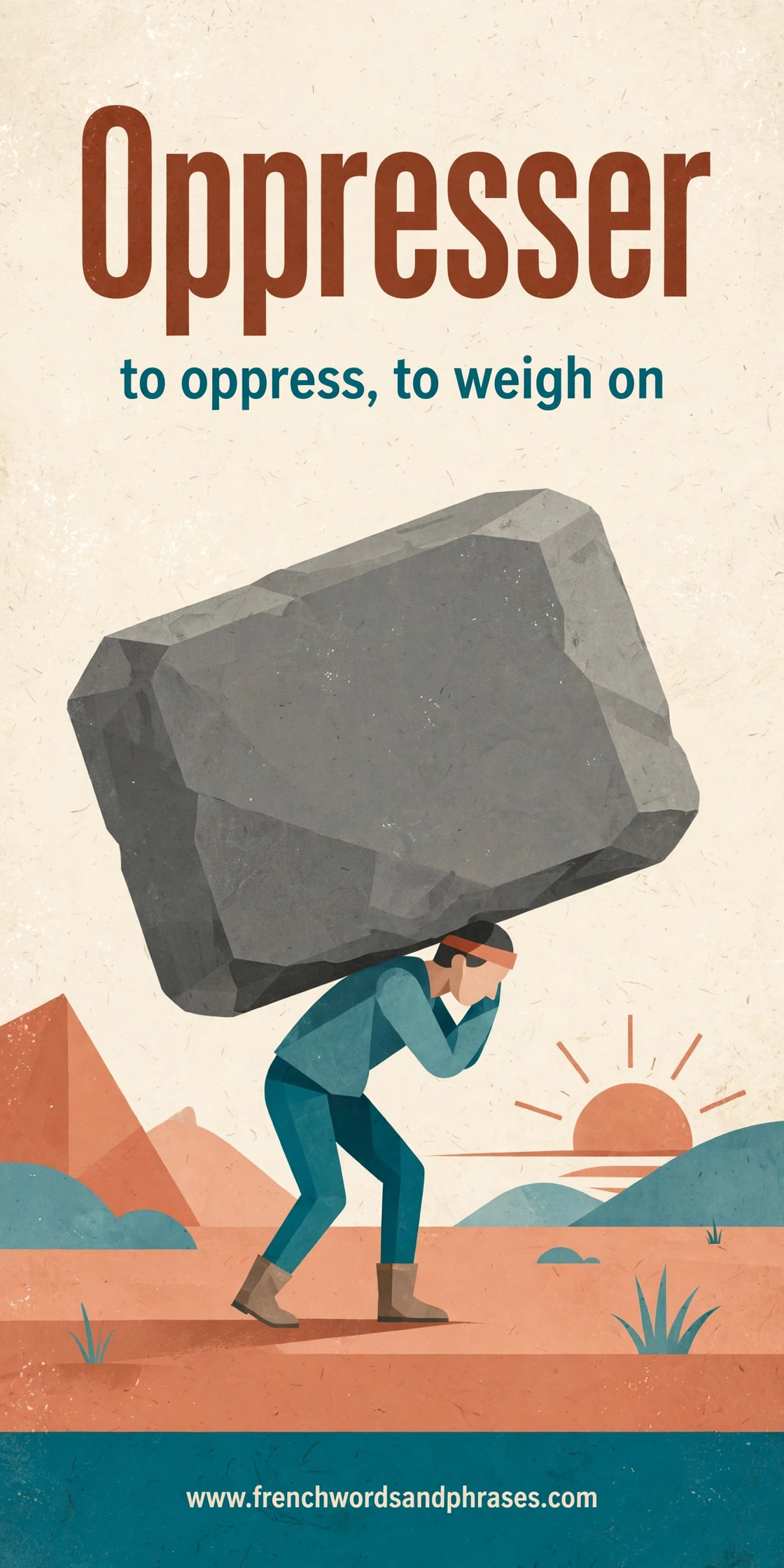
Oppresser means to oppress — to weigh on the chest and make breathing hard, like stifling heat, a pressing crowd or heavy news.
A crowded train in August, the air thick, the windows fogged and a stranger’s elbow in your ribs — oppresser is the verb of weight on the chest, of air that will not move and news that will not lift.
In this guide, you’ll learn how to conjugate oppresser in all the major French tenses and moods. Explore complete conjugation tables, French examples, English translations, and practice quizzes.
Understanding the French Verb Oppresser
Oppresser is a regular French verb belonging to the first group of verbs, those ending in -er.
It means to oppress, to weigh on. It is commonly used for stifling heat and heavy air, for crowds pressing in on all sides, and for anxiety or bad news that sits on the chest — anywhere something weighs on body or mind.
Verb classification: First group (-er)
Auxiliary verb: Avoir
Past participle: oppressé
Present participle: oppressant
English equivalents: To oppress, to weigh on, to make breathing hard; une chaleur qui oppresse — stifling heat; se sentir oppressé — to feel weighed down, anxious.
One important detail: oppresser keeps its double s in every form — j’oppresse, nous oppressons, past participle oppressé. Do not confuse it with its twin opprimer: opprimer is the tyrant’s verb, used of regimes and peoples, while oppresser presses on the chest — heat, crowds, smoke and anxiety. Its noun is a sensation: une oppression, a feeling of suffocation or dread, and je me sens oppressé is what you say when the air or the worry gets heavy.
Experience the Word
Oppresser is pressure you can feel in your lungs — the verb of air that will not move.
Imagine the last métro of a heatwave evening. The carriage is packed, the air is warm soup, and la foule oppresse les voyageurs de tous côtés until the doors sigh open at the station and the platform air arrives like a gift.
Then the weight lifts off every chest at once. On respire — on n’est plus oppressé.
How to Conjugate Oppresser: Complete French Conjugation Guide
Let’s explore every major conjugation of oppresser, beginning with the indicative mood.
How to Conjugate Oppresser in the Indicative Mood
The indicative mood is used to express facts, observations, actions, and events.
How to Conjugate Oppresser in the Present Tense (Présent)
Used for actions happening now, habitual actions, and general truths.
| Subject | Conjugation |
|---|---|
| je | oppresse |
| tu | oppresses |
| il / elle | oppresse |
| nous | oppressons |
| vous | oppressez |
| ils / elles | oppressent |
Example
La chaleur oppresse toute la ville en août.
The heat oppresses the whole city in August.
Quick Quiz 1
Complete the sentence:
La foule ______ les voyageurs sur le quai.
Reveal the answer
oppresse
La foule oppresse les voyageurs sur le quai.
The crowd presses on the travellers on the platform.
How to Conjugate Oppresser in the Passé Composé
Used for completed actions in the past. Oppresser takes the auxiliary verb avoir.
| Subject | Conjugation |
|---|---|
| j’ | ai oppressé |
| tu | as oppressé |
| il / elle | a oppressé |
| nous | avons oppressé |
| vous | avez oppressé |
| ils / elles | ont oppressé |
Example
Une angoisse étrange l’a oppressé toute la nuit.
A strange anxiety weighed on him all night.
How to Conjugate Oppresser in the Imparfait (Imperfect Tense)
Used for habitual past actions, descriptions, and ongoing situations in the past.
| Subject | Conjugation |
|---|---|
| je | oppressais |
| tu | oppressais |
| il / elle | oppressait |
| nous | oppressions |
| vous | oppressiez |
| ils / elles | oppressaient |
Example
La fumée oppressait les pompiers près du foyer.
The smoke made it hard for the firefighters to breathe near the blaze.
Quick Quiz 2
Choose the correct form:
The heat weighed on us all summer.
La chaleur ______ tout l’été. (nous a oppressés / nous est oppressée)
Reveal the answer
nous a oppressés
La chaleur nous a oppressés tout l’été.
Oppresser takes avoir.
How to Conjugate Oppresser in the Plus-que-parfait
Used to describe an action that had already been completed before another past event.
| Subject | Conjugation |
|---|---|
| j’ | avais oppressé |
| tu | avais oppressé |
| il / elle | avait oppressé |
| nous | avions oppressé |
| vous | aviez oppressé |
| ils / elles | avaient oppressé |
Example
Le silence avait oppressé la pièce pendant de longues minutes.
Silence had weighed on the room for long minutes.
How to Conjugate Oppresser in the Passé Simple
Primarily used in formal writing, literature, and historical narratives. It is rarely used in everyday conversation.
| Subject | Conjugation |
|---|---|
| je | oppressai |
| tu | oppressas |
| il / elle | oppressa |
| nous | oppressâmes |
| vous | oppressâtes |
| ils / elles | oppressèrent |
Example
Une chaleur de plomb oppressa la plaine tout l’été.
A leaden heat oppressed the plain all summer.
How to Conjugate Oppresser in the Passé Antérieur
A literary tense used to express an action completed immediately before another past action, generally in the passé simple.
| Subject | Conjugation |
|---|---|
| j’ | eus oppressé |
| tu | eus oppressé |
| il / elle | eut oppressé |
| nous | eûmes oppressé |
| vous | eûtes oppressé |
| ils / elles | eurent oppressé |
Example
Quand la nouvelle eut oppressé tous les esprits, la réunion s’acheva en silence.
When the news had weighed on everyone’s mind, the meeting ended in silence.
How to Conjugate Oppresser in the Future Tense (Futur Simple)
Used to describe actions that will take place in the future.
| Subject | Conjugation |
|---|---|
| je | oppresserai |
| tu | oppresseras |
| il / elle | oppressera |
| nous | oppresserons |
| vous | oppresserez |
| ils / elles | oppresseront |
Example
Cette humidité nous oppressera jusqu’à l’orage.
This humidity will oppress us until the storm.
How to Conjugate Oppresser in the Futur Antérieur (Future Perfect)
Used for an action that will have been completed before a particular point in the future.
| Subject | Conjugation |
|---|---|
| j’ | aurai oppressé |
| tu | auras oppressé |
| il / elle | aura oppressé |
| nous | aurons oppressé |
| vous | aurez oppressé |
| ils / elles | auront oppressé |
Example
À la fin de la journée, la fatigue aura oppressé toute l’équipe.
By the end of the day, tiredness will have weighed down the whole team.
How to Conjugate Oppresser in the Near Future (Futur Proche)
Used to describe something that is going to happen soon. Formed with aller + infinitive.
| Subject | Conjugation |
|---|---|
| je | vais oppresser |
| tu | vas oppresser |
| il / elle | va oppresser |
| nous | allons oppresser |
| vous | allez oppresser |
| ils / elles | vont oppresser |
Example
Je sens que cette attente va m’oppresser encore longtemps.
I feel this waiting is going to weigh on me for a long time yet.
How to Conjugate Oppresser in the Conditional Mood
The conditional mood expresses what would happen under certain circumstances. It is also frequently used to make polite requests or express wishes.
How to Conjugate Oppresser in the Present Conditional
| Subject | Conjugation |
|---|---|
| je | oppresserais |
| tu | oppresserais |
| il / elle | oppresserait |
| nous | oppresserions |
| vous | oppresseriez |
| ils / elles | oppresseraient |
Example
Sans la climatisation, la chaleur nous oppresserait nuit et jour.
Without air conditioning, the heat would oppress us night and day.
How to Conjugate Oppresser in the Past Conditional
| Subject | Conjugation |
|---|---|
| j’ | aurais oppressé |
| tu | aurais oppressé |
| il / elle | aurait oppressé |
| nous | aurions oppressé |
| vous | auriez oppressé |
| ils / elles | auraient oppressé |
Example
La nouvelle l’aurait moins oppressé s’il l’avait apprise en douceur.
The news would have weighed less on him if he had learned it gently.
Oppresser in the Literary Past Conditional Form
This less common literary form uses the imperfect subjunctive of avoir.
| Subject | Conjugation |
|---|---|
| j’ | eusse oppressé |
| tu | eusses oppressé |
| il / elle | eût oppressé |
| nous | eussions oppressé |
| vous | eussiez oppressé |
| ils / elles | eussent oppressé |
Example
Nulle angoisse ne l’eût oppressé en ces lieux paisibles.
No anxiety would have weighed on him in that peaceful place.
How to Conjugate Oppresser in the Subjunctive Mood
The subjunctive is used to express wishes, emotions, doubts, necessity, and uncertainty. It frequently follows expressions such as il faut que (it is necessary that) or bien que (although).
How to Conjugate Oppresser in the Present Subjunctive
| Subject | Conjugation |
|---|---|
| que je | oppresse |
| que tu | oppresses |
| qu’il / qu’elle | oppresse |
| que nous | oppressions |
| que vous | oppressiez |
| qu’ils / qu’elles | oppressent |
Example
Il est possible que ce silence oppresse les enfants.
It is possible that this silence weighs on the children.
Quick Quiz 3
Complete the sentence using the subjunctive:
Il est possible que ce silence ______ les enfants.
Reveal the answer
oppresse
Il est possible que ce silence oppresse les enfants.
It is possible that this silence weighs on the children.
How to Conjugate Oppresser in the Imperfect Subjunctive
A literary tense, rarely encountered in modern spoken French.
| Subject | Conjugation |
|---|---|
| que je | oppressasse |
| que tu | oppressasses |
| qu’il / qu’elle | oppressât |
| que nous | oppressassions |
| que vous | oppressassiez |
| qu’ils / qu’elles | oppressassent |
Example
Elle craignait que la chaleur n’oppressât les malades.
She feared the heat would oppress the patients.
How to Conjugate Oppresser in the Pluperfect Subjunctive
A literary construction used to express an action completed before another past action.
| Subject | Conjugation |
|---|---|
| que j’ | eusse oppressé |
| que tu | eusses oppressé |
| qu’il / qu’elle | eût oppressé |
| que nous | eussions oppressé |
| que vous | eussiez oppressé |
| qu’ils / qu’elles | eussent oppressé |
Example
On sentait que la peur eût oppressé le village entier.
You could feel that fear had weighed on the whole village.
How to Conjugate Oppresser in the Past Subjunctive
| Subject | Conjugation |
|---|---|
| que j’ | aie oppressé |
| que tu | aies oppressé |
| qu’il / qu’elle | ait oppressé |
| que nous | ayons oppressé |
| que vous | ayez oppressé |
| qu’ils / qu’elles | aient oppressé |
Example
Je suis désolé que cette affaire vous ait oppressé à ce point.
I am sorry this business weighed on you so heavily.
How to Conjugate Oppresser in the Imperative
The imperative is used to give commands, instructions, invitations, or suggestions. Subject pronouns are omitted.
How to Conjugate Oppresser in the Present Imperative
| Person | Conjugation |
|---|---|
| (tu) | oppresse |
| (nous) | oppressons |
| (vous) | oppressez |
Example
N’oppresse pas ton frère avec tes questions !
Do not overwhelm your brother with your questions!
Quick Quiz 4
How would you say I feel weighed down?
Reveal the answer
Je me sens oppressé.
French Participles of Oppresser
Participles are verb forms that can be used in compound tenses and other grammatical constructions.
Present Participle of Oppresser
oppressant
Oppressant les poumons, la fumée a fait reculer les pompiers.
Weighing on their lungs, the smoke drove the firefighters back.
Past Participle of Oppresser
oppressé
Oppressée par la chaleur, elle a cherché l’ombre d’un arbre.
Weighed down by the heat, she looked for the shade of a tree.
Oppresser in Everyday French: Real-Life Examples
Now that you know the conjugations, let’s see how oppresser appears in everyday French.
Example 1 — Present
La chaleur m’oppresse.
The heat weighs on me.
Example 2 — Passé composé
Cette nouvelle l’a oppressé toute la soirée.
The news weighed on him all evening.
Example 3 — Imparfait
La foule oppressait les voyageurs.
The crowd pressed on the travellers.
Example 4 — Future
Demain, l’humidité oppressera la ville entière.
Tomorrow, the humidity will oppress the whole city.
Example 5 — Conditional
Sans vent, la chaleur nous oppresserait.
Without a breeze, the heat would weigh on us.
Example 6 — Imperative
Ne l’oppresse pas de questions !
Do not overwhelm him with questions!
Beyond Translation: The Meaning of Oppresser
English oppress belongs almost entirely to politics; French oppresser keeps one foot in the body — it is what heatwaves, crowds and 3 a.m. worries do.
Oppression you can breathe.
Une oppression in French can be a tight chest on a airless night — the word never fully left the lungs, and neither does the verb.
How to Remember the French Verb Oppresser
Remember it this way: Oppresser is about weight on the chest — stifling air, pressing crowds, heavy news.
- Oppresser presses on the chest: heat, crowds, anxiety — je me sens oppressé.
- Its twin opprimer is for tyrants and peoples; oppresser is for air and feelings.
- Double s everywhere: j’oppresse, nous oppressons, past participle oppressé.
The key idea is weight on the chest — stifling air, pressing crowds, heavy news.
Test Your Knowledge of Oppresser
Let’s see how much you’ve learned. Try answering these questions before revealing the answers.
Question 1
How do you say The heat weighs on me in French?
Reveal the answer
La chaleur m’oppresse.
Question 2
What is the difference between oppresser and opprimer?
Reveal the answer
Oppresser presses on the chest — heat, crowds, anxiety. Opprimer is a tyrant or regime oppressing a people.
Question 3
Translate: The news weighed on him all evening.
Reveal the answer
La nouvelle l’a oppressé toute la soirée.
Question 4
What is the past participle of oppresser?
Reveal the answer
Oppressé.
Question 5
Complete the sentence:
Elle craignait que la chaleur ______ les malades.
Reveal the answer
n’oppressât
Elle craignait que la chaleur n’oppressât les malades.
She feared the heat would oppress the patients.
Your Final Challenge
Can You Use It?
How would you say this in French?
The heat oppressed the city all day, then the storm set the air free.
Reveal the answer
La chaleur a oppressé la ville tout le jour, puis l’orage a libéré l’air.
The heat oppressed the city all day, then the storm set the air free.
A little French. A little curiosity. A richer everyday life.
LEARN FRENCH ONE WORD AT A TIME




