A French Word to Live By
How to Conjugate Opiacer in French
/ɔ.pja.se/
Opiacer means to opiate — to mix opium into a drink or a remedy, as doctors and villains once did.
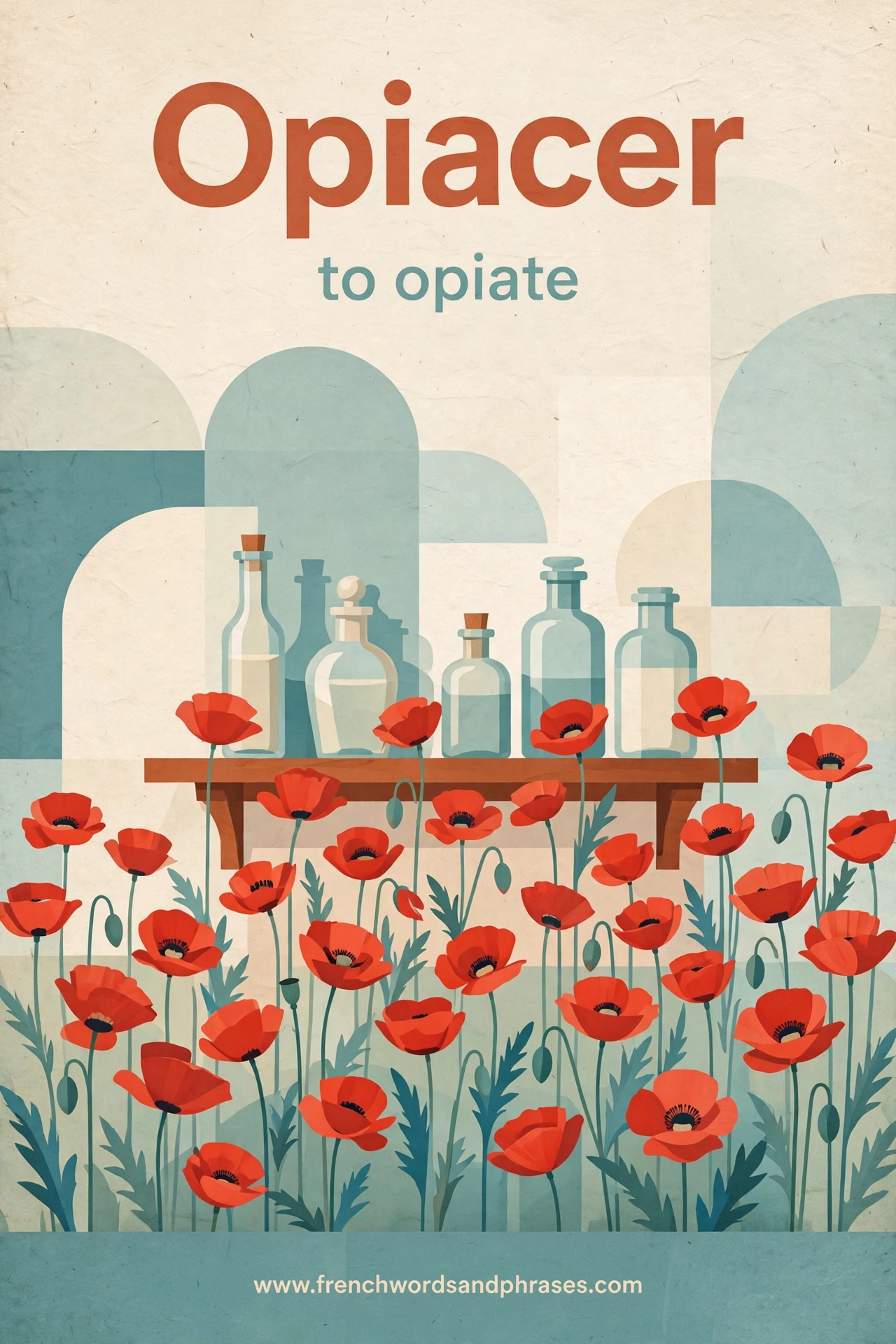
A gaslit pharmacy in 1880: rows of brown bottles, a brass scale, and a syrup darkened with a few drops of laudanum — opiacer is a verb from the age when opium was medicine, comfort and plot device all at once.
In this guide, you’ll learn how to conjugate opiacer in all the major French tenses and moods. Explore complete conjugation tables, French examples, English translations, and practice quizzes.
Understanding the French Verb Opiacer
Opiacer is a regular French verb belonging to the first group of verbs, those ending in -er.
It means to opiate. It is commonly used in historical and literary contexts for doctors dosing remedies with opium, for poisoners lacing drinks in classic novels, and in histories of medicine describing the age of laudanum.
Verb classification: First group (-er)
Auxiliary verb: Avoir
Past participle: opiacé
Present participle: opiaçant
English equivalents: To opiate, to drug with opium; opiacer un vin — to lace a wine with opium; un sirop opiacé — an opiated syrup; l’opium — opium.
One important detail: opiacer is a -cer verb, so the c takes a cedilla before a and o to keep its soft sound: nous opiaçons, j’opiaçais, en opiaçant. The verb belongs to history and literature now: nineteenth-century doctors opiaçaient cough syrups and soothing potions, and novelists gave it to their poisoners — you will meet it in old novels far more often than in a modern pharmacy.
Experience the Word
Opiacer is a verb that smells of old pharmacies — brown glass, brass scales and handwritten labels.
Imagine a country doctor’s bag in 1890. Between the bandages and the thermometer sits a small bottle of laudanum, and for a patient mad with pain the doctor opiace a glass of warm wine: a few drops, a deep sleep, a quieter night. The whole century trusted that little bottle — perhaps too much.
The bottle is in a museum now. The verb survives — opiacer — as a fossil of the age of laudanum.
How to Conjugate Opiacer: Complete French Conjugation Guide
Let’s explore every major conjugation of opiacer, beginning with the indicative mood.
How to Conjugate Opiacer in the Indicative Mood
The indicative mood is used to express facts, observations, actions, and events.
How to Conjugate Opiacer in the Present Tense (Présent)
Used for actions happening now, habitual actions, and general truths.
| Subject | Conjugation |
|---|---|
| je | opiace |
| tu | opiaces |
| il / elle | opiace |
| nous | opiaçons |
| vous | opiacez |
| ils / elles | opiacent |
Example
Dans ce vieux roman, le médecin opiace les boissons des malades agités.
In this old novel, the doctor laces the restless patients’ drinks with opium.
Quick Quiz 1
Complete the sentence:
Nous ______ le vin du blessé.
Reveal the answer
opiaçons
Nous opiaçons le vin du blessé.
We lace the wounded man’s wine with opium — cedilla before the o.
How to Conjugate Opiacer in the Passé Composé
Used for completed actions in the past. Opiacer takes the auxiliary verb avoir.
| Subject | Conjugation |
|---|---|
| j’ | ai opiacé |
| tu | as opiacé |
| il / elle | a opiacé |
| nous | avons opiacé |
| vous | avez opiacé |
| ils / elles | ont opiacé |
Example
Le rebouteux a opiacé le vin du blessé pour calmer sa douleur.
The bonesetter laced the wounded man’s wine with opium to calm his pain.
How to Conjugate Opiacer in the Imparfait (Imperfect Tense)
Used for habitual past actions, descriptions, and ongoing situations in the past.
| Subject | Conjugation |
|---|---|
| je | opiaçais |
| tu | opiaçais |
| il / elle | opiaçait |
| nous | opiacions |
| vous | opiaciez |
| ils / elles | opiaçaient |
Example
Au siècle dernier, on opiaçait souvent les sirops contre la toux.
Last century, people often laced cough syrups with opium.
Quick Quiz 2
Choose the correct form:
The doctor laced the potion with opium.
Le médecin ______ la potion. (a opiacé / est opiacé)
Reveal the answer
a opiacé
Le médecin a opiacé la potion.
Opiacer takes avoir.
How to Conjugate Opiacer in the Plus-que-parfait
Used to describe an action that had already been completed before another past event.
| Subject | Conjugation |
|---|---|
| j’ | avais opiacé |
| tu | avais opiacé |
| il / elle | avait opiacé |
| nous | avions opiacé |
| vous | aviez opiacé |
| ils / elles | avaient opiacé |
Example
Elle avait opiacé la tisane avant de la servir à son mari.
She had laced the herbal tea with opium before serving it to her husband.
How to Conjugate Opiacer in the Passé Simple
Primarily used in formal writing, literature, and historical narratives. It is rarely used in everyday conversation.
| Subject | Conjugation |
|---|---|
| je | opiaçai |
| tu | opiaças |
| il / elle | opiaça |
| nous | opiaçâmes |
| vous | opiaçâtes |
| ils / elles | opiaçèrent |
Example
Le médecin opiaça légèrement la potion du malade.
The doctor lightly laced the patient’s potion with opium.
How to Conjugate Opiacer in the Passé Antérieur
A literary tense used to express an action completed immediately before another past action, generally in the passé simple.
| Subject | Conjugation |
|---|---|
| j’ | eus opiacé |
| tu | eus opiacé |
| il / elle | eut opiacé |
| nous | eûmes opiacé |
| vous | eûtes opiacé |
| ils / elles | eurent opiacé |
Example
Quand il eut opiacé le remède, le malade s’endormit profondément.
When he had laced the remedy with opium, the patient fell into a deep sleep.
How to Conjugate Opiacer in the Future Tense (Futur Simple)
Used to describe actions that will take place in the future.
| Subject | Conjugation |
|---|---|
| je | opiacerai |
| tu | opiaceras |
| il / elle | opiacera |
| nous | opiacerons |
| vous | opiacerez |
| ils / elles | opiaceront |
Example
Personne n’opiacera plus les remèdes, c’est heureusement interdit.
No one will lace remedies with opium any more, it is thankfully forbidden.
How to Conjugate Opiacer in the Futur Antérieur (Future Perfect)
Used for an action that will have been completed before a particular point in the future.
| Subject | Conjugation |
|---|---|
| j’ | aurai opiacé |
| tu | auras opiacé |
| il / elle | aura opiacé |
| nous | aurons opiacé |
| vous | aurez opiacé |
| ils / elles | auront opiacé |
Example
À la fin du roman, le traître aura opiacé trois verres.
By the end of the novel, the traitor will have laced three glasses with opium.
How to Conjugate Opiacer in the Near Future (Futur Proche)
Used to describe something that is going to happen soon. Formed with aller + infinitive.
| Subject | Conjugation |
|---|---|
| je | vais opiacer |
| tu | vas opiacer |
| il / elle | va opiacer |
| nous | allons opiacer |
| vous | allez opiacer |
| ils / elles | vont opiacer |
Example
Dans ce film, le serviteur va opiacer le vin de son maître.
In this film, the servant is going to lace his master’s wine with opium.
How to Conjugate Opiacer in the Conditional Mood
The conditional mood expresses what would happen under certain circumstances. It is also frequently used to make polite requests or express wishes.
How to Conjugate Opiacer in the Present Conditional
| Subject | Conjugation |
|---|---|
| je | opiacerais |
| tu | opiacerais |
| il / elle | opiacerait |
| nous | opiacerions |
| vous | opiaceriez |
| ils / elles | opiaceraient |
Example
Un apothicaire prudent n’opiacerait jamais un sirop pour enfants.
A careful apothecary would never lace a children’s syrup with opium.
How to Conjugate Opiacer in the Past Conditional
| Subject | Conjugation |
|---|---|
| j’ | aurais opiacé |
| tu | aurais opiacé |
| il / elle | aurait opiacé |
| nous | aurions opiacé |
| vous | auriez opiacé |
| ils / elles | auraient opiacé |
Example
Il aurait opiacé la boisson si on le lui avait demandé.
He would have laced the drink with opium if he had been asked to.
Opiacer in the Literary Past Conditional Form
This less common literary form uses the imperfect subjunctive of avoir.
| Subject | Conjugation |
|---|---|
| j’ | eusse opiacé |
| tu | eusses opiacé |
| il / elle | eût opiacé |
| nous | eussions opiacé |
| vous | eussiez opiacé |
| ils / elles | eussent opiacé |
Example
Le médecin eût opiacé la potion sans hésiter une seconde.
The doctor would have laced the potion without a second’s hesitation.
How to Conjugate Opiacer in the Subjunctive Mood
The subjunctive is used to express wishes, emotions, doubts, necessity, and uncertainty. It frequently follows expressions such as il faut que (it is necessary that) or bien que (although).
How to Conjugate Opiacer in the Present Subjunctive
| Subject | Conjugation |
|---|---|
| que je | opiace |
| que tu | opiaces |
| qu’il / qu’elle | opiace |
| que nous | opiacions |
| que vous | opiaciez |
| qu’ils / qu’elles | opiacent |
Example
Je doute qu’on opiace encore les remèdes aujourd’hui.
I doubt anyone still laces remedies with opium today.
Quick Quiz 3
Complete the sentence using the subjunctive:
Je doute qu’on ______ encore les remèdes.
Reveal the answer
opiace
Je doute qu’on opiace encore les remèdes.
I doubt anyone still laces remedies with opium.
How to Conjugate Opiacer in the Imperfect Subjunctive
A literary tense, rarely encountered in modern spoken French.
| Subject | Conjugation |
|---|---|
| que je | opiacasse |
| que tu | opiacasses |
| qu’il / qu’elle | opiacât |
| que nous | opiacassions |
| que vous | opiacassiez |
| qu’ils / qu’elles | opiacassent |
Example
Il ne fallait pas qu’il opiaçât le vin des invités.
He must not have laced the guests’ wine with opium.
How to Conjugate Opiacer in the Pluperfect Subjunctive
A literary construction used to express an action completed before another past action.
| Subject | Conjugation |
|---|---|
| que j’ | eusse opiacé |
| que tu | eusses opiacé |
| qu’il / qu’elle | eût opiacé |
| que nous | eussions opiacé |
| que vous | eussiez opiacé |
| qu’ils / qu’elles | eussent opiacé |
Example
On soupçonnait qu’elle eût opiacé le verre de son mari.
People suspected she had laced her husband’s glass with opium.
How to Conjugate Opiacer in the Past Subjunctive
| Subject | Conjugation |
|---|---|
| que j’ | aie opiacé |
| que tu | aies opiacé |
| qu’il / qu’elle | ait opiacé |
| que nous | ayons opiacé |
| que vous | ayez opiacé |
| qu’ils / qu’elles | aient opiacé |
Example
Je suis étonné qu’il ait opiacé la tisane de sa grand-mère.
I am astonished he laced his grandmother’s herbal tea with opium.
How to Conjugate Opiacer in the Imperative
The imperative is used to give commands, instructions, invitations, or suggestions. Subject pronouns are omitted.
How to Conjugate Opiacer in the Present Imperative
| Person | Conjugation |
|---|---|
| (tu) | opiace |
| (nous) | opiaçons |
| (vous) | opiacez |
Example
Opiace la potion, mais d’une main légère !
Lace the potion with opium, but with a light hand!
Quick Quiz 4
How would you say Lace the potion with a light hand (tu form)?
Reveal the answer
Opiace la potion d’une main légère !
French Participles of Opiacer
Participles are verb forms that can be used in compound tenses and other grammatical constructions.
Present Participle of Opiacer
opiaçant
En opiaçant le sirop, l’apothicaire suivait une très vieille recette.
In lacing the syrup with opium, the apothecary was following a very old recipe.
Past Participle of Opiacer
opiacé
Opiacé par le serviteur, le vin endormit le maître en quelques minutes.
Laced with opium by the servant, the wine put the master to sleep within minutes.
Opiacer in Everyday French: Real-Life Examples
Now that you know the conjugations, let’s see how opiacer appears in everyday French.
Example 1 — Present
Le médecin du roman opiace les boissons des malades.
The doctor in the novel laces the patients’ drinks with opium.
Example 2 — Passé composé
Le rebouteux a opiacé le vin du blessé.
The bonesetter laced the wounded man’s wine with opium.
Example 3 — Imparfait
On opiaçait les sirops contre la toux, autrefois.
People used to lace cough syrups with opium.
Example 4 — Future
Personne n’opiacera plus les remèdes.
No one will lace remedies with opium any more.
Example 5 — Conditional
Un apothicaire prudent n’opiacerait jamais un sirop.
A careful apothecary would never lace a syrup with opium.
Example 6 — Imperative
Opiace la potion, mais d’une main légère !
Lace the potion with opium, but with a light hand!
Beyond Translation: The Meaning of Opiacer
English to opiate exists but sleeps in dictionaries; French opiacer is its twin, kept alive by classic novels and histories of medicine.
Some verbs are fossils of a vanished world.
Opiacer preserves the whole nineteenth century in six letters of stem: the laudanum bottle, the gaslit pharmacy, and the poisoned glass of wine at the centre of a hundred plots.
How to Remember the French Verb Opiacer
Remember it this way: Opiacer is about a brown laudanum bottle in a gaslit pharmacy.
- Opiacer = to lace a drink or remedy with opium — a verb of old novels and old pharmacies.
- A -cer verb: cedilla before a and o — nous opiaçons, j’opiaçais, en opiaçant.
- From l’opium; past participle opiacé, as in un sirop opiacé.
The key idea is a brown laudanum bottle in a gaslit pharmacy.
Test Your Knowledge of Opiacer
Let’s see how much you’ve learned. Try answering these questions before revealing the answers.
Question 1
How do you say to lace a wine with opium in French?
Reveal the answer
Opiacer un vin.
Question 2
How do you say People used to lace cough syrups with opium in French?
Reveal the answer
On opiaçait les sirops contre la toux.
Question 3
Translate: The servant laced his master’s wine with opium.
Reveal the answer
Le serviteur a opiacé le vin de son maître.
Question 4
What is the past participle of opiacer?
Reveal the answer
Opiacé.
Question 5
Complete the sentence:
Nous ______ le sirop selon la vieille recette.
Reveal the answer
opiaçons
Nous opiaçons le sirop selon la vieille recette.
We lace the syrup with opium following the old recipe — note the cedilla.
Your Final Challenge
Can You Use It?
How would you say this in French?
In the novel, the apothecary laces the syrup with opium, and the patient finally falls asleep without pain.
Reveal the answer
Dans le roman, l’apothicaire opiace le sirop, et le malade s’endort enfin sans douleur.
In the novel, the apothecary laces the syrup with opium, and the patient finally falls asleep without pain.
A little French. A little curiosity. A richer everyday life.
LEARN FRENCH ONE WORD AT A TIME