A French Word to Live By
How to Conjugate Ombrer in French
/ɔ̃.bʁe/
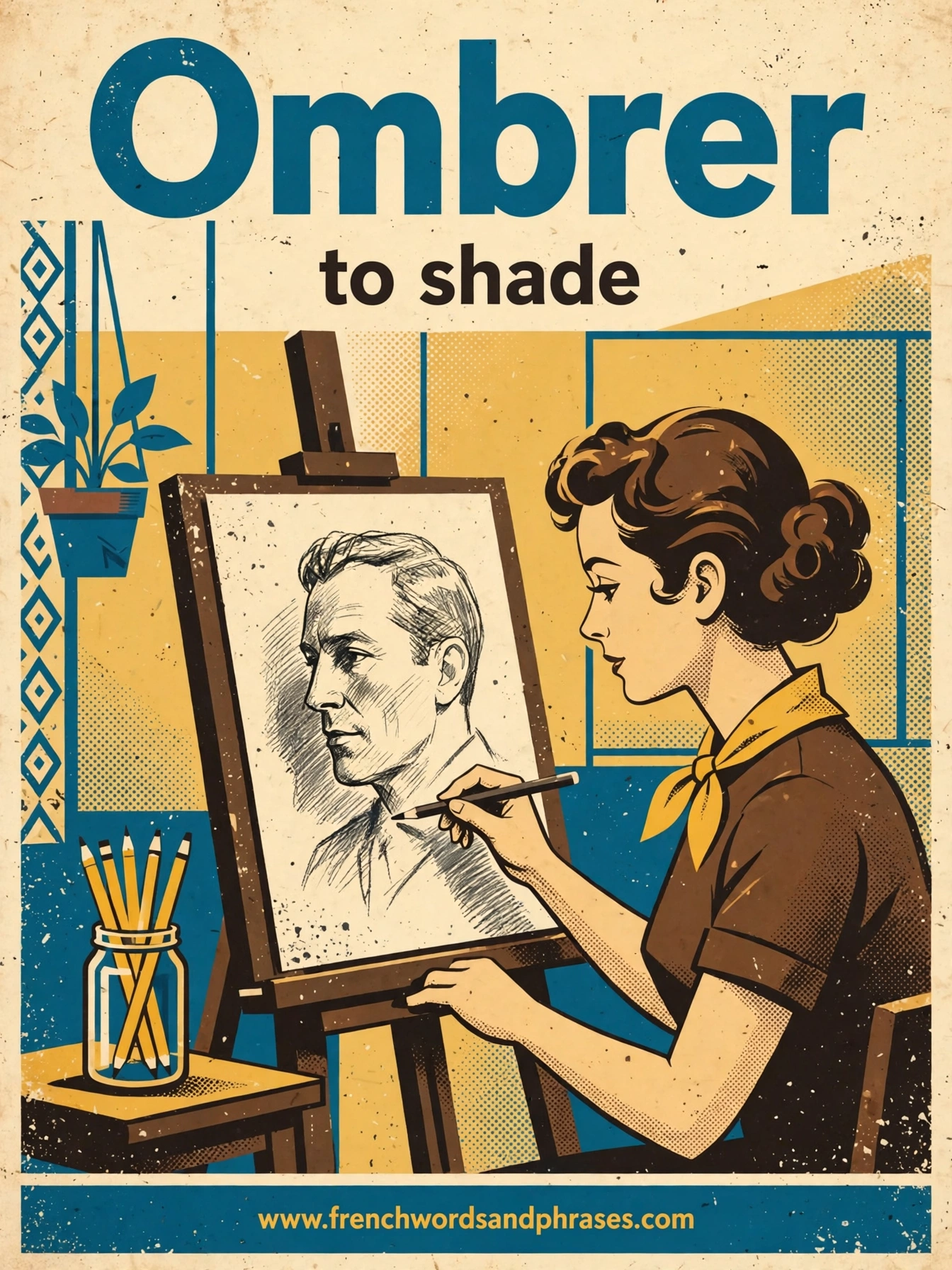
Ombrer means to shade — to deepen the dark parts of a drawing so the light can shine.
A stick of charcoal, a portrait half-finished, and the artist’s thumb softening the shadow under a cheekbone — ombrer is the draughtsman’s verb, the shading that turns flat lines into a face.
In this guide, you’ll learn how to conjugate ombrer in all the major French tenses and moods. Explore complete conjugation tables, French examples, English translations, and practice quizzes.
Understanding the French Verb Ombrer
Ombrer is a regular French verb belonging to the first group of verbs, those ending in -er.
It means to shade. It is commonly used in drawing and painting lessons for shading sketches and portraits, in art criticism for the dark modelling of a face or drapery, and in makeup for shading eyelids and contours.
Verb classification: First group (-er)
Auxiliary verb: Avoir
Past participle: ombré
Present participle: ombrant
English equivalents: To shade (a drawing); ombrer un dessin — to shade a drawing; ombrer au fusain — to shade with charcoal; ombrer les paupières — to shade the eyelids (makeup).
One important detail: ombrer is the artist’s member of the ombre family. Where ombrager shades a terrace with trees, ombrer shades paper with charcoal, pencil or a fingertip: ombrer un croquis, to shade a sketch. Makeup artists borrowed it too — ombrer les paupières is to shade the eyelids with shadow, which English even names after it: eye shadow.
Experience the Word
Ombrer is the verb of depth on paper — nothing exists until its shadow does.
Imagine an evening art class. The model sits still under a single lamp, and twenty pencils hover over twenty blank faces. The teacher leans over one drawing and says: ombrez d’abord les grandes masses — shade the big masses first. Suddenly the face has a cheek, a jaw, a life.
The lines were already there. It was the shading — l’ombrage — that made them real.
How to Conjugate Ombrer: Complete French Conjugation Guide
Let’s explore every major conjugation of ombrer, beginning with the indicative mood.
How to Conjugate Ombrer in the Indicative Mood
The indicative mood is used to express facts, observations, actions, and events.
How to Conjugate Ombrer in the Present Tense (Présent)
Used for actions happening now, habitual actions, and general truths.
| Subject | Conjugation |
|---|---|
| je | ombre |
| tu | ombres |
| il / elle | ombre |
| nous | ombrons |
| vous | ombrez |
| ils / elles | ombrent |
Example
L’artiste ombre le portrait au fusain.
The artist shades the portrait with charcoal.
Quick Quiz 1
Complete the sentence:
Nous ______ le fond du tableau.
Reveal the answer
ombrons
Nous ombrons le fond du tableau.
We shade the background of the painting.
How to Conjugate Ombrer in the Passé Composé
Used for completed actions in the past. Ombrer takes the auxiliary verb avoir.
| Subject | Conjugation |
|---|---|
| j’ | ai ombré |
| tu | as ombré |
| il / elle | a ombré |
| nous | avons ombré |
| vous | avez ombré |
| ils / elles | ont ombré |
Example
Elle a ombré les coins du dessin pour donner du relief.
She shaded the corners of the drawing to give it depth.
How to Conjugate Ombrer in the Imparfait (Imperfect Tense)
Used for habitual past actions, descriptions, and ongoing situations in the past.
| Subject | Conjugation |
|---|---|
| je | ombrais |
| tu | ombrais |
| il / elle | ombrait |
| nous | ombrions |
| vous | ombriez |
| ils / elles | ombraient |
Example
Il ombrait ses croquis du bout du pouce.
He used to shade his sketches with the tip of his thumb.
Quick Quiz 2
Choose the correct form:
She shaded the drawing.
Elle ______ le dessin. (a ombré / est ombrée)
Reveal the answer
a ombré
Elle a ombré le dessin.
Ombrer takes avoir.
How to Conjugate Ombrer in the Plus-que-parfait
Used to describe an action that had already been completed before another past event.
| Subject | Conjugation |
|---|---|
| j’ | avais ombré |
| tu | avais ombré |
| il / elle | avait ombré |
| nous | avions ombré |
| vous | aviez ombré |
| ils / elles | avaient ombré |
Example
Le peintre avait ombré le fond avant d’ajouter la lumière.
The painter had shaded the background before adding the light.
How to Conjugate Ombrer in the Passé Simple
Primarily used in formal writing, literature, and historical narratives. It is rarely used in everyday conversation.
| Subject | Conjugation |
|---|---|
| je | ombrai |
| tu | ombras |
| il / elle | ombra |
| nous | ombrâmes |
| vous | ombrâtes |
| ils / elles | ombrèrent |
Example
Elle ombra le ciel d’un gris léger.
She shaded the sky a light grey.
How to Conjugate Ombrer in the Passé Antérieur
A literary tense used to express an action completed immediately before another past action, generally in the passé simple.
| Subject | Conjugation |
|---|---|
| j’ | eus ombré |
| tu | eus ombré |
| il / elle | eut ombré |
| nous | eûmes ombré |
| vous | eûtes ombré |
| ils / elles | eurent ombré |
Example
Quand il eut ombré le visage, le portrait prit vie.
When he had shaded the face, the portrait came to life.
How to Conjugate Ombrer in the Future Tense (Futur Simple)
Used to describe actions that will take place in the future.
| Subject | Conjugation |
|---|---|
| je | ombrerai |
| tu | ombreras |
| il / elle | ombrera |
| nous | ombrerons |
| vous | ombrerez |
| ils / elles | ombreront |
Example
Demain, nous ombrerons les zones sombres du tableau.
Tomorrow, we will shade the dark areas of the painting.
How to Conjugate Ombrer in the Futur Antérieur (Future Perfect)
Used for an action that will have been completed before a particular point in the future.
| Subject | Conjugation |
|---|---|
| j’ | aurai ombré |
| tu | auras ombré |
| il / elle | aura ombré |
| nous | aurons ombré |
| vous | aurez ombré |
| ils / elles | auront ombré |
Example
À la fin du cours, vous aurez ombré tout le modèle.
By the end of the class, you will have shaded the whole model.
How to Conjugate Ombrer in the Near Future (Futur Proche)
Used to describe something that is going to happen soon. Formed with aller + infinitive.
| Subject | Conjugation |
|---|---|
| je | vais ombrer |
| tu | vas ombrer |
| il / elle | va ombrer |
| nous | allons ombrer |
| vous | allez ombrer |
| ils / elles | vont ombrer |
Example
Je vais ombrer ce coin pour créer un contraste.
I am going to shade this corner to create a contrast.
How to Conjugate Ombrer in the Conditional Mood
The conditional mood expresses what would happen under certain circumstances. It is also frequently used to make polite requests or express wishes.
How to Conjugate Ombrer in the Present Conditional
| Subject | Conjugation |
|---|---|
| je | ombrerais |
| tu | ombrerais |
| il / elle | ombrerait |
| nous | ombrerions |
| vous | ombreriez |
| ils / elles | ombreraient |
Example
Avec un crayon plus gras, tu ombrerais mieux les volumes.
With a softer pencil, you would shade the volumes better.
How to Conjugate Ombrer in the Past Conditional
| Subject | Conjugation |
|---|---|
| j’ | aurais ombré |
| tu | aurais ombré |
| il / elle | aurait ombré |
| nous | aurions ombré |
| vous | auriez ombré |
| ils / elles | auraient ombré |
Example
Elle aurait ombré davantage si elle avait eu le temps.
She would have shaded more if she had had the time.
Ombrer in the Literary Past Conditional Form
This less common literary form uses the imperfect subjunctive of avoir.
| Subject | Conjugation |
|---|---|
| j’ | eusse ombré |
| tu | eusses ombré |
| il / elle | eût ombré |
| nous | eussions ombré |
| vous | eussiez ombré |
| ils / elles | eussent ombré |
Example
L’illustrateur eût ombré chaque recoin du dessin.
The illustrator would have shaded every corner of the drawing.
How to Conjugate Ombrer in the Subjunctive Mood
The subjunctive is used to express wishes, emotions, doubts, necessity, and uncertainty. It frequently follows expressions such as il faut que (it is necessary that) or bien que (although).
How to Conjugate Ombrer in the Present Subjunctive
| Subject | Conjugation |
|---|---|
| que je | ombre |
| que tu | ombres |
| qu’il / qu’elle | ombre |
| que nous | ombrions |
| que vous | ombriez |
| qu’ils / qu’elles | ombrent |
Example
Il faut que tu ombres doucement, sans appuyer.
You must shade gently, without pressing.
Quick Quiz 3
Complete the sentence using the subjunctive:
Il faut que tu ______ sans appuyer.
Reveal the answer
ombres
Il faut que tu ombres sans appuyer.
You must shade without pressing.
How to Conjugate Ombrer in the Imperfect Subjunctive
A literary tense, rarely encountered in modern spoken French.
| Subject | Conjugation |
|---|---|
| que je | ombrasse |
| que tu | ombrasses |
| qu’il / qu’elle | ombrât |
| que nous | ombrassions |
| que vous | ombrassiez |
| qu’ils / qu’elles | ombrassent |
Example
Le professeur voulait qu’elle ombrât les bords du vase.
The teacher wanted her to shade the edges of the vase.
How to Conjugate Ombrer in the Pluperfect Subjunctive
A literary construction used to express an action completed before another past action.
| Subject | Conjugation |
|---|---|
| que j’ | eusse ombré |
| que tu | eusses ombré |
| qu’il / qu’elle | eût ombré |
| que nous | eussions ombré |
| que vous | eussiez ombré |
| qu’ils / qu’elles | eussent ombré |
Example
On doutait qu’il eût ombré le dessin entièrement seul.
People doubted he had shaded the drawing entirely on his own.
How to Conjugate Ombrer in the Past Subjunctive
| Subject | Conjugation |
|---|---|
| que j’ | aie ombré |
| que tu | aies ombré |
| qu’il / qu’elle | ait ombré |
| que nous | ayons ombré |
| que vous | ayez ombré |
| qu’ils / qu’elles | aient ombré |
Example
Je suis contente que tu aies ombré le fond du tableau.
I am glad you shaded the background of the painting.
How to Conjugate Ombrer in the Imperative
The imperative is used to give commands, instructions, invitations, or suggestions. Subject pronouns are omitted.
How to Conjugate Ombrer in the Present Imperative
| Person | Conjugation |
|---|---|
| (tu) | ombre |
| (nous) | ombrons |
| (vous) | ombrez |
Example
Ombre légèrement le dessous du menton !
Shade lightly under the chin!
Quick Quiz 4
How would you say Shade under the chin (tu form)?
Reveal the answer
Ombre le dessous du menton !
French Participles of Ombrer
Participles are verb forms that can be used in compound tenses and other grammatical constructions.
Present Participle of Ombrer
ombrant
En ombrant les contours, elle donne du volume au visage.
By shading the contours, she gives volume to the face.
Past Participle of Ombrer
ombré
Ombré au fusain, le portrait semble presque vivant.
Shaded in charcoal, the portrait seems almost alive.
Ombrer in Everyday French: Real-Life Examples
Now that you know the conjugations, let’s see how ombrer appears in everyday French.
Example 1 — Present
L’artiste ombre le portrait au fusain.
The artist shades the portrait with charcoal.
Example 2 — Passé composé
Elle a ombré les coins du dessin ce matin.
She shaded the corners of the drawing this morning.
Example 3 — Imparfait
Il ombrait ses croquis du bout du pouce.
He used to shade his sketches with his thumb.
Example 4 — Future
Nous ombrerons les zones sombres demain.
We will shade the dark areas tomorrow.
Example 5 — Conditional
Tu ombrerais mieux avec un crayon plus gras.
You would shade better with a softer pencil.
Example 6 — Imperative
Ombre légèrement le dessous du menton !
Shade lightly under the chin!
Beyond Translation: The Meaning of Ombrer
English art teachers say shade it in; French has a dedicated verb, ombrer, because drawing built the word straight from l’ombre, the shadow itself.
Ombrer is shading with a tool; ombrager is shading with a tree.
Keep the pair apart and the whole ombre family — ombrageux, ombrelle, pénombre — starts to make sense.
How to Remember the French Verb Ombrer
Remember it this way: Ombrer is about a thumb softening charcoal under a cheekbone.
- Ombrer = the artist’s shading: charcoal, pencil, or a thumb on paper.
- Ombrager shades places with trees; ombrer shades drawings with shadow.
- Regular -er: j’ombre, nous ombrons, past participle ombré.
The key idea is a thumb softening charcoal under a cheekbone.
Test Your Knowledge of Ombrer
Let’s see how much you’ve learned. Try answering these questions before revealing the answers.
Question 1
How do you say to shade a drawing in French?
Reveal the answer
Ombrer un dessin.
Question 2
How do you say The artist shades the portrait in French?
Reveal the answer
L’artiste ombre le portrait.
Question 3
Translate: She shaded the corners of the drawing.
Reveal the answer
Elle a ombré les coins du dessin.
Question 4
What is the past participle of ombrer?
Reveal the answer
Ombré.
Question 5
Complete the sentence:
Il faut que tu ______ doucement, sans appuyer.
Reveal the answer
ombres
Il faut que tu ombres doucement, sans appuyer.
You must shade gently, without pressing.
Your Final Challenge
Can You Use It?
How would you say this in French?
She shades the portrait in charcoal, and the face slowly emerges from the page.
Reveal the answer
Elle ombre le portrait au fusain, et le visage sort lentement de la page.
She shades the portrait in charcoal, and the face slowly emerges from the page.
A little French. A little curiosity. A richer everyday life.
LEARN FRENCH ONE WORD AT A TIME