
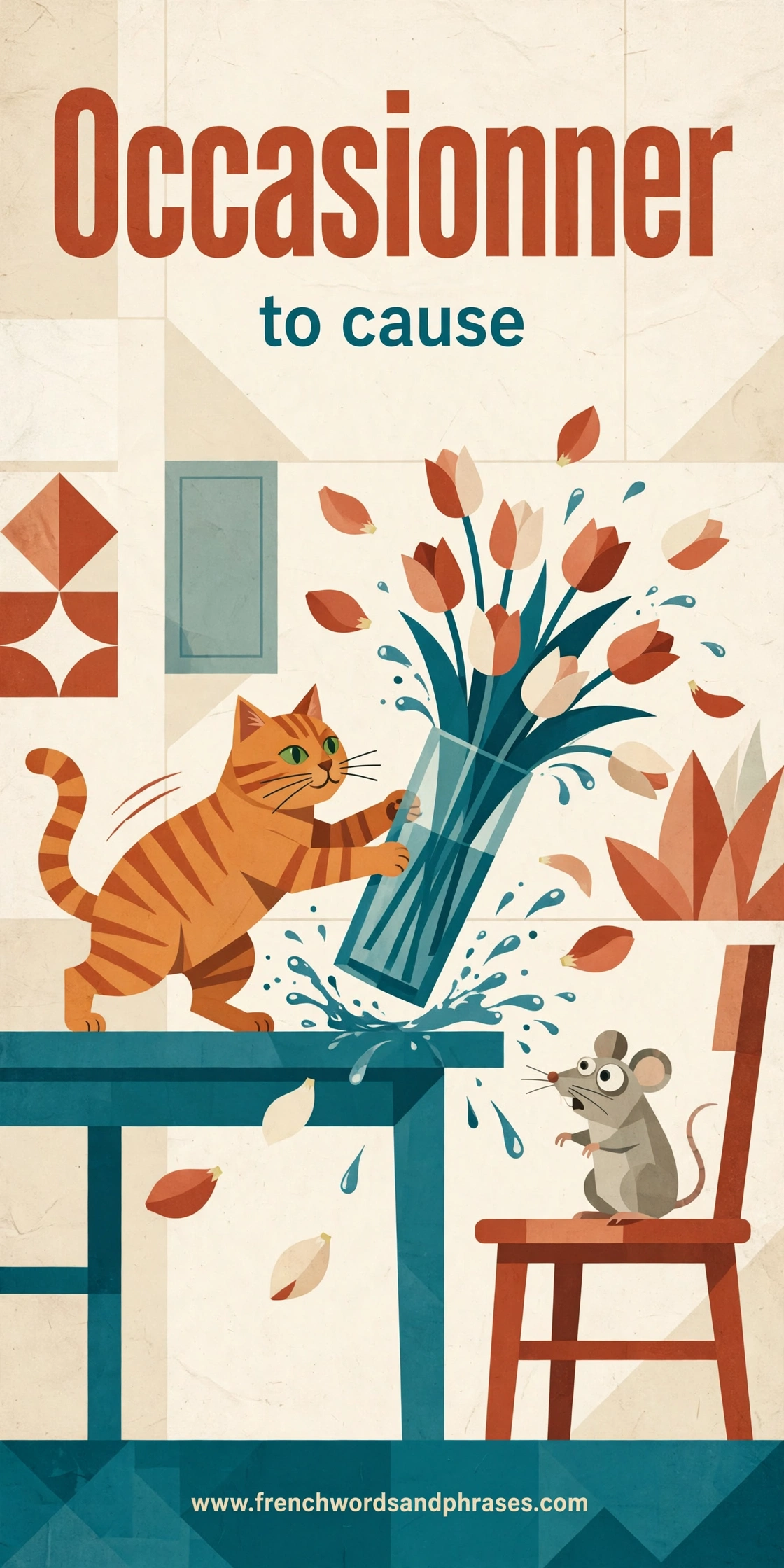
A French Word to Live By
How to Conjugate Occasionner in French
/ɔ.ka.zjɔ.ne/
Occasionner means to cause — to bring something about, usually an unwelcome effect like delays, damage or expense.
One jackknifed lorry on the ring road at eight in the morning, and by nine a whole city is late — occasionner is the verb of causing trouble, the word French reaches for when one thing brings an unwelcome another.
In this guide, you’ll learn how to conjugate occasionner in all the major French tenses and moods. Explore complete conjugation tables, French examples, English translations, and practice quizzes.
Understanding the French Verb Occasionner
Occasionner is a regular French verb belonging to the first group of verbs, those ending in -er.
It means to cause. It is commonly used in news reports, transport announcements and official letters for the delays, damage, costs and disruption that accidents, weather and roadworks leave behind them.
Verb classification: First group (-er)
Auxiliary verb: Avoir
Past participle: occasionné
Present participle: occasionnant
English equivalents: To cause, to give rise to, to occasion; occasionner des retards — to cause delays; occasionner des dégâts — to cause damage; occasionner des frais — to give rise to expenses.
One important detail: occasionner looks like the noun une occasion (an opportunity, a bargain), and the two are cousins — but as a verb it almost always causes something unwelcome: delays, damage, expense, complaints. It is a perfectly regular -er verb, and it is a shade more formal than causer or provoquer, at home in reports, announcements and insurance letters.
Experience the Word
Occasionner is the verb of the knock-on effect — nothing it causes was wanted.
Imagine the station loudspeaker on a snowy Monday: « La neige occasionne des retards sur l’ensemble du réseau. » Behind that calm sentence stand a thousand missed meetings, cold platforms and rearranged days — all from a few centimetres of snow.
Nobody chose any of it. It was all caused — occasionné — by one white morning.
How to Conjugate Occasionner: Complete French Conjugation Guide
Let’s explore every major conjugation of occasionner, beginning with the indicative mood.
How to Conjugate Occasionner in the Indicative Mood
The indicative mood is used to express facts, observations, actions, and events.
How to Conjugate Occasionner in the Present Tense (Présent)
Used for actions happening now, habitual actions, and general truths.
| Subject | Conjugation |
|---|---|
| je | occasionne |
| tu | occasionnes |
| il / elle | occasionne |
| nous | occasionnons |
| vous | occasionnez |
| ils / elles | occasionnent |
Example
La pluie occasionne des retards sur toutes les lignes.
The rain is causing delays on all the lines.
Quick Quiz 1
Complete the sentence:
La neige ______ des retards partout.
Reveal the answer
occasionne
La neige occasionne des retards partout.
The snow is causing delays everywhere.
How to Conjugate Occasionner in the Passé Composé
Used for completed actions in the past. Occasionner takes the auxiliary verb avoir.
| Subject | Conjugation |
|---|---|
| j’ | ai occasionné |
| tu | as occasionné |
| il / elle | a occasionné |
| nous | avons occasionné |
| vous | avez occasionné |
| ils / elles | ont occasionné |
Example
L’accident a occasionné un énorme embouteillage.
The accident caused a huge traffic jam.
How to Conjugate Occasionner in the Imparfait (Imperfect Tense)
Used for habitual past actions, descriptions, and ongoing situations in the past.
| Subject | Conjugation |
|---|---|
| je | occasionnais |
| tu | occasionnais |
| il / elle | occasionnait |
| nous | occasionnions |
| vous | occasionniez |
| ils / elles | occasionnaient |
Example
Ses retards occasionnaient des plaintes chaque semaine.
His lateness used to cause complaints every week.
Quick Quiz 2
Choose the correct form:
The accident caused a traffic jam.
L’accident ______ un embouteillage. (a occasionné / est occasionné)
Reveal the answer
a occasionné
L’accident a occasionné un embouteillage.
Occasionner takes avoir.
How to Conjugate Occasionner in the Plus-que-parfait
Used to describe an action that had already been completed before another past event.
| Subject | Conjugation |
|---|---|
| j’ | avais occasionné |
| tu | avais occasionné |
| il / elle | avait occasionné |
| nous | avions occasionné |
| vous | aviez occasionné |
| ils / elles | avaient occasionné |
Example
La panne avait occasionné l’annulation du spectacle.
The breakdown had caused the cancellation of the show.
How to Conjugate Occasionner in the Passé Simple
Primarily used in formal writing, literature, and historical narratives. It is rarely used in everyday conversation.
| Subject | Conjugation |
|---|---|
| je | occasionnai |
| tu | occasionnas |
| il / elle | occasionna |
| nous | occasionnâmes |
| vous | occasionnâtes |
| ils / elles | occasionnèrent |
Example
La tempête occasionna des dégâts considérables.
The storm caused considerable damage.
How to Conjugate Occasionner in the Passé Antérieur
A literary tense used to express an action completed immediately before another past action, generally in the passé simple.
| Subject | Conjugation |
|---|---|
| j’ | eus occasionné |
| tu | eus occasionné |
| il / elle | eut occasionné |
| nous | eûmes occasionné |
| vous | eûtes occasionné |
| ils / elles | eurent occasionné |
Example
Quand la nouvelle eut occasionné un tollé, le ministre réagit.
When the news had caused an outcry, the minister reacted.
How to Conjugate Occasionner in the Future Tense (Futur Simple)
Used to describe actions that will take place in the future.
| Subject | Conjugation |
|---|---|
| je | occasionnerai |
| tu | occasionneras |
| il / elle | occasionnera |
| nous | occasionnerons |
| vous | occasionnerez |
| ils / elles | occasionneront |
Example
Ces travaux occasionneront des fermetures de nuit.
This work will cause night closures.
How to Conjugate Occasionner in the Futur Antérieur (Future Perfect)
Used for an action that will have been completed before a particular point in the future.
| Subject | Conjugation |
|---|---|
| j’ | aurai occasionné |
| tu | auras occasionné |
| il / elle | aura occasionné |
| nous | aurons occasionné |
| vous | aurez occasionné |
| ils / elles | auront occasionné |
Example
À la fin des travaux, le chantier aura occasionné bien des détours.
By the end of the work, the site will have caused many detours.
How to Conjugate Occasionner in the Near Future (Futur Proche)
Used to describe something that is going to happen soon. Formed with aller + infinitive.
| Subject | Conjugation |
|---|---|
| je | vais occasionner |
| tu | vas occasionner |
| il / elle | va occasionner |
| nous | allons occasionner |
| vous | allez occasionner |
| ils / elles | vont occasionner |
Example
Ce changement va occasionner quelques retards.
This change is going to cause a few delays.
How to Conjugate Occasionner in the Conditional Mood
The conditional mood expresses what would happen under certain circumstances. It is also frequently used to make polite requests or express wishes.
How to Conjugate Occasionner in the Present Conditional
| Subject | Conjugation |
|---|---|
| je | occasionnerais |
| tu | occasionnerais |
| il / elle | occasionnerait |
| nous | occasionnerions |
| vous | occasionneriez |
| ils / elles | occasionneraient |
Example
Sans le vent, la traversée n’occasionnerait aucun retard.
Without the wind, the crossing would cause no delay.
How to Conjugate Occasionner in the Past Conditional
| Subject | Conjugation |
|---|---|
| j’ | aurais occasionné |
| tu | aurais occasionné |
| il / elle | aurait occasionné |
| nous | aurions occasionné |
| vous | auriez occasionné |
| ils / elles | auraient occasionné |
Example
Il aurait occasionné un scandale s’il avait parlé.
He would have caused a scandal if he had spoken.
Occasionner in the Literary Past Conditional Form
This less common literary form uses the imperfect subjunctive of avoir.
| Subject | Conjugation |
|---|---|
| j’ | eusse occasionné |
| tu | eusses occasionné |
| il / elle | eût occasionné |
| nous | eussions occasionné |
| vous | eussiez occasionné |
| ils / elles | eussent occasionné |
Example
Elle eût occasionné une crise par son silence.
She would have caused a crisis by her silence.
How to Conjugate Occasionner in the Subjunctive Mood
The subjunctive is used to express wishes, emotions, doubts, necessity, and uncertainty. It frequently follows expressions such as il faut que (it is necessary that) or bien que (although).
How to Conjugate Occasionner in the Present Subjunctive
| Subject | Conjugation |
|---|---|
| que je | occasionne |
| que tu | occasionnes |
| qu’il / qu’elle | occasionne |
| que nous | occasionnions |
| que vous | occasionniez |
| qu’ils / qu’elles | occasionnent |
Example
Il est possible que ce projet occasionne des dépenses imprévues.
It is possible that this project will cause unforeseen expenses.
Quick Quiz 3
Complete the sentence using the subjunctive:
On craint que la grève ______ des pénuries.
Reveal the answer
occasionne
On craint que la grève occasionne des pénuries.
People fear the strike will cause shortages.
How to Conjugate Occasionner in the Imperfect Subjunctive
A literary tense, rarely encountered in modern spoken French.
| Subject | Conjugation |
|---|---|
| que je | occasionnasse |
| que tu | occasionnasses |
| qu’il / qu’elle | occasionnât |
| que nous | occasionnassions |
| que vous | occasionnassiez |
| qu’ils / qu’elles | occasionnassent |
Example
On craignait que la grève n’occasionnât des pénuries.
People feared the strike would cause shortages.
How to Conjugate Occasionner in the Pluperfect Subjunctive
A literary construction used to express an action completed before another past action.
| Subject | Conjugation |
|---|---|
| que j’ | eusse occasionné |
| que tu | eusses occasionné |
| qu’il / qu’elle | eût occasionné |
| que nous | eussions occasionné |
| que vous | eussiez occasionné |
| qu’ils / qu’elles | eussent occasionné |
Example
On regrettait qu’il eût occasionné tant de frais.
People regretted that he had caused so many expenses.
How to Conjugate Occasionner in the Past Subjunctive
| Subject | Conjugation |
|---|---|
| que j’ | aie occasionné |
| que tu | aies occasionné |
| qu’il / qu’elle | ait occasionné |
| que nous | ayons occasionné |
| que vous | ayez occasionné |
| qu’ils / qu’elles | aient occasionné |
Example
Je suis désolé que ce retard ait occasionné la perte de votre correspondance.
I am sorry that this delay caused you to miss your connection.
How to Conjugate Occasionner in the Imperative
The imperative is used to give commands, instructions, invitations, or suggestions. Subject pronouns are omitted.
How to Conjugate Occasionner in the Present Imperative
| Person | Conjugation |
|---|---|
| (tu) | occasionne |
| (nous) | occasionnons |
| (vous) | occasionnez |
Example
N’occasionnez aucun dégât dans l’appartement !
Do not cause any damage in the flat!
Quick Quiz 4
How would you say Do not cause any damage (vous form)?
Reveal the answer
N’occasionnez aucun dégât !
French Participles of Occasionner
Participles are verb forms that can be used in compound tenses and other grammatical constructions.
Present Participle of Occasionner
occasionnant
En occasionnant des retards, la neige a paralysé la ville.
By causing delays, the snow paralysed the city.
Past Participle of Occasionner
occasionné
Occasionnés par la sécheresse, les incendies ont ravagé la colline.
Caused by the drought, the fires ravaged the hillside.
Occasionner in Everyday French: Real-Life Examples
Now that you know the conjugations, let’s see how occasionner appears in everyday French.
Example 1 — Present
La pluie occasionne des retards sur toutes les lignes.
The rain is causing delays on all the lines.
Example 2 — Passé composé
L’accident a occasionné un énorme embouteillage.
The accident caused a huge traffic jam.
Example 3 — Imparfait
Ses retards occasionnaient des plaintes chaque semaine.
His lateness used to cause complaints every week.
Example 4 — Future
Ces travaux occasionneront des fermetures de nuit.
This work will cause night closures.
Example 5 — Conditional
Sans le vent, la traversée n’occasionnerait aucun retard.
Without the wind, the crossing would cause no delay.
Example 6 — Imperative
N’occasionnez aucun dégât dans l’appartement !
Do not cause any damage in the flat!
Beyond Translation: The Meaning of Occasionner
English to occasion survives in formal writing with exactly this meaning — to give rise to — and occasionner is its French twin, still alive and busy in everyday announcements.
The causer is rarely a person.
What occasionne things in French is weather, works, breakdowns and accidents — the verb belongs to the impersonal machinery of disruption, announced in stations and printed in reports.
How to Remember the French Verb Occasionner
Remember it this way: Occasionner is about one thing bringing an unwelcome another.
- Occasionner = to cause something unwelcome: retards, dégâts, frais.
- Cousin of une occasion, but as a verb it brings trouble, not bargains.
- Regular -er: j’occasionne, nous occasionnons, past participle occasionné.
The key idea is one thing bringing an unwelcome another.
Test Your Knowledge of Occasionner
Let’s see how much you’ve learned. Try answering these questions before revealing the answers.
Question 1
How do you say to cause delays in French?
Reveal the answer
Occasionner des retards.
Question 2
How do you say The rain is causing delays on all the lines in French?
Reveal the answer
La pluie occasionne des retards sur toutes les lignes.
Question 3
Translate: The storm caused considerable damage.
Reveal the answer
La tempête a occasionné des dégâts considérables.
Question 4
What is the past participle of occasionner?
Reveal the answer
Occasionné.
Question 5
Complete the sentence:
Il est possible que ce projet ______ des dépenses imprévues.
Reveal the answer
occasionne
Il est possible que ce projet occasionne des dépenses imprévues.
It is possible that this project will cause unforeseen expenses.
Your Final Challenge
Can You Use It?
How would you say this in French?
In one night, the storm caused damage across the whole department.
Reveal the answer
En une nuit, la tempête a occasionné des dégâts dans tout le département.
In one night, the storm caused damage across the whole department.
A little French. A little curiosity. A richer everyday life.
LEARN FRENCH ONE WORD AT A TIME




