A French Word to Live By
How to Conjugate S’obstiner in French
/sɔp.sti.ne/
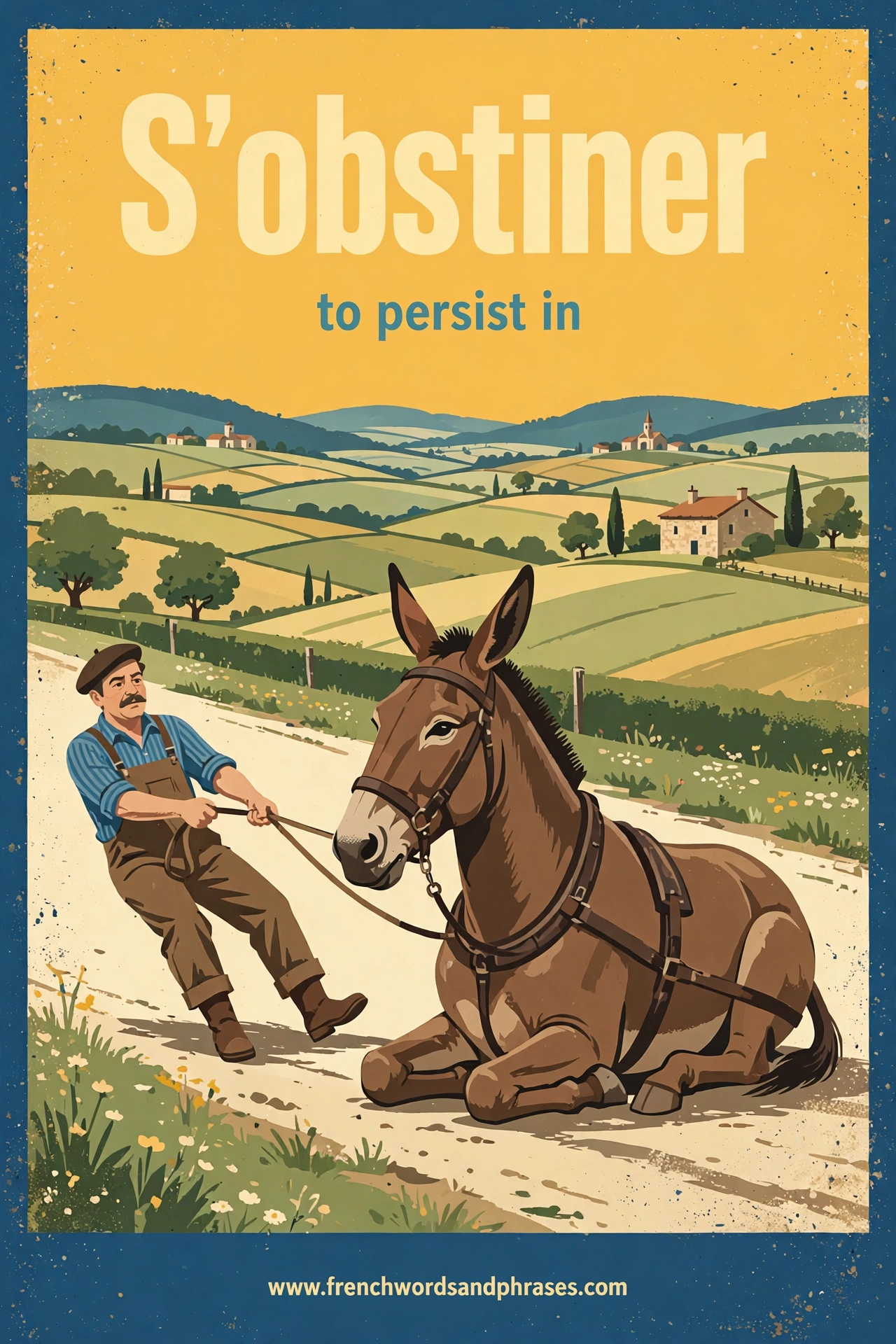
S’obstiner means to persist in — to dig in your heels and keep doing something against advice, evidence and common sense.
A toddler refusing the green beans, a climber refusing to turn back below the summit, an inventor on his hundredth failed prototype — s’obstiner is the verb of the dug-in heel: reason says stop, and the will answers no.
In this guide, you’ll learn how to conjugate s’obstiner in all the major French tenses and moods. Explore complete conjugation tables, French examples, English translations, and practice quizzes.
Understanding the French Verb S’obstiner
S’obstiner is a regular French verb belonging to the first group of verbs, those ending in -er.
It means to persist in. It is commonly used for children who will not give in, patients who refuse treatment and negotiators holding a line — and, admiringly, for artists and athletes whose stubbornness turns into perseverance.
Verb classification: First group (-er), reflexive
Auxiliary verb: Être
Past participle: obstiné
Present participle: obstinant
English equivalents: To persist in, to stubbornly insist on; s’obstiner à faire — to persist in doing; s’obstiner dans son refus — to stick stubbornly to one’s refusal; s’obstiner contre — to hold out against.
One important detail: s’obstiner lives only with its pronoun — modern French has no plain obstiner working on its own: je m’obstine, nous nous obstinons. Being reflexive, it takes être and the participle agrees: elle s’est obstinée. The usual constructions are s’obstiner à plus an infinitive (s’obstiner à refuser) and s’obstiner dans plus a noun (s’obstiner dans son silence). It comes from Latin obstinare — to set one’s mind firmly and not be moved.
Experience the Word
S’obstiner is a hinge word: the same dug-in heel is a fault in a child and a glory in an inventor.
Imagine an old fisherman mending the same torn net every evening while the harbour laughs at him. The young men buy new nets; he patches, knots, patches again. He s’obstine — and when the autumn storm tears every new net on the quay, his old patched one holds.
Everyone advised him to stop. He s’obstine — he persists, and the net holds.
How to Conjugate S’obstiner: Complete French Conjugation Guide
Let’s explore every major conjugation of s’obstiner, beginning with the indicative mood.
How to Conjugate S’obstiner in the Indicative Mood
The indicative mood is used to express facts, observations, actions, and events.
How to Conjugate S’obstiner in the Present Tense (Présent)
Used for actions happening now, habitual actions, and general truths.
| Subject | Conjugation |
|---|---|
| je | m’obstine |
| tu | t’obstines |
| il / elle | s’obstine |
| nous | nous obstinons |
| vous | vous obstinez |
| ils / elles | s’obstinent |
Example
Il s’obstine à refuser notre aide.
He persists in refusing our help.
Quick Quiz 1
Complete the sentence:
Nous nous ______ à finir ce travail.
Reveal the answer
obstinons
Nous nous obstinons à finir ce travail.
We persist in finishing this work.
How to Conjugate S’obstiner in the Passé Composé
Used for completed actions in the past. S’obstiner takes the auxiliary verb être.
| Subject | Conjugation |
|---|---|
| je | me suis obstiné / me suis obstinée |
| tu | t’es obstiné / t’es obstinée |
| il / elle | s’est obstiné / s’est obstinée |
| nous | nous sommes obstinés / nous sommes obstinées |
| vous | vous êtes obstinés / vous êtes obstinées / vous êtes obstiné / vous êtes obstinée |
| ils / elles | se sont obstinés / se sont obstinées |
Example
Elle s’est obstinée à finir le marathon malgré la douleur.
She stubbornly persisted in finishing the marathon despite the pain.
How to Conjugate S’obstiner in the Imparfait (Imperfect Tense)
Used for habitual past actions, descriptions, and ongoing situations in the past.
| Subject | Conjugation |
|---|---|
| je | m’obstinais |
| tu | t’obstinais |
| il / elle | s’obstinait |
| nous | nous obstinions |
| vous | vous obstiniez |
| ils / elles | s’obstinaient |
Example
Enfant, il s’obstinait à ne manger que des pâtes.
As a child, he stubbornly insisted on eating only pasta.
Quick Quiz 2
Choose the correct form:
She persisted to the very end.
Elle ______ jusqu’au bout. (s’est obstinée / a obstiné)
Reveal the answer
s’est obstinée
Elle s’est obstinée jusqu’au bout.
S’obstiner is reflexive, takes être, and the participle agrees: obstinée.
How to Conjugate S’obstiner in the Plus-que-parfait
Used to describe an action that had already been completed before another past event.
| Subject | Conjugation |
|---|---|
| je | m’étais obstiné / m’étais obstinée |
| tu | t’étais obstiné / t’étais obstinée |
| il / elle | s’était obstiné / s’était obstinée |
| nous | nous étions obstinés / nous étions obstinées |
| vous | vous étiez obstinés / vous étiez obstinées / vous étiez obstiné / vous étiez obstinée |
| ils / elles | s’étaient obstinés / s’étaient obstinées |
Example
Elle s’était obstinée dans son refus pendant des mois.
She had stuck to her refusal for months.
How to Conjugate S’obstiner in the Passé Simple
Primarily used in formal writing, literature, and historical narratives. It is rarely used in everyday conversation.
| Subject | Conjugation |
|---|---|
| je | m’obstinai |
| tu | t’obstinas |
| il / elle | s’obstina |
| nous | nous obstinâmes |
| vous | vous obstinâtes |
| ils / elles | s’obstinèrent |
Example
Malgré la tempête, le capitaine s’obstina à prendre la mer.
Despite the storm, the captain insisted on putting to sea.
How to Conjugate S’obstiner in the Passé Antérieur
A literary tense used to express an action completed immediately before another past action, generally in the passé simple.
| Subject | Conjugation |
|---|---|
| je | me fus obstiné / me fus obstinée |
| tu | te fus obstiné / te fus obstinée |
| il / elle | se fut obstiné / se fut obstinée |
| nous | nous fûmes obstinés / nous fûmes obstinées |
| vous | vous fûtes obstinés / vous fûtes obstinées / vous fûtes obstiné / vous fûtes obstinée |
| ils / elles | se furent obstinés / se furent obstinées |
Example
Dès qu’il se fut obstiné dans son idée, personne ne put le faire changer.
Once he had dug in his heels over his idea, no one could change his mind.
How to Conjugate S’obstiner in the Future Tense (Futur Simple)
Used to describe actions that will take place in the future.
| Subject | Conjugation |
|---|---|
| je | m’obstinerai |
| tu | t’obstineras |
| il / elle | s’obstinera |
| nous | nous obstinerons |
| vous | vous obstinerez |
| ils / elles | s’obstineront |
Example
Tu t’obstineras encore, je te connais.
You will dig your heels in again, I know you.
How to Conjugate S’obstiner in the Futur Antérieur (Future Perfect)
Used for an action that will have been completed before a particular point in the future.
| Subject | Conjugation |
|---|---|
| je | me serai obstiné / me serai obstinée |
| tu | te seras obstiné / te seras obstinée |
| il / elle | se sera obstiné / se sera obstinée |
| nous | nous serons obstinés / nous serons obstinées |
| vous | vous serez obstinés / vous serez obstinées / vous serez obstiné / vous serez obstinée |
| ils / elles | se seront obstinés / se seront obstinées |
Example
À la fin, elle se sera obstinée si longtemps que tout le monde aura cédé.
In the end, she will have persisted so long that everyone will have given in.
How to Conjugate S’obstiner in the Near Future (Futur Proche)
Used to describe something that is going to happen soon. Formed with aller + infinitive.
| Subject | Conjugation |
|---|---|
| je | vais m’obstiner |
| tu | vas t’obstiner |
| il / elle | va s’obstiner |
| nous | allons nous obstiner |
| vous | allez vous obstiner |
| ils / elles | vont s’obstiner |
Example
Je sens qu’il va s’obstiner à dire non.
I feel he is going to persist in saying no.
How to Conjugate S’obstiner in the Conditional Mood
The conditional mood expresses what would happen under certain circumstances. It is also frequently used to make polite requests or express wishes.
How to Conjugate S’obstiner in the Present Conditional
| Subject | Conjugation |
|---|---|
| je | m’obstinerais |
| tu | t’obstinerais |
| il / elle | s’obstinerait |
| nous | nous obstinerions |
| vous | vous obstineriez |
| ils / elles | s’obstineraient |
Example
À ta place, je ne m’obstinerais pas dans cette erreur.
In your place, I would not persist in this mistake.
How to Conjugate S’obstiner in the Past Conditional
| Subject | Conjugation |
|---|---|
| je | me serais obstiné / me serais obstinée |
| tu | te serais obstiné / te serais obstinée |
| il / elle | se serait obstiné / se serait obstinée |
| nous | nous serions obstinés / nous serions obstinées |
| vous | vous seriez obstinés / vous seriez obstinées / vous seriez obstiné / vous seriez obstinée |
| ils / elles | se seraient obstinés / se seraient obstinées |
Example
Il se serait obstiné davantage sans tes conseils.
He would have dug in his heels more without your advice.
S’obstiner in the Literary Past Conditional Form
This less common literary form uses the imperfect subjunctive of être.
| Subject | Conjugation |
|---|---|
| je | me fusse obstiné / me fusse obstinée |
| tu | te fusses obstiné / te fusses obstinée |
| il / elle | se fût obstiné / se fût obstinée |
| nous | nous fussions obstinés / nous fussions obstinées |
| vous | vous fussiez obstinés / vous fussiez obstinées / vous fussiez obstiné / vous fussiez obstinée |
| ils / elles | se fussent obstinés / se fussent obstinées |
Example
Elle se fût obstinée contre tous, seule s’il le fallait.
She would have held out against everyone, alone if necessary.
How to Conjugate S’obstiner in the Subjunctive Mood
The subjunctive is used to express wishes, emotions, doubts, necessity, and uncertainty. It frequently follows expressions such as il faut que (it is necessary that) or bien que (although).
How to Conjugate S’obstiner in the Present Subjunctive
| Subject | Conjugation |
|---|---|
| que je | m’obstine |
| que tu | t’obstines |
| qu’il / qu’elle | s’obstine |
| que nous | nous obstinions |
| que vous | vous obstiniez |
| qu’ils / qu’elles | s’obstinent |
Example
Il faut que tu t’obstines si tu veux réussir.
You must persist if you want to succeed.
Quick Quiz 3
Complete the sentence using the subjunctive:
Il faut que vous vous ______.
Reveal the answer
obstiniez
Il faut que vous vous obstiniez.
You must persist.
How to Conjugate S’obstiner in the Imperfect Subjunctive
A literary tense, rarely encountered in modern spoken French.
| Subject | Conjugation |
|---|---|
| que je | m’obstinasse |
| que tu | t’obstinasses |
| qu’il / qu’elle | s’obstinât |
| que nous | nous obstinassions |
| que vous | vous obstinassiez |
| qu’ils / qu’elles | s’obstinassent |
Example
Je craignais qu’il ne s’obstinât dans son silence.
I feared he would persist in his silence.
How to Conjugate S’obstiner in the Pluperfect Subjunctive
A literary construction used to express an action completed before another past action.
| Subject | Conjugation |
|---|---|
| que je | me fusse obstiné / me fusse obstinée |
| que tu | te fusses obstiné / te fusses obstinée |
| qu’il / qu’elle | se fût obstiné / se fût obstinée |
| que nous | nous fussions obstinés / nous fussions obstinées |
| que vous | vous fussiez obstinés / vous fussiez obstinées / vous fussiez obstiné / vous fussiez obstinée |
| qu’ils / qu’elles | se fussent obstinés / se fussent obstinées |
Example
On regretta qu’elle se fût obstinée à partir seule.
People regretted that she had insisted on leaving alone.
How to Conjugate S’obstiner in the Past Subjunctive
| Subject | Conjugation |
|---|---|
| que je | me sois obstiné / me sois obstinée |
| que tu | te sois obstiné / te sois obstinée |
| qu’il / qu’elle | se soit obstiné / se soit obstinée |
| que nous | nous soyons obstinés / nous soyons obstinées |
| que vous | vous soyez obstinés / vous soyez obstinées / vous soyez obstiné / vous soyez obstinée |
| qu’ils / qu’elles | se soient obstinés / se soient obstinées |
Example
Je suis étonné qu’il se soit obstiné si longtemps.
I am surprised he persisted for so long.
How to Conjugate S’obstiner in the Imperative
The imperative is used to give commands, instructions, invitations, or suggestions. Subject pronouns are omitted.
How to Conjugate S’obstiner in the Present Imperative
| Person | Conjugation |
|---|---|
| (tu) | obstine-toi |
| (nous) | obstinons-nous |
| (vous) | obstinez-vous |
Example
Obstine-toi un peu, tu y es presque !
Stick at it a little, you are nearly there!
Quick Quiz 4
How would you say Stick at it (tu form)?
Reveal the answer
Obstine-toi !
French Participles of S’obstiner
Participles are verb forms that can be used in compound tenses and other grammatical constructions.
Present Participle of S’obstiner
obstinant
En s’obstinant à réparer la vieille horloge, il a fini par la remettre en marche.
By persisting in repairing the old clock, he finally got it working again.
Past Participle of S’obstiner
obstiné
Obstinés dans leur projet, ils ont travaillé tout l’hiver.
Stubborn in their project, they worked all winter.
S’obstiner in Everyday French: Real-Life Examples
Now that you know the conjugations, let’s see how s’obstiner appears in everyday French.
Example 1 — Present
Il s’obstine à dire non.
He persists in saying no.
Example 2 — Passé composé
Elle s’est obstinée jusqu’au bout.
She persisted to the very end.
Example 3 — Imparfait
Tu t’obstinais toujours, enfant.
You always dug your heels in as a child.
Example 4 — Future
Il s’obstinera, comme d’habitude.
He will persist, as usual.
Example 5 — Conditional
Je ne m’obstinerais pas à ta place.
I would not persist if I were you.
Example 6 — Imperative
Obstinez-vous un peu, ça vaut la peine !
Stick at it a little, it is worth it!
Beyond Translation: The Meaning of S’obstiner
English persist sounds neutral, almost admirable; French s’obstiner keeps the heels visible.
The same stubbornness, judged two ways.
Its noun, l’obstination, names both the fault and the virtue, and only the context — a mule or a marathon runner — tells you which one the speaker means.
How to Remember the French Verb S’obstiner
Remember it this way: S’obstiner is about heels dug in — reason says stop, the will says no.
- S’obstiner à + infinitive: s’obstiner à refuser — to persist in refusing.
- Reflexive with être: elle s’est obstinée — the participle agrees.
- Fault or virtue, the heels are the same: context decides.
The key idea is heels dug in — reason says stop, the will says no.
Test Your Knowledge of S’obstiner
Let’s see how much you’ve learned. Try answering these questions before revealing the answers.
Question 1
Which auxiliary does s’obstiner use, and why?
Reveal the answer
Être — it is a reflexive verb: elle s’est obstinée.
Question 2
How do you say He persists in refusing our help in French?
Reveal the answer
Il s’obstine à refuser notre aide.
Question 3
Translate: She persisted to the very end.
Reveal the answer
Elle s’est obstinée jusqu’au bout.
Question 4
What is the past participle of s’obstiner?
Reveal the answer
Obstiné — agreeing: obstinée, obstinés, obstinées.
Question 5
Complete the sentence:
Il faut que tu ______ si tu veux réussir.
Reveal the answer
t’obstines
Il faut que tu t’obstines si tu veux réussir.
You must persist if you want to succeed.
Your Final Challenge
Can You Use It?
How would you say this in French?
She persisted in learning the violin at fifty, and tonight she is playing in a concert.
Reveal the answer
Elle s’est obstinée à apprendre le violon à cinquante ans, et ce soir, elle joue en concert.
She persisted in learning the violin at fifty, and tonight she is playing in a concert.
A little French. A little curiosity. A richer everyday life.
LEARN FRENCH ONE WORD AT A TIME