
A French Word to Live By
Translate Carvi to English
/kaʁ.vi/
Le carvi means caraway.
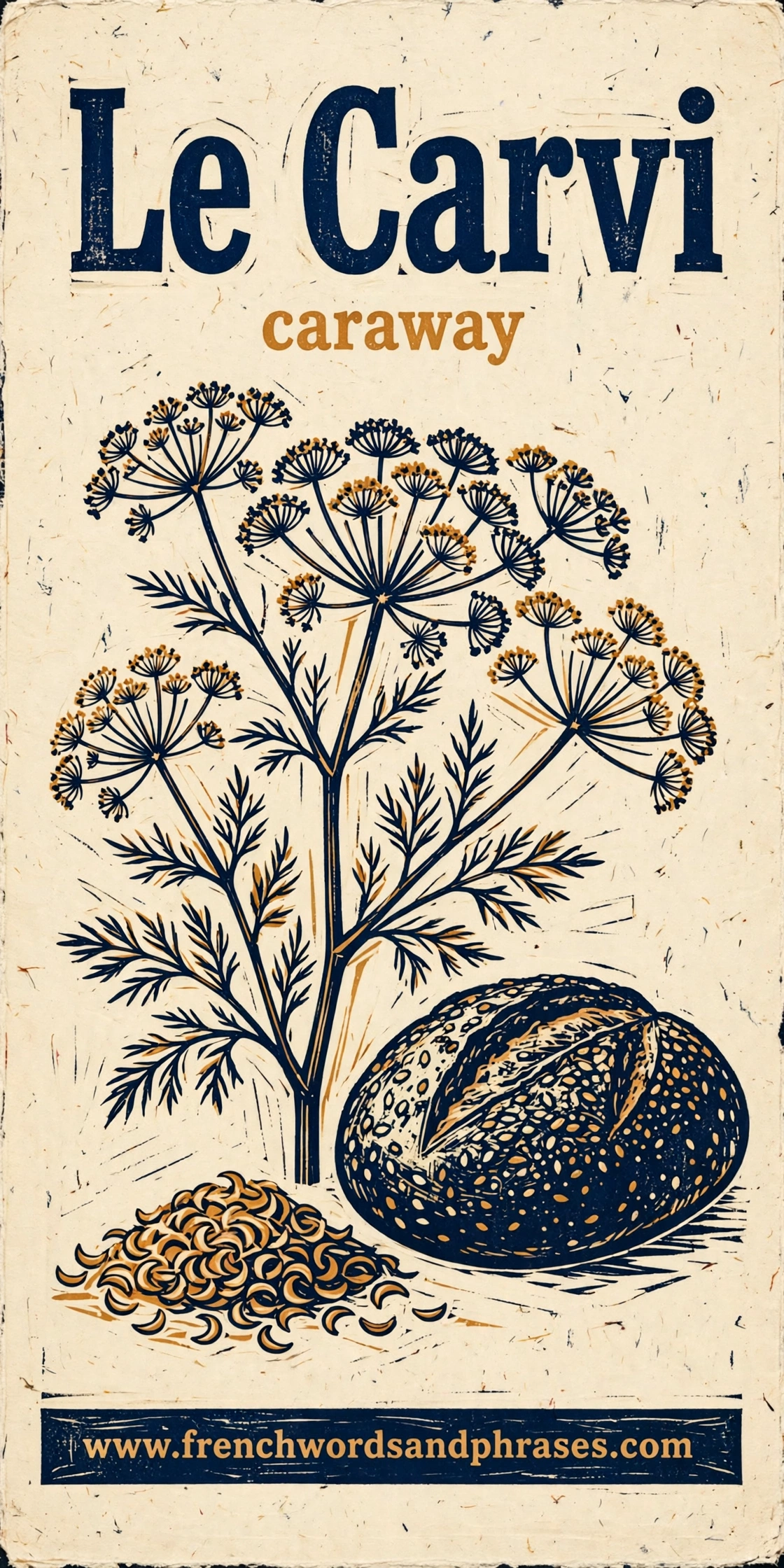
A bakery in Alsace in the morning: the loaves come out dark and fragrant, their crusts freckled with little crescent seeds — le carvi, caraway, the spice of bread, cabbage and northern kitchens.
In this guide, you’ll learn what carvi means in English, how to use it with its articles, how to form its plural, and how it appears in everyday French. Explore French examples, English translations, and practice quizzes.
Understanding the French Noun Carvi
Carvi is a masculine French noun. It is learned together with its article: le carvi, un carvi. It names the caraway plant and above all its seeds, les graines de carvi — small, curved, and warm with a taste between aniseed and earth.
It means caraway — the seeds scattered over bread and cheese, stirred into cabbage dishes and sauerkraut, and loved across Alsace and the north of Europe. In France its most famous partnership is with munster cheese: a little dish of carvi seeds is served beside it, to sprinkle as you eat.
Gender: Masculine
Definite article: le — le carvi (the caraway)
Indefinite article: un — un carvi (a caraway)
Plural: les carvis (rare — seeds are measured, not counted)
English equivalents: Caraway.
One important usage detail: carvi is forever being confused with its cousin le cumin — the seeds look alike, and cooks mix up the jars. The difference is in the taste: carvi is warmer and sweeter, with an aniseed note; cumin is earthier and stronger. Check before you sprinkle: le carvi n’est pas le cumin.
Experience the Word
Carvi is more than a seed. It is the flavour of northern bread — the little crescents that crackle in the crust and warm the whole loaf.
Imagine a slice of munster in an Alsatian inn: the cheese strong and golden, and beside it the small dish of carvi, each bite sprinkled, the seeds softening the cheese and perfuming the mouth.
You have not just eaten cheese. You have tasted le carvi, the seed that travels with it.
How to Use Carvi in French: Complete Guide
Let’s explore how carvi works in French, beginning with its articles.
Carvi with the Definite Article (Le, Les)
Used for the caraway everyone in the conversation knows — the jar by the bread board, the seeds by the cheese.
| Number | French |
|---|---|
| Singular | le carvi |
| Plural | les carvis |
Example
Le carvi est dans le petit bol, à côté du fromage.
The caraway is in the little bowl, next to the cheese.
Carvi with the Indefinite Article (Un, Des)
The indefinite exists — un carvi — but for seeds the partitive does the everyday work.
| Number | French |
|---|---|
| Singular | un carvi |
| Plural | des carvis |
Example
Le boulanger a mis un carvi nouveau dans sa pâte.
The baker put a new caraway in his dough.
Carvi with the Partitive Article (Du)
Seeds are measured by the spoonful and the pinch — French uses du carvi for some of it.
| Quantity | French |
|---|---|
| some | du carvi |
| a little | un peu de carvi |
| a spoonful | une cuillère de carvi |
| a pinch | une pincée de carvi |
| no more | plus de carvi |
Example
Mets un peu de carvi dans la pâte à pain.
Put a little caraway in the bread dough.
Quick Quiz 1
True or false: le carvi and le cumin are the same spice.
Reveal the answer
False — they are cousins, not twins. Carvi is warmer and sweeter; cumin is earthier and stronger.
Attention, ce bocal, c’est du carvi, pas du cumin !
Careful, this jar is caraway, not cumin!
The Plural of Carvi
The plural exists — les carvis — but it is rare: caraway lives in spoonfuls and pinches, not in counts.
| Number | French |
|---|---|
| Singular | le carvi |
| Plural | les carvis |
Example
Ces carvis viennent d’un marché d’Alsace.
These caraways come from a market in Alsace.
Carvi with Possessive Adjectives (Mon, Ton, Son…)
Possessives agree with the noun, not with the owner — and carvi is masculine, so it takes mon, ton, son.
| Owner | French |
|---|---|
| my | mon carvi |
| your (tu) | ton carvi |
| his / her | son carvi |
| our | notre carvi |
| your (vous) | votre carvi |
| their | leur carvi |
Example
Elle garde son carvi dans un bocal en verre.
She keeps her caraway in a glass jar.
Quick Quiz 2
Complete the sentence:
______ carvi parfume le pain de seigle. (My)
Reveal the answer
Mon
Mon carvi parfume le pain de seigle.
My caraway scents the rye bread.
Carvi with Demonstrative Adjectives (Ce, Ces)
Used to point: this caraway here, those caraways there.
| Number | French |
|---|---|
| Singular | ce carvi |
| Plural | ces carvis |
Example
Ce carvi est trop vieux, les graines n’ont plus de goût.
This caraway is too old, the seeds have no taste left.
Carvi with Adjectives
Adjectives agree with carvi, masculine — entier, moulu, parfumé.
| Adjective | With Carvi |
|---|---|
| entier (whole) | un carvi entier |
| moulu (ground) | un carvi moulu |
| parfumé (fragrant) | un carvi parfumé |
| chaud (warm, of taste) | un carvi chaud |
| fin (fine) | un carvi fin |
Example
Un carvi entier garde son parfum plus longtemps.
A whole caraway keeps its aroma longer.
Quick Quiz 3
Complete the sentence:
Je préfère le carvi ______. (whole)
Reveal the answer
entier
Je préfère le carvi entier.
I prefer caraway whole.
Everyday Expressions with Carvi
Bread, cheese and cabbage — the carvi phrases of daily life.
| Expression | In English |
|---|---|
| les graines de carvi | caraway seeds |
| le pain au carvi | caraway bread |
| le carvi et le munster | caraway served with munster cheese |
| le carvi dans le chou | caraway in the cabbage |
| confondre carvi et cumin | to mix up caraway and cumin |
| une pincée de carvi | a pinch of caraway |
Example
Le pain au carvi est encore chaud, il sort du four.
The caraway bread is still warm, it is out of the oven.
Words from the Same Family as Carvi
Seeds, bread and its famous cousin — the words that travel with carvi.
| French | In English |
|---|---|
| la graine | the seed |
| le cumin | cumin, the look-alike cousin |
| le pain de seigle | rye bread |
| le chou | cabbage |
| le munster | munster cheese |
| moudre | to grind |
Example
On sert le munster avec des graines de carvi.
Munster is served with caraway seeds.
Quick Quiz 4
At an Alsatian inn, a little dish of seeds arrives with your munster. What are they, and what do you do?
Reveal the answer
Carvi seeds — you sprinkle them on the cheese as you eat. It is the classic partnership of the region.
Un peu de carvi sur le munster, c’est la tradition.
A little caraway on the munster, that is the tradition.
Carvi in Everyday French: Real-Life Examples
Now that you know the word, let’s see how carvi appears in everyday French.
Example 1 — At the bakery
Un pain au carvi, s’il vous plaît, bien cuit.
A caraway bread, please, well baked.
Example 2 — With the cheese
Elle saupoudre son munster de carvi.
She sprinkles her munster with caraway.
Example 3 — In the cabbage
Le carvi rend le chou plus doux et plus léger.
Caraway makes the cabbage sweeter and lighter.
Example 4 — The wrong jar
Attention, tu as pris le cumin, pas le carvi !
Careful, you took the cumin, not the caraway!
Example 5 — A pinch
Une pincée de carvi suffit pour la pâte.
A pinch of caraway is enough for the dough.
Example 6 — In the jar
Il garde son carvi entier, il le moud au dernier moment.
He keeps his caraway whole, he grinds it at the last moment.
See le carvi in a story: Spices: French Vocabulary (Les Épices) — a cook restocking her spice drawer.
Beyond Translation: The Meaning of Carvi
Caraway is one of the oldest spices in Europe — its seeds have been found in prehistoric kitchens — and it settled deepest in the north and east: German breads, Scandinavian spirits, and in France the tables of Alsace, where the little dish of carvi beside the munster is a ritual nobody skips. It is a modest seed with a long memory.
To say carvi is to taste the bread of the north.
It evokes the freckled crust of a rye loaf, the warm inn, the strong cheese — and the eternal warning of the spice drawer: not the cumin, the carvi.
How to Remember the French Noun Carvi
Remember it this way: Carvi is caraway — masculine, with le and un, the seed of northern bread and the munster’s best friend.
- You sprinkle it on cheese — du carvi sur le munster, masculine with le.
- You bake it in bread — le pain au carvi, warm from the oven.
- You never confuse it — le carvi n’est pas le cumin, check the jar.
The key idea is le carvi on the cheese — never le cumin by mistake.
Test Your Knowledge of Carvi
Let’s see how much you’ve learned. Try answering these questions before revealing the answers.
Question 1
Is carvi masculine or feminine?
Reveal the answer
Masculine — le carvi, un carvi.
Question 2
Which cheese is caraway served with in Alsace?
Reveal the answer
Munster — a little dish of carvi seeds comes beside it, to sprinkle as you eat.
Question 3
Translate: She sprinkles her munster with caraway.
Reveal the answer
Elle saupoudre son munster de carvi.
Question 4
What is le carvi often confused with?
Reveal the answer
Le cumin — cumin, its look-alike cousin; carvi is warmer and sweeter.
Question 5
Complete the sentence:
Mets un peu ______ carvi dans la pâte.
Reveal the answer
de
Mets un peu de carvi dans la pâte.
Put a little caraway in the dough.
Your Final Challenge
Can You Use It?
How would you say this in French?
“A little caraway on the cheese, and the meal tastes of Alsace.”
Reveal the answer
Un peu de carvi sur le fromage, et le repas a le goût de l’Alsace.
A little caraway on the cheese, and the meal tastes of Alsace.
A little French. A little curiosity. A richer everyday life.
LEARN FRENCH ONE WORD AT A TIME




