A French Word to Live By
Translate Moutarde to English
/mus.taʁd/
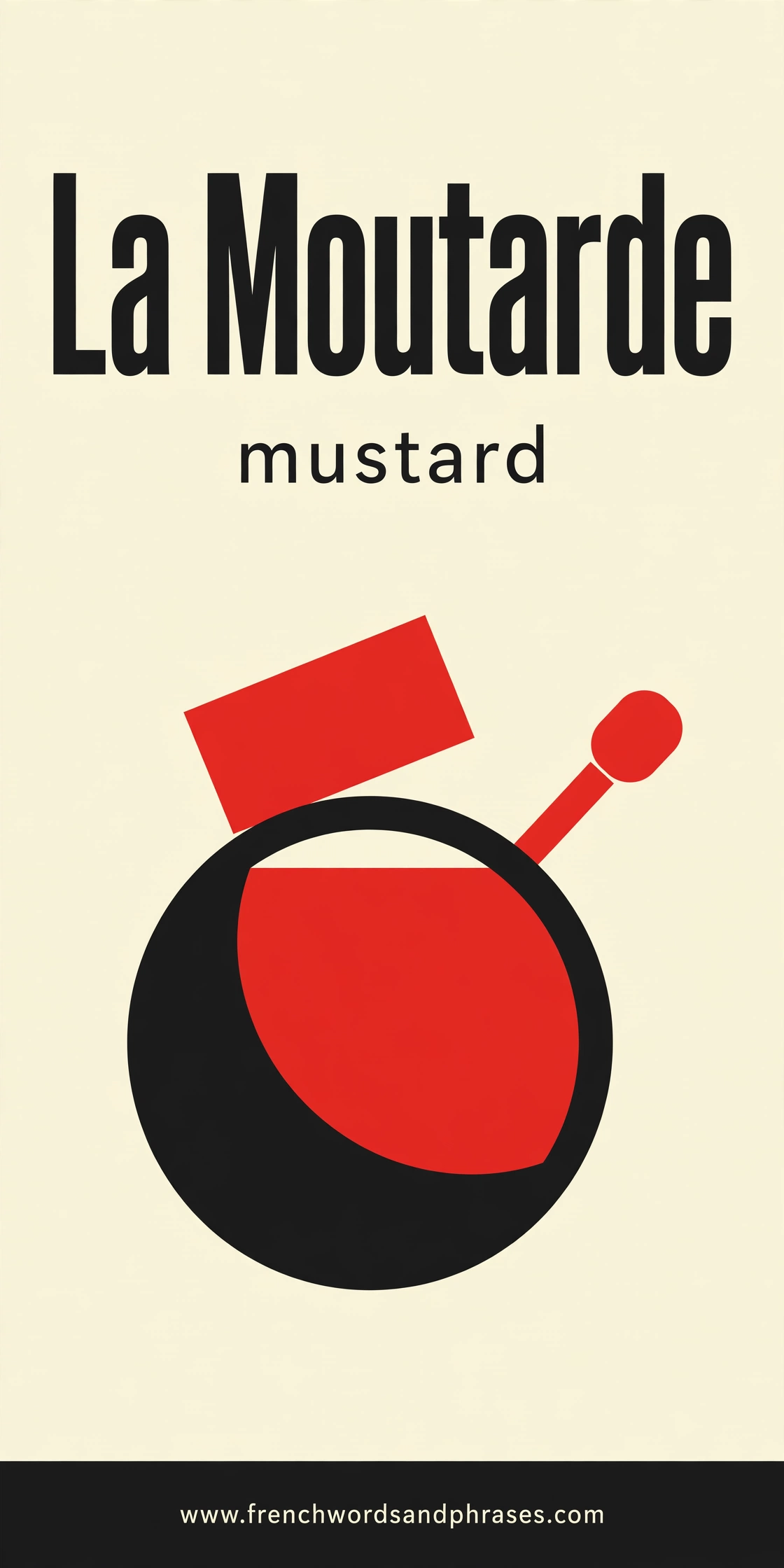
La moutarde means mustard.
A bistro table in Dijon: beside the steak, a little glass pot with a spoon standing in it, yellow as a traffic light and twice as commanding — la moutarde, the mustard, and in France it is never an afterthought.
In this guide, you’ll learn what moutarde means in English, how to use it with its articles, how to form its plural, and how it appears in everyday French. Explore French examples, English translations, and practice quizzes.
Understanding the French Noun Moutarde
Moutarde is a feminine French noun. It is learned together with its article: la moutarde, une moutarde. It names the sharp yellow condiment ground from mustard seeds — and Dijon, its capital, has given its name to the most famous moutarde in the world.
It means mustard — the pungent paste of ground mustard seeds, vinegar and salt, served with meats, whisked into la vinaigrette, and spread in sandwiches. It ranges from la moutarde douce, mild, to la moutarde forte, the strong Dijon kind that clears the nose, with la moutarde à l’ancienne, wholegrain, in between.
Gender: Feminine
Definite article: la — la moutarde (the mustard)
Indefinite article: une — une moutarde (a mustard)
Plural: les moutardes
English equivalents: Mustard.
One important usage detail: la moutarde lui monte au nez — literally, the mustard is rising to his nose — means he is losing his temper, anger climbing like the heat of strong mustard. It is the perfect image of French irritation: slow, warm, and impossible to hide once it reaches the nose.
Experience the Word
Moutarde is more than a condiment. It is France’s sharp accent — the spoonful that wakes up a steak, a sauce, a whole plate.
Imagine the first taste of real Dijon mustard: a tiny dab, a slow warmth, then the famous rush to the nose that makes your eyes shine and the whole table laugh.
You have not just seasoned your food. You have felt la moutarde monter au nez.
How to Use Moutarde in French: Complete Guide
Let’s explore how moutarde works in French, beginning with its articles.
Moutarde with the Definite Article (La, Les)
Used for the mustard everyone in the conversation knows — the pot on the table, the jar in the fridge door.
| Number | French |
|---|---|
| Singular | la moutarde |
| Plural | les moutardes |
Example
La moutarde est à côté de l’assiette, dans son petit pot.
The mustard is next to the plate, in its little pot.
Moutarde with the Indefinite Article (Une, Des)
Used for a mustard in general — the kind you choose at the shop, mild or strong.
| Number | French |
|---|---|
| Singular | une moutarde |
| Plural | des moutardes |
Example
Elle cherche une moutarde douce pour les enfants.
She is looking for a mild mustard for the children.
Moutarde with the Partitive Article (De la)
Mustard is served by the spoonful, not counted — French uses de la moutarde for some of it.
| Quantity | French |
|---|---|
| some | de la moutarde |
| a little | un peu de moutarde |
| a spoonful | une cuillère de moutarde |
| a dab | une pointe de moutarde |
| no more | plus de moutarde |
Example
Mets un peu de moutarde dans la vinaigrette.
Put a little mustard in the dressing.
Quick Quiz 1
What is la moutarde à l’ancienne?
Reveal the answer
Wholegrain mustard — made the old way, with whole seeds you can see and crunch.
La moutarde à l’ancienne est douce et croquante.
Wholegrain mustard is mild and crunchy.
The Plural of Moutarde
Moutarde adds an -s in the plural — les moutardes, when you compare kinds: strong, mild, wholegrain.
| Number | French |
|---|---|
| Singular | la moutarde |
| Plural | les moutardes |
Example
Les moutardes de Dijon sont célèbres dans le monde entier.
The mustards of Dijon are famous throughout the world.
Moutarde with Possessive Adjectives (Ma, Ta, Sa…)
Possessives agree with the noun, not with the owner — and moutarde is feminine, so it takes ma, ta, sa.
| Owner | French |
|---|---|
| my | ma moutarde |
| your (tu) | ta moutarde |
| his / her | sa moutarde |
| our | notre moutarde |
| your (vous) | votre moutarde |
| their | leur moutarde |
Example
Il prépare sa moutarde lui-même, avec des graines et du vinaigre.
He makes his mustard himself, with seeds and vinegar.
Quick Quiz 2
Complete the sentence:
______ moutarde est trop forte pour moi. (My)
Reveal the answer
Ma
Ma moutarde est trop forte pour moi.
My mustard is too strong for me.
Moutarde with Demonstrative Adjectives (Cette, Ces)
Used to point: this mustard here, those mustards there.
| Number | French |
|---|---|
| Singular | cette moutarde |
| Plural | ces moutardes |
Example
Cette moutarde monte au nez en deux secondes.
This mustard goes up your nose in two seconds.
Moutarde with Adjectives
Adjectives agree with moutarde, feminine — forte, douce, fine.
| Adjective | With Moutarde |
|---|---|
| forte (strong) | une moutarde forte |
| douce (mild) | une moutarde douce |
| fine (fine, smooth) | une moutarde fine |
| ancienne (old-style, wholegrain) | une moutarde à l’ancienne |
| piquante (sharp, hot) | une moutarde piquante |
Example
Une moutarde forte réveille n’importe quel plat.
A strong mustard wakes up any dish.
Quick Quiz 3
Complete the sentence:
Je préfère une moutarde bien ______. (mild)
Reveal the answer
douce
Je préfère une moutarde bien douce.
I prefer a really mild mustard.
Everyday Expressions with Moutarde
Temper, seeds and Dijon — the moutarde phrases of daily life.
| Expression | In English |
|---|---|
| la moutarde monte au nez | anger is rising, someone is losing their temper |
| la moutarde de Dijon | Dijon mustard |
| un grain de moutarde | a mustard seed |
| la moutarde à l’ancienne | wholegrain mustard |
| une cuillère de moutarde | a spoonful of mustard |
| passer la moutarde | to pass the mustard |
Example
Quand il a vu la facture, la moutarde lui est montée au nez.
When he saw the bill, he lost his temper.
Words from the Same Family as Moutarde
Seeds, pots and vinegar — the words that travel with moutarde.
| French | In English |
|---|---|
| la graine de moutarde | the mustard seed |
| le moutardier | the mustard pot |
| le vinaigre | vinegar |
| Dijon | Dijon, mustard’s capital |
| piquant | sharp, hot (of taste) |
| la vinaigrette | the salad dressing |
Example
Les graines de moutarde sont moulues avec du vinaigre.
The mustard seeds are ground with vinegar.
Quick Quiz 4
A colleague mutters: « La moutarde me monte au nez. » Is lunch ready?
Reveal the answer
No — he is getting angry. The mustard rising to the nose is the French image of a temper climbing.
Laisse-le tranquille, la moutarde lui monte au nez.
Leave him alone, he is losing his temper.
Moutarde in Everyday French: Real-Life Examples
Now that you know the word, let’s see how moutarde appears in everyday French.
Example 1 — At the bistro
Un peu de moutarde avec le steak, s’il vous plaît.
A little mustard with the steak, please.
Example 2 — Making the dressing
Elle met une cuillère de moutarde dans la vinaigrette.
She puts a spoonful of mustard in the dressing.
Example 3 — At the shop
Je cherche la moutarde de Dijon, la forte.
I’m looking for Dijon mustard, the strong kind.
Example 4 — A rising temper
La moutarde lui monte au nez, il faut changer de sujet.
He is losing his temper, we should change the subject.
Example 5 — In the sandwich
Il étale la moutarde sur le pain avant le jambon.
He spreads the mustard on the bread before the ham.
Example 6 — Wholegrain
Cette moutarde à l’ancienne croque sous la dent.
This wholegrain mustard crunches between the teeth.
See la moutarde in a story: Spices: French Vocabulary (Les Épices) — a cook restocking her spice drawer.
Beyond Translation: The Meaning of Moutarde
Dijon became the capital of mustard in the Middle Ages, and its name is protected like a title: a true moutarde de Dijon follows a recipe of seeds, vinegar and salt, with a heat that rises to the nose and clears. The condiment even climbed into the language of feelings — la moutarde qui monte au nez is the most kitchen-born image of anger in French.
To say moutarde is to taste France’s sharp side.
It evokes the little pot on the bistro table, the spoon standing upright in it, and the slow warmth of a temper — or a steak — properly seasoned.
How to Remember the French Noun Moutarde
Remember it this way: Moutarde is mustard — feminine, with la and une, the sharp pride of Dijon and a famous image of anger.
- You spread it — la moutarde de Dijon, feminine with la.
- You feel it rise — la moutarde monte au nez, the temper climbing.
- You choose your strength — forte for the brave, douce for the wise.
The key idea is la moutarde on the steak — la moutarde up the nose.
Test Your Knowledge of Moutarde
Let’s see how much you’ve learned. Try answering these questions before revealing the answers.
Question 1
Is moutarde masculine or feminine?
Reveal the answer
Feminine — la moutarde, une moutarde.
Question 2
What does la moutarde lui monte au nez mean?
Reveal the answer
He is losing his temper — literally, the mustard is rising to his nose.
Question 3
Translate: She puts a little mustard in the dressing.
Reveal the answer
Elle met un peu de moutarde dans la vinaigrette.
Question 4
What is la moutarde à l’ancienne?
Reveal the answer
Wholegrain mustard — made the old way, with visible whole seeds.
Question 5
Complete the sentence:
Je voudrais ______ moutarde forte, s’il vous plaît.
Reveal the answer
la
Je voudrais la moutarde forte, s’il vous plaît.
I would like the strong mustard, please.
Your Final Challenge
Can You Use It?
How would you say this in French?
“A spoonful of mustard wakes up the whole dish.”
Reveal the answer
Une cuillère de moutarde réveille tout le plat.
A spoonful of mustard wakes up the whole dish.
A little French. A little curiosity. A richer everyday life.
LEARN FRENCH ONE WORD AT A TIME