
A French Word to Live By
How to Conjugate Ragrafer in French
/ʁa.ɡʁa.fe/
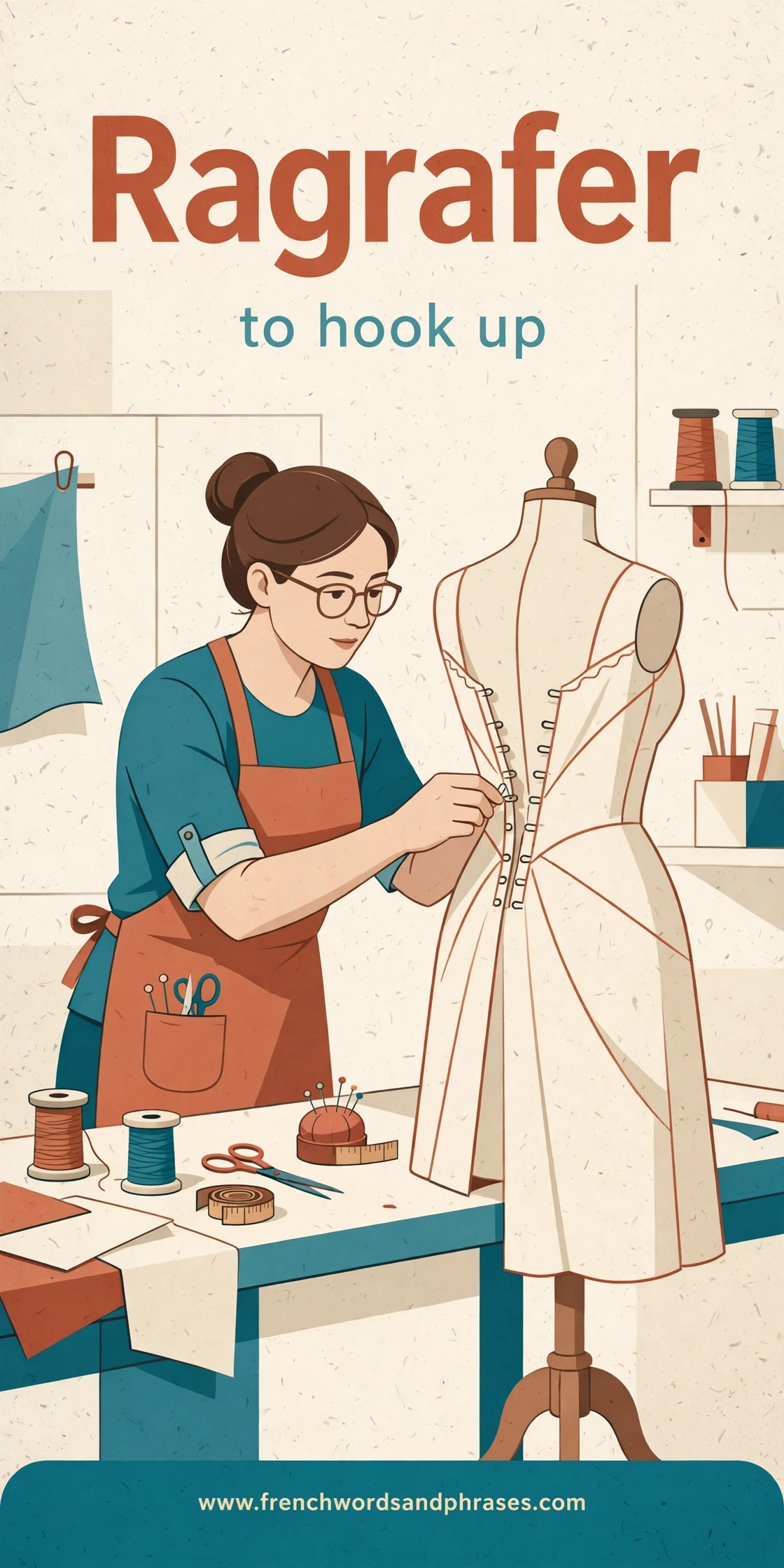
Ragrafer means to hook up — to fasten again with hooks or clasps.
A hook slipped loose on a dress, a curtain half down, a coat opened by the wind — ragrafer is the small, practical verb of fastening things up again, hook by hook.
In this guide, you’ll learn how to conjugate ragrafer in all the major French tenses and moods. Explore complete conjugation tables, French examples, English translations, and practice quizzes.
Understanding the French Verb Ragrafer
Ragrafer is a regular French verb belonging to the first group of verbs, those ending in -er.
It means to hook up. It is commonly used for dresses, corsets and coats fastened with hooks, for curtains hooked back onto their rings, and in the reflexive when someone does themselves up again before facing the world.
Verb classification: First group (-er)
Auxiliary verb: Avoir
Past participle: ragrafé
Present participle: ragrafant
English equivalents: To hook up, to fasten again; se ragrafer — to do oneself up again; dégrafer — to unfasten; une agrafe — a hook, a clasp, a staple.
One important detail: ragrafer is half of a pair — its mirror twin is dégrafer, to unfasten, and French speakers reach for the two together all day: dégrafe ton manteau, ragrafe ta robe. The hook itself is une agrafe, a word that also means a staple, so the same verb family fastens dresses and paperwork. The reflexive se ragrafer means to do yourself up again — the quick rescue before a photo or an entrance.
Experience the Word
Ragrafer is the verb of the small repair done in a mirror — nothing grand, just everything back where it belongs.
Imagine a dressing room before a wedding. The bride turns, something has slipped, and three friends converge at once — one holds the bouquet, one finds the loose hook, and the third ragrafes the dress with the calm of long practice.
The dress has not changed at all. It has been ragrafée — hooked up again, secure, ready.
How to Conjugate Ragrafer: Complete French Conjugation Guide
Let’s explore every major conjugation of ragrafer, beginning with the indicative mood.
How to Conjugate Ragrafer in the Indicative Mood
The indicative mood is used to express facts, observations, actions, and events.
How to Conjugate Ragrafer in the Present Tense (Présent)
Used for actions happening now, habitual actions, and general truths.
| Subject | Conjugation |
|---|---|
| je | ragrafe |
| tu | ragrafes |
| il / elle | ragrafe |
| nous | ragrafons |
| vous | ragrafez |
| ils / elles | ragrafent |
Example
Elle ragrafe sa robe avant de sortir.
She fastens up her dress before going out.
Quick Quiz 1
Complete the sentence:
Nous ______ les rideaux.
Reveal the answer
ragrafons
Nous ragrafons les rideaux.
We hook the curtains back up.
How to Conjugate Ragrafer in the Passé Composé
Used for completed actions in the past. Ragrafer takes the auxiliary verb avoir.
| Subject | Conjugation |
|---|---|
| j’ | ai ragrafé |
| tu | as ragrafé |
| il / elle | a ragrafé |
| nous | avons ragrafé |
| vous | avez ragrafé |
| ils / elles | ont ragrafé |
Example
Il a ragrafé le rideau sur ses crochets.
He hooked the curtain back onto its hooks.
How to Conjugate Ragrafer in the Imparfait (Imperfect Tense)
Used for habitual past actions, descriptions, and ongoing situations in the past.
| Subject | Conjugation |
|---|---|
| je | ragrafais |
| tu | ragrafais |
| il / elle | ragrafait |
| nous | ragrafions |
| vous | ragrafiez |
| ils / elles | ragrafaient |
Example
La couturière ragrafait les agrafes une à une.
The seamstress used to refasten the hooks one by one.
Quick Quiz 2
Choose the correct form:
She fastened up her dress.
Elle ______ sa robe. (a ragrafé / est ragrafée)
Reveal the answer
a ragrafé
Elle a ragrafé sa robe.
Ragrafer takes avoir.
How to Conjugate Ragrafer in the Plus-que-parfait
Used to describe an action that had already been completed before another past event.
| Subject | Conjugation |
|---|---|
| j’ | avais ragrafé |
| tu | avais ragrafé |
| il / elle | avait ragrafé |
| nous | avions ragrafé |
| vous | aviez ragrafé |
| ils / elles | avaient ragrafé |
Example
Elle avait ragrafé sa ceinture avant la photo.
She had fastened her belt again before the photo.
How to Conjugate Ragrafer in the Passé Simple
Primarily used in formal writing, literature, and historical narratives. It is rarely used in everyday conversation.
| Subject | Conjugation |
|---|---|
| je | ragrafai |
| tu | ragrafas |
| il / elle | ragrafa |
| nous | ragrafâmes |
| vous | ragrafâtes |
| ils / elles | ragrafèrent |
Example
D’un geste rapide, elle ragrafa son corsage.
With a quick gesture, she fastened up her bodice.
How to Conjugate Ragrafer in the Passé Antérieur
A literary tense used to express an action completed immediately before another past action, generally in the passé simple.
| Subject | Conjugation |
|---|---|
| j’ | eus ragrafé |
| tu | eus ragrafé |
| il / elle | eut ragrafé |
| nous | eûmes ragrafé |
| vous | eûtes ragrafé |
| ils / elles | eurent ragrafé |
Example
Quand elle eut ragrafé sa robe, elle descendit.
When she had fastened up her dress, she went downstairs.
How to Conjugate Ragrafer in the Future Tense (Futur Simple)
Used to describe actions that will take place in the future.
| Subject | Conjugation |
|---|---|
| je | ragraferai |
| tu | ragraferas |
| il / elle | ragrafera |
| nous | ragraferons |
| vous | ragraferez |
| ils / elles | ragraferont |
Example
Je ragraferai la bandoulière du sac ce soir.
I will refasten the strap of the bag this evening.
How to Conjugate Ragrafer in the Futur Antérieur (Future Perfect)
Used for an action that will have been completed before a particular point in the future.
| Subject | Conjugation |
|---|---|
| j’ | aurai ragrafé |
| tu | auras ragrafé |
| il / elle | aura ragrafé |
| nous | aurons ragrafé |
| vous | aurez ragrafé |
| ils / elles | auront ragrafé |
Example
À huit heures, elle aura ragrafé toutes les robes du défilé.
By eight o’clock, she will have fastened up all the dresses for the show.
How to Conjugate Ragrafer in the Near Future (Futur Proche)
Used to describe something that is going to happen soon. Formed with aller + infinitive.
| Subject | Conjugation |
|---|---|
| je | vais ragrafer |
| tu | vas ragrafer |
| il / elle | va ragrafer |
| nous | allons ragrafer |
| vous | allez ragrafer |
| ils / elles | vont ragrafer |
Example
Tu vas ragrafer ton manteau, il fait froid.
You are going to fasten your coat up again, it is cold.
How to Conjugate Ragrafer in the Conditional Mood
The conditional mood expresses what would happen under certain circumstances. It is also frequently used to make polite requests or express wishes.
How to Conjugate Ragrafer in the Present Conditional
| Subject | Conjugation |
|---|---|
| je | ragraferais |
| tu | ragraferais |
| il / elle | ragraferait |
| nous | ragraferions |
| vous | ragraferiez |
| ils / elles | ragraferaient |
Example
Avec de nouvelles agrafes, on ragraferait mieux ce rideau.
With new hooks, we would refasten this curtain better.
How to Conjugate Ragrafer in the Past Conditional
| Subject | Conjugation |
|---|---|
| j’ | aurais ragrafé |
| tu | aurais ragrafé |
| il / elle | aurait ragrafé |
| nous | aurions ragrafé |
| vous | auriez ragrafé |
| ils / elles | auraient ragrafé |
Example
Elle aurait ragrafé sa robe si l’agrafe n’avait pas cassé.
She would have fastened her dress if the clasp had not broken.
Ragrafer in the Literary Past Conditional Form
This less common literary form uses the imperfect subjunctive of avoir.
| Subject | Conjugation |
|---|---|
| j’ | eusse ragrafé |
| tu | eusses ragrafé |
| il / elle | eût ragrafé |
| nous | eussions ragrafé |
| vous | eussiez ragrafé |
| ils / elles | eussent ragrafé |
Example
La dame eût ragrafé son corsage avant le bal.
The lady would have fastened her bodice before the ball.
How to Conjugate Ragrafer in the Subjunctive Mood
The subjunctive is used to express wishes, emotions, doubts, necessity, and uncertainty. It frequently follows expressions such as il faut que (it is necessary that) or bien que (although).
How to Conjugate Ragrafer in the Present Subjunctive
| Subject | Conjugation |
|---|---|
| que je | ragrafe |
| que tu | ragrafes |
| qu’il / qu’elle | ragrafe |
| que nous | ragrafions |
| que vous | ragrafiez |
| qu’ils / qu’elles | ragrafent |
Example
Il faut que tu ragrafes ton gilet.
You must fasten up your waistcoat.
Quick Quiz 3
Complete the sentence using the subjunctive:
Il faut que vous ______ votre manteau.
Reveal the answer
ragrafiez
Il faut que vous ragrafiez votre manteau.
You must fasten up your coat.
How to Conjugate Ragrafer in the Imperfect Subjunctive
A literary tense, rarely encountered in modern spoken French.
| Subject | Conjugation |
|---|---|
| que je | ragrafasse |
| que tu | ragrafasses |
| qu’il / qu’elle | ragrafât |
| que nous | ragrafassions |
| que vous | ragrafassiez |
| qu’ils / qu’elles | ragrafassent |
Example
Elle attendait que la couturière ragrafât la traîne.
She waited for the seamstress to refasten the train.
How to Conjugate Ragrafer in the Pluperfect Subjunctive
A literary construction used to express an action completed before another past action.
| Subject | Conjugation |
|---|---|
| que j’ | eusse ragrafé |
| que tu | eusses ragrafé |
| qu’il / qu’elle | eût ragrafé |
| que nous | eussions ragrafé |
| que vous | eussiez ragrafé |
| qu’ils / qu’elles | eussent ragrafé |
Example
Il semblait qu’elle eût ragrafé sa robe à la hâte.
It seemed she had fastened her dress in a hurry.
How to Conjugate Ragrafer in the Past Subjunctive
| Subject | Conjugation |
|---|---|
| que j’ | aie ragrafé |
| que tu | aies ragrafé |
| qu’il / qu’elle | ait ragrafé |
| que nous | ayons ragrafé |
| que vous | ayez ragrafé |
| qu’ils / qu’elles | aient ragrafé |
Example
Je suis sûre que vous avez ragrafé le rideau.
I am sure you hooked the curtain back up.
How to Conjugate Ragrafer in the Imperative
The imperative is used to give commands, instructions, invitations, or suggestions. Subject pronouns are omitted.
How to Conjugate Ragrafer in the Present Imperative
| Person | Conjugation |
|---|---|
| (tu) | ragrafe |
| (nous) | ragrafons |
| (vous) | ragrafez |
Example
Ragrafe ton manteau, le vent se lève !
Fasten your coat up, the wind is rising!
Quick Quiz 4
How would you say Fasten your coat up (tu form)?
Reveal the answer
Ragrafe ton manteau !
French Participles of Ragrafer
Participles are verb forms that can be used in compound tenses and other grammatical constructions.
Present Participle of Ragrafer
ragrafant
En ragrafant sa ceinture, il a cassé l’agrafe.
While refastening his belt, he broke the clasp.
Past Participle of Ragrafer
ragrafé
Ragrafée à la hâte, la robe tenait à peine.
Fastened in a hurry, the dress barely held.
Ragrafer in Everyday French: Real-Life Examples
Now that you know the conjugations, let’s see how ragrafer appears in everyday French.
Example 1 — Present
Je ragrafe toujours mon manteau en sortant.
I always fasten my coat up again when I go out.
Example 2 — Passé composé
Elle s’est ragrafée avant la photo.
She did herself up again before the photo.
Example 3 — Imparfait
Grand-mère ragrafait son tablier après la vaisselle.
Grandmother used to refasten her apron after the washing-up.
Example 4 — Future
Nous ragraferons les rideaux demain.
We will hook the curtains back up tomorrow.
Example 5 — Conditional
Tu ragraferais ton sac s’il s’ouvrait tout le temps.
You would refasten your bag if it kept opening.
Example 6 — Imperative
Ragrafez-vous, la visite commence !
Do yourselves up, the tour is starting!
Beyond Translation: The Meaning of Ragrafer
English hook up has wandered off into electronics and slang; French ragrafer has stayed at the wardrobe, faithful to the little metal hook.
Dégrafer and ragrafer are the inhale and exhale of getting dressed.
One undoes, the other redoes, and between the two of them they cover every dress, curtain and coat in France — plus, by way of the staple, a good deal of its paperwork too.
How to Remember the French Verb Ragrafer
Remember it this way: Ragrafer is about hooks back in place — the dress, the curtain, the coat against the wind.
- Une agrafe — a hook, a clasp, a staple: ragrafer is putting the agrafes back.
- Dégrafer undoes, ragrafer redoes — the pair works like unfasten and refasten.
- Regular -er: je ragrafe, nous ragrafons, past participle ragrafé.
The key idea is hooks back in place — the dress, the curtain, the coat against the wind.
Test Your Knowledge of Ragrafer
Let’s see how much you’ve learned. Try answering these questions before revealing the answers.
Question 1
What is the opposite of ragrafer?
Reveal the answer
Dégrafer — to unfasten, to undo the hooks.
Question 2
How do you say She fastens up her dress in French?
Reveal the answer
Elle ragrafe sa robe.
Question 3
Translate: He hooked the curtain back onto its hooks.
Reveal the answer
Il a ragrafé le rideau sur ses crochets.
Question 4
What is the past participle of ragrafer?
Reveal the answer
Ragrafé.
Question 5
Complete the sentence:
Il faut que tu ______ ton gilet.
Reveal the answer
ragrafes
Il faut que tu ragrafes ton gilet.
You must fasten up your waistcoat.
Your Final Challenge
Can You Use It?
How would you say this in French?
She fastens up her dress, grabs her bag, and she is ready for the party.
Reveal the answer
Elle ragrafe sa robe, attrape son sac, et elle est prête pour la fête.
She fastens up her dress, grabs her bag, and she is ready for the party.
A little French. A little curiosity. A richer everyday life.
LEARN FRENCH ONE WORD AT A TIME




