
A French Word to Live By
How to Conjugate Radiner in French
/ʁa.di.ne/
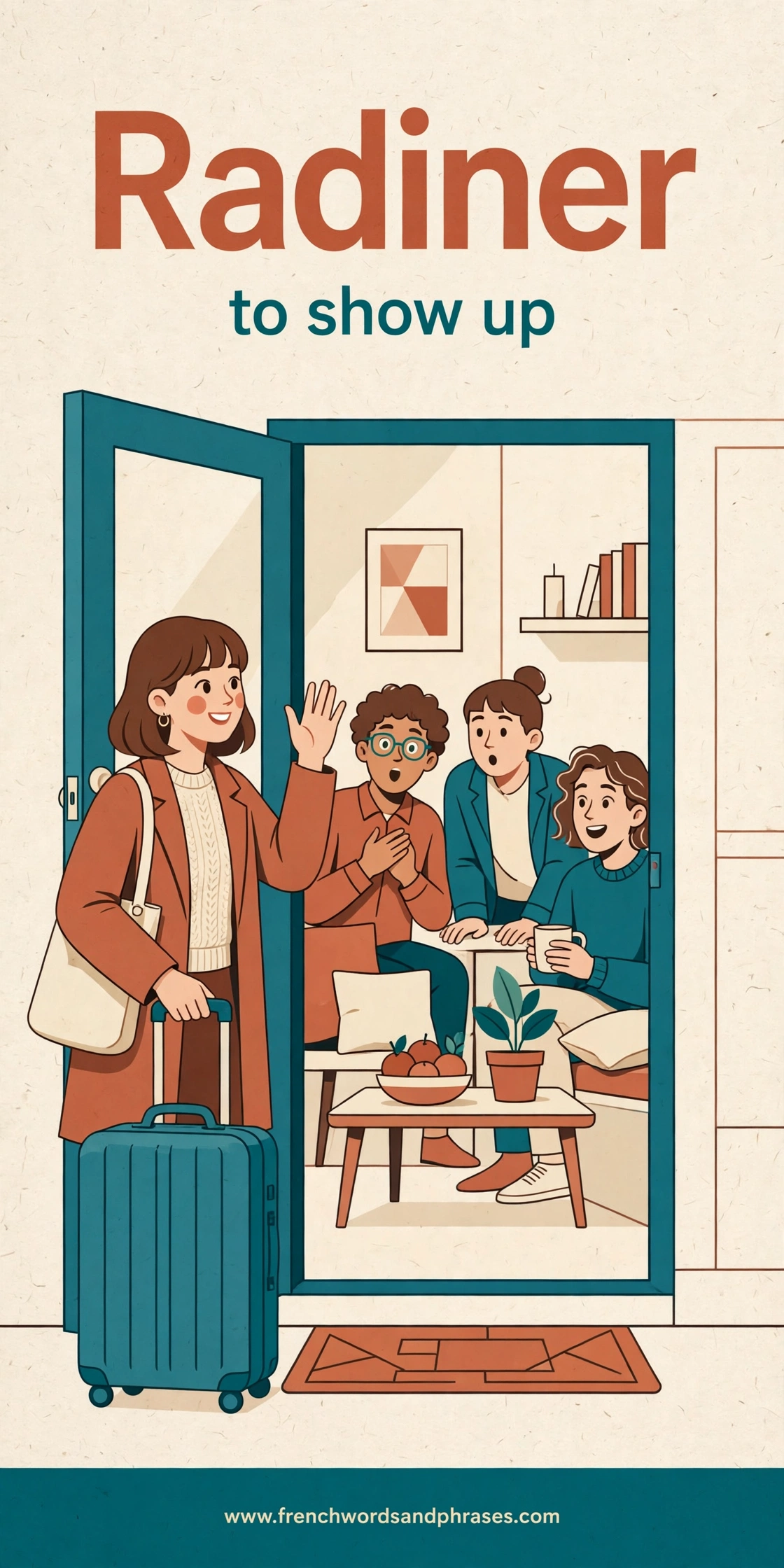
Radiner means to show up — in familiar French, to turn up, to arrive, usually late or unannounced.
The film started twenty minutes ago, the raclette is already melting, and the doorbell finally rings — radiner is familiar French for that moment: to show up, to turn up at last, usually late, usually grinning, never in a hurry.
In this guide, you’ll learn how to conjugate radiner in all the major French tenses and moods. Explore complete conjugation tables, French examples, English translations, and practice quizzes.
Understanding the French Verb Radiner
Radiner is a regular French verb belonging to the first group of verbs, those ending in -er.
It means to show up. It is commonly used for friends arriving at parties and dinners, for colleagues drifting into meetings, and in the eternal question of French social life — il radine quand, lui ? — when is he actually going to show up? The tone is teasing rather than angry: radiner is lateness with charm.
Verb classification: First group (-er)
Auxiliary verb: Avoir
Past participle: radiné
Present participle: radinant
English equivalents: (Familiar) To show up, to turn up, to roll in; se radiner — also to turn up, very common in speech.
One important detail: radiner is familiar French — the French of friends, text messages and café terraces, not of formal letters. It means to arrive, to turn up, often later than promised and without warning. Do not confuse it with its look-alike un radin, a stingy person, a miser: the friend who radine at midnight is late, not mean. You will also hear the reflexive se radiner with the same meaning — il s’est radiné à minuit, he showed up at midnight.
Experience the Word
Radiner is the verb of the late arrival — the door opening an hour into the evening, and nobody really minding.
Imagine a birthday dinner in a small Paris flat. Eight o’clock, nine o’clock — one chair stays empty. At ten, the bell rings: Karim radine, a bottle in each hand, apologising to the room and already laughing.
He has not exactly arrived on time. He has radiné — turned up in his own time, and the party is complete.
How to Conjugate Radiner: Complete French Conjugation Guide
Let’s explore every major conjugation of radiner, beginning with the indicative mood.
How to Conjugate Radiner in the Indicative Mood
The indicative mood is used to express facts, observations, actions, and events.
How to Conjugate Radiner in the Present Tense (Présent)
Used for actions happening now, habitual actions, and general truths.
| Subject | Conjugation |
|---|---|
| je | radine |
| tu | radines |
| il / elle | radine |
| nous | radinons |
| vous | radinez |
| ils / elles | radinent |
Example
Il radine toujours en retard, mais toujours avec le sourire.
He always shows up late, but always with a smile.
Quick Quiz 1
Complete the sentence:
Nous ______ toujours en retard à ses fêtes.
Reveal the answer
radinons
Nous radinons toujours en retard à ses fêtes.
We always show up late to his parties.
How to Conjugate Radiner in the Passé Composé
Used for completed actions in the past. Radiner takes the auxiliary verb avoir.
| Subject | Conjugation |
|---|---|
| j’ | ai radiné |
| tu | as radiné |
| il / elle | a radiné |
| nous | avons radiné |
| vous | avez radiné |
| ils / elles | ont radiné |
Example
Elle a radiné à minuit avec deux pizzas froides.
She showed up at midnight with two cold pizzas.
How to Conjugate Radiner in the Imparfait (Imperfect Tense)
Used for habitual past actions, descriptions, and ongoing situations in the past.
| Subject | Conjugation |
|---|---|
| je | radinais |
| tu | radinais |
| il / elle | radinait |
| nous | radinions |
| vous | radiniez |
| ils / elles | radinaient |
Example
Autrefois, il radinait chez nous tous les dimanches sans prévenir.
In the old days, he used to turn up at our place every Sunday without warning.
Quick Quiz 2
Choose the correct form:
She showed up at midnight.
Elle ______ à minuit. (a radiné / est radinée)
Reveal the answer
a radiné
Elle a radiné à minuit.
Radiner takes avoir.
How to Conjugate Radiner in the Plus-que-parfait
Used to describe an action that had already been completed before another past event.
| Subject | Conjugation |
|---|---|
| j’ | avais radiné |
| tu | avais radiné |
| il / elle | avait radiné |
| nous | avions radiné |
| vous | aviez radiné |
| ils / elles | avaient radiné |
Example
Il avait radiné si tard que le dessert était déjà servi.
He had shown up so late that dessert was already being served.
How to Conjugate Radiner in the Passé Simple
Primarily used in formal writing, literature, and historical narratives. It is rarely used in everyday conversation.
| Subject | Conjugation |
|---|---|
| je | radinai |
| tu | radinas |
| il / elle | radina |
| nous | radinâmes |
| vous | radinâtes |
| ils / elles | radinèrent |
Example
À minuit sonnant, il radina enfin, trempé par la pluie.
As midnight struck, he finally showed up, soaked by the rain.
How to Conjugate Radiner in the Passé Antérieur
A literary tense used to express an action completed immediately before another past action, generally in the passé simple.
| Subject | Conjugation |
|---|---|
| j’ | eus radiné |
| tu | eus radiné |
| il / elle | eut radiné |
| nous | eûmes radiné |
| vous | eûtes radiné |
| ils / elles | eurent radiné |
Example
Quand il eut radiné, la fête put vraiment commencer.
When he had shown up, the party could really begin.
How to Conjugate Radiner in the Future Tense (Futur Simple)
Used to describe actions that will take place in the future.
| Subject | Conjugation |
|---|---|
| je | radinerai |
| tu | radineras |
| il / elle | radinera |
| nous | radinerons |
| vous | radinerez |
| ils / elles | radineront |
Example
Ne l’attends pas à huit heures : il radinera vers dix heures.
Do not expect him at eight: he will show up around ten.
How to Conjugate Radiner in the Futur Antérieur (Future Perfect)
Used for an action that will have been completed before a particular point in the future.
| Subject | Conjugation |
|---|---|
| j’ | aurai radiné |
| tu | auras radiné |
| il / elle | aura radiné |
| nous | aurons radiné |
| vous | aurez radiné |
| ils / elles | auront radiné |
Example
À minuit, tout le monde aura radiné, même les plus lents.
By midnight, everyone will have shown up, even the slowest.
How to Conjugate Radiner in the Near Future (Futur Proche)
Used to describe something that is going to happen soon. Formed with aller + infinitive.
| Subject | Conjugation |
|---|---|
| je | vais radiner |
| tu | vas radiner |
| il / elle | va radiner |
| nous | allons radiner |
| vous | allez radiner |
| ils / elles | vont radiner |
Example
Regarde ton téléphone, je crois qu’il va radiner.
Check your phone, I think he is going to show up.
How to Conjugate Radiner in the Conditional Mood
The conditional mood expresses what would happen under certain circumstances. It is also frequently used to make polite requests or express wishes.
How to Conjugate Radiner in the Present Conditional
| Subject | Conjugation |
|---|---|
| je | radinerais |
| tu | radinerais |
| il / elle | radinerait |
| nous | radinerions |
| vous | radineriez |
| ils / elles | radineraient |
Example
Avec un bon GPS, il radinerait à l’heure pour une fois.
With a good GPS, he would show up on time for once.
How to Conjugate Radiner in the Past Conditional
| Subject | Conjugation |
|---|---|
| j’ | aurais radiné |
| tu | aurais radiné |
| il / elle | aurait radiné |
| nous | aurions radiné |
| vous | auriez radiné |
| ils / elles | auraient radiné |
Example
Elle aurait radiné plus tôt sans les embouteillages.
She would have shown up earlier without the traffic jams.
Radiner in the Literary Past Conditional Form
This less common literary form uses the imperfect subjunctive of avoir.
| Subject | Conjugation |
|---|---|
| j’ | eusse radiné |
| tu | eusses radiné |
| il / elle | eût radiné |
| nous | eussions radiné |
| vous | eussiez radiné |
| ils / elles | eussent radiné |
Example
Il eût radiné avant la nuit sans cette panne.
He would have shown up before nightfall without that breakdown.
How to Conjugate Radiner in the Subjunctive Mood
The subjunctive is used to express wishes, emotions, doubts, necessity, and uncertainty. It frequently follows expressions such as il faut que (it is necessary that) or bien que (although).
How to Conjugate Radiner in the Present Subjunctive
| Subject | Conjugation |
|---|---|
| que je | radine |
| que tu | radines |
| qu’il / qu’elle | radine |
| que nous | radinions |
| que vous | radiniez |
| qu’ils / qu’elles | radinent |
Example
Je doute qu’il radine avant onze heures.
I doubt he will show up before eleven.
Quick Quiz 3
Complete the sentence using the subjunctive:
Il est peu probable que vous ______ à l’heure.
Reveal the answer
radiniez
Il est peu probable que vous radiniez à l’heure.
It is unlikely you will show up on time.
How to Conjugate Radiner in the Imperfect Subjunctive
A literary tense, rarely encountered in modern spoken French.
| Subject | Conjugation |
|---|---|
| que je | radinasse |
| que tu | radinasses |
| qu’il / qu’elle | radinât |
| que nous | radinassions |
| que vous | radinassiez |
| qu’ils / qu’elles | radinassent |
Example
On ne s’attendait pas à ce qu’il radinât si tôt.
Nobody expected him to show up so early.
How to Conjugate Radiner in the Pluperfect Subjunctive
A literary construction used to express an action completed before another past action.
| Subject | Conjugation |
|---|---|
| que j’ | eusse radiné |
| que tu | eusses radiné |
| qu’il / qu’elle | eût radiné |
| que nous | eussions radiné |
| que vous | eussiez radiné |
| qu’ils / qu’elles | eussent radiné |
Example
Elle plaisantait sur le fait qu’il fût radiné à l’aube.
She joked about the fact that he had shown up at dawn.
How to Conjugate Radiner in the Past Subjunctive
| Subject | Conjugation |
|---|---|
| que j’ | aie radiné |
| que tu | aies radiné |
| qu’il / qu’elle | ait radiné |
| que nous | ayons radiné |
| que vous | ayez radiné |
| qu’ils / qu’elles | aient radiné |
Example
Je suis content qu’elle ait radiné, finalement.
I am glad she showed up, in the end.
How to Conjugate Radiner in the Imperative
The imperative is used to give commands, instructions, invitations, or suggestions. Subject pronouns are omitted.
How to Conjugate Radiner in the Present Imperative
| Person | Conjugation |
|---|---|
| (tu) | radine |
| (nous) | radinons |
| (vous) | radinez |
Example
Radine à huit heures précises, pour une fois !
Show up at eight sharp, for once!
Quick Quiz 4
How would you say Show up early (tu form)?
Reveal the answer
Radine tôt !
French Participles of Radiner
Participles are verb forms that can be used in compound tenses and other grammatical constructions.
Present Participle of Radiner
radinant
En radinant à l’improviste, il a surpris tout le monde.
By showing up unexpectedly, he surprised everyone.
Past Participle of Radiner
radiné
Radiné à la dernière minute, il a quand même eu sa part de gâteau.
Having shown up at the last minute, he still got his share of cake.
Radiner in Everyday French: Real-Life Examples
Now that you know the conjugations, let’s see how radiner appears in everyday French.
Example 1 — Present
Il radine toujours chez nous le vendredi soir.
He always shows up at our place on Friday evenings.
Example 2 — Passé composé
Elle a radiné avec une heure de retard.
She showed up an hour late.
Example 3 — Imparfait
On radinait les uns chez les autres sans prévenir.
We used to turn up at each other’s places without warning.
Example 4 — Future
Tu radineras à quelle heure, demain ?
What time will you show up tomorrow?
Example 5 — Conditional
Il radinerait plus tôt s’il habitait plus près.
He would show up earlier if he lived closer.
Example 6 — Imperative
Radine tôt, on commence sans toi sinon !
Show up early, or we start without you!
Beyond Translation: The Meaning of Radiner
English says show up or turn up and thinks no more of it; French radiner packs the same idea into one familiar little verb with a shrug built in.
It is lateness without drama.
To say il a radiné à minuit is not to accuse — it is to smile. The formal language has arriver and se présenter; radiner belongs to the kitchen, the terrace and the group chat.
How to Remember the French Verb Radiner
Remember it this way: Radiner is about the late arrival — turned up at last, grinning.
- Radiner = to show up, familiar style — the late friend’s verb.
- Not a radin: un radin is a miser; radiner is about arriving, not saving.
- Regular -er: je radine, nous radinons, past participle radiné.
The key idea is the late arrival — turned up at last, grinning.
Test Your Knowledge of Radiner
Let’s see how much you’ve learned. Try answering these questions before revealing the answers.
Question 1
What register is radiner?
Reveal the answer
Familiar / informal — the French of friends and terraces, not of formal letters.
Question 2
How do you say He showed up at midnight in French?
Reveal the answer
Il a radiné à minuit.
Question 3
Translate: She always shows up late.
Reveal the answer
Elle radine toujours en retard.
Question 4
What is the past participle of radiner?
Reveal the answer
Radiné.
Question 5
Complete the sentence:
Je doute qu’il ______ avant onze heures.
Reveal the answer
radine
Je doute qu’il radine avant onze heures.
I doubt he will show up before eleven.
Your Final Challenge
Can You Use It?
How would you say this in French?
He shows up at ten, a bottle in his hand, and the evening can finally begin.
Reveal the answer
Il radine à dix heures, une bouteille à la main, et la soirée peut enfin commencer.
He shows up at ten, a bottle in his hand, and the evening can finally begin.
A little French. A little curiosity. A richer everyday life.
LEARN FRENCH ONE WORD AT A TIME




