A French Word to Live By
How to Conjugate Queuter in French
/kø.te/
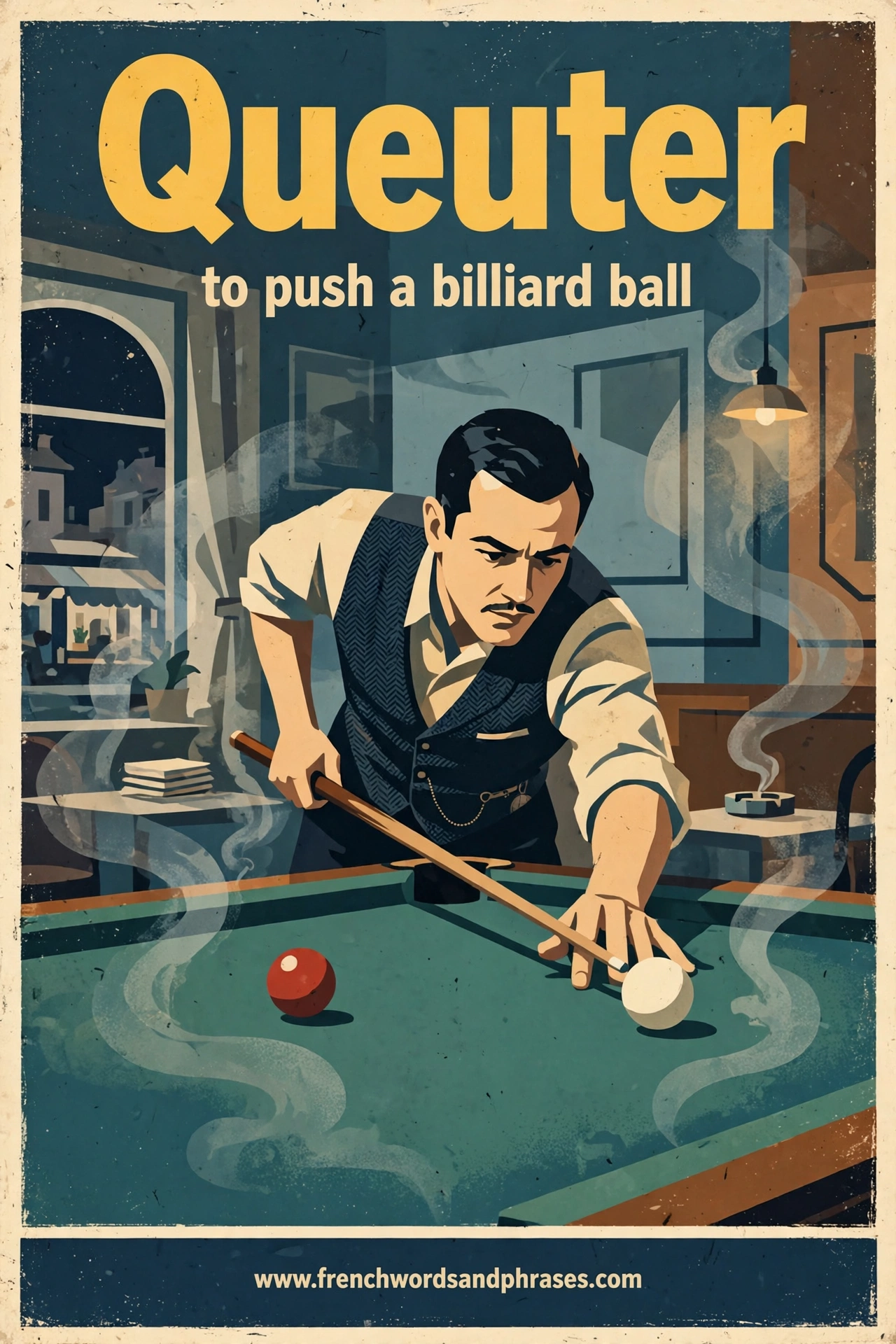
Queuter means to push a billiard ball — to strike the cue ball with the tip of the cue.
A hushed room, a green cloth, the soft click of ivory — queuter is the billiard player’s verb, the small precise push that sends the white ball rolling toward its target.
In this guide, you’ll learn how to conjugate queuter in all the major French tenses and moods. Explore complete conjugation tables, French examples, English translations, and practice quizzes.
Understanding the French Verb Queuter
Queuter is a regular French verb belonging to the first group of verbs, those ending in -er.
It means to push a billiard ball. It is commonly used at the billiard and pool table for the act of striking the cue ball, in coaching (queuter doucement, queuter sans forcer), and in descriptions of a player’s touch — bien queuter, to have a good cue action.
Verb classification: First group (-er)
Auxiliary verb: Avoir
Past participle: queuté
Present participle: queutant
English equivalents: To push a billiard ball, to strike the cue ball; la queue de billard — the cue; la bille — the ball.
One important detail: queuter is built on la queue — and in the billiard room, la queue is the cue itself, the long tapered stick. To queuter is to use the queue: to push the cue ball, la bille blanche, with a short controlled stroke. Players distinguish a gentle push from a full shot, and a beginner who queute mal — who pushes clumsily — will tear the cloth or send the ball hopping. The verb lives almost entirely in this one room and this one game.
Experience the Word
Queuter is the verb of the fingertips and the held breath — the whole game decided by one small push.
Imagine an old billiard room above a café. The player chalks the tip of his cue, leans over the green cloth, and the room goes quiet. One soft push — queuter — and the white ball rolls, kisses the red, and settles exactly where he dreamed it.
The ball has barely been touched. It has been queuté — pushed with just enough force, and no more.
How to Conjugate Queuter: Complete French Conjugation Guide
Let’s explore every major conjugation of queuter, beginning with the indicative mood.
How to Conjugate Queuter in the Indicative Mood
The indicative mood is used to express facts, observations, actions, and events.
How to Conjugate Queuter in the Present Tense (Présent)
Used for actions happening now, habitual actions, and general truths.
| Subject | Conjugation |
|---|---|
| je | queute |
| tu | queutes |
| il / elle | queute |
| nous | queutons |
| vous | queutez |
| ils / elles | queutent |
Example
Il queute la bille blanche avec une précision admirable.
He pushes the cue ball with admirable precision.
Quick Quiz 1
Complete the sentence:
Nous ______ la bille vers la bande.
Reveal the answer
queutons
Nous queutons la bille vers la bande.
We push the ball toward the cushion.
How to Conjugate Queuter in the Passé Composé
Used for completed actions in the past. Queuter takes the auxiliary verb avoir.
| Subject | Conjugation |
|---|---|
| j’ | ai queuté |
| tu | as queuté |
| il / elle | a queuté |
| nous | avons queuté |
| vous | avez queuté |
| ils / elles | ont queuté |
Example
Elle a queuté trop fort et la bille a sauté.
She pushed too hard and the ball jumped.
How to Conjugate Queuter in the Imparfait (Imperfect Tense)
Used for habitual past actions, descriptions, and ongoing situations in the past.
| Subject | Conjugation |
|---|---|
| je | queutais |
| tu | queutais |
| il / elle | queutait |
| nous | queutions |
| vous | queutiez |
| ils / elles | queutaient |
Example
Le vieux joueur queutait lentement, sans jamais se presser.
The old player used to push the ball slowly, never hurrying.
Quick Quiz 2
Choose the correct form:
She pushed too hard.
Elle ______ trop fort. (a queuté / est queutée)
Reveal the answer
a queuté
Elle a queuté trop fort.
Queuter takes avoir.
How to Conjugate Queuter in the Plus-que-parfait
Used to describe an action that had already been completed before another past event.
| Subject | Conjugation |
|---|---|
| j’ | avais queuté |
| tu | avais queuté |
| il / elle | avait queuté |
| nous | avions queuté |
| vous | aviez queuté |
| ils / elles | avaient queuté |
Example
Il avait queuté la bille avant que l’arbitre arrive.
He had pushed the ball before the referee arrived.
How to Conjugate Queuter in the Passé Simple
Primarily used in formal writing, literature, and historical narratives. It is rarely used in everyday conversation.
| Subject | Conjugation |
|---|---|
| je | queutai |
| tu | queutas |
| il / elle | queuta |
| nous | queutâmes |
| vous | queutâtes |
| ils / elles | queutèrent |
Example
Le champion queuta la bille d’un geste sec et sûr.
The champion pushed the ball with a dry, sure gesture.
How to Conjugate Queuter in the Passé Antérieur
A literary tense used to express an action completed immediately before another past action, generally in the passé simple.
| Subject | Conjugation |
|---|---|
| j’ | eus queuté |
| tu | eus queuté |
| il / elle | eut queuté |
| nous | eûmes queuté |
| vous | eûtes queuté |
| ils / elles | eurent queuté |
Example
Quand il eut queuté, un silence admiratif suivit.
When he had pushed the ball, an admiring silence followed.
How to Conjugate Queuter in the Future Tense (Futur Simple)
Used to describe actions that will take place in the future.
| Subject | Conjugation |
|---|---|
| je | queuterai |
| tu | queuteras |
| il / elle | queutera |
| nous | queuterons |
| vous | queuterez |
| ils / elles | queuteront |
Example
Tu queuteras plus doucement au prochain coup.
You will push more gently on the next shot.
How to Conjugate Queuter in the Futur Antérieur (Future Perfect)
Used for an action that will have been completed before a particular point in the future.
| Subject | Conjugation |
|---|---|
| j’ | aurai queuté |
| tu | auras queuté |
| il / elle | aura queuté |
| nous | aurons queuté |
| vous | aurez queuté |
| ils / elles | auront queuté |
Example
À la fin de la partie, il aura queuté cent fois.
By the end of the game, he will have pushed the ball a hundred times.
How to Conjugate Queuter in the Near Future (Futur Proche)
Used to describe something that is going to happen soon. Formed with aller + infinitive.
| Subject | Conjugation |
|---|---|
| je | vais queuter |
| tu | vas queuter |
| il / elle | va queuter |
| nous | allons queuter |
| vous | allez queuter |
| ils / elles | vont queuter |
Example
Je vais queuter la bille vers la bande.
I am going to push the ball toward the cushion.
How to Conjugate Queuter in the Conditional Mood
The conditional mood expresses what would happen under certain circumstances. It is also frequently used to make polite requests or express wishes.
How to Conjugate Queuter in the Present Conditional
| Subject | Conjugation |
|---|---|
| je | queuterais |
| tu | queuterais |
| il / elle | queuterait |
| nous | queuterions |
| vous | queuteriez |
| ils / elles | queuteraient |
Example
Avec une meilleure queue, je queuterais plus droit.
With a better cue, I would push straighter.
How to Conjugate Queuter in the Past Conditional
| Subject | Conjugation |
|---|---|
| j’ | aurais queuté |
| tu | aurais queuté |
| il / elle | aurait queuté |
| nous | aurions queuté |
| vous | auriez queuté |
| ils / elles | auraient queuté |
Example
Il aurait queuté plus fort si la bille avait été plus loin.
He would have pushed harder if the ball had been farther away.
Queuter in the Literary Past Conditional Form
This less common literary form uses the imperfect subjunctive of avoir.
| Subject | Conjugation |
|---|---|
| j’ | eusse queuté |
| tu | eusses queuté |
| il / elle | eût queuté |
| nous | eussions queuté |
| vous | eussiez queuté |
| ils / elles | eussent queuté |
Example
Le joueur eût queuté sans trembler, même en finale.
The player would have pushed without trembling, even in a final.
How to Conjugate Queuter in the Subjunctive Mood
The subjunctive is used to express wishes, emotions, doubts, necessity, and uncertainty. It frequently follows expressions such as il faut que (it is necessary that) or bien que (although).
How to Conjugate Queuter in the Present Subjunctive
| Subject | Conjugation |
|---|---|
| que je | queute |
| que tu | queutes |
| qu’il / qu’elle | queute |
| que nous | queutions |
| que vous | queutiez |
| qu’ils / qu’elles | queutent |
Example
Il faut que tu queutes sans lever la queue.
You must push without lifting the cue.
Quick Quiz 3
Complete the sentence using the subjunctive:
Il faut que vous ______ sans forcer.
Reveal the answer
queutiez
Il faut que vous queutiez sans forcer.
You must push without forcing.
How to Conjugate Queuter in the Imperfect Subjunctive
A literary tense, rarely encountered in modern spoken French.
| Subject | Conjugation |
|---|---|
| que je | queutasse |
| que tu | queutasses |
| qu’il / qu’elle | queutât |
| que nous | queutassions |
| que vous | queutassiez |
| qu’ils / qu’elles | queutassent |
Example
Le professeur voulait qu’il queutât plus lentement.
The teacher wanted him to push more slowly.
How to Conjugate Queuter in the Pluperfect Subjunctive
A literary construction used to express an action completed before another past action.
| Subject | Conjugation |
|---|---|
| que j’ | eusse queuté |
| que tu | eusses queuté |
| qu’il / qu’elle | eût queuté |
| que nous | eussions queuté |
| que vous | eussiez queuté |
| qu’ils / qu’elles | eussent queuté |
Example
On racontait qu’il eût queuté la bille les yeux fermés.
They said he had pushed the ball with his eyes closed.
How to Conjugate Queuter in the Past Subjunctive
| Subject | Conjugation |
|---|---|
| que j’ | aie queuté |
| que tu | aies queuté |
| qu’il / qu’elle | ait queuté |
| que nous | ayons queuté |
| que vous | ayez queuté |
| qu’ils / qu’elles | aient queuté |
Example
Je suis content que tu aies queuté si doucement.
I am glad you pushed so gently.
How to Conjugate Queuter in the Imperative
The imperative is used to give commands, instructions, invitations, or suggestions. Subject pronouns are omitted.
How to Conjugate Queuter in the Present Imperative
| Person | Conjugation |
|---|---|
| (tu) | queute |
| (nous) | queutons |
| (vous) | queutez |
Example
Queute doucement, la bille est près de la bande !
Push gently, the ball is near the cushion!
Quick Quiz 4
How would you say Push gently (tu form)?
Reveal the answer
Queute doucement !
French Participles of Queuter
Participles are verb forms that can be used in compound tenses and other grammatical constructions.
Present Participle of Queuter
queutant
En queutant, il garde le poignet souple.
While pushing the ball, he keeps his wrist supple.
Past Participle of Queuter
queuté
Queutée avec soin, la bille a roulé exactement au bon endroit.
Pushed with care, the ball rolled to exactly the right spot.
Queuter in Everyday French: Real-Life Examples
Now that you know the conjugations, let’s see how queuter appears in everyday French.
Example 1 — Present
Il queute toujours trop fort.
He always pushes too hard.
Example 2 — Passé composé
Tu as queuté la bille comme un débutant.
You pushed the ball like a beginner.
Example 3 — Imparfait
Autrefois, on queutait sur des tables en ardoise.
In the old days, people played on slate tables.
Example 4 — Future
Ce soir, nous queuterons entre amis au café.
This evening, we will play a friendly game at the café.
Example 5 — Conditional
Je queuterais mieux avec ma propre queue.
I would play better with my own cue.
Example 6 — Imperative
Queutez sans forcer, c’est un coup facile !
Push without forcing, it is an easy shot!
Beyond Translation: The Meaning of Queuter
English talks about striking or hitting the cue ball, big violent words for a gesture of millimetres; French queuter is honest about the scale — it is a push, not a blow.
The verb is the cue itself, turned into an action.
La queue pushes, la bille rolls: queuter names the exact moment where the player’s intention passes into the ball.
How to Remember the French Verb Queuter
Remember it this way: Queuter is about the small precise push of the cue on the white ball.
- La queue — the cue; queuter is what the queue does to the ball.
- Queuter doucement — push gently, the first lesson of every billiard teacher.
- Regular -er: je queute, nous queutons, past participle queuté.
The key idea is the small precise push of the cue on the white ball.
Test Your Knowledge of Queuter
Let’s see how much you’ve learned. Try answering these questions before revealing the answers.
Question 1
What is la queue at a billiard table?
Reveal the answer
The cue — the stick you queuter with.
Question 2
How do you say Push gently in French (at the billiard table)?
Reveal the answer
Queute doucement.
Question 3
Translate: He pushes the cue ball with admirable precision.
Reveal the answer
Il queute la bille blanche avec une précision admirable.
Question 4
What is the past participle of queuter?
Reveal the answer
Queuté.
Question 5
Complete the sentence:
Il faut que tu ______ sans lever la queue.
Reveal the answer
queutes
Il faut que tu queutes sans lever la queue.
You must push without lifting the cue.
Your Final Challenge
Can You Use It?
How would you say this in French?
He pushes the cue ball in silence, and the room holds its breath.
Reveal the answer
Il queute la bille en silence, et la salle retient son souffle.
He pushes the cue ball in silence, and the room holds its breath.
A little French. A little curiosity. A richer everyday life.
LEARN FRENCH ONE WORD AT A TIME