A French Word to Live By
How to Conjugate Quémander in French
/ke.mɑ̃.de/
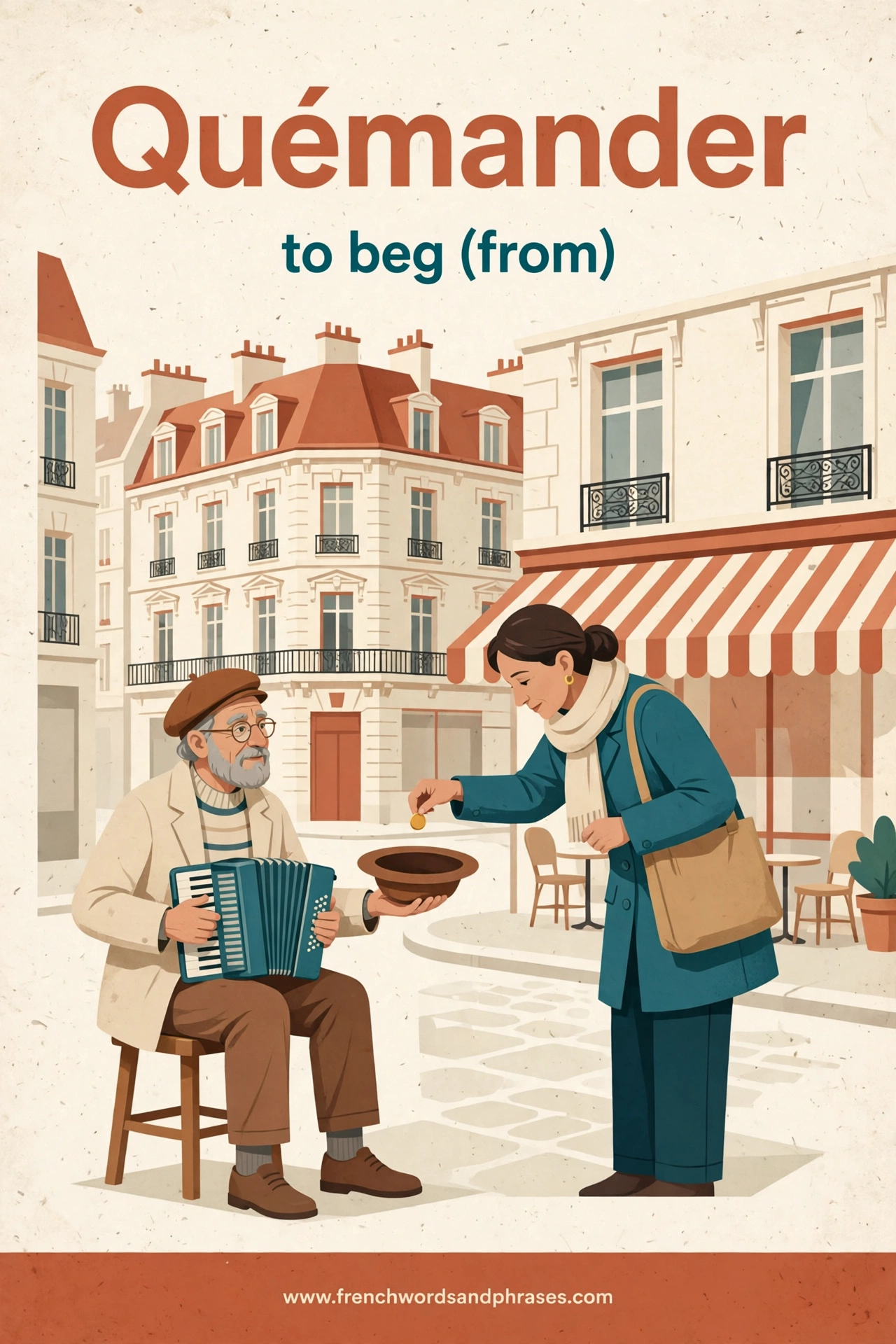
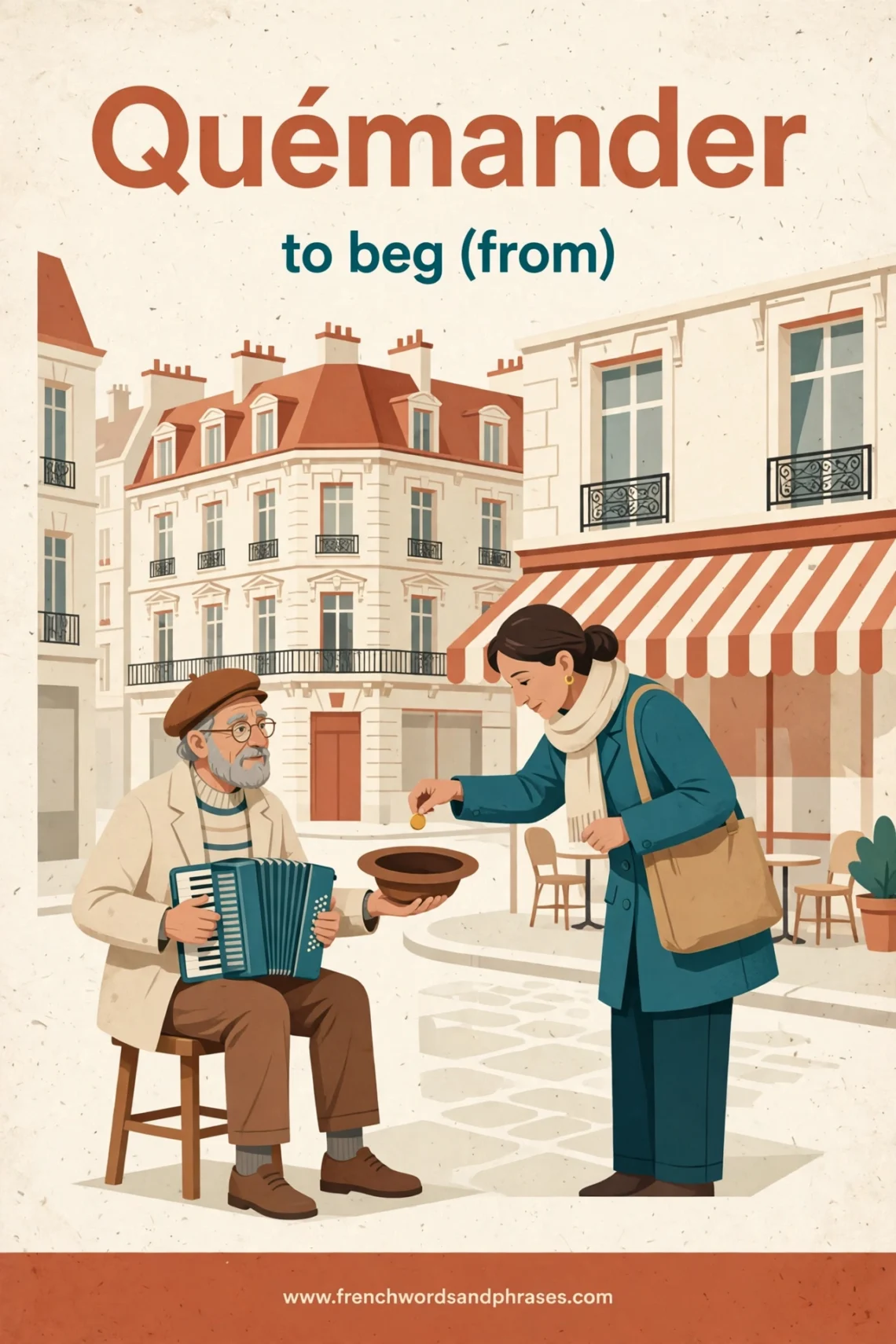
Quémander means to beg — to ask humbly and persistently for something.
A hand held out at the church door, a student begging one more signature, a dog fixing you with solemn eyes at the table — quémander is the verb of asking humbly and insistently, of begging a favour rather than claiming a right.
In this guide, you’ll learn how to conjugate quémander in all the major French tenses and moods. Explore complete conjugation tables, French examples, English translations, and practice quizzes.
Understanding the French Verb Quémander
Quémander is a regular French verb belonging to the first group of verbs, those ending in -er.
It means to beg (from). It is commonly used for begging alms or money (quémander aux portes), for pleading for favours and signatures (quémander une faveur, quémander des voix before an election), for the shameless begging of dogs at the table, and in literature for begging mercy, pardon or attention.
Verb classification: First group (-er)
Auxiliary verb: Avoir
Past participle: quémandé
Present participle: quémandant
English equivalents: To beg, to ask humbly for; un quémandeur — a persistent beggar, a solicitor of favours.
One important detail: quémander is stronger and more humble than demander. Demander is the neutral verb — to ask. Quémander adds the bowed head and the repeated plea: you quémandez what you have no right to demand — a favour, a pardon, a coin, an autograph, a second chance. Its noun un quémandeur can be a simple beggar, but in offices and corridors it means the tireless solicitor who is always asking for something.
Experience the Word
Quémander is the verb of the outstretched hand — asking where you cannot order, pleading where you cannot claim.
Imagine the steps of a cathedral at dusk. An old man sits with his cap at his feet, quémandant l’aumône — begging alms — from the crowd streaming out, and now and then a coin falls, and he nods his thanks without ever raising his voice.
He has asked for nothing that was owed to him. He has begged — humbly, patiently, again and again.
How to Conjugate Quémander: Complete French Conjugation Guide
Let’s explore every major conjugation of quémander, beginning with the indicative mood.
How to Conjugate Quémander in the Indicative Mood
The indicative mood is used to express facts, observations, actions, and events.
How to Conjugate Quémander in the Present Tense (Présent)
Used for actions happening now, habitual actions, and general truths.
| Subject | Conjugation |
|---|---|
| je | quémande |
| tu | quémandes |
| il / elle | quémande |
| nous | quémandons |
| vous | quémandez |
| ils / elles | quémandent |
Example
Il quémande une signature à tous les passants.
He begs a signature from every passer-by.
Quick Quiz 1
Complete the sentence:
Nous ______ une faveur au directeur.
Reveal the answer
quémandons
Nous quémandons une faveur au directeur.
We beg a favour from the director.
How to Conjugate Quémander in the Passé Composé
Used for completed actions in the past. Quémander takes the auxiliary verb avoir.
| Subject | Conjugation |
|---|---|
| j’ | ai quémandé |
| tu | as quémandé |
| il / elle | a quémandé |
| nous | avons quémandé |
| vous | avez quémandé |
| ils / elles | ont quémandé |
Example
Elle a quémandé une faveur au directeur.
She begged a favour from the director.
How to Conjugate Quémander in the Imparfait (Imperfect Tense)
Used for habitual past actions, descriptions, and ongoing situations in the past.
| Subject | Conjugation |
|---|---|
| je | quémandais |
| tu | quémandais |
| il / elle | quémandait |
| nous | quémandions |
| vous | quémandiez |
| ils / elles | quémandaient |
Example
Les pauvres quémandaient du pain à la porte du couvent.
The poor used to beg for bread at the convent gate.
Quick Quiz 2
Choose the correct form:
She begged in vain.
Elle ______ en vain. (a quémandé / est quémandée)
Reveal the answer
a quémandé
Elle a quémandé en vain.
Quémander takes avoir.
How to Conjugate Quémander in the Plus-que-parfait
Used to describe an action that had already been completed before another past event.
| Subject | Conjugation |
|---|---|
| j’ | avais quémandé |
| tu | avais quémandé |
| il / elle | avait quémandé |
| nous | avions quémandé |
| vous | aviez quémandé |
| ils / elles | avaient quémandé |
Example
Il avait quémandé trois fois avant d’obtenir une réponse.
He had begged three times before getting an answer.
How to Conjugate Quémander in the Passé Simple
Primarily used in formal writing, literature, and historical narratives. It is rarely used in everyday conversation.
| Subject | Conjugation |
|---|---|
| je | quémandai |
| tu | quémandas |
| il / elle | quémanda |
| nous | quémandâmes |
| vous | quémandâtes |
| ils / elles | quémandèrent |
Example
Le mendiant quémanda une pièce et remercia d’un signe de tête.
The beggar begged for a coin and thanked with a nod.
How to Conjugate Quémander in the Passé Antérieur
A literary tense used to express an action completed immediately before another past action, generally in the passé simple.
| Subject | Conjugation |
|---|---|
| j’ | eus quémandé |
| tu | eus quémandé |
| il / elle | eut quémandé |
| nous | eûmes quémandé |
| vous | eûtes quémandé |
| ils / elles | eurent quémandé |
Example
Quand elle eut quémandé partout, quelqu’un enfin l’écouta.
When she had begged everywhere, someone finally listened to her.
How to Conjugate Quémander in the Future Tense (Futur Simple)
Used to describe actions that will take place in the future.
| Subject | Conjugation |
|---|---|
| je | quémanderai |
| tu | quémanderas |
| il / elle | quémandera |
| nous | quémanderons |
| vous | quémanderez |
| ils / elles | quémanderont |
Example
Demain, ils quémanderont des voix dans tout le quartier.
Tomorrow, they will beg for votes all over the district.
How to Conjugate Quémander in the Futur Antérieur (Future Perfect)
Used for an action that will have been completed before a particular point in the future.
| Subject | Conjugation |
|---|---|
| j’ | aurai quémandé |
| tu | auras quémandé |
| il / elle | aura quémandé |
| nous | aurons quémandé |
| vous | aurez quémandé |
| ils / elles | auront quémandé |
Example
À la fin de la journée, il aura quémandé devant cent portes.
By the end of the day, he will have begged at a hundred doors.
How to Conjugate Quémander in the Near Future (Futur Proche)
Used to describe something that is going to happen soon. Formed with aller + infinitive.
| Subject | Conjugation |
|---|---|
| je | vais quémander |
| tu | vas quémander |
| il / elle | va quémander |
| nous | allons quémander |
| vous | allez quémander |
| ils / elles | vont quémander |
Example
Le chien va quémander un morceau de fromage, regarde-le.
The dog is going to beg for a piece of cheese, watch him.
How to Conjugate Quémander in the Conditional Mood
The conditional mood expresses what would happen under certain circumstances. It is also frequently used to make polite requests or express wishes.
How to Conjugate Quémander in the Present Conditional
| Subject | Conjugation |
|---|---|
| je | quémanderais |
| tu | quémanderais |
| il / elle | quémanderait |
| nous | quémanderions |
| vous | quémanderiez |
| ils / elles | quémanderaient |
Example
Sans ce travail, il quémanderait son pain dans la rue.
Without this job, he would be begging for his bread in the street.
How to Conjugate Quémander in the Past Conditional
| Subject | Conjugation |
|---|---|
| j’ | aurais quémandé |
| tu | aurais quémandé |
| il / elle | aurait quémandé |
| nous | aurions quémandé |
| vous | auriez quémandé |
| ils / elles | auraient quémandé |
Example
Elle aurait quémandé une aide si sa fierté l’avait permis.
She would have begged for help if her pride had allowed it.
Quémander in the Literary Past Conditional Form
This less common literary form uses the imperfect subjunctive of avoir.
| Subject | Conjugation |
|---|---|
| j’ | eusse quémandé |
| tu | eusses quémandé |
| il / elle | eût quémandé |
| nous | eussions quémandé |
| vous | eussiez quémandé |
| ils / elles | eussent quémandé |
Example
Le suppliant eût quémandé grâce aux pieds du roi.
The supplicant would have begged for mercy at the king’s feet.
How to Conjugate Quémander in the Subjunctive Mood
The subjunctive is used to express wishes, emotions, doubts, necessity, and uncertainty. It frequently follows expressions such as il faut que (it is necessary that) or bien que (although).
How to Conjugate Quémander in the Present Subjunctive
| Subject | Conjugation |
|---|---|
| que je | quémande |
| que tu | quémandes |
| qu’il / qu’elle | quémande |
| que nous | quémandions |
| que vous | quémandiez |
| qu’ils / qu’elles | quémandent |
Example
Je ne veux pas que tu quémandes ce qui t’est dû.
I do not want you to beg for what is owed to you.
Quick Quiz 3
Complete the sentence using the subjunctive:
Je ne veux pas que vous ______ aux passants.
Reveal the answer
quémandiez
Je ne veux pas que vous quémandiez aux passants.
I do not want you to beg from the passers-by.
How to Conjugate Quémander in the Imperfect Subjunctive
A literary tense, rarely encountered in modern spoken French.
| Subject | Conjugation |
|---|---|
| que je | quémandasse |
| que tu | quémandasses |
| qu’il / qu’elle | quémandât |
| que nous | quémandassions |
| que vous | quémandassiez |
| qu’ils / qu’elles | quémandassent |
Example
Il fallait qu’elle quémandât une audience pendant des semaines.
She had to beg for an audience for weeks.
How to Conjugate Quémander in the Pluperfect Subjunctive
A literary construction used to express an action completed before another past action.
| Subject | Conjugation |
|---|---|
| que j’ | eusse quémandé |
| que tu | eusses quémandé |
| qu’il / qu’elle | eût quémandé |
| que nous | eussions quémandé |
| que vous | eussiez quémandé |
| qu’ils / qu’elles | eussent quémandé |
Example
On s’étonna qu’il eût quémandé si longtemps sans honte.
People were surprised he had begged so long without shame.
How to Conjugate Quémander in the Past Subjunctive
| Subject | Conjugation |
|---|---|
| que j’ | aie quémandé |
| que tu | aies quémandé |
| qu’il / qu’elle | ait quémandé |
| que nous | ayons quémandé |
| que vous | ayez quémandé |
| qu’ils / qu’elles | aient quémandé |
Example
Je suis triste qu’elle ait quémandé en vain.
I am sad that she begged in vain.
How to Conjugate Quémander in the Imperative
The imperative is used to give commands, instructions, invitations, or suggestions. Subject pronouns are omitted.
How to Conjugate Quémander in the Present Imperative
| Person | Conjugation |
|---|---|
| (tu) | quémande |
| (nous) | quémandons |
| (vous) | quémandez |
Example
Ne quémande pas : demande franchement !
Do not beg: ask frankly!
Quick Quiz 4
How would you say Do not beg, ask frankly (tu form)?
Reveal the answer
Ne quémande pas : demande franchement !
French Participles of Quémander
Participles are verb forms that can be used in compound tenses and other grammatical constructions.
Present Participle of Quémander
quémandant
En quémandant de porte en porte, il a rempli son sac.
By begging from door to door, he filled his bag.
Past Participle of Quémander
quémandé
Quémandée pendant des mois, la faveur arriva enfin.
Begged for over months, the favour finally arrived.
Quémander in Everyday French: Real-Life Examples
Now that you know the conjugations, let’s see how quémander appears in everyday French.
Example 1 — Present
Le chien quémande toujours à table.
The dog always begs at the table.
Example 2 — Passé composé
Il a quémandé une pièce aux passants.
He begged a coin from the passers-by.
Example 3 — Imparfait
Elle quémandait des autographes à la sortie du théâtre.
She used to beg for autographs at the theatre exit.
Example 4 — Future
Ils quémanderont des dons pour l’association.
They will beg for donations for the charity.
Example 5 — Conditional
Tu quémanderais une faveur, toi ?
Would you beg for a favour, you?
Example 6 — Imperative
Ne quémandez plus à cette porte !
Stop begging at this door!
Beyond Translation: The Meaning of Quémander
English beg is blunt and short; French quémander stretches the asking out — the word itself sounds like a plea repeated at a door.
Demander asks; quémander pleads.
Between the two verbs lies the whole difference between a right and a favour — and French speakers feel it instantly when a politician is accused of quémander des voix, begging for votes.
How to Remember the French Verb Quémander
Remember it this way: Quémander is about the outstretched hand — begging humbly for what you cannot claim.
- Demander — to ask; quémander — to beg, to plead humbly and repeatedly.
- Un quémandeur — a beggar, or the office pest who is always soliciting something.
- Regular -er: je quémande, nous quémandons, past participle quémandé.
The key idea is the outstretched hand — begging humbly for what you cannot claim.
Test Your Knowledge of Quémander
Let’s see how much you’ve learned. Try answering these questions before revealing the answers.
Question 1
How does quémander differ from demander?
Reveal the answer
Demander simply asks; quémander begs — humbly, insistently, for a favour.
Question 2
How do you say He begged a coin from the passers-by in French?
Reveal the answer
Il a quémandé une pièce aux passants.
Question 3
Translate: The dog always begs at the table.
Reveal the answer
Le chien quémande toujours à table.
Question 4
What is the past participle of quémander?
Reveal the answer
Quémandé.
Question 5
Complete the sentence:
Je ne veux pas que tu ______ ce qui t’est dû.
Reveal the answer
quémandes
Je ne veux pas que tu quémandes ce qui t’est dû.
I do not want you to beg for what is owed to you.
Your Final Challenge
Can You Use It?
How would you say this in French?
He begs for a coin at the church door, and someone always stops.
Reveal the answer
Il quémande une pièce à la porte de l’église, et quelqu’un s’arrête toujours.
He begs for a coin at the church door, and someone always stops.
A little French. A little curiosity. A richer everyday life.
LEARN FRENCH ONE WORD AT A TIME