
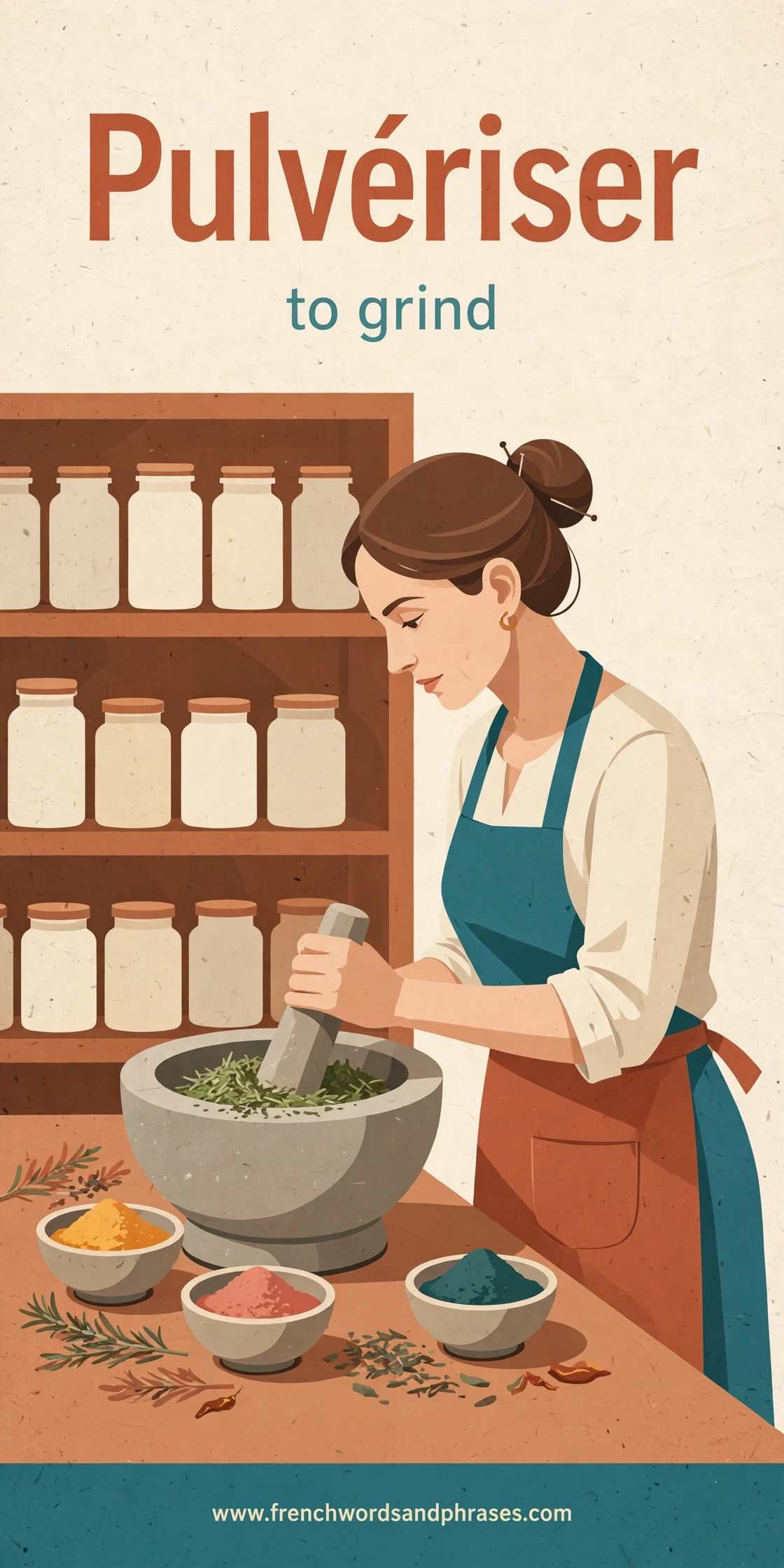
A French Word to Live By
How to Conjugate Pulvériser in French
/pyl.ve.ʁi.ze/
Pulvériser means to grind — to crush into fine powder.
Coffee beans vanishing into powder, spices crushed in a mortar, a sprinter leaving a record in pieces — pulvériser is the verb of total reduction, of crushing things down to dust or smashing them beyond recognition.
In this guide, you’ll learn how to conjugate pulvériser in all the major French tenses and moods. Explore complete conjugation tables, French examples, English translations, and practice quizzes.
Understanding the French Verb Pulvériser
Pulvériser is a regular French verb belonging to the first group of verbs, those ending in -er.
It means to grind. It is commonly used for grinding coffee, spices and grain, for pulverizing rock and rubble on building sites, for spraying water and garden products in a fine mist, and figuratively for smashing records and demolishing opponents.
Verb classification: First group (-er)
Auxiliary verb: Avoir
Past participle: pulvérisé
Present participle: pulvérisant
English equivalents: To grind, to pulverize; to spray (a fine mist); (figurative) to shatter a record.
One important detail: pulvériser hides Latin pulvis — dust, powder. It works in three directions: crushing to powder (pulvériser le café, les épices), spraying as a fine mist (pulvériser de l’eau sur les plantes, with un pulvérisateur, a spray bottle), and the sports page’s favourite — pulvériser un record, to shatter a record completely.
Experience the Word
Pulvériser is the verb of no half measures — what it touches does not merely break, it becomes powder.
Imagine a spice merchant’s stall. The mortar rises and falls, cinnamon and pepper give up their shape, and the air itself turns fragrant — in two minutes, whole spices have become a cloud of powder that will season a whole kitchen.
Nothing solid survived the mortar. It was ground — pulvérisé — to scented dust.
How to Conjugate Pulvériser: Complete French Conjugation Guide
Let’s explore every major conjugation of pulvériser, beginning with the indicative mood.
How to Conjugate Pulvériser in the Indicative Mood
The indicative mood is used to express facts, observations, actions, and events.
How to Conjugate Pulvériser in the Present Tense (Présent)
Used for actions happening now, habitual actions, and general truths.
| Subject | Conjugation |
|---|---|
| je | pulvérise |
| tu | pulvérises |
| il / elle | pulvérise |
| nous | pulvérisons |
| vous | pulvérisez |
| ils / elles | pulvérisent |
Example
Cette machine pulvérise le café en quelques secondes.
This machine grinds the coffee in a few seconds.
Quick Quiz 1
Complete the sentence:
Nous ______ les épices au mortier.
Reveal the answer
pulvérisons
Nous pulvérisons les épices au mortier.
We grind the spices with a mortar.
How to Conjugate Pulvériser in the Passé Composé
Used for completed actions in the past. Pulvériser takes the auxiliary verb avoir.
| Subject | Conjugation |
|---|---|
| j’ | ai pulvérisé |
| tu | as pulvérisé |
| il / elle | a pulvérisé |
| nous | avons pulvérisé |
| vous | avez pulvérisé |
| ils / elles | ont pulvérisé |
Example
Il a pulvérisé les épices au mortier.
He ground the spices with a mortar.
How to Conjugate Pulvériser in the Imparfait (Imperfect Tense)
Used for habitual past actions, descriptions, and ongoing situations in the past.
| Subject | Conjugation |
|---|---|
| je | pulvérisais |
| tu | pulvérisais |
| il / elle | pulvérisait |
| nous | pulvérisions |
| vous | pulvérisiez |
| ils / elles | pulvérisaient |
Example
Le moulin pulvérisait le blé pour tout le village.
The mill used to grind the wheat for the whole village.
Quick Quiz 2
Choose the correct form:
He ground the spices.
Il ______ les épices. (a pulvérisé / est pulvérisé)
Reveal the answer
a pulvérisé
Il a pulvérisé les épices.
Pulvériser takes avoir.
How to Conjugate Pulvériser in the Plus-que-parfait
Used to describe an action that had already been completed before another past event.
| Subject | Conjugation |
|---|---|
| j’ | avais pulvérisé |
| tu | avais pulvérisé |
| il / elle | avait pulvérisé |
| nous | avions pulvérisé |
| vous | aviez pulvérisé |
| ils / elles | avaient pulvérisé |
Example
Ils avaient pulvérisé la roche avant de construire la route.
They had pulverized the rock before building the road.
How to Conjugate Pulvériser in the Passé Simple
Primarily used in formal writing, literature, and historical narratives. It is rarely used in everyday conversation.
| Subject | Conjugation |
|---|---|
| je | pulvérisai |
| tu | pulvérisas |
| il / elle | pulvérisa |
| nous | pulvérisâmes |
| vous | pulvérisâtes |
| ils / elles | pulvérisèrent |
Example
Le coureur pulvérisa le record du monde.
The runner smashed the world record.
How to Conjugate Pulvériser in the Passé Antérieur
A literary tense used to express an action completed immediately before another past action, generally in the passé simple.
| Subject | Conjugation |
|---|---|
| j’ | eus pulvérisé |
| tu | eus pulvérisé |
| il / elle | eut pulvérisé |
| nous | eûmes pulvérisé |
| vous | eûtes pulvérisé |
| ils / elles | eurent pulvérisé |
Example
Quand le moulin eut pulvérisé le grain, la farine partit au four.
When the mill had ground the grain, the flour went to the oven.
How to Conjugate Pulvériser in the Future Tense (Futur Simple)
Used to describe actions that will take place in the future.
| Subject | Conjugation |
|---|---|
| je | pulvériserai |
| tu | pulvériseras |
| il / elle | pulvérisera |
| nous | pulvériserons |
| vous | pulvériserez |
| ils / elles | pulvériseront |
Example
Demain, nous pulvériserons ces branches en copeaux.
Tomorrow, we will grind these branches into chips.
How to Conjugate Pulvériser in the Futur Antérieur (Future Perfect)
Used for an action that will have been completed before a particular point in the future.
| Subject | Conjugation |
|---|---|
| j’ | aurai pulvérisé |
| tu | auras pulvérisé |
| il / elle | aura pulvérisé |
| nous | aurons pulvérisé |
| vous | aurez pulvérisé |
| ils / elles | auront pulvérisé |
Example
À midi, la machine aura pulvérisé tout le café.
By noon, the machine will have ground all the coffee.
How to Conjugate Pulvériser in the Near Future (Futur Proche)
Used to describe something that is going to happen soon. Formed with aller + infinitive.
| Subject | Conjugation |
|---|---|
| je | vais pulvériser |
| tu | vas pulvériser |
| il / elle | va pulvériser |
| nous | allons pulvériser |
| vous | allez pulvériser |
| ils / elles | vont pulvériser |
Example
Je vais pulvériser un peu d’eau sur les plantes.
I am going to spray a little water on the plants.
How to Conjugate Pulvériser in the Conditional Mood
The conditional mood expresses what would happen under certain circumstances. It is also frequently used to make polite requests or express wishes.
How to Conjugate Pulvériser in the Present Conditional
| Subject | Conjugation |
|---|---|
| je | pulvériserais |
| tu | pulvériserais |
| il / elle | pulvériserait |
| nous | pulvériserions |
| vous | pulvériseriez |
| ils / elles | pulvériseraient |
Example
Avec un meilleur moulin, on pulvériserait le café plus finement.
With a better mill, we would grind the coffee more finely.
How to Conjugate Pulvériser in the Past Conditional
| Subject | Conjugation |
|---|---|
| j’ | aurais pulvérisé |
| tu | aurais pulvérisé |
| il / elle | aurait pulvérisé |
| nous | aurions pulvérisé |
| vous | auriez pulvérisé |
| ils / elles | auraient pulvérisé |
Example
Elle aurait pulvérisé le record avec un peu de vent favorable.
She would have smashed the record with a bit of a tailwind.
Pulvériser in the Literary Past Conditional Form
This less common literary form uses the imperfect subjunctive of avoir.
| Subject | Conjugation |
|---|---|
| j’ | eusse pulvérisé |
| tu | eusses pulvérisé |
| il / elle | eût pulvérisé |
| nous | eussions pulvérisé |
| vous | eussiez pulvérisé |
| ils / elles | eussent pulvérisé |
Example
Le pilon eût pulvérisé les épices du festin.
The pestle would have ground the spices for the feast.
How to Conjugate Pulvériser in the Subjunctive Mood
The subjunctive is used to express wishes, emotions, doubts, necessity, and uncertainty. It frequently follows expressions such as il faut que (it is necessary that) or bien que (although).
How to Conjugate Pulvériser in the Present Subjunctive
| Subject | Conjugation |
|---|---|
| que je | pulvérise |
| que tu | pulvérises |
| qu’il / qu’elle | pulvérise |
| que nous | pulvérisions |
| que vous | pulvérisiez |
| qu’ils / qu’elles | pulvérisent |
Example
Il faut que tu pulvérises le sucre en poudre fine.
You must grind the sugar into a fine powder.
Quick Quiz 3
Complete the sentence using the subjunctive:
Il faut que vous ______ le café.
Reveal the answer
pulvérisiez
Il faut que vous pulvérisiez le café.
You must grind the coffee.
How to Conjugate Pulvériser in the Imperfect Subjunctive
A literary tense, rarely encountered in modern spoken French.
| Subject | Conjugation |
|---|---|
| que je | pulvérisasse |
| que tu | pulvérisasses |
| qu’il / qu’elle | pulvérisât |
| que nous | pulvérisassions |
| que vous | pulvérisassiez |
| qu’ils / qu’elles | pulvérisassent |
Example
Le chef voulait que l’on pulvérisât les amandes.
The chef wanted the almonds ground.
How to Conjugate Pulvériser in the Pluperfect Subjunctive
A literary construction used to express an action completed before another past action.
| Subject | Conjugation |
|---|---|
| que j’ | eusse pulvérisé |
| que tu | eusses pulvérisé |
| qu’il / qu’elle | eût pulvérisé |
| que nous | eussions pulvérisé |
| que vous | eussiez pulvérisé |
| qu’ils / qu’elles | eussent pulvérisé |
Example
On annonça qu’il eût pulvérisé le record national.
It was announced that he had smashed the national record.
How to Conjugate Pulvériser in the Past Subjunctive
| Subject | Conjugation |
|---|---|
| que j’ | aie pulvérisé |
| que tu | aies pulvérisé |
| qu’il / qu’elle | ait pulvérisé |
| que nous | ayons pulvérisé |
| que vous | ayez pulvérisé |
| qu’ils / qu’elles | aient pulvérisé |
Example
Je suis fier qu’elle ait pulvérisé son propre record.
I am proud that she smashed her own record.
How to Conjugate Pulvériser in the Imperative
The imperative is used to give commands, instructions, invitations, or suggestions. Subject pronouns are omitted.
How to Conjugate Pulvériser in the Present Imperative
| Person | Conjugation |
|---|---|
| (tu) | pulvérise |
| (nous) | pulvérisons |
| (vous) | pulvérisez |
Example
Pulvérise le café, les invités arrivent !
Grind the coffee, the guests are coming!
Quick Quiz 4
How would you say Grind the coffee (tu form)?
Reveal the answer
Pulvérise le café !
French Participles of Pulvériser
Participles are verb forms that can be used in compound tenses and other grammatical constructions.
Present Participle of Pulvériser
pulvérisant
En pulvérisant les épices, il a parfumé toute la cuisine.
By grinding the spices, he filled the whole kitchen with scent.
Past Participle of Pulvériser
pulvérisé
Pulvérisé au moulin, le café garde tout son arôme.
Ground at the mill, the coffee keeps all its aroma.
Pulvériser in Everyday French: Real-Life Examples
Now that you know the conjugations, let’s see how pulvériser appears in everyday French.
Example 1 — Present
Je pulvérise le café chaque matin.
I grind the coffee every morning.
Example 2 — Passé composé
Elle a pulvérisé le record de France.
She smashed the French record.
Example 3 — Imparfait
Le moulin pulvérisait le grain pour le village.
The mill used to grind the grain for the village.
Example 4 — Future
Nous pulvériserons les branches demain.
We will grind the branches tomorrow.
Example 5 — Conditional
Avec ce moulin, on pulvériserait le café plus vite.
With this mill, we would grind the coffee faster.
Example 6 — Imperative
Pulvérise un peu d’eau sur les rosiers !
Spray a little water on the rose bushes!
Beyond Translation: The Meaning of Pulvériser
English pulverize is a heavy, technical word; French pulvériser runs from the coffee mill to the sports headline without changing shoes.
Powder, mist, and shattered records.
The same verb grinds your coffee, sprays your roses and destroys a world record — reduction to the finest possible state, in every sense.
How to Remember the French Verb Pulvériser
Remember it this way: Pulvériser is about total reduction — powder, mist, shattered records.
- Pulvis = dust: pulvériser reduces things to powder.
- Pulvériser un record — to shatter a record, the sports headline use.
- Regular -er: je pulvérise, nous pulvérisons, past participle pulvérisé.
The key idea is total reduction — powder, mist, shattered records.
Test Your Knowledge of Pulvériser
Let’s see how much you’ve learned. Try answering these questions before revealing the answers.
Question 1
What Latin word hides inside pulvériser?
Reveal the answer
Pulvis — dust, powder: pulvériser reduces things to powder.
Question 2
How do you say She smashed the French record in French?
Reveal the answer
Elle a pulvérisé le record de France.
Question 3
Translate: I grind the coffee every morning.
Reveal the answer
Je pulvérise le café chaque matin.
Question 4
What is the past participle of pulvériser?
Reveal the answer
Pulvérisé.
Question 5
Complete the sentence:
Il faut que tu ______ le sucre en poudre fine.
Reveal the answer
pulvérises
Il faut que tu pulvérises le sucre en poudre fine.
You must grind the sugar into a fine powder.
Your Final Challenge
Can You Use It?
How would you say this in French?
The mill grinds the coffee, and the whole house wakes to its scent.
Reveal the answer
Le moulin pulvérise le café, et toute la maison se réveille à son parfum.
The mill grinds the coffee, and the whole house wakes to its scent.
A little French. A little curiosity. A richer everyday life.
LEARN FRENCH ONE WORD AT A TIME




