A French Word to Live By
How to Conjugate Pulluler in French
/py.ly.le/
Pulluler means to pullulate — to swarm and multiply.
Ants pouring from a crack, jellyfish crowding a bay, rumours multiplying faster than the facts — pulluler is the verb of teeming abundance, of things that multiply until they are simply everywhere.
In this guide, you’ll learn how to conjugate pulluler in all the major French tenses and moods. Explore complete conjugation tables, French examples, English translations, and practice quizzes.
Understanding the French Verb Pulluler
Pulluler is a regular French verb belonging to the first group of verbs, those ending in -er.
It means to pullulate. It is commonly used for insects and small animals multiplying — ants, aphids, jellyfish, rabbits — for crowds swarming in streets and seaside resorts, for weeds overrunning a garden, and figuratively for rumours, errors and ideas spreading everywhere at once.
Verb classification: First group (-er)
Auxiliary verb: Avoir
Past participle: pullulé
Present participle: pullulant
English equivalents: To pullulate, to swarm, to teem; to multiply rapidly.
One important detail: pulluler comes from Latin pullulare, to sprout and swarm — and it is almost always a third-person verb: things pullulent, people rarely do. Its favourite subjects are insects, crowds, weeds, rumours and mistakes: les fautes pullulent dans ce brouillon, errors swarm in this draft. The tone is rarely neutral — to pulluler is to be too many, too fast, and slightly out of control.
Experience the Word
Pulluler is the verb of too many — the moment a few become a swarm, and the swarm becomes the story.
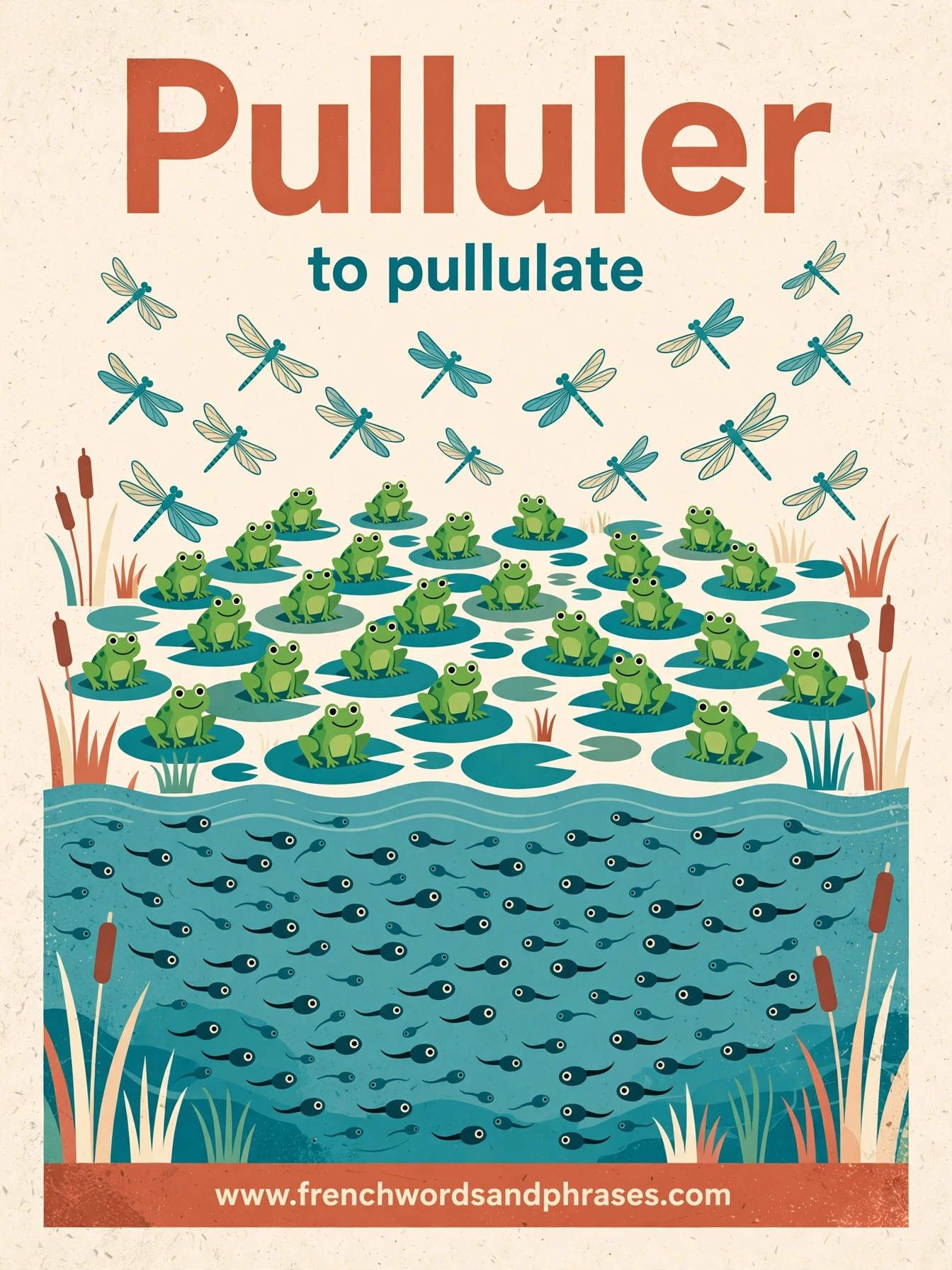
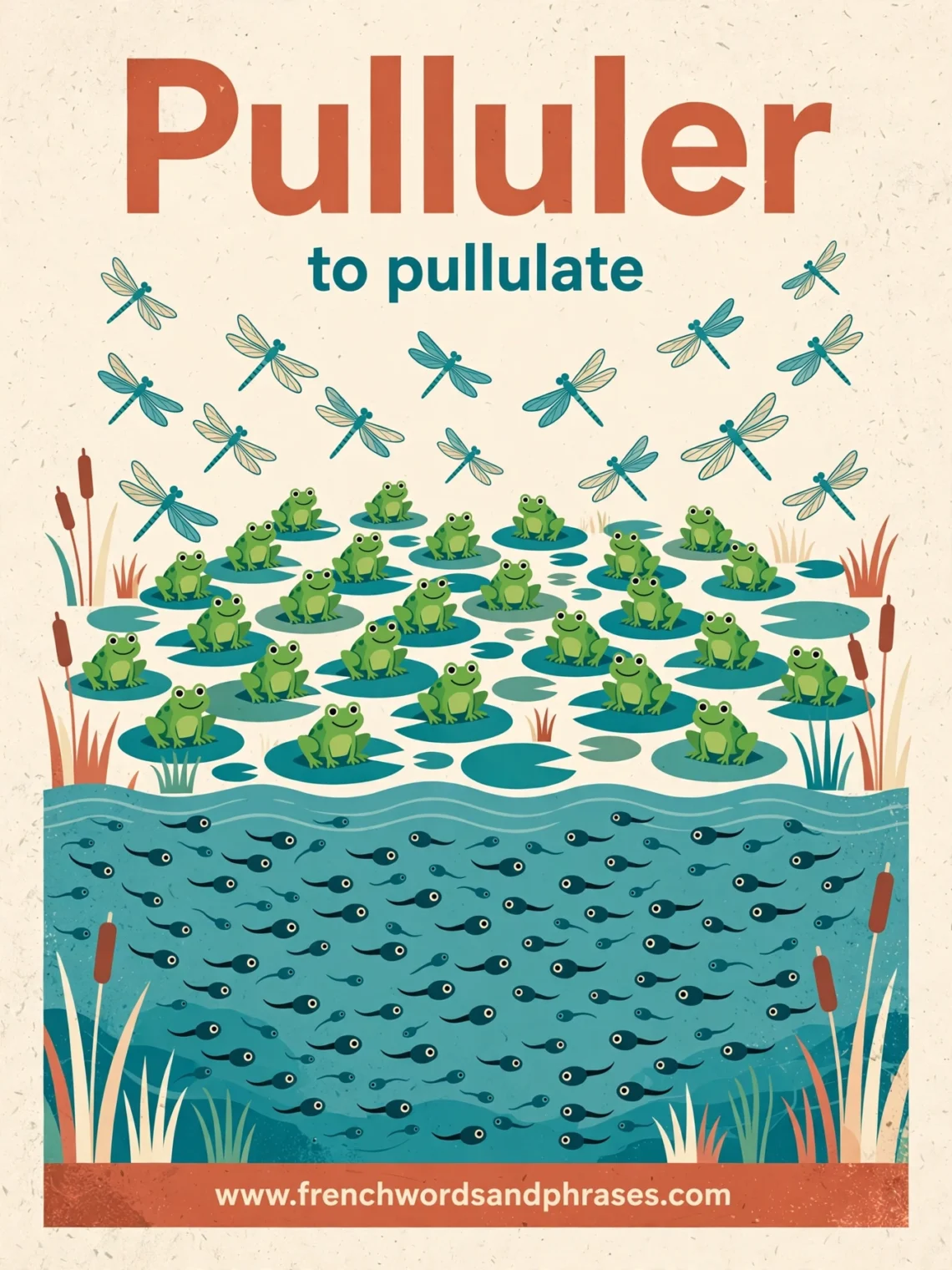
Imagine a pond in May. Last week there were a dozen tadpoles by the reeds; today the water is black and moving, thousands of them, and the heron has noticed. La vie pullule, and the pond will never hold them all.
A few had become thousands. They pullulated — pullulaient — beyond all counting.
How to Conjugate Pulluler: Complete French Conjugation Guide
Let’s explore every major conjugation of pulluler, beginning with the indicative mood.
How to Conjugate Pulluler in the Indicative Mood
The indicative mood is used to express facts, observations, actions, and events.
How to Conjugate Pulluler in the Present Tense (Présent)
Used for actions happening now, habitual actions, and general truths.
| Subject | Conjugation |
|---|---|
| je | pullule |
| tu | pullules |
| il / elle | pullule |
| nous | pullulons |
| vous | pullulez |
| ils / elles | pullulent |
Example
Les fourmis pullulent dans le jardin après la pluie.
Ants swarm in the garden after the rain.
Quick Quiz 1
Complete the sentence:
Les fourmis ______ dans le jardin.
Reveal the answer
pullulent
Les fourmis pullulent dans le jardin.
The ants are swarming in the garden.
How to Conjugate Pulluler in the Passé Composé
Used for completed actions in the past. Pulluler takes the auxiliary verb avoir.
| Subject | Conjugation |
|---|---|
| j’ | ai pullulé |
| tu | as pullulé |
| il / elle | a pullulé |
| nous | avons pullulé |
| vous | avez pullulé |
| ils / elles | ont pullulé |
Example
Les touristes ont pullulé sur la côte cet été.
Tourists swarmed the coast this summer.
How to Conjugate Pulluler in the Imparfait (Imperfect Tense)
Used for habitual past actions, descriptions, and ongoing situations in the past.
| Subject | Conjugation |
|---|---|
| je | pullulais |
| tu | pullulais |
| il / elle | pullulait |
| nous | pullulions |
| vous | pulluliez |
| ils / elles | pullulaient |
Example
Les moustiques pullulaient autour du lac.
Mosquitoes used to swarm around the lake.
Quick Quiz 2
Choose the correct form:
The weeds overran the garden.
Les mauvaises herbes ______ dans le jardin. (ont pullulé / sont pullulées)
Reveal the answer
ont pullulé
Les mauvaises herbes ont pullulé dans le jardin.
Pulluler takes avoir.
How to Conjugate Pulluler in the Plus-que-parfait
Used to describe an action that had already been completed before another past event.
| Subject | Conjugation |
|---|---|
| j’ | avais pullulé |
| tu | avais pullulé |
| il / elle | avait pullulé |
| nous | avions pullulé |
| vous | aviez pullulé |
| ils / elles | avaient pullulé |
Example
Les rumeurs avaient pullulé avant même l’annonce.
Rumours had multiplied even before the announcement.
How to Conjugate Pulluler in the Passé Simple
Primarily used in formal writing, literature, and historical narratives. It is rarely used in everyday conversation.
| Subject | Conjugation |
|---|---|
| je | pullulai |
| tu | pullulas |
| il / elle | pullula |
| nous | pullulâmes |
| vous | pullulâtes |
| ils / elles | pullulèrent |
Example
Les lapins pullulèrent dans les dunes.
The rabbits multiplied in the dunes.
How to Conjugate Pulluler in the Passé Antérieur
A literary tense used to express an action completed immediately before another past action, generally in the passé simple.
| Subject | Conjugation |
|---|---|
| j’ | eus pullulé |
| tu | eus pullulé |
| il / elle | eut pullulé |
| nous | eûmes pullulé |
| vous | eûtes pullulé |
| ils / elles | eurent pullulé |
Example
Quand les algues eurent pullulé, la plage ferma.
When the algae had spread everywhere, the beach closed.
How to Conjugate Pulluler in the Future Tense (Futur Simple)
Used to describe actions that will take place in the future.
| Subject | Conjugation |
|---|---|
| je | pullulerai |
| tu | pulluleras |
| il / elle | pullulera |
| nous | pullulerons |
| vous | pullulerez |
| ils / elles | pulluleront |
Example
Sans prédateurs, ces insectes pulluleront.
Without predators, these insects will swarm.
How to Conjugate Pulluler in the Futur Antérieur (Future Perfect)
Used for an action that will have been completed before a particular point in the future.
| Subject | Conjugation |
|---|---|
| j’ | aurai pullulé |
| tu | auras pullulé |
| il / elle | aura pullulé |
| nous | aurons pullulé |
| vous | aurez pullulé |
| ils / elles | auront pullulé |
Example
Au printemps, les pucerons auront pullulé sur les rosiers.
By spring, the aphids will have swarmed over the rose bushes.
How to Conjugate Pulluler in the Near Future (Futur Proche)
Used to describe something that is going to happen soon. Formed with aller + infinitive.
| Subject | Conjugation |
|---|---|
| je | vais pulluler |
| tu | vas pulluler |
| il / elle | va pulluler |
| nous | allons pulluler |
| vous | allez pulluler |
| ils / elles | vont pulluler |
Example
Regarde, les têtards vont pulluler dans la mare.
Look, the tadpoles are going to swarm in the pond.
How to Conjugate Pulluler in the Conditional Mood
The conditional mood expresses what would happen under certain circumstances. It is also frequently used to make polite requests or express wishes.
How to Conjugate Pulluler in the Present Conditional
| Subject | Conjugation |
|---|---|
| je | pullulerais |
| tu | pullulerais |
| il / elle | pullulerait |
| nous | pullulerions |
| vous | pulluleriez |
| ils / elles | pulluleraient |
Example
Avec cette chaleur, les mouches pulluleraient partout.
With this heat, flies would swarm everywhere.
How to Conjugate Pulluler in the Past Conditional
| Subject | Conjugation |
|---|---|
| j’ | aurais pullulé |
| tu | aurais pullulé |
| il / elle | aurait pullulé |
| nous | aurions pullulé |
| vous | auriez pullulé |
| ils / elles | auraient pullulé |
Example
Les mauvaises herbes auraient pullulé sans le jardinier.
The weeds would have overrun everything without the gardener.
Pulluler in the Literary Past Conditional Form
This less common literary form uses the imperfect subjunctive of avoir.
| Subject | Conjugation |
|---|---|
| j’ | eusse pullulé |
| tu | eusses pullulé |
| il / elle | eût pullulé |
| nous | eussions pullulé |
| vous | eussiez pullulé |
| ils / elles | eussent pullulé |
Example
Les vers eussent pullulé dans les cales du navire.
Worms would have swarmed in the ship’s holds.
How to Conjugate Pulluler in the Subjunctive Mood
The subjunctive is used to express wishes, emotions, doubts, necessity, and uncertainty. It frequently follows expressions such as il faut que (it is necessary that) or bien que (although).
How to Conjugate Pulluler in the Present Subjunctive
| Subject | Conjugation |
|---|---|
| que je | pullule |
| que tu | pullules |
| qu’il / qu’elle | pullule |
| que nous | pullulions |
| que vous | pulluliez |
| qu’ils / qu’elles | pullulent |
Example
Il est étonnant que les méduses pullulent cette année.
It is surprising that jellyfish are swarming this year.
Quick Quiz 3
Complete the sentence using the subjunctive:
On craint que les rats ______ dans les caves.
Reveal the answer
pullulent
On craint que les rats pullulent dans les caves.
People fear rats are swarming in the cellars.
How to Conjugate Pulluler in the Imperfect Subjunctive
A literary tense, rarely encountered in modern spoken French.
| Subject | Conjugation |
|---|---|
| que je | pullulasse |
| que tu | pullulasses |
| qu’il / qu’elle | pullulât |
| que nous | pullulassions |
| que vous | pullulassiez |
| qu’ils / qu’elles | pullulassent |
Example
On craignait que les rats pullulassent dans les caves.
People feared rats might swarm in the cellars.
How to Conjugate Pulluler in the Pluperfect Subjunctive
A literary construction used to express an action completed before another past action.
| Subject | Conjugation |
|---|---|
| que j’ | eusse pullulé |
| que tu | eusses pullulé |
| qu’il / qu’elle | eût pullulé |
| que nous | eussions pullulé |
| que vous | eussiez pullulé |
| qu’ils / qu’elles | eussent pullulé |
Example
Le rapport notait que les erreurs eussent pullulé dans le texte.
The report noted that errors had multiplied throughout the text.
How to Conjugate Pulluler in the Past Subjunctive
| Subject | Conjugation |
|---|---|
| que j’ | aie pullulé |
| que tu | aies pullulé |
| qu’il / qu’elle | ait pullulé |
| que nous | ayons pullulé |
| que vous | ayez pullulé |
| qu’ils / qu’elles | aient pullulé |
Example
Je suis surpris que les champignons aient pullulé si vite.
I am surprised the mushrooms spread so quickly.
How to Conjugate Pulluler in the Imperative
The imperative is used to give commands, instructions, invitations, or suggestions. Subject pronouns are omitted.
How to Conjugate Pulluler in the Present Imperative
| Person | Conjugation |
|---|---|
| (tu) | pullule |
| (nous) | pullulons |
| (vous) | pullulez |
Example
Pullulez, petits poissons, la mare est à vous !
Multiply, little fish, the pond is yours!
Quick Quiz 4
How would you say The rumours are multiplying (present tense)?
Reveal the answer
Les rumeurs pullulent.
French Participles of Pulluler
Participles are verb forms that can be used in compound tenses and other grammatical constructions.
Present Participle of Pulluler
pullulant
En pullulant, les algues ont asphyxié l’étang.
By spreading everywhere, the algae choked the pond.
Past Participle of Pulluler
pullulé
Les méduses ont pullulé après la tempête.
The jellyfish swarmed after the storm.
Pulluler in Everyday French: Real-Life Examples
Now that you know the conjugations, let’s see how pulluler appears in everyday French.
Example 1 — Present
Les pucerons pullulent sur les rosiers.
Aphids are swarming over the rose bushes.
Example 2 — Passé composé
Les méduses ont pullulé cet été.
Jellyfish swarmed this summer.
Example 3 — Imparfait
Les rumeurs pullulaient dans le village.
Rumours used to multiply in the village.
Example 4 — Future
Les mauvaises herbes pulluleront au printemps.
The weeds will overrun everything in spring.
Example 5 — Conditional
Sans les hirondelles, les moustiques pulluleraient.
Without the swallows, the mosquitoes would swarm.
Example 6 — Imperative
Pullulez, petits poissons, la mare est grande !
Multiply, little fish, the pond is big!
Beyond Translation: The Meaning of Pulluler
English pullulate exists but lives in textbooks; French pulluler is an everyday verb, as at home in a news report as in a garden.
It is rarely good news.
What pullule — jellyfish, weeds, errors, rumours — is almost always something you would prefer in smaller numbers, and the verb carries that shiver of abundance gone too far.
How to Remember the French Verb Pulluler
Remember it this way: Pulluler is about teeming abundance — a few become a swarm.
- Pulluler = to swarm and multiply — almost always third person: les fourmis pullulent.
- Les fautes pullulent — errors swarm; the proofreader’s nightmare sentence.
- Regular -er: il pullule, ils pullulent, past participle pullulé.
The key idea is teeming abundance — a few become a swarm.
Test Your Knowledge of Pulluler
Let’s see how much you’ve learned. Try answering these questions before revealing the answers.
Question 1
What kind of subject does pulluler usually take?
Reveal the answer
A swarming multitude — insects, crowds, weeds, rumours; it is almost always third person.
Question 2
How do you say Aphids are swarming over the rose bushes in French?
Reveal the answer
Les pucerons pullulent sur les rosiers.
Question 3
Translate: Jellyfish swarmed this summer.
Reveal the answer
Les méduses ont pullulé cet été.
Question 4
What is the past participle of pulluler?
Reveal the answer
Pullulé.
Question 5
Complete the sentence:
Il est étonnant que les méduses ______ cette année.
Reveal the answer
pullulent
Il est étonnant que les méduses pullulent cette année.
It is surprising that jellyfish are swarming this year.
Your Final Challenge
Can You Use It?
How would you say this in French?
The tadpoles swarm in the pond, and the heron watches over its larder.
Reveal the answer
Les têtards pullulent dans la mare, et le héron surveille son garde-manger.
The tadpoles swarm in the pond, and the heron watches over its larder.
A little French. A little curiosity. A richer everyday life.
LEARN FRENCH ONE WORD AT A TIME