A French Word to Live By
How to Conjugate Puiser in French
/pɥi.ze/
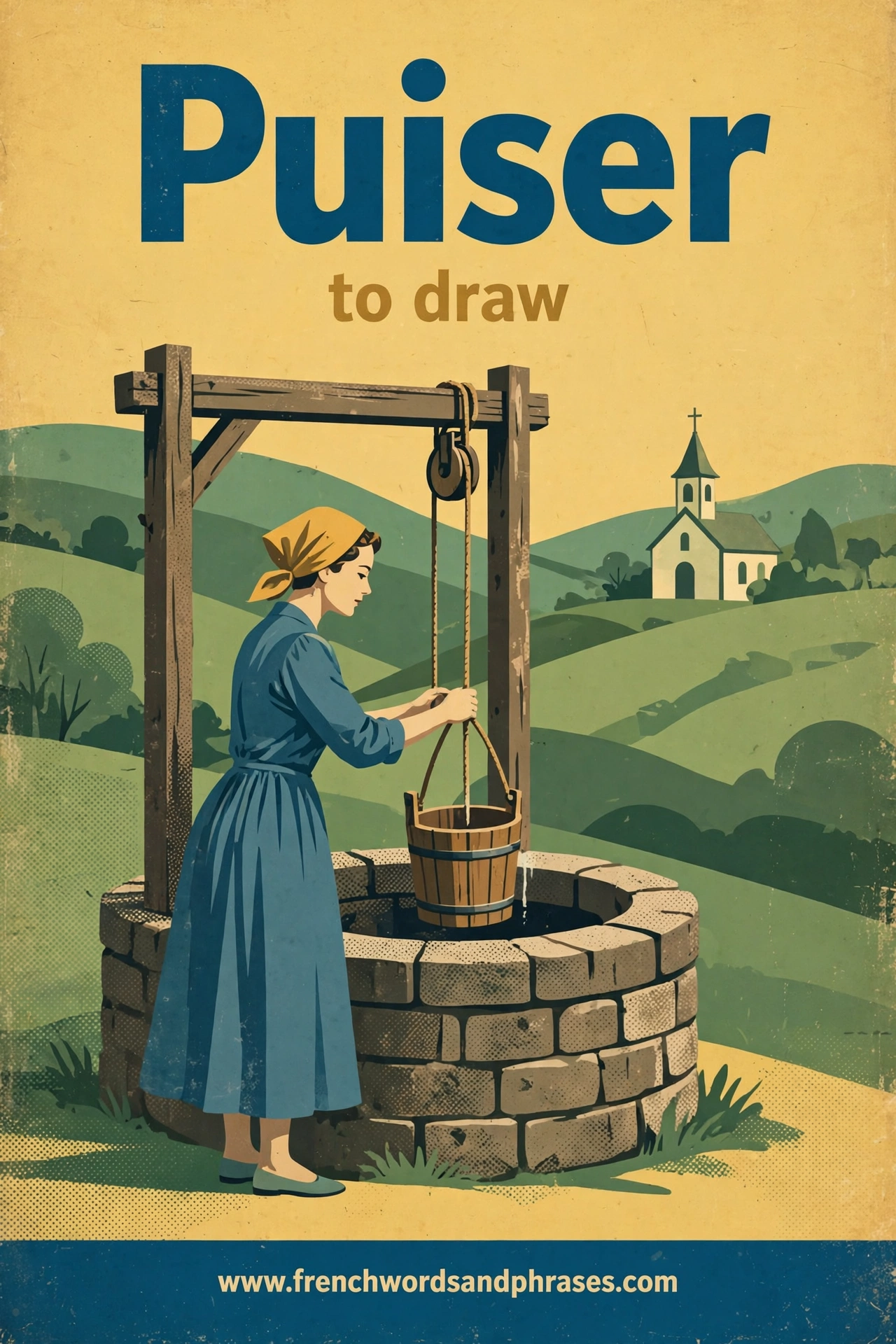
Puiser means to draw.
A bucket sinking into a well, a hand dipping into a sack of grain, a writer reaching into childhood for a story — puiser is the verb of drawing from a source, of taking what you need from deep reserves.
In this guide, you’ll learn how to conjugate puiser in all the major French tenses and moods. Explore complete conjugation tables, French examples, English translations, and practice quizzes.
Understanding the French Verb Puiser
Puiser is a regular French verb belonging to the first group of verbs, those ending in -er.
It means to draw. It is commonly used for drawing water from wells, fountains and rivers, for drawing on savings, stocks and reserves of every kind, and figuratively for drawing strength, courage and inspiration from an inner source.
Verb classification: First group (-er)
Auxiliary verb: Avoir
Past participle: puisé
Present participle: puisant
English equivalents: To draw (water), to dip into; puiser dans — to draw on (reserves, savings); puiser son inspiration — to draw one’s inspiration.
One important detail: puiser comes from un puits, a well — the verb is literally to draw from the well. That origin explains its favourite construction: puiser dans plus a reserve. Puiser dans ses économies, to draw on one’s savings; puiser dans ses forces, to draw on one’s strength; puiser aux sources, to go back to the sources. Whatever is deep and stored — water, money, courage, memories — French puise dedans.
Experience the Word
Puiser is the verb of the deep reserve — the well, the savings, the last of your strength, all reached into the same way.
Imagine a farmyard at dawn a century ago. The bucket drops into the dark well, the rope creaks, and up comes the day’s water, cold and clear — the whole household will drink, wash and cook from what one person a puisé au puits.
The source was deep and quiet. She drew from it — puisa — and the day could begin.
How to Conjugate Puiser: Complete French Conjugation Guide
Let’s explore every major conjugation of puiser, beginning with the indicative mood.
How to Conjugate Puiser in the Indicative Mood
The indicative mood is used to express facts, observations, actions, and events.
How to Conjugate Puiser in the Present Tense (Présent)
Used for actions happening now, habitual actions, and general truths.
| Subject | Conjugation |
|---|---|
| je | puise |
| tu | puises |
| il / elle | puise |
| nous | puisons |
| vous | puisez |
| ils / elles | puisent |
Example
Elle puise l’eau du puits chaque matin.
She draws water from the well every morning.
Quick Quiz 1
Complete the sentence:
Nous ______ l’eau du puits.
Reveal the answer
puisons
Nous puisons l’eau du puits.
We draw water from the well.
How to Conjugate Puiser in the Passé Composé
Used for completed actions in the past. Puiser takes the auxiliary verb avoir.
| Subject | Conjugation |
|---|---|
| j’ | ai puisé |
| tu | as puisé |
| il / elle | a puisé |
| nous | avons puisé |
| vous | avez puisé |
| ils / elles | ont puisé |
Example
Ils ont puisé dans leurs économies pour réparer le toit.
They drew on their savings to repair the roof.
How to Conjugate Puiser in the Imparfait (Imperfect Tense)
Used for habitual past actions, descriptions, and ongoing situations in the past.
| Subject | Conjugation |
|---|---|
| je | puisais |
| tu | puisais |
| il / elle | puisait |
| nous | puisions |
| vous | puisiez |
| ils / elles | puisaient |
Example
Les femmes puisaient l’eau à la fontaine du village.
The women used to draw water at the village fountain.
Quick Quiz 2
Choose the correct form:
They drew on their savings.
Ils ______ dans leurs économies. (ont puisé / sont puisés)
Reveal the answer
ont puisé
Ils ont puisé dans leurs économies.
Puiser takes avoir.
How to Conjugate Puiser in the Plus-que-parfait
Used to describe an action that had already been completed before another past event.
| Subject | Conjugation |
|---|---|
| j’ | avais puisé |
| tu | avais puisé |
| il / elle | avait puisé |
| nous | avions puisé |
| vous | aviez puisé |
| ils / elles | avaient puisé |
Example
Il avait puisé toutes ses forces avant le dernier kilomètre.
He had drawn on all his strength before the last kilometre.
How to Conjugate Puiser in the Passé Simple
Primarily used in formal writing, literature, and historical narratives. It is rarely used in everyday conversation.
| Subject | Conjugation |
|---|---|
| je | puisai |
| tu | puisas |
| il / elle | puisa |
| nous | puisâmes |
| vous | puisâtes |
| ils / elles | puisèrent |
Example
Le voyageur puisa de l’eau fraîche et repartit.
The traveller drew some fresh water and set off again.
How to Conjugate Puiser in the Passé Antérieur
A literary tense used to express an action completed immediately before another past action, generally in the passé simple.
| Subject | Conjugation |
|---|---|
| j’ | eus puisé |
| tu | eus puisé |
| il / elle | eut puisé |
| nous | eûmes puisé |
| vous | eûtes puisé |
| ils / elles | eurent puisé |
Example
Quand elle eut puisé l’eau, elle remonta le sentier.
When she had drawn the water, she went back up the path.
How to Conjugate Puiser in the Future Tense (Futur Simple)
Used to describe actions that will take place in the future.
| Subject | Conjugation |
|---|---|
| je | puiserai |
| tu | puiseras |
| il / elle | puisera |
| nous | puiserons |
| vous | puiserez |
| ils / elles | puiseront |
Example
Nous puiserons dans la réserve en cas de sécheresse.
We will draw on the reserve in case of drought.
How to Conjugate Puiser in the Futur Antérieur (Future Perfect)
Used for an action that will have been completed before a particular point in the future.
| Subject | Conjugation |
|---|---|
| j’ | aurai puisé |
| tu | auras puisé |
| il / elle | aura puisé |
| nous | aurons puisé |
| vous | aurez puisé |
| ils / elles | auront puisé |
Example
À la fin du mois, ils auront puisé dans tout le stock.
By the end of the month, they will have drawn on the whole stock.
How to Conjugate Puiser in the Near Future (Futur Proche)
Used to describe something that is going to happen soon. Formed with aller + infinitive.
| Subject | Conjugation |
|---|---|
| je | vais puiser |
| tu | vas puiser |
| il / elle | va puiser |
| nous | allons puiser |
| vous | allez puiser |
| ils / elles | vont puiser |
Example
Je vais puiser un seau d’eau pour les fleurs.
I am going to draw a bucket of water for the flowers.
How to Conjugate Puiser in the Conditional Mood
The conditional mood expresses what would happen under certain circumstances. It is also frequently used to make polite requests or express wishes.
How to Conjugate Puiser in the Present Conditional
| Subject | Conjugation |
|---|---|
| je | puiserais |
| tu | puiserais |
| il / elle | puiserait |
| nous | puiserions |
| vous | puiseriez |
| ils / elles | puiseraient |
Example
Sans la pompe, on puiserait encore à la main.
Without the pump, we would still draw water by hand.
How to Conjugate Puiser in the Past Conditional
| Subject | Conjugation |
|---|---|
| j’ | aurais puisé |
| tu | aurais puisé |
| il / elle | aurait puisé |
| nous | aurions puisé |
| vous | auriez puisé |
| ils / elles | auraient puisé |
Example
Il aurait puisé dans ses réserves plus tôt.
He would have drawn on his reserves earlier.
Puiser in the Literary Past Conditional Form
This less common literary form uses the imperfect subjunctive of avoir.
| Subject | Conjugation |
|---|---|
| j’ | eusse puisé |
| tu | eusses puisé |
| il / elle | eût puisé |
| nous | eussions puisé |
| vous | eussiez puisé |
| ils / elles | eussent puisé |
Example
La servante eût puisé l’eau avant l’aube.
The maid would have drawn the water before dawn.
How to Conjugate Puiser in the Subjunctive Mood
The subjunctive is used to express wishes, emotions, doubts, necessity, and uncertainty. It frequently follows expressions such as il faut que (it is necessary that) or bien que (although).
How to Conjugate Puiser in the Present Subjunctive
| Subject | Conjugation |
|---|---|
| que je | puise |
| que tu | puises |
| qu’il / qu’elle | puise |
| que nous | puisions |
| que vous | puisiez |
| qu’ils / qu’elles | puisent |
Example
Il faut que tu puises dans ton courage.
You must draw on your courage.
Quick Quiz 3
Complete the sentence using the subjunctive:
Il faut que vous ______ dans la réserve.
Reveal the answer
puisiez
Il faut que vous puisiez dans la réserve.
You must draw on the reserve.
How to Conjugate Puiser in the Imperfect Subjunctive
A literary tense, rarely encountered in modern spoken French.
| Subject | Conjugation |
|---|---|
| que je | puisasse |
| que tu | puisasses |
| qu’il / qu’elle | puisât |
| que nous | puisassions |
| que vous | puisassiez |
| qu’ils / qu’elles | puisassent |
Example
Le chef voulait qu’on puisât l’eau avant la nuit.
The chief wanted the water drawn before nightfall.
How to Conjugate Puiser in the Pluperfect Subjunctive
A literary construction used to express an action completed before another past action.
| Subject | Conjugation |
|---|---|
| que j’ | eusse puisé |
| que tu | eusses puisé |
| qu’il / qu’elle | eût puisé |
| que nous | eussions puisé |
| que vous | eussiez puisé |
| qu’ils / qu’elles | eussent puisé |
Example
On savait qu’il eût puisé dans la caisse commune.
People knew he had drawn on the common fund.
How to Conjugate Puiser in the Past Subjunctive
| Subject | Conjugation |
|---|---|
| que j’ | aie puisé |
| que tu | aies puisé |
| qu’il / qu’elle | ait puisé |
| que nous | ayons puisé |
| que vous | ayez puisé |
| qu’ils / qu’elles | aient puisé |
Example
Je suis heureux que tu aies puisé la force de continuer.
I am glad you drew the strength to carry on.
How to Conjugate Puiser in the Imperative
The imperative is used to give commands, instructions, invitations, or suggestions. Subject pronouns are omitted.
How to Conjugate Puiser in the Present Imperative
| Person | Conjugation |
|---|---|
| (tu) | puise |
| (nous) | puisons |
| (vous) | puisez |
Example
Puise de l’eau pour les invités !
Draw some water for the guests!
Quick Quiz 4
How would you say Draw some water for the guests (tu form)?
Reveal the answer
Puise de l’eau pour les invités !
French Participles of Puiser
Participles are verb forms that can be used in compound tenses and other grammatical constructions.
Present Participle of Puiser
puisant
En puisant dans ses souvenirs, elle a écrit son roman.
Drawing on her memories, she wrote her novel.
Past Participle of Puiser
puisé
Puisée à la source, cette eau est d’une pureté rare.
Drawn at the source, this water is exceptionally pure.
Puiser in Everyday French: Real-Life Examples
Now that you know the conjugations, let’s see how puiser appears in everyday French.
Example 1 — Present
Elle puise l’eau à la fontaine.
She draws water at the fountain.
Example 2 — Passé composé
Nous avons puisé dans nos réserves.
We drew on our reserves.
Example 3 — Imparfait
On puisait l’eau du puits à la main.
We used to draw water from the well by hand.
Example 4 — Future
Tu puiseras dans ton courage pour finir.
You will draw on your courage to finish.
Example 5 — Conditional
Sans le puits, on puiserait à la rivière.
Without the well, we would draw water at the river.
Example 6 — Imperative
Puise un seau d’eau pour les chevaux !
Draw a bucket of water for the horses!
Beyond Translation: The Meaning of Puiser
English draw does this work only with help — draw water, draw on savings; French puiser carries the well inside it everywhere it goes.
Every reserve is a well.
Money, strength, inspiration: puiser dans treats them all as deep water, and the bucket is whatever effort you lower into yourself.
How to Remember the French Verb Puiser
Remember it this way: Puiser is about drawing from the deep reserve — water, savings, strength.
- Un puits — a well: puiser is drawing from the well, literally and figuratively.
- Puiser dans ses économies / ses forces — to draw on one’s savings / strength.
- Regular -er: je puise, nous puisons, past participle puisé.
The key idea is drawing from the deep reserve — water, savings, strength.
Test Your Knowledge of Puiser
Let’s see how much you’ve learned. Try answering these questions before revealing the answers.
Question 1
What is un puits, the word inside puiser?
Reveal the answer
A well — puiser is drawing from the well.
Question 2
How do you say They drew on their savings in French?
Reveal the answer
Ils ont puisé dans leurs économies.
Question 3
Translate: She draws water from the well every morning.
Reveal the answer
Elle puise l’eau du puits chaque matin.
Question 4
What is the past participle of puiser?
Reveal the answer
Puisé.
Question 5
Complete the sentence:
Il faut que tu ______ dans ton courage.
Reveal the answer
puises
Il faut que tu puises dans ton courage.
You must draw on your courage.
Your Final Challenge
Can You Use It?
How would you say this in French?
She draws water from the well at dawn, and the house wakes up gently.
Reveal the answer
Elle puise l’eau du puits à l’aube, et la maison s’éveille doucement.
She draws water from the well at dawn, and the house wakes up gently.
A little French. A little curiosity. A richer everyday life.
LEARN FRENCH ONE WORD AT A TIME