A French Word to Live By
How to Conjugate Éditer in French
/e.di.te/
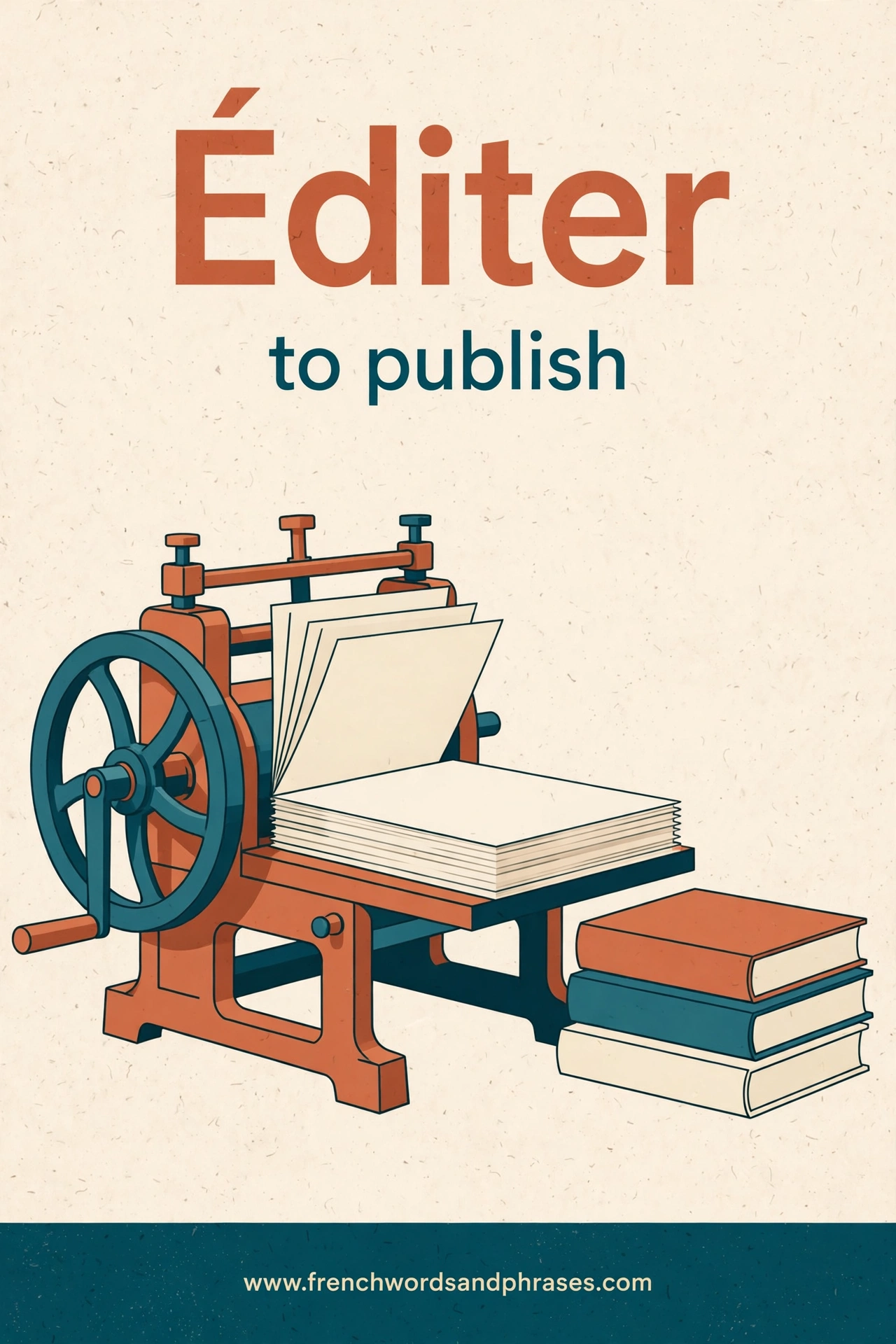
Éditer means to publish.
A manuscript wrapped in string, a proof covered in red pencil, a crate of new books smelling of ink — éditer is the publisher’s verb, the moment a private text becomes a public book.
In this guide, you’ll learn how to conjugate éditer in all the major French tenses and moods. Explore complete conjugation tables, French examples, English translations, and practice quizzes.
Understanding the French Verb Éditer
Éditer is a regular French verb belonging to the first group of verbs, those ending in -er.
It means to publish. It is commonly used for publishing books, journals and music (éditer un roman, éditer une revue), for issuing official documents and programmes, and in computing for editing files, texts and settings — the two great workshops of the written word.
Verb classification: First group (-er)
Auxiliary verb: Avoir
Past participle: édité
Present participle: éditant
English equivalents: To publish (a book); (computing) to edit; un éditeur — a publisher; une maison d’édition — a publishing house.
One important detail: éditer is the classic half-false-friend. Éditer un livre means to publish it, and un éditeur is a publisher — the English word editor is un rédacteur. But the friendship is not entirely false: in computing, éditer un texte, éditer un fichier really does mean to edit it. So the same verb publishes the novel and edits the document — context, as always, decides.
Experience the Word
Éditer is the verb of the threshold — on one side a manuscript read by three people, on the other a book read by thousands.
Imagine a small Paris office above a bookshop. The publisher reads the last page of a young author’s novel, closes the folder, and nods. A year of corrections begins — and at the end of it, the book exists for everyone: elle va l’éditer.
The text has not changed its words. It has been édité — chosen, prepared and given to the world.
How to Conjugate Éditer: Complete French Conjugation Guide
Let’s explore every major conjugation of éditer, beginning with the indicative mood.
How to Conjugate Éditer in the Indicative Mood
The indicative mood is used to express facts, observations, actions, and events.
How to Conjugate Éditer in the Present Tense (Présent)
Used for actions happening now, habitual actions, and general truths.
| Subject | Conjugation |
|---|---|
| je | édite |
| tu | édites |
| il / elle | édite |
| nous | éditons |
| vous | éditez |
| ils / elles | éditent |
Example
Cette maison édite des romans depuis 1920.
This house has been publishing novels since 1920.
Quick Quiz 1
Complete the sentence:
Nous ______ une nouvelle édition en septembre.
Reveal the answer
éditerons
Nous éditerons une nouvelle édition en septembre.
We will publish a new edition in September.
How to Conjugate Éditer in the Passé Composé
Used for completed actions in the past. Éditer takes the auxiliary verb avoir.
| Subject | Conjugation |
|---|---|
| j’ | ai édité |
| tu | as édité |
| il / elle | a édité |
| nous | avons édité |
| vous | avez édité |
| ils / elles | ont édité |
Example
Une grande maison a édité son premier roman l’an dernier.
A big publishing house published her first novel last year.
How to Conjugate Éditer in the Imparfait (Imperfect Tense)
Used for habitual past actions, descriptions, and ongoing situations in the past.
| Subject | Conjugation |
|---|---|
| je | éditais |
| tu | éditais |
| il / elle | éditait |
| nous | éditions |
| vous | éditiez |
| ils / elles | éditaient |
Example
Ce petit éditeur éditait des livres d’art magnifiques.
This small publisher used to publish magnificent art books.
Quick Quiz 2
Choose the correct form:
They published twenty titles.
Ils ______ vingt titres. (ont édité / sont édités)
Reveal the answer
ont édité
Ils ont édité vingt titres.
Éditer takes avoir.
How to Conjugate Éditer in the Plus-que-parfait
Used to describe an action that had already been completed before another past event.
| Subject | Conjugation |
|---|---|
| j’ | avais édité |
| tu | avais édité |
| il / elle | avait édité |
| nous | avions édité |
| vous | aviez édité |
| ils / elles | avaient édité |
Example
Ils avaient édité le manuscrit avant les vacances.
They had published the manuscript before the holidays.
How to Conjugate Éditer in the Passé Simple
Primarily used in formal writing, literature, and historical narratives. It is rarely used in everyday conversation.
| Subject | Conjugation |
|---|---|
| je | éditai |
| tu | éditas |
| il / elle | édita |
| nous | éditâmes |
| vous | éditâtes |
| ils / elles | éditèrent |
Example
La maison édita le roman en 1947, et ce fut un succès.
The house published the novel in 1947, and it was a success.
How to Conjugate Éditer in the Passé Antérieur
A literary tense used to express an action completed immediately before another past action, generally in the passé simple.
| Subject | Conjugation |
|---|---|
| j’ | eus édité |
| tu | eus édité |
| il / elle | eut édité |
| nous | eûmes édité |
| vous | eûtes édité |
| ils / elles | eurent édité |
Example
Quand l’éditeur eut édité le catalogue, la foire du livre ouvrit.
When the publisher had issued the catalogue, the book fair opened.
How to Conjugate Éditer in the Future Tense (Futur Simple)
Used to describe actions that will take place in the future.
| Subject | Conjugation |
|---|---|
| je | éditerai |
| tu | éditeras |
| il / elle | éditera |
| nous | éditerons |
| vous | éditerez |
| ils / elles | éditeront |
Example
Nous éditerons une nouvelle édition en septembre.
We will publish a new edition in September.
How to Conjugate Éditer in the Futur Antérieur (Future Perfect)
Used for an action that will have been completed before a particular point in the future.
| Subject | Conjugation |
|---|---|
| j’ | aurai édité |
| tu | auras édité |
| il / elle | aura édité |
| nous | aurons édité |
| vous | aurez édité |
| ils / elles | auront édité |
Example
À Noël, ils auront édité vingt titres cette année.
By Christmas, they will have published twenty titles this year.
How to Conjugate Éditer in the Near Future (Futur Proche)
Used to describe something that is going to happen soon. Formed with aller + infinitive.
| Subject | Conjugation |
|---|---|
| je | vais éditer |
| tu | vas éditer |
| il / elle | va éditer |
| nous | allons éditer |
| vous | allez éditer |
| ils / elles | vont éditer |
Example
Je vais éditer le texte avant de l’envoyer.
I am going to edit the text before sending it.
How to Conjugate Éditer in the Conditional Mood
The conditional mood expresses what would happen under certain circumstances. It is also frequently used to make polite requests or express wishes.
How to Conjugate Éditer in the Present Conditional
| Subject | Conjugation |
|---|---|
| je | éditerais |
| tu | éditerais |
| il / elle | éditerait |
| nous | éditerions |
| vous | éditeriez |
| ils / elles | éditeraient |
Example
Sans subvention, la revue n’éditerait que deux numéros par an.
Without a grant, the journal would only publish two issues a year.
How to Conjugate Éditer in the Past Conditional
| Subject | Conjugation |
|---|---|
| j’ | aurais édité |
| tu | aurais édité |
| il / elle | aurait édité |
| nous | aurions édité |
| vous | auriez édité |
| ils / elles | auraient édité |
Example
Elle aurait édité le recueil si l’auteur avait accepté.
She would have published the collection if the author had agreed.
Éditer in the Literary Past Conditional Form
This less common literary form uses the imperfect subjunctive of avoir.
| Subject | Conjugation |
|---|---|
| j’ | eusse édité |
| tu | eusses édité |
| il / elle | eût édité |
| nous | eussions édité |
| vous | eussiez édité |
| ils / elles | eussent édité |
Example
L’imprimeur eût édité le pamphlet malgré l’interdiction.
The printer would have published the pamphlet despite the ban.
How to Conjugate Éditer in the Subjunctive Mood
The subjunctive is used to express wishes, emotions, doubts, necessity, and uncertainty. It frequently follows expressions such as il faut que (it is necessary that) or bien que (although).
How to Conjugate Éditer in the Present Subjunctive
| Subject | Conjugation |
|---|---|
| que je | édite |
| que tu | édites |
| qu’il / qu’elle | édite |
| que nous | éditions |
| que vous | éditiez |
| qu’ils / qu’elles | éditent |
Example
Il faut que la maison édite ce roman avant l’automne.
The house must publish this novel before autumn.
Quick Quiz 3
Complete the sentence using the subjunctive:
Il faut que vous ______ ce beau livre.
Reveal the answer
éditiez
Il faut que vous éditiez ce beau livre.
You must publish this beautiful book.
How to Conjugate Éditer in the Imperfect Subjunctive
A literary tense, rarely encountered in modern spoken French.
| Subject | Conjugation |
|---|---|
| que je | éditasse |
| que tu | éditasses |
| qu’il / qu’elle | éditât |
| que nous | éditassions |
| que vous | éditassiez |
| qu’ils / qu’elles | éditassent |
Example
L’auteur souhaitait que l’on éditât son livre sans coupures.
The author wanted his book published without cuts.
How to Conjugate Éditer in the Pluperfect Subjunctive
A literary construction used to express an action completed before another past action.
| Subject | Conjugation |
|---|---|
| que j’ | eusse édité |
| que tu | eusses édité |
| qu’il / qu’elle | eût édité |
| que nous | eussions édité |
| que vous | eussiez édité |
| qu’ils / qu’elles | eussent édité |
Example
Elle regrettait que la maison eût édité une version incomplète.
She regretted that the house had published an incomplete version.
How to Conjugate Éditer in the Past Subjunctive
| Subject | Conjugation |
|---|---|
| que j’ | aie édité |
| que tu | aies édité |
| qu’il / qu’elle | ait édité |
| que nous | ayons édité |
| que vous | ayez édité |
| qu’ils / qu’elles | aient édité |
Example
Je suis ravi que vous ayez édité ce beau livre.
I am delighted you published this beautiful book.
How to Conjugate Éditer in the Imperative
The imperative is used to give commands, instructions, invitations, or suggestions. Subject pronouns are omitted.
How to Conjugate Éditer in the Present Imperative
| Person | Conjugation |
|---|---|
| (tu) | édite |
| (nous) | éditons |
| (vous) | éditez |
Example
Éditez ce jeune auteur, son roman le mérite !
Publish this young author, his novel deserves it!
Quick Quiz 4
How would you say Edit this text before noon (tu form)?
Reveal the answer
Édite ce texte avant midi !
French Participles of Éditer
Participles are verb forms that can be used in compound tenses and other grammatical constructions.
Present Participle of Éditer
éditant
En éditant des poètes inconnus, elle a fait sa réputation.
By publishing unknown poets, she made her reputation.
Past Participle of Éditer
édité
Édité à compte d’auteur, le recueil trouva pourtant ses lecteurs.
Published at the author’s expense, the collection nevertheless found its readers.
Éditer in Everyday French: Real-Life Examples
Now that you know the conjugations, let’s see how éditer appears in everyday French.
Example 1 — Present
Cette maison édite surtout des essais.
This house mainly publishes essays.
Example 2 — Passé composé
Ils ont édité une nouvelle édition du dictionnaire.
They published a new edition of the dictionary.
Example 3 — Imparfait
Mon oncle éditait un journal local.
My uncle used to publish a local newspaper.
Example 4 — Future
Nous éditerons le programme demain.
We will issue the programme tomorrow.
Example 5 — Conditional
Tu éditerais ce manuscrit, toi ?
Would you publish this manuscript?
Example 6 — Imperative
Édite le fichier et envoie-le-moi !
Edit the file and send it to me!
Beyond Translation: The Meaning of Éditer
English sorts the book trade into separate boxes — author, editor, publisher — and French éditer cheerfully covers two of them at once.
The éditeur decides, the rédacteur corrects.
Mix them up and you will compliment the wrong person at the book launch: l’éditeur chose the manuscript and paid for the printing; le rédacteur chased its commas. And on a computer the verb quietly changes jobs — éditer un fichier is simply to edit it.
How to Remember the French Verb Éditer
Remember it this way: Éditer is about the publisher’s verb — manuscripts in, books out.
- Éditer un livre = to publish it; un éditeur is a publisher, not an editor.
- Une maison d’édition — a publishing house; you will find the name on every French title page.
- Regular -er: j’édite, nous éditons, past participle édité. In computing, éditer un texte = to edit it.
The key idea is the publisher’s verb — manuscripts in, books out.
Test Your Knowledge of Éditer
Let’s see how much you’ve learned. Try answering these questions before revealing the answers.
Question 1
What is un éditeur?
Reveal the answer
A publisher — the person or house that édite books. An English-style editor is un rédacteur.
Question 2
How do you say This house publishes essays in French?
Reveal the answer
Cette maison édite des essais.
Question 3
Translate: They published a new edition of the dictionary.
Reveal the answer
Ils ont édité une nouvelle édition du dictionnaire.
Question 4
What is the past participle of éditer?
Reveal the answer
Édité.
Question 5
Complete the sentence:
Il faut que la maison ______ ce roman avant l’automne.
Reveal the answer
édite
Il faut que la maison édite ce roman avant l’automne.
The house must publish this novel before autumn.
Your Final Challenge
Can You Use It?
How would you say this in French?
The small house published the novel in March, and success came in June.
Reveal the answer
La petite maison a édité le roman en mars, et le succès est venu en juin.
The small house published the novel in March, and success came in June.
A little French. A little curiosity. A richer everyday life.
LEARN FRENCH ONE WORD AT A TIME