A French Word to Live By
How to Conjugate Écrémer in French
/e.kʁe.me/
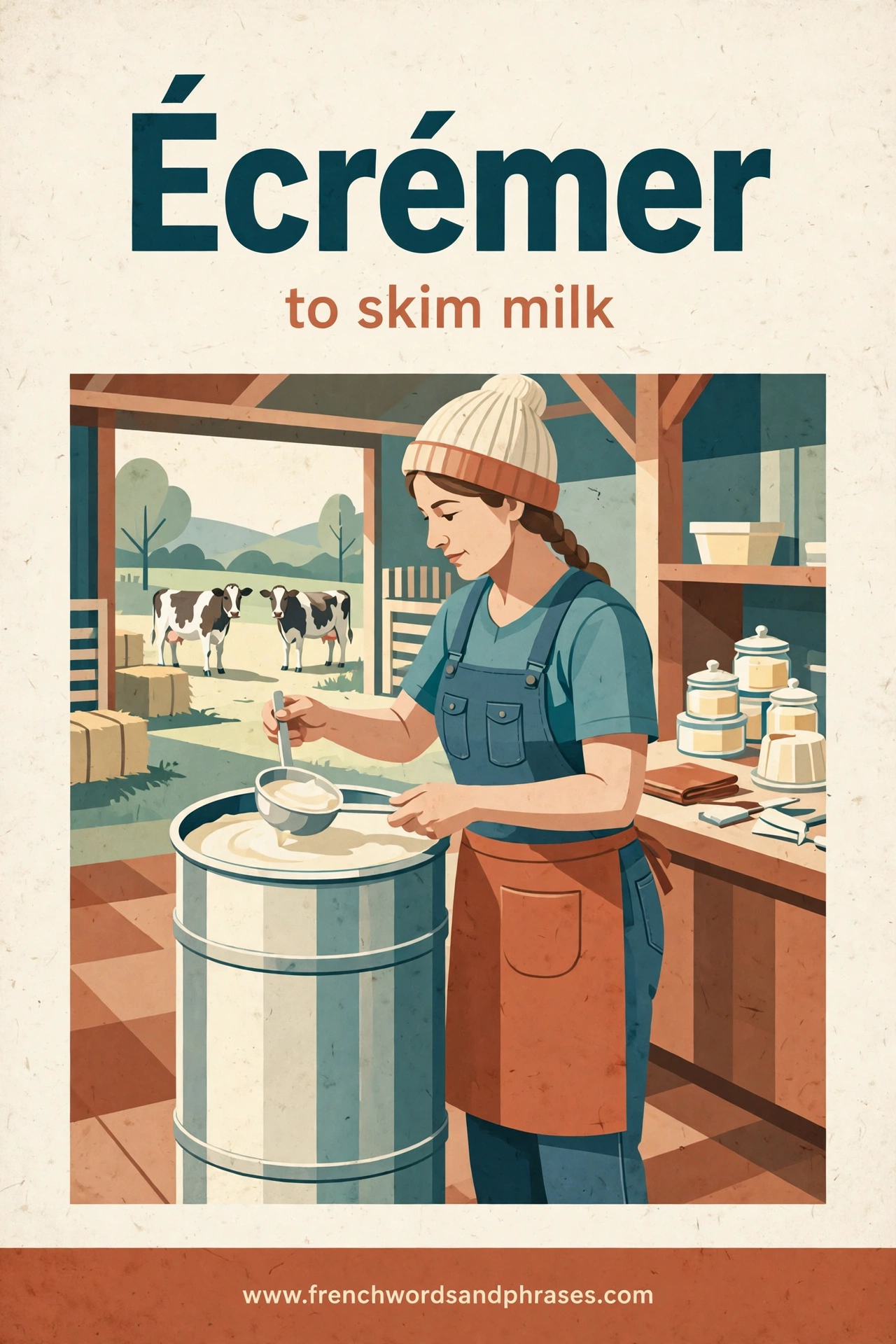
Écrémer means to skim milk.
A pan of milk left to rest overnight, a thick golden skin of cream gathered on top, and a wide flat spoon sliding just beneath it — écrémer is the verb of that patient harvest: taking the cream off the milk, and, by extension, skimming the best off anything.
In this guide, you’ll learn how to conjugate écrémer in all the major French tenses and moods. Explore complete conjugation tables, French examples, English translations, and practice quizzes.
Understanding the French Verb Écrémer
Écrémer is a regular French verb belonging to the first group of verbs, those ending in -er.
It means to skim milk. It is commonly used on the farm and in the dairy for skimming cream from milk, in the kitchen for skimming a sauce or a stock, and figuratively in business and politics for creaming off the best part — the best pupils, the best clients, the richest land — and leaving the rest behind.
Verb classification: First group (-er)
Auxiliary verb: Avoir
Past participle: écrémé
Present participle: écrémant
English equivalents: To skim (milk), to take the cream off; du lait écrémé — skimmed milk; figuratively, écrémer un marché — to cream off the best customers.
One important detail: écrémer is a céder-type verb — the é of the stem opens to è wherever the next syllable is mute: j’écrème, il écrème, ils écrèment, and through the future stem, j’écrèmerai. But where the ending is sounded, the é stays: nous écrémons, vous écrémez, en écrémant. What you take off is la crème, the cream, and milk that has given it up is du lait écrémé — skimmed milk, the carton in every French supermarket.
Experience the Word
Écrémer is the verb of the top layer — the richest part of the milk, taken first and taken carefully.
Imagine a farmhouse dairy at dawn, cool and smelling of stone and straw. Bowls of yesterday’s milk stand in a row, each crowned with cream, and the farmer’s wife slides her flat spoon across the surface, bowl after bowl, without breaking the skin.
The milk is still there, thinner and bluer. Its crown has been skimmed — écrémée — and the cream is already on its way to butter.
How to Conjugate Écrémer: Complete French Conjugation Guide
Let’s explore every major conjugation of écrémer, beginning with the indicative mood.
How to Conjugate Écrémer in the Indicative Mood
The indicative mood is used to express facts, observations, actions, and events.
How to Conjugate Écrémer in the Present Tense (Présent)
Used for actions happening now, habitual actions, and general truths.
| Subject | Conjugation |
|---|---|
| je | écrème |
| tu | écrèmes |
| il / elle | écrème |
| nous | écrémons |
| vous | écrémez |
| ils / elles | écrèment |
Example
Chaque matin, elle écrème le lait de la veille.
Every morning, she skims the milk from the day before.
Quick Quiz 1
Complete the sentence:
Nous ______ le lait de la veille.
Reveal the answer
écrémons
Nous écrémons le lait de la veille.
We skim yesterday’s milk. No accent change here: the ending is sounded.
How to Conjugate Écrémer in the Passé Composé
Used for completed actions in the past. Écrémer takes the auxiliary verb avoir.
| Subject | Conjugation |
|---|---|
| j’ | ai écrémé |
| tu | as écrémé |
| il / elle | a écrémé |
| nous | avons écrémé |
| vous | avez écrémé |
| ils / elles | ont écrémé |
Example
Nous avons écrémé le lait avant de le vendre.
We skimmed the milk before selling it.
How to Conjugate Écrémer in the Imparfait (Imperfect Tense)
Used for habitual past actions, descriptions, and ongoing situations in the past.
| Subject | Conjugation |
|---|---|
| je | écrémais |
| tu | écrémais |
| il / elle | écrémait |
| nous | écrémions |
| vous | écrémiez |
| ils / elles | écrémaient |
Example
Autrefois, on écrémait le lait à la main dans les fermes.
In the old days, people used to skim milk by hand on farms.
Quick Quiz 2
Choose the correct form:
She skimmed the milk.
Elle ______ le lait. (a écrémé / est écrémée)
Reveal the answer
a écrémé
Elle a écrémé le lait.
Écrémer takes avoir.
How to Conjugate Écrémer in the Plus-que-parfait
Used to describe an action that had already been completed before another past event.
| Subject | Conjugation |
|---|---|
| j’ | avais écrémé |
| tu | avais écrémé |
| il / elle | avait écrémé |
| nous | avions écrémé |
| vous | aviez écrémé |
| ils / elles | avaient écrémé |
Example
Elle avait écrémé la crème avant l’arrivée des invités.
She had skimmed off the cream before the guests arrived.
How to Conjugate Écrémer in the Passé Simple
Primarily used in formal writing, literature, and historical narratives. It is rarely used in everyday conversation.
| Subject | Conjugation |
|---|---|
| je | écrémai |
| tu | écrémas |
| il / elle | écréma |
| nous | écrémâmes |
| vous | écrémâtes |
| ils / elles | écrémèrent |
Example
La fermière écréma le lait et mit la crème au frais.
The farmer’s wife skimmed the milk and put the cream in a cool place.
How to Conjugate Écrémer in the Passé Antérieur
A literary tense used to express an action completed immediately before another past action, generally in the passé simple.
| Subject | Conjugation |
|---|---|
| j’ | eus écrémé |
| tu | eus écrémé |
| il / elle | eut écrémé |
| nous | eûmes écrémé |
| vous | eûtes écrémé |
| ils / elles | eurent écrémé |
Example
Quand elle eut écrémé le lait, elle prépara le beurre.
When she had skimmed the milk, she prepared the butter.
How to Conjugate Écrémer in the Future Tense (Futur Simple)
Used to describe actions that will take place in the future.
| Subject | Conjugation |
|---|---|
| je | écrèmerai |
| tu | écrèmeras |
| il / elle | écrèmera |
| nous | écrèmerons |
| vous | écrèmerez |
| ils / elles | écrèmeront |
Example
Demain, j’écrèmerai le lait dès l’aube.
Tomorrow, I will skim the milk at dawn.
How to Conjugate Écrémer in the Futur Antérieur (Future Perfect)
Used for an action that will have been completed before a particular point in the future.
| Subject | Conjugation |
|---|---|
| j’ | aurai écrémé |
| tu | auras écrémé |
| il / elle | aura écrémé |
| nous | aurons écrémé |
| vous | aurez écrémé |
| ils / elles | auront écrémé |
Example
À sept heures, elle aura écrémé tous les bols.
By seven o’clock, she will have skimmed all the bowls.
How to Conjugate Écrémer in the Near Future (Futur Proche)
Used to describe something that is going to happen soon. Formed with aller + infinitive.
| Subject | Conjugation |
|---|---|
| je | vais écrémer |
| tu | vas écrémer |
| il / elle | va écrémer |
| nous | allons écrémer |
| vous | allez écrémer |
| ils / elles | vont écrémer |
Example
Je vais écrémer le lait, la crème est bien montée.
I am going to skim the milk, the cream has risen well.
How to Conjugate Écrémer in the Conditional Mood
The conditional mood expresses what would happen under certain circumstances. It is also frequently used to make polite requests or express wishes.
How to Conjugate Écrémer in the Present Conditional
| Subject | Conjugation |
|---|---|
| je | écrèmerais |
| tu | écrèmerais |
| il / elle | écrèmerait |
| nous | écrèmerions |
| vous | écrèmeriez |
| ils / elles | écrèmeraient |
Example
Avec une écrémeuse, on écrèmerait le lait en quelques minutes.
With a cream separator, we would skim the milk in a few minutes.
How to Conjugate Écrémer in the Past Conditional
| Subject | Conjugation |
|---|---|
| j’ | aurais écrémé |
| tu | aurais écrémé |
| il / elle | aurait écrémé |
| nous | aurions écrémé |
| vous | auriez écrémé |
| ils / elles | auraient écrémé |
Example
Elle aurait écrémé le lait si la crème avait monté.
She would have skimmed the milk if the cream had risen.
Écrémer in the Literary Past Conditional Form
This less common literary form uses the imperfect subjunctive of avoir.
| Subject | Conjugation |
|---|---|
| j’ | eusse écrémé |
| tu | eusses écrémé |
| il / elle | eût écrémé |
| nous | eussions écrémé |
| vous | eussiez écrémé |
| ils / elles | eussent écrémé |
Example
Elle eût écrémé le lait avant même le chant du coq.
She would have skimmed the milk before even the cockcrow.
How to Conjugate Écrémer in the Subjunctive Mood
The subjunctive is used to express wishes, emotions, doubts, necessity, and uncertainty. It frequently follows expressions such as il faut que (it is necessary that) or bien que (although).
How to Conjugate Écrémer in the Present Subjunctive
| Subject | Conjugation |
|---|---|
| que je | écrème |
| que tu | écrèmes |
| qu’il / qu’elle | écrème |
| que nous | écrémions |
| que vous | écrémiez |
| qu’ils / qu’elles | écrèment |
Example
Il faut que tu écrèmes le lait ce soir.
You must skim the milk this evening.
Quick Quiz 3
Complete the sentence using the subjunctive:
Il faut que vous ______ le lait ce soir.
Reveal the answer
écrémiez
Il faut que vous écrémiez le lait ce soir.
You must skim the milk this evening.
How to Conjugate Écrémer in the Imperfect Subjunctive
A literary tense, rarely encountered in modern spoken French.
| Subject | Conjugation |
|---|---|
| que je | écrémasse |
| que tu | écrémasses |
| qu’il / qu’elle | écrémât |
| que nous | écrémassions |
| que vous | écrémassiez |
| qu’ils / qu’elles | écrémassent |
Example
Il voulait qu’elle écrémât le lait avant la traite.
He wanted her to skim the milk before the milking.
How to Conjugate Écrémer in the Pluperfect Subjunctive
A literary construction used to express an action completed before another past action.
| Subject | Conjugation |
|---|---|
| que j’ | eusse écrémé |
| que tu | eusses écrémé |
| qu’il / qu’elle | eût écrémé |
| que nous | eussions écrémé |
| que vous | eussiez écrémé |
| qu’ils / qu’elles | eussent écrémé |
Example
Il regrettait qu’elle eût écrémé le meilleur lait pour les voisins.
He regretted that she had skimmed the best milk for the neighbours.
How to Conjugate Écrémer in the Past Subjunctive
| Subject | Conjugation |
|---|---|
| que j’ | aie écrémé |
| que tu | aies écrémé |
| qu’il / qu’elle | ait écrémé |
| que nous | ayons écrémé |
| que vous | ayez écrémé |
| qu’ils / qu’elles | aient écrémé |
Example
Je suis content que vous ayez écrémé la crème à temps.
I am glad you skimmed the cream in time.
How to Conjugate Écrémer in the Imperative
The imperative is used to give commands, instructions, invitations, or suggestions. Subject pronouns are omitted.
How to Conjugate Écrémer in the Present Imperative
| Person | Conjugation |
|---|---|
| (tu) | écrème |
| (nous) | écrémons |
| (vous) | écrémez |
Example
Écrème le lait avant qu’il ne tourne !
Skim the milk before it turns!
Quick Quiz 4
How would you say Skim the milk (tu form)?
Reveal the answer
Écrème le lait !
French Participles of Écrémer
Participles are verb forms that can be used in compound tenses and other grammatical constructions.
Present Participle of Écrémer
écrémant
En écrémant le lait, elle chantait doucement.
While skimming the milk, she sang softly.
Past Participle of Écrémer
écrémé
Écrémé dès l’aube, le lait partait au marché dans des bidons.
Skimmed at dawn, the milk left for market in churns.
Écrémer in Everyday French: Real-Life Examples
Now that you know the conjugations, let’s see how écrémer appears in everyday French.
Example 1 — Present
J’écrème le lait tous les matins.
I skim the milk every morning.
Example 2 — Passé composé
Elle a écrémé la crème pour le dessert.
She skimmed off the cream for the dessert.
Example 3 — Imparfait
Ma grand-mère écrémait le lait à la louche.
My grandmother used to skim the milk with a ladle.
Example 4 — Future
Nous écrèmerons le lait demain.
We will skim the milk tomorrow.
Example 5 — Conditional
Tu écrèmerais le lait plus vite avec une machine.
You would skim the milk faster with a machine.
Example 6 — Imperative
Écrémez la sauce avant de la servir !
Skim the sauce before serving it!
Beyond Translation: The Meaning of Écrémer
English skim does this work for milk, for books and for stones on water alike; French écrémer keeps the dairy at its centre and lets the metaphor grow out of it.
To skim the cream is to take the best first.
So a school that écrème the best pupils, or a firm that écrème a market, is doing at a desk what the farmer’s wife does with her flat spoon — and French speakers hear the milk bowl behind the boardroom word.
How to Remember the French Verb Écrémer
Remember it this way: Écrémer is about the cream taken off the milk — and the best taken off anything.
- La crème rises to the top, and écrémer takes it off — du lait écrémé is skimmed milk.
- Céder-type stem change: j’écrème, ils écrèment, but nous écrémons.
- Figuratively: écrémer un marché — to cream off the best of a market.
The key idea is the cream taken off the milk — and the best taken off anything.
Test Your Knowledge of Écrémer
Let’s see how much you’ve learned. Try answering these questions before revealing the answers.
Question 1
What is du lait écrémé?
Reveal the answer
Skimmed milk — milk whose cream has been écrémée.
Question 2
How do you say She skims the milk every morning in French?
Reveal the answer
Elle écrème le lait tous les matins.
Question 3
Translate: We skimmed the milk before selling it.
Reveal the answer
Nous avons écrémé le lait avant de le vendre.
Question 4
What is the past participle of écrémer?
Reveal the answer
Écrémé.
Question 5
Complete the sentence:
Il faut que tu ______ le lait ce soir.
Reveal the answer
écrèmes
Il faut que tu écrèmes le lait ce soir.
You must skim the milk this evening.
Your Final Challenge
Can You Use It?
How would you say this in French?
She skims the milk in the early morning, and the cream becomes butter before noon.
Reveal the answer
Elle écrème le lait au petit matin, et la crème devient beurre avant midi.
She skims the milk in the early morning, and the cream becomes butter before noon.
A little French. A little curiosity. A richer everyday life.
LEARN FRENCH ONE WORD AT A TIME