A French Word to Live By
How to Conjugate Écraser in French
/e.kʁa.ze/
Écraser means to crush — to press something flat or to pieces under weight or force.
Garlic under the flat of a knife, grapes under the press, a wave of heat that flattens a whole city — écraser is the verb of crushing weight, and French reaches for it everywhere from the kitchen to the battlefield to the weather forecast.
In this guide, you’ll learn how to conjugate écraser in all the major French tenses and moods. Explore complete conjugation tables, French examples, English translations, and practice quizzes.
Understanding the French Verb Écraser
Écraser is a regular French verb belonging to the first group of verbs, those ending in -er.
It means to crush. It is commonly used for crushing and mashing food (garlic, potatoes, grapes), for running over or flattening in accidents, in the reflexive for planes and vehicles that crash, and figuratively for anything overwhelming — heat, work, taxes, an opponent beaten écrasé in a match.
Verb classification: First group (-er)
Auxiliary verb: Avoir
Past participle: écrasé
Present participle: écrasant
English equivalents: To crush, to mash, to run over; écraser une cigarette — to stub out a cigarette; une chaleur écrasante — crushing, sweltering heat; s’écraser — to crash (of a plane), to smash into.
One important detail: écraser carries two famous passengers. First, the reflexive: s’écraser, with être, is how planes and cars crash — l’avion s’est écrasé — and how a bird or a ball smashes against a wall. Second, the participle écrasant has become an adjective of overwhelming weight: une chaleur écrasante, crushing heat; une majorité écrasante, an overwhelming majority; écrasé de travail, crushed — buried — under work. The kitchen keeps the plain sense: écraser l’ail, écraser les pommes de terre, to crush the garlic, to mash the potatoes.
Experience the Word
Écraser is the verb of weight that wins — whatever is underneath ends up flat, mashed or overwhelmed.
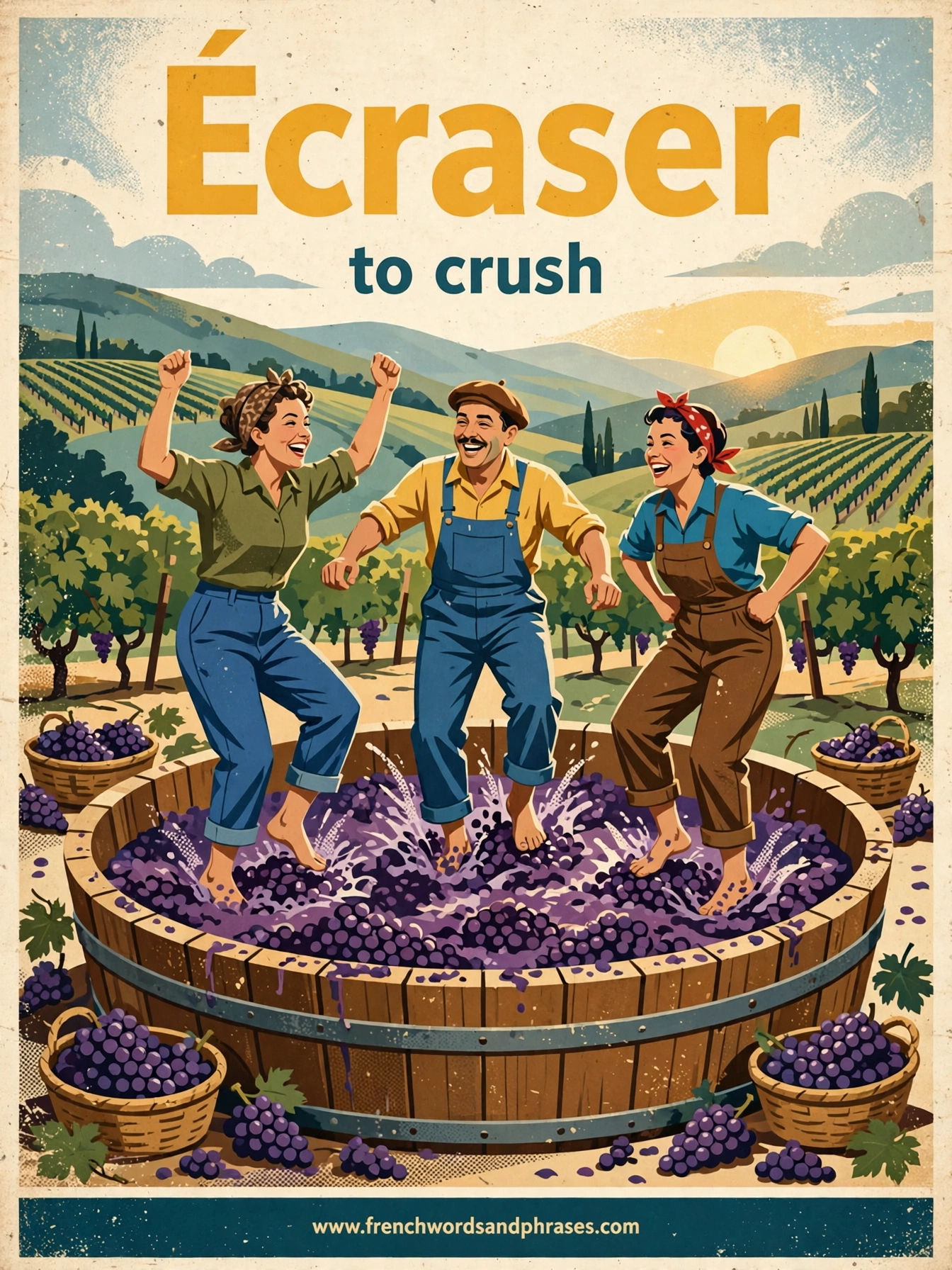
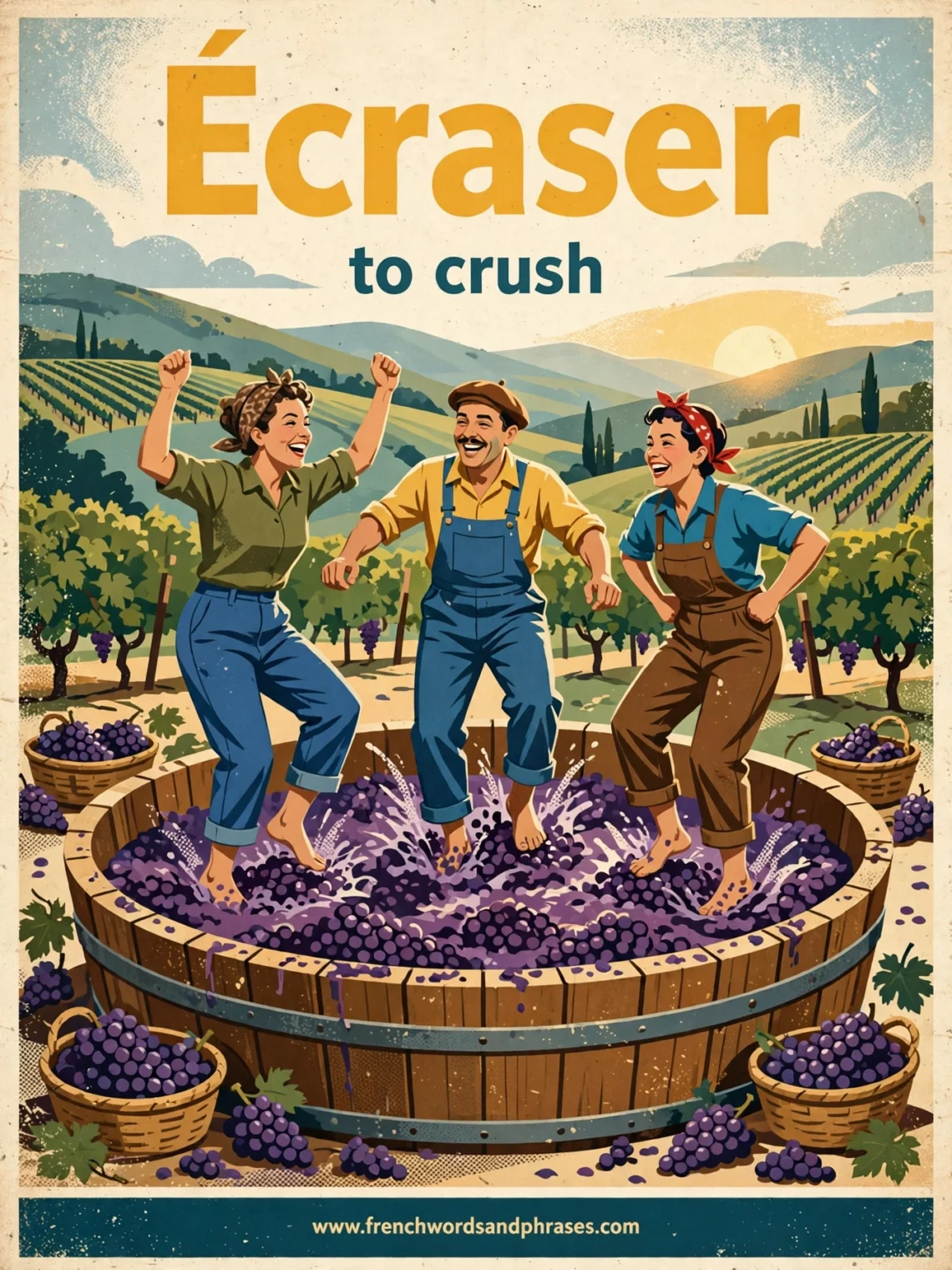
Imagine the vendanges in a Burgundy cellar. The grapes tip into the great press, the screw turns, and the weight écrase them slowly until the first juice runs dark and sweet — crushing as the first act of wine.
The grapes have not been cut or torn. They have been crushed — pressed flat until they gave up their juice.
How to Conjugate Écraser: Complete French Conjugation Guide
Let’s explore every major conjugation of écraser, beginning with the indicative mood.
How to Conjugate Écraser in the Indicative Mood
The indicative mood is used to express facts, observations, actions, and events.
How to Conjugate Écraser in the Present Tense (Présent)
Used for actions happening now, habitual actions, and general truths.
| Subject | Conjugation |
|---|---|
| je | écrase |
| tu | écrases |
| il / elle | écrase |
| nous | écrasons |
| vous | écrasez |
| ils / elles | écrasent |
Example
Elle écrase l’ail avec le plat du couteau.
She crushes the garlic with the flat of the knife.
Quick Quiz 1
Complete the sentence:
Nous ______ les pommes de terre pour la purée.
Reveal the answer
écrasons
Nous écrasons les pommes de terre pour la purée.
We mash the potatoes for the purée.
How to Conjugate Écraser in the Passé Composé
Used for completed actions in the past. Écraser takes the auxiliary verb avoir.
| Subject | Conjugation |
|---|---|
| j’ | ai écrasé |
| tu | as écrasé |
| il / elle | a écrasé |
| nous | avons écrasé |
| vous | avez écrasé |
| ils / elles | ont écrasé |
Example
Le camion a écrasé la barrière du jardin.
The truck crushed the garden fence.
How to Conjugate Écraser in the Imparfait (Imperfect Tense)
Used for habitual past actions, descriptions, and ongoing situations in the past.
| Subject | Conjugation |
|---|---|
| je | écrasais |
| tu | écrasais |
| il / elle | écrasait |
| nous | écrasions |
| vous | écrasiez |
| ils / elles | écrasaient |
Example
La chaleur écrasait la ville dès le matin.
The heat was crushing the city from the morning on.
Quick Quiz 2
Choose the correct form:
She crushed the garlic.
Elle ______ l’ail. (a écrasé / est écrasée)
Reveal the answer
a écrasé
Elle a écrasé l’ail.
Écraser takes avoir.
How to Conjugate Écraser in the Plus-que-parfait
Used to describe an action that had already been completed before another past event.
| Subject | Conjugation |
|---|---|
| j’ | avais écrasé |
| tu | avais écrasé |
| il / elle | avait écrasé |
| nous | avions écrasé |
| vous | aviez écrasé |
| ils / elles | avaient écrasé |
Example
Ils avaient écrasé le raisin avant la fermentation.
They had crushed the grapes before fermentation.
How to Conjugate Écraser in the Passé Simple
Primarily used in formal writing, literature, and historical narratives. It is rarely used in everyday conversation.
| Subject | Conjugation |
|---|---|
| je | écrasai |
| tu | écrasas |
| il / elle | écrasa |
| nous | écrasâmes |
| vous | écrasâtes |
| ils / elles | écrasèrent |
Example
Le rocher roula et écrasa la clôture.
The boulder rolled and crushed the fence.
How to Conjugate Écraser in the Passé Antérieur
A literary tense used to express an action completed immediately before another past action, generally in the passé simple.
| Subject | Conjugation |
|---|---|
| j’ | eus écrasé |
| tu | eus écrasé |
| il / elle | eut écrasé |
| nous | eûmes écrasé |
| vous | eûtes écrasé |
| ils / elles | eurent écrasé |
Example
Quand le pressoir eut écrasé le raisin, le jus coula dans les cuves.
When the press had crushed the grapes, the juice ran into the vats.
How to Conjugate Écraser in the Future Tense (Futur Simple)
Used to describe actions that will take place in the future.
| Subject | Conjugation |
|---|---|
| je | écraserai |
| tu | écraseras |
| il / elle | écrasera |
| nous | écraserons |
| vous | écraserez |
| ils / elles | écraseront |
Example
Ce poids écrasera la boîte si tu le poses dessus.
That weight will crush the box if you put it on top.
How to Conjugate Écraser in the Futur Antérieur (Future Perfect)
Used for an action that will have been completed before a particular point in the future.
| Subject | Conjugation |
|---|---|
| j’ | aurai écrasé |
| tu | auras écrasé |
| il / elle | aura écrasé |
| nous | aurons écrasé |
| vous | aurez écrasé |
| ils / elles | auront écrasé |
Example
À la fin du jour, le pressoir aura écrasé toute la récolte.
By the end of the day, the press will have crushed the whole harvest.
How to Conjugate Écraser in the Near Future (Futur Proche)
Used to describe something that is going to happen soon. Formed with aller + infinitive.
| Subject | Conjugation |
|---|---|
| je | vais écraser |
| tu | vas écraser |
| il / elle | va écraser |
| nous | allons écraser |
| vous | allez écraser |
| ils / elles | vont écraser |
Example
Attention, tu vas écraser les lunettes sur la chaise !
Careful, you are going to crush the glasses on the chair!
How to Conjugate Écraser in the Conditional Mood
The conditional mood expresses what would happen under certain circumstances. It is also frequently used to make polite requests or express wishes.
How to Conjugate Écraser in the Present Conditional
| Subject | Conjugation |
|---|---|
| je | écraserais |
| tu | écraserais |
| il / elle | écraserait |
| nous | écraserions |
| vous | écraseriez |
| ils / elles | écraseraient |
Example
Sans renfort, ce mur écraserait la cabane.
Without support, that wall would crush the shed.
How to Conjugate Écraser in the Past Conditional
| Subject | Conjugation |
|---|---|
| j’ | aurais écrasé |
| tu | aurais écrasé |
| il / elle | aurait écrasé |
| nous | aurions écrasé |
| vous | auriez écrasé |
| ils / elles | auraient écrasé |
Example
L’avion se serait écrasé sans l’habileté du pilote.
The plane would have crashed without the pilot’s skill.
Écraser in the Literary Past Conditional Form
This less common literary form uses the imperfect subjunctive of avoir.
| Subject | Conjugation |
|---|---|
| j’ | eusse écrasé |
| tu | eusses écrasé |
| il / elle | eût écrasé |
| nous | eussions écrasé |
| vous | eussiez écrasé |
| ils / elles | eussent écrasé |
Example
La foule eût écrasé les barrières sans les gardes.
The crowd would have crushed the barriers without the guards.
How to Conjugate Écraser in the Subjunctive Mood
The subjunctive is used to express wishes, emotions, doubts, necessity, and uncertainty. It frequently follows expressions such as il faut que (it is necessary that) or bien que (although).
How to Conjugate Écraser in the Present Subjunctive
| Subject | Conjugation |
|---|---|
| que je | écrase |
| que tu | écrases |
| qu’il / qu’elle | écrase |
| que nous | écrasions |
| que vous | écrasiez |
| qu’ils / qu’elles | écrasent |
Example
Il faut que tu écrases bien les pommes de terre.
You must mash the potatoes well.
Quick Quiz 3
Complete the sentence using the subjunctive:
Il faut que vous ______ le raisin avant ce soir.
Reveal the answer
écrasiez
Il faut que vous écrasiez le raisin avant ce soir.
You must crush the grapes before this evening.
How to Conjugate Écraser in the Imperfect Subjunctive
A literary tense, rarely encountered in modern spoken French.
| Subject | Conjugation |
|---|---|
| que je | écrasasse |
| que tu | écrasasses |
| qu’il / qu’elle | écrasât |
| que nous | écrasassions |
| que vous | écrasassiez |
| qu’ils / qu’elles | écrasassent |
Example
On craignait que le rocher n’écrasât le sentier.
People feared the boulder might crush the path.
How to Conjugate Écraser in the Pluperfect Subjunctive
A literary construction used to express an action completed before another past action.
| Subject | Conjugation |
|---|---|
| que j’ | eusse écrasé |
| que tu | eusses écrasé |
| qu’il / qu’elle | eût écrasé |
| que nous | eussions écrasé |
| que vous | eussiez écrasé |
| qu’ils / qu’elles | eussent écrasé |
Example
Le journal rapporta que l’avion se fût écrasé en mer.
The newspaper reported that the plane had crashed at sea.
How to Conjugate Écraser in the Past Subjunctive
| Subject | Conjugation |
|---|---|
| que j’ | aie écrasé |
| que tu | aies écrasé |
| qu’il / qu’elle | ait écrasé |
| que nous | ayons écrasé |
| que vous | ayez écrasé |
| qu’ils / qu’elles | aient écrasé |
Example
Je suis désolé que la grêle ait écrasé les récoltes.
I am sorry the hail crushed the crops.
How to Conjugate Écraser in the Imperative
The imperative is used to give commands, instructions, invitations, or suggestions. Subject pronouns are omitted.
How to Conjugate Écraser in the Present Imperative
| Person | Conjugation |
|---|---|
| (tu) | écrase |
| (nous) | écrasons |
| (vous) | écrasez |
Example
Écrase ta cigarette avant d’entrer !
Stub out your cigarette before coming in!
Quick Quiz 4
How would you say Stub out your cigarette (tu form)?
Reveal the answer
Écrase ta cigarette !
French Participles of Écraser
Participles are verb forms that can be used in compound tenses and other grammatical constructions.
Present Participle of Écraser
écrasant
En écrasant les pommes de terre, elle ajoute du beurre et du lait.
While mashing the potatoes, she adds butter and milk.
Past Participle of Écraser
écrasé
Écrasé de travail, il a enfin pris des vacances.
Crushed under work, he finally took a holiday.
Écraser in Everyday French: Real-Life Examples
Now that you know the conjugations, let’s see how écraser appears in everyday French.
Example 1 — Present
J’écrase les pommes de terre pour la purée.
I mash the potatoes for the purée.
Example 2 — Passé composé
L’avion s’est écrasé dans les montagnes.
The plane crashed in the mountains.
Example 3 — Imparfait
Le soleil écrasait la place du village à midi.
The sun used to crush the village square at noon.
Example 4 — Future
Le pressoir écrasera le raisin demain.
The press will crush the grapes tomorrow.
Example 5 — Conditional
Cette chaleur écraserait n’importe qui.
This heat would crush anyone.
Example 6 — Imperative
Écrasez votre cigarette, s’il vous plaît !
Stub out your cigarette, please!
Beyond Translation: The Meaning of Écraser
English crush stays mostly physical; French écraser crushes everything in sight — garlic, grapes, opponents, majorities, the August heat, and you under your workload.
Écrasant is the adjective of too much.
And when the thing doing the falling is a plane, French turns the verb on itself: s’écraser — to be crushed against the ground. One verb, from the garlic press to the evening news.
How to Remember the French Verb Écraser
Remember it this way: Écraser is about weight that wins — garlic, grapes, heat and workload, all crushed.
- Écraser l’ail, les pommes de terre, le raisin — the kitchen and cellar verb of crushing.
- S’écraser (être) — to crash: l’avion s’est écrasé; écrasant — overwhelming, crushing heat.
- Regular -er: j’écrase, nous écrasons, past participle écrasé.
The key idea is weight that wins — garlic, grapes, heat and workload, all crushed.
Test Your Knowledge of Écraser
Let’s see how much you’ve learned. Try answering these questions before revealing the answers.
Question 1
How do you say The plane crashed in French?
Reveal the answer
L’avion s’est écrasé.
Question 2
How do you say She crushes the garlic in French?
Reveal the answer
Elle écrase l’ail.
Question 3
Translate: The truck crushed the garden fence.
Reveal the answer
Le camion a écrasé la barrière du jardin.
Question 4
What is the past participle of écraser?
Reveal the answer
Écrasé.
Question 5
Complete the sentence:
Il faut que tu ______ bien les pommes de terre.
Reveal the answer
écrases
Il faut que tu écrases bien les pommes de terre.
You must mash the potatoes well.
Your Final Challenge
Can You Use It?
How would you say this in French?
The press crushes the grapes slowly, and the first juice of the harvest finally flows.
Reveal the answer
Le pressoir écrase le raisin lentement, et le premier jus de la vendange coule enfin.
The press crushes the grapes slowly, and the first juice of the harvest finally flows.
A little French. A little curiosity. A richer everyday life.
LEARN FRENCH ONE WORD AT A TIME