
A French Word to Live By
How to Conjugate Écoper in French
/e.kɔ.pe/
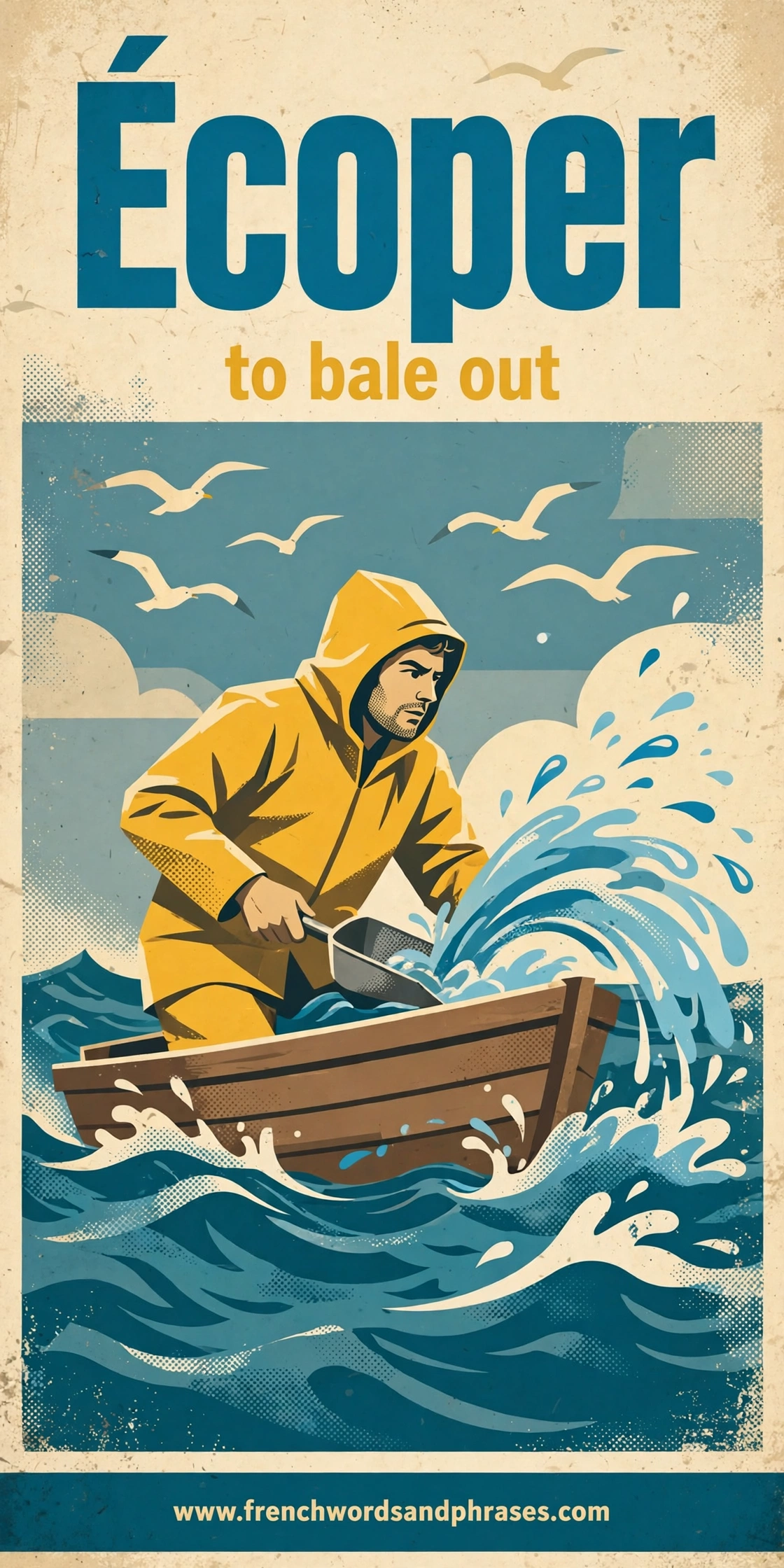
Écoper means to bale out — to scoop the water out of a boat.
Waves slapping over the gunwale, water sloshing around the ankles, and a sailor scooping furiously with a bucket — écoper is the verb of emptying a boat by hand, and by extension, of taking the punishment that lands on you.
In this guide, you’ll learn how to conjugate écoper in all the major French tenses and moods. Explore complete conjugation tables, French examples, English translations, and practice quizzes.
Understanding the French Verb Écoper
Écoper is a regular French verb belonging to the first group of verbs, those ending in -er.
It means to bale out. It is commonly used by sailors and fishermen for baling a leaking or swamped boat, in rowing and small-boat talk along every French coast, and in the familiar sense for fines, prison sentences, blame and extra work that fall on someone — usually the same person every time.
Verb classification: First group (-er)
Auxiliary verb: Avoir
Past participle: écopé
Present participle: écopant
English equivalents: To bale out (a boat); (familiar) to cop, to get landed with — écoper d’une amende, to get fined.
One important detail: écoper has two lives. At sea it is literal: you scoop water out with une écope, a bailer or scoop, and the verb is écoper l’eau or simply écoper while the boat fills. In familiar everyday French it means to cop the consequences: écoper d’une amende, to be landed with a fine; il a écopé de deux ans de prison, he got two years in prison; c’est toujours moi qui écope, it is always me who gets it. The link is easy to feel — you take in what you did not want, and you deal with it.
Experience the Word
Écoper is the verb of unwelcome water — in the boat, you throw it out; in life, you take it on the chin.
Imagine a small fishing boat off Brittany in a rising sea. The old fisherman rows while his grandson écopes without stopping, bucket after bucket, until the water drops below the floorboards and the boat rides light again.
The sea has not calmed down. The water has been baled out — scooped, thrown, beaten back by hand.
How to Conjugate Écoper: Complete French Conjugation Guide
Let’s explore every major conjugation of écoper, beginning with the indicative mood.
How to Conjugate Écoper in the Indicative Mood
The indicative mood is used to express facts, observations, actions, and events.
How to Conjugate Écoper in the Present Tense (Présent)
Used for actions happening now, habitual actions, and general truths.
| Subject | Conjugation |
|---|---|
| je | écope |
| tu | écopes |
| il / elle | écope |
| nous | écopons |
| vous | écopez |
| ils / elles | écopent |
Example
Le marin écope l’eau qui entre dans la barque.
The sailor bales out the water coming into the boat.
Quick Quiz 1
Complete the sentence:
Nous ______ l’eau qui entre dans le canot.
Reveal the answer
écopons
Nous écopons l’eau qui entre dans le canot.
We bale out the water coming into the dinghy.
How to Conjugate Écoper in the Passé Composé
Used for completed actions in the past. Écoper takes the auxiliary verb avoir.
| Subject | Conjugation |
|---|---|
| j’ | ai écopé |
| tu | as écopé |
| il / elle | a écopé |
| nous | avons écopé |
| vous | avez écopé |
| ils / elles | ont écopé |
Example
Nous avons écopé pendant une heure avant d’atteindre le port.
We baled for an hour before reaching the harbour.
How to Conjugate Écoper in the Imparfait (Imperfect Tense)
Used for habitual past actions, descriptions, and ongoing situations in the past.
| Subject | Conjugation |
|---|---|
| je | écopais |
| tu | écopais |
| il / elle | écopait |
| nous | écopions |
| vous | écopiez |
| ils / elles | écopaient |
Example
Les pêcheurs écopaient dès que la mer devenait mauvaise.
The fishermen would start baling as soon as the sea turned rough.
Quick Quiz 2
Choose the correct form:
He got a fine.
Il ______ d’une amende. (a écopé / est écopé)
Reveal the answer
a écopé
Il a écopé d’une amende.
Écoper takes avoir.
How to Conjugate Écoper in the Plus-que-parfait
Used to describe an action that had already been completed before another past event.
| Subject | Conjugation |
|---|---|
| j’ | avais écopé |
| tu | avais écopé |
| il / elle | avait écopé |
| nous | avions écopé |
| vous | aviez écopé |
| ils / elles | avaient écopé |
Example
Ils avaient écopé toute la nuit pour sauver le bateau.
They had baled all night to save the boat.
How to Conjugate Écoper in the Passé Simple
Primarily used in formal writing, literature, and historical narratives. It is rarely used in everyday conversation.
| Subject | Conjugation |
|---|---|
| je | écopai |
| tu | écopas |
| il / elle | écopa |
| nous | écopâmes |
| vous | écopâtes |
| ils / elles | écopèrent |
Example
Le mousse écopa sans relâche jusqu’à l’aube.
The cabin boy baled without stopping until dawn.
How to Conjugate Écoper in the Passé Antérieur
A literary tense used to express an action completed immediately before another past action, generally in the passé simple.
| Subject | Conjugation |
|---|---|
| j’ | eus écopé |
| tu | eus écopé |
| il / elle | eut écopé |
| nous | eûmes écopé |
| vous | eûtes écopé |
| ils / elles | eurent écopé |
Example
Quand ils eurent écopé l’eau, la barque flotta de nouveau.
When they had baled out the water, the boat floated again.
How to Conjugate Écoper in the Future Tense (Futur Simple)
Used to describe actions that will take place in the future.
| Subject | Conjugation |
|---|---|
| je | écoperai |
| tu | écoperas |
| il / elle | écopera |
| nous | écoperons |
| vous | écoperez |
| ils / elles | écoperont |
Example
Si la voie d’eau s’aggrave, nous écoperons à tour de rôle.
If the leak gets worse, we will bale in turns.
How to Conjugate Écoper in the Futur Antérieur (Future Perfect)
Used for an action that will have been completed before a particular point in the future.
| Subject | Conjugation |
|---|---|
| j’ | aurai écopé |
| tu | auras écopé |
| il / elle | aura écopé |
| nous | aurons écopé |
| vous | aurez écopé |
| ils / elles | auront écopé |
Example
À ce rythme, vous aurez écopé cent seaux avant midi.
At this rate, you will have baled a hundred buckets by noon.
How to Conjugate Écoper in the Near Future (Futur Proche)
Used to describe something that is going to happen soon. Formed with aller + infinitive.
| Subject | Conjugation |
|---|---|
| je | vais écoper |
| tu | vas écoper |
| il / elle | va écoper |
| nous | allons écoper |
| vous | allez écoper |
| ils / elles | vont écoper |
Example
Dépêche-toi, le bateau se remplit, on va écoper !
Hurry, the boat is filling up, we are going to have to bale!
How to Conjugate Écoper in the Conditional Mood
The conditional mood expresses what would happen under certain circumstances. It is also frequently used to make polite requests or express wishes.
How to Conjugate Écoper in the Present Conditional
| Subject | Conjugation |
|---|---|
| je | écoperais |
| tu | écoperais |
| il / elle | écoperait |
| nous | écoperions |
| vous | écoperiez |
| ils / elles | écoperaient |
Example
Avec une pompe, on écoperait bien moins longtemps.
With a pump, we would bale for much less time.
How to Conjugate Écoper in the Past Conditional
| Subject | Conjugation |
|---|---|
| j’ | aurais écopé |
| tu | aurais écopé |
| il / elle | aurait écopé |
| nous | aurions écopé |
| vous | auriez écopé |
| ils / elles | auraient écopé |
Example
Sans ton aide, il aurait écopé jusqu’au soir.
Without your help, he would have baled until evening.
Écoper in the Literary Past Conditional Form
This less common literary form uses the imperfect subjunctive of avoir.
| Subject | Conjugation |
|---|---|
| j’ | eusse écopé |
| tu | eusses écopé |
| il / elle | eût écopé |
| nous | eussions écopé |
| vous | eussiez écopé |
| ils / elles | eussent écopé |
Example
Les matelots eussent écopé jusqu’à la dernière goutte.
The sailors would have baled to the last drop.
How to Conjugate Écoper in the Subjunctive Mood
The subjunctive is used to express wishes, emotions, doubts, necessity, and uncertainty. It frequently follows expressions such as il faut que (it is necessary that) or bien que (although).
How to Conjugate Écoper in the Present Subjunctive
| Subject | Conjugation |
|---|---|
| que je | écope |
| que tu | écopes |
| qu’il / qu’elle | écope |
| que nous | écopions |
| que vous | écopiez |
| qu’ils / qu’elles | écopent |
Example
Il faut que tout le monde écope, vite !
Everyone must bale, quickly!
Quick Quiz 3
Complete the sentence using the subjunctive:
Il faut que vous ______ plus vite.
Reveal the answer
écopiez
Il faut que vous écopiez plus vite.
You must bale faster.
How to Conjugate Écoper in the Imperfect Subjunctive
A literary tense, rarely encountered in modern spoken French.
| Subject | Conjugation |
|---|---|
| que je | écopasse |
| que tu | écopasses |
| qu’il / qu’elle | écopât |
| que nous | écopassions |
| que vous | écopassiez |
| qu’ils / qu’elles | écopassent |
Example
Le capitaine ordonna que l’équipage écopât sans pause.
The captain ordered the crew to bale without a break.
How to Conjugate Écoper in the Pluperfect Subjunctive
A literary construction used to express an action completed before another past action.
| Subject | Conjugation |
|---|---|
| que j’ | eusse écopé |
| que tu | eusses écopé |
| qu’il / qu’elle | eût écopé |
| que nous | eussions écopé |
| que vous | eussiez écopé |
| qu’ils / qu’elles | eussent écopé |
Example
On raconta qu’ils eussent écopé pendant des heures.
It was said that they had baled for hours.
How to Conjugate Écoper in the Past Subjunctive
| Subject | Conjugation |
|---|---|
| que j’ | aie écopé |
| que tu | aies écopé |
| qu’il / qu’elle | ait écopé |
| que nous | ayons écopé |
| que vous | ayez écopé |
| qu’ils / qu’elles | aient écopé |
Example
Je suis soulagé que vous ayez écopé à temps.
I am relieved that you baled in time.
How to Conjugate Écoper in the Imperative
The imperative is used to give commands, instructions, invitations, or suggestions. Subject pronouns are omitted.
How to Conjugate Écoper in the Present Imperative
| Person | Conjugation |
|---|---|
| (tu) | écope |
| (nous) | écopons |
| (vous) | écopez |
Example
Écope plus vite, l’eau monte !
Bale faster, the water is rising!
Quick Quiz 4
How would you say Bale faster (tu form)?
Reveal the answer
Écope plus vite !
French Participles of Écoper
Participles are verb forms that can be used in compound tenses and other grammatical constructions.
Present Participle of Écoper
écopant
En écopant, il chantait pour garder le rythme.
While baling, he sang to keep the rhythm.
Past Participle of Écoper
écopé
Écopée seau après seau, l’eau finit par baisser.
Baled bucket after bucket, the water finally went down.
Écoper in Everyday French: Real-Life Examples
Now that you know the conjugations, let’s see how écoper appears in everyday French.
Example 1 — Present
Le bateau prend l’eau, et j’écope comme je peux.
The boat is taking on water, and I bale as best I can.
Example 2 — Passé composé
Il a écopé d’une amende pour excès de vitesse.
He got a fine for speeding.
Example 3 — Imparfait
Les marins écopaient après chaque grosse vague.
The sailors used to bale after each big wave.
Example 4 — Future
Si ça continue, nous écoperons toute la nuit.
If this goes on, we will be baling all night.
Example 5 — Conditional
C’est toujours le même qui écoperait, évidemment.
It would always be the same one who cops it, of course.
Example 6 — Imperative
Écopez tous, et vite !
Everyone bale, and quickly!
Beyond Translation: The Meaning of Écoper
English bale out stays mostly at sea or in finance; French écoper walked from the boat into the courtroom and the office.
To bale is to cop it.
Il a écopé d’une amende — the fine landed in his boat, so to speak, and now he has to deal with it. One verb for the water you throw out and the trouble you take in.
How to Remember the French Verb Écoper
Remember it this way: Écoper is about the bucket verb — water out of the boat, trouble onto your shoulders.
- Une écope — the bailer or scoop; écoper is what you do with it.
- Familiar second sense: écoper de — to get landed with (a fine, a sentence, the blame).
- Regular -er: j’écope, nous écopons, past participle écopé.
The key idea is the bucket verb — water out of the boat, trouble onto your shoulders.
Test Your Knowledge of Écoper
Let’s see how much you’ve learned. Try answering these questions before revealing the answers.
Question 1
What is une écope?
Reveal the answer
A bailer — the scoop used to écoper a boat.
Question 2
How do you say He got a fine in familiar French?
Reveal the answer
Il a écopé d’une amende.
Question 3
Translate: We baled for an hour before reaching the harbour.
Reveal the answer
Nous avons écopé pendant une heure avant d’atteindre le port.
Question 4
What is the past participle of écoper?
Reveal the answer
Écopé.
Question 5
Complete the sentence:
Il faut que tout le monde ______ , vite !
Reveal the answer
écope
Il faut que tout le monde écope, vite !
Everyone must bale, quickly!
Your Final Challenge
Can You Use It?
How would you say this in French?
The sailor bales without stopping, and the little boat holds firm against the sea.
Reveal the answer
Le marin écope sans relâche, et la petite barque tient bon contre la mer.
The sailor bales without stopping, and the little boat holds firm against the sea.
A little French. A little curiosity. A richer everyday life.
LEARN FRENCH ONE WORD AT A TIME




