A French Word to Live By
How to Conjugate Éclipser in French
/e.klip.se/
Éclipser means to eclipse.
The moon slides across the sun and the day turns to dusk; a young singer walks on stage and the headliner is forgotten — éclipser is the verb of one light hiding another.
In this guide, you’ll learn how to conjugate éclipser in all the major French tenses and moods. Explore complete conjugation tables, French examples, English translations, and practice quizzes.
Understanding the French Verb Éclipser
Éclipser is a regular French verb belonging to the first group of verbs, those ending in -er.
It means to eclipse. It is commonly used for solar and lunar eclipses, for stars and celebrities overshadowing their rivals, for performances that make everything around them forgettable, and in the reflexive for leaving quietly, without farewell or fuss.
Verb classification: First group (-er)
Auxiliary verb: Avoir
Past participle: éclipsé
Present participle: éclipsant
English equivalents: To eclipse, to overshadow; s’éclipser — to slip away discreetly; une éclipse — an eclipse.
One important detail: éclipser lives three lives. In astronomy, the moon éclipse the sun. In everyday life, to eclipse someone is to overshadow them completely: la jeune chanteuse a éclipsé toutes ses rivales. And the reflexive s’éclipser is a social art: slipping away from a party or a meeting without being noticed — à minuit, il s’est éclipsé. The noun is une éclipse, for the sky, and figuratively for a career or a reputation passing through shadow.
Experience the Word
Éclipser is the verb of the light going behind something — sometimes for three minutes, sometimes for a whole career.
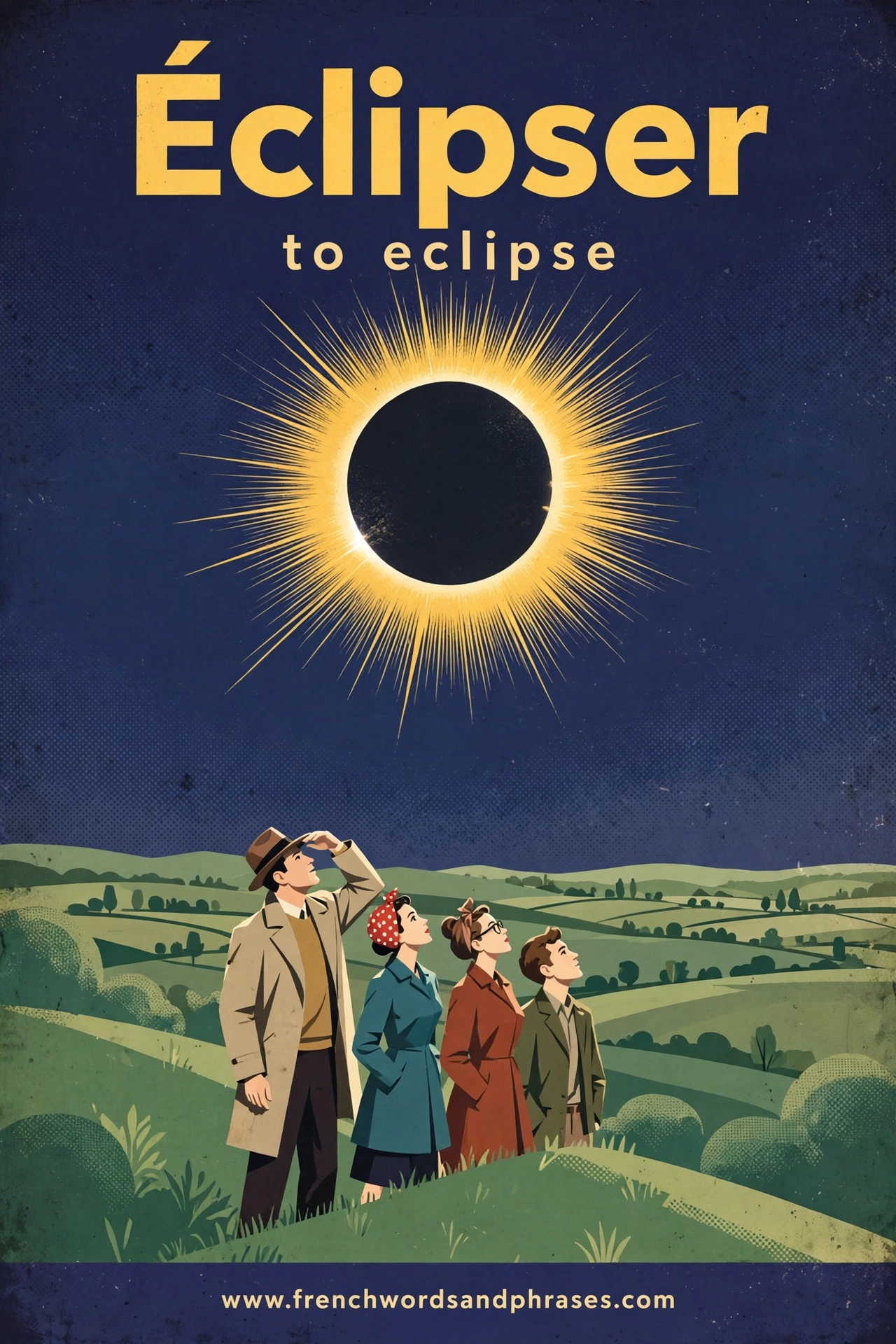
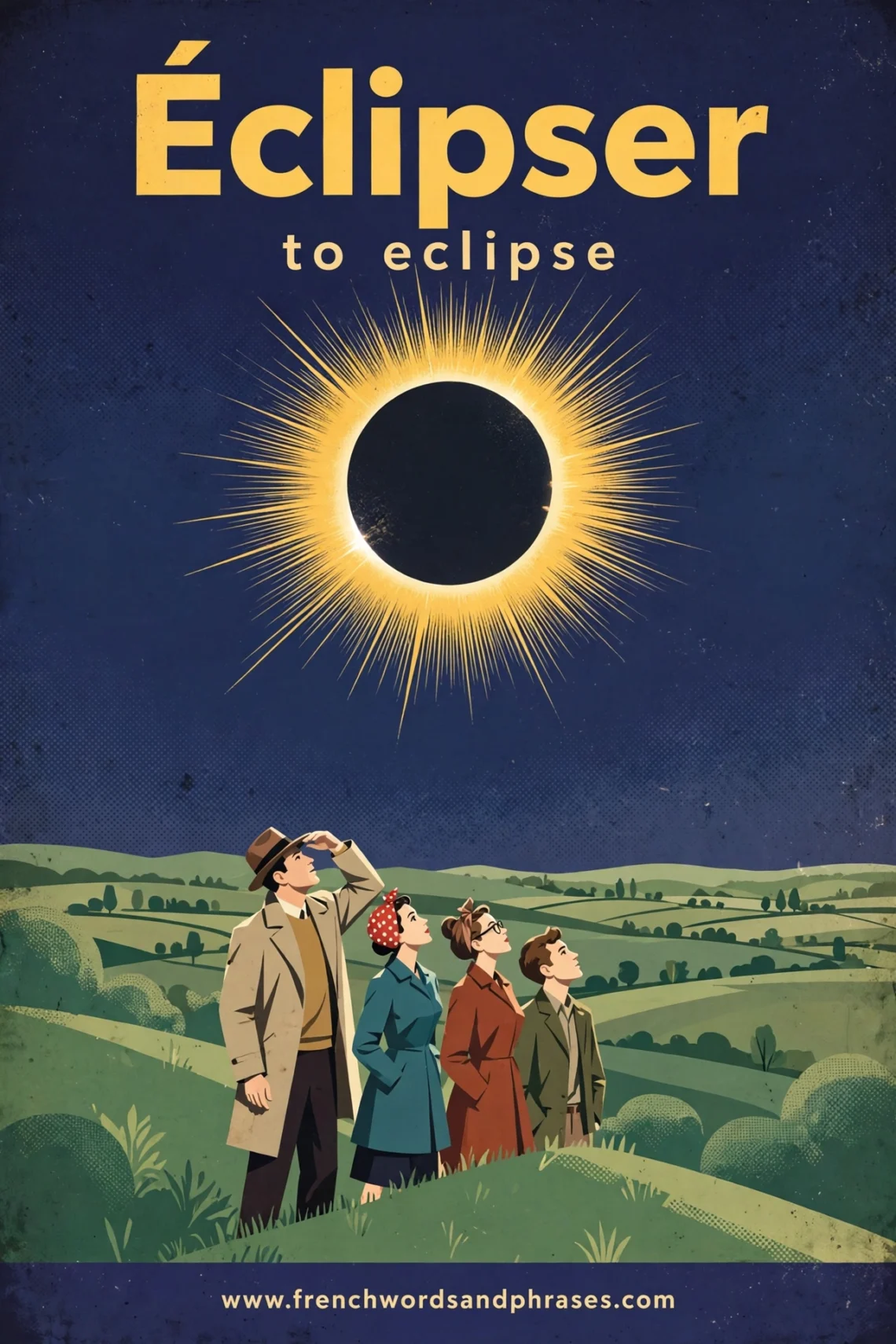
Imagine the great eclipse over a small town. The square goes quiet, the birds stop, a strange dusk falls at noon — and everyone, young and old, stands looking up through dark glasses at the moon calmly éclipsant the sun.
The sun has not gone anywhere. It has been eclipsed — éclipsé — hidden by a smaller, nearer light.
How to Conjugate Éclipser: Complete French Conjugation Guide
Let’s explore every major conjugation of éclipser, beginning with the indicative mood.
How to Conjugate Éclipser in the Indicative Mood
The indicative mood is used to express facts, observations, actions, and events.
How to Conjugate Éclipser in the Present Tense (Présent)
Used for actions happening now, habitual actions, and general truths.
| Subject | Conjugation |
|---|---|
| je | éclipse |
| tu | éclipses |
| il / elle | éclipse |
| nous | éclipsons |
| vous | éclipsez |
| ils / elles | éclipsent |
Example
La lune éclipse le soleil pendant quelques minutes.
The moon eclipses the sun for a few minutes.
Quick Quiz 1
Complete the sentence:
Nous ______ toutes les autres équipes cette saison.
Reveal the answer
éclipsons
Nous éclipsons toutes les autres équipes cette saison.
We are eclipsing all the other teams this season.
How to Conjugate Éclipser in the Passé Composé
Used for completed actions in the past. Éclipser takes the auxiliary verb avoir.
| Subject | Conjugation |
|---|---|
| j’ | ai éclipsé |
| tu | as éclipsé |
| il / elle | a éclipsé |
| nous | avons éclipsé |
| vous | avez éclipsé |
| ils / elles | ont éclipsé |
Example
La jeune actrice a éclipsé toutes ses partenaires.
The young actress eclipsed all her co-stars.
How to Conjugate Éclipser in the Imparfait (Imperfect Tense)
Used for habitual past actions, descriptions, and ongoing situations in the past.
| Subject | Conjugation |
|---|---|
| je | éclipsais |
| tu | éclipsais |
| il / elle | éclipsait |
| nous | éclipsions |
| vous | éclipsiez |
| ils / elles | éclipsaient |
Example
Son frère aîné éclipsait tout le monde aux réunions de famille.
His older brother used to overshadow everyone at family gatherings.
Quick Quiz 2
Choose the correct form:
She eclipsed her rivals.
Elle ______ ses rivales. (a éclipsé / est éclipsée)
Reveal the answer
a éclipsé
Elle a éclipsé ses rivales.
Éclipser takes avoir.
How to Conjugate Éclipser in the Plus-que-parfait
Used to describe an action that had already been completed before another past event.
| Subject | Conjugation |
|---|---|
| j’ | avais éclipsé |
| tu | avais éclipsé |
| il / elle | avait éclipsé |
| nous | avions éclipsé |
| vous | aviez éclipsé |
| ils / elles | avaient éclipsé |
Example
Elle avait éclipsé ses rivales dès sa première chanson.
She had eclipsed her rivals from her very first song.
How to Conjugate Éclipser in the Passé Simple
Primarily used in formal writing, literature, and historical narratives. It is rarely used in everyday conversation.
| Subject | Conjugation |
|---|---|
| je | éclipsai |
| tu | éclipsas |
| il / elle | éclipsa |
| nous | éclipsâmes |
| vous | éclipsâtes |
| ils / elles | éclipsèrent |
Example
Le champion éclipsa tous ses adversaires ce jour-là.
The champion eclipsed all his opponents that day.
How to Conjugate Éclipser in the Passé Antérieur
A literary tense used to express an action completed immediately before another past action, generally in the passé simple.
| Subject | Conjugation |
|---|---|
| j’ | eus éclipsé |
| tu | eus éclipsé |
| il / elle | eut éclipsé |
| nous | eûmes éclipsé |
| vous | eûtes éclipsé |
| ils / elles | eurent éclipsé |
Example
Quand la lune eut éclipsé le soleil, la foule applaudit.
When the moon had eclipsed the sun, the crowd applauded.
How to Conjugate Éclipser in the Future Tense (Futur Simple)
Used to describe actions that will take place in the future.
| Subject | Conjugation |
|---|---|
| je | éclipserai |
| tu | éclipseras |
| il / elle | éclipsera |
| nous | éclipserons |
| vous | éclipserez |
| ils / elles | éclipseront |
Example
Cette découverte éclipsera toutes les autres.
This discovery will eclipse all the others.
How to Conjugate Éclipser in the Futur Antérieur (Future Perfect)
Used for an action that will have been completed before a particular point in the future.
| Subject | Conjugation |
|---|---|
| j’ | aurai éclipsé |
| tu | auras éclipsé |
| il / elle | aura éclipsé |
| nous | aurons éclipsé |
| vous | aurez éclipsé |
| ils / elles | auront éclipsé |
Example
À la fin du concert, elle aura éclipsé la vedette elle-même.
By the end of the concert, she will have eclipsed the star herself.
How to Conjugate Éclipser in the Near Future (Futur Proche)
Used to describe something that is going to happen soon. Formed with aller + infinitive.
| Subject | Conjugation |
|---|---|
| je | vais éclipser |
| tu | vas éclipser |
| il / elle | va éclipser |
| nous | allons éclipser |
| vous | allez éclipser |
| ils / elles | vont éclipser |
Example
Attention, ce nuage va éclipser le soleil.
Careful, that cloud is going to eclipse the sun.
How to Conjugate Éclipser in the Conditional Mood
The conditional mood expresses what would happen under certain circumstances. It is also frequently used to make polite requests or express wishes.
How to Conjugate Éclipser in the Present Conditional
| Subject | Conjugation |
|---|---|
| je | éclipserais |
| tu | éclipserais |
| il / elle | éclipserait |
| nous | éclipserions |
| vous | éclipseriez |
| ils / elles | éclipseraient |
Example
Un tel talent éclipserait n’importe quel rival.
Such talent would eclipse any rival.
How to Conjugate Éclipser in the Past Conditional
| Subject | Conjugation |
|---|---|
| j’ | aurais éclipsé |
| tu | aurais éclipsé |
| il / elle | aurait éclipsé |
| nous | aurions éclipsé |
| vous | auriez éclipsé |
| ils / elles | auraient éclipsé |
Example
Il aurait éclipsé son maître avec un peu plus de temps.
He would have eclipsed his master with a little more time.
Éclipser in the Literary Past Conditional Form
This less common literary form uses the imperfect subjunctive of avoir.
| Subject | Conjugation |
|---|---|
| j’ | eusse éclipsé |
| tu | eusses éclipsé |
| il / elle | eût éclipsé |
| nous | eussions éclipsé |
| vous | eussiez éclipsé |
| ils / elles | eussent éclipsé |
Example
L’élève eût éclipsé le maître en une saison.
The pupil would have eclipsed the master in a single season.
How to Conjugate Éclipser in the Subjunctive Mood
The subjunctive is used to express wishes, emotions, doubts, necessity, and uncertainty. It frequently follows expressions such as il faut que (it is necessary that) or bien que (although).
How to Conjugate Éclipser in the Present Subjunctive
| Subject | Conjugation |
|---|---|
| que je | éclipse |
| que tu | éclipses |
| qu’il / qu’elle | éclipse |
| que nous | éclipsions |
| que vous | éclipsiez |
| qu’ils / qu’elles | éclipsent |
Example
Je ne veux pas que ce projet éclipse les autres.
I do not want this project to eclipse the others.
Quick Quiz 3
Complete the sentence using the subjunctive:
Il ne faut pas que tu ______ tes camarades.
Reveal the answer
éclipses
Il ne faut pas que tu éclipses tes camarades.
You must not overshadow your classmates.
How to Conjugate Éclipser in the Imperfect Subjunctive
A literary tense, rarely encountered in modern spoken French.
| Subject | Conjugation |
|---|---|
| que je | éclipsasse |
| que tu | éclipsasses |
| qu’il / qu’elle | éclipsât |
| que nous | éclipsassions |
| que vous | éclipsassiez |
| qu’ils / qu’elles | éclipsassent |
Example
On craignait que la nouvelle star éclipsât l’équipe entière.
People feared the new star might overshadow the whole team.
How to Conjugate Éclipser in the Pluperfect Subjunctive
A literary construction used to express an action completed before another past action.
| Subject | Conjugation |
|---|---|
| que j’ | eusse éclipsé |
| que tu | eusses éclipsé |
| qu’il / qu’elle | eût éclipsé |
| que nous | eussions éclipsé |
| que vous | eussiez éclipsé |
| qu’ils / qu’elles | eussent éclipsé |
Example
Les critiques écrivirent qu’elle eût éclipsé la vedette.
The critics wrote that she had eclipsed the star.
How to Conjugate Éclipser in the Past Subjunctive
| Subject | Conjugation |
|---|---|
| que j’ | aie éclipsé |
| que tu | aies éclipsé |
| qu’il / qu’elle | ait éclipsé |
| que nous | ayons éclipsé |
| que vous | ayez éclipsé |
| qu’ils / qu’elles | aient éclipsé |
Example
Je suis fier que tu aies éclipsé tes concurrents.
I am proud that you eclipsed your competitors.
How to Conjugate Éclipser in the Imperative
The imperative is used to give commands, instructions, invitations, or suggestions. Subject pronouns are omitted.
How to Conjugate Éclipser in the Present Imperative
| Person | Conjugation |
|---|---|
| (tu) | éclipse |
| (nous) | éclipsons |
| (vous) | éclipsez |
Example
N’éclipse pas tes camarades, laisse-leur leur chance !
Do not overshadow your classmates, give them their chance!
Quick Quiz 4
How would you say Slip away quietly (tu form)?
Reveal the answer
Éclipse-toi discrètement !
French Participles of Éclipser
Participles are verb forms that can be used in compound tenses and other grammatical constructions.
Present Participle of Éclipser
éclipsant
En éclipsant ses rivales, elle est devenue la préférée du public.
By eclipsing her rivals, she became the audience’s favourite.
Past Participle of Éclipser
éclipsé
Éclipsé par son élève, le vieux maître souriait.
Eclipsed by his pupil, the old master smiled.
Éclipser in Everyday French: Real-Life Examples
Now that you know the conjugations, let’s see how éclipser appears in everyday French.
Example 1 — Present
La lune éclipse le soleil aujourd’hui.
The moon is eclipsing the sun today.
Example 2 — Passé composé
Il s’est éclipsé avant la fin de la soirée.
He slipped away before the end of the evening.
Example 3 — Imparfait
Elle éclipsait toutes les autres chanteuses.
She used to eclipse all the other singers.
Example 4 — Future
Ce nuage éclipsera le soleil dans un instant.
That cloud will eclipse the sun in a moment.
Example 5 — Conditional
Tu éclipserais tout le monde avec cette robe.
You would eclipse everyone in that dress.
Example 6 — Imperative
Éclipse-toi avant qu’on te demande de laver la vaisselle !
Slip away before they ask you to do the dishes!
Beyond Translation: The Meaning of Éclipser
English eclipse stays mostly in the sky and in metaphors of fame; French éclipser adds the graceful exit: s’éclipser.
To eclipse yourself is a courtesy.
To be eclipsed is to lose the light; to eclipse yourself, politely, is to take your leave inside the shadow — the same verb, at the door of the party, bowing out unnoticed.
How to Remember the French Verb Éclipser
Remember it this way: Éclipser is about one light hiding another — in the sky, on stage, at the door.
- Une éclipse — an eclipse; éclipser un rival — to overshadow a rival completely.
- S’éclipser — to slip away quietly, without saying goodbye.
- Regular -er: j’éclipse, nous éclipsons, past participle éclipsé.
The key idea is one light hiding another — in the sky, on stage, at the door.
Test Your Knowledge of Éclipser
Let’s see how much you’ve learned. Try answering these questions before revealing the answers.
Question 1
How do you say He slipped away in French?
Reveal the answer
Il s’est éclipsé.
Question 2
What is une éclipse?
Reveal the answer
An eclipse — the moon or the earth hiding the light.
Question 3
Translate: The young actress eclipsed all her co-stars.
Reveal the answer
La jeune actrice a éclipsé toutes ses partenaires.
Question 4
What is the past participle of éclipser?
Reveal the answer
Éclipsé.
Question 5
Complete the sentence:
Je ne veux pas que ce projet ______ les autres.
Reveal the answer
éclipse
Je ne veux pas que ce projet éclipse les autres.
I do not want this project to eclipse the others.
Your Final Challenge
Can You Use It?
How would you say this in French?
The moon eclipses the sun, then he slips away without a sound.
Reveal the answer
La lune éclipse le soleil, puis il s’éclipse sans bruit.
The moon eclipses the sun, then he slips away without a sound.
A little French. A little curiosity. A richer everyday life.
LEARN FRENCH ONE WORD AT A TIME