A French Word to Live By
How to Conjugate Défaire in French
/de.fɛʁ/
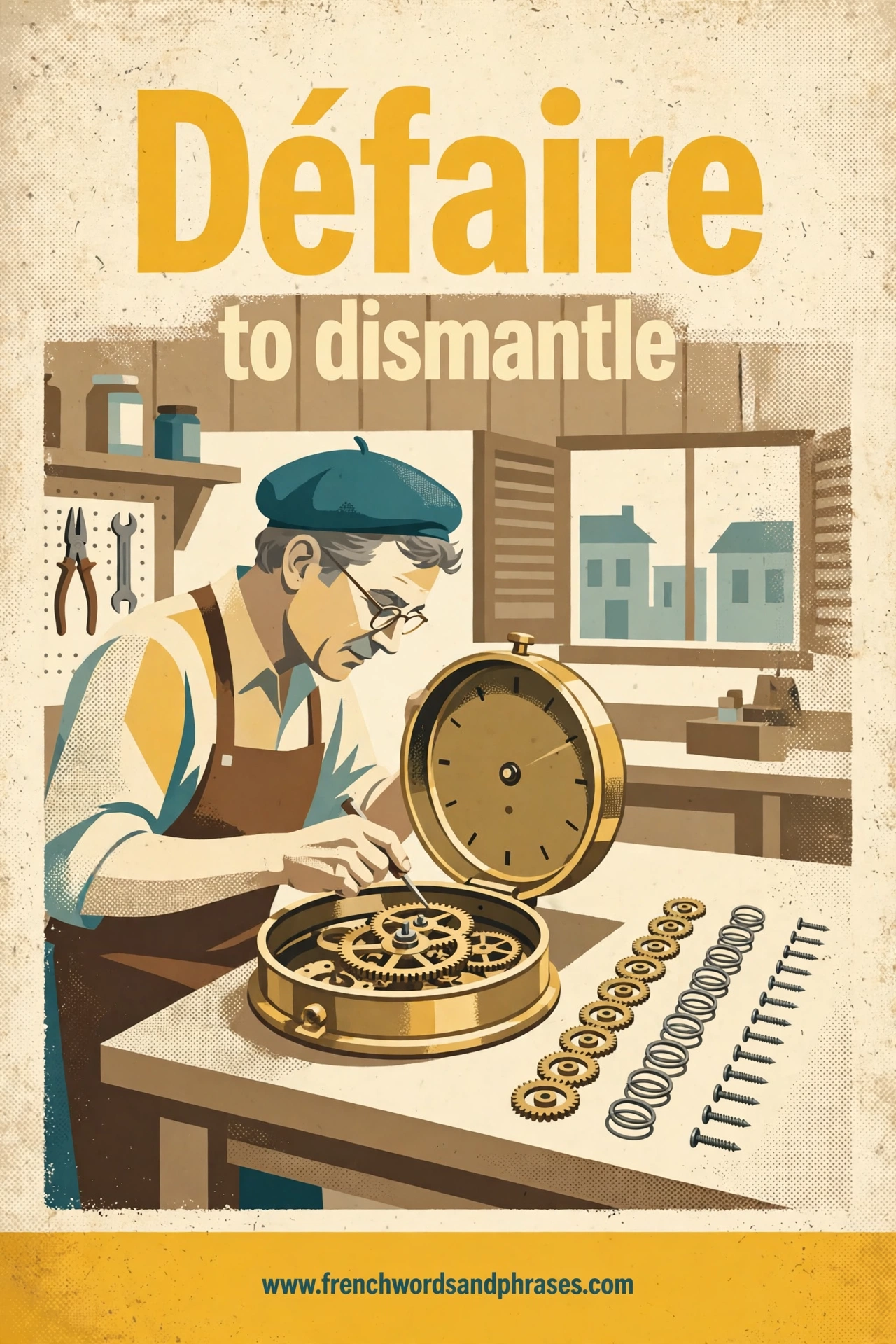
Défaire means to dismantle — to undo, to take apart what was made.
A bed stripped in the morning, a suitcase unpacked, a knot worked loose by patient fingers — défaire is the verb of undoing: everything faire builds, défaire takes apart, piece by piece, knot by knot.
In this guide, you’ll learn how to conjugate défaire in all the major French tenses and moods. Explore complete conjugation tables, French examples, English translations, and practice quizzes.
Understanding the French Verb Défaire
Défaire is an irregular French verb conjugated exactly like faire — défaire is faire in reverse, and it keeps every irregular form of the family.
It means to dismantle. It is commonly used for undoing knots, stitches and hairstyles, for stripping beds and unpacking suitcases, for dismantling furniture and machines, and in the reflexive — se défaire de — for getting rid of objects, habits and even, coldly, employees.
Verb classification: Irregular (faire family)
Auxiliary verb: Avoir
Past participle: défait
Present participle: défaisant
English equivalents: To undo, to dismantle, to take apart; défaire un lit — to strip a bed; défaire ses valises — to unpack; se défaire de — to get rid of.
One important detail: défaire conjugates exactly like faire, irregularities included: je défais, il défait, nous défaisons, vous défaites, ils défont, future je déferai, past participle défait. In the passé simple the il form is il défit, without a circumflex, exactly like il fit; the hat appears only in nous défîmes, vous défîtes. And learn the reflexive treasure: se défaire de quelque chose means to get rid of it — se défaire d’une vieille voiture, d’une mauvaise habitude.
Experience the Word
Défaire is the verb of the reverse journey — every knot, seam and screw travelling back to the beginning.
Imagine the evening after a long trip. The suitcase lands on the bed, the zip sighs open, and in ten minutes the whole journey is défaite: clothes in the wash, gifts on the table, the trip dismantled back into ordinary life. Défaire ses valises is the true end of every holiday.
The journey has not been forgotten. It has been undone — défaite, unpacked, folded back into home.
How to Conjugate Défaire: Complete French Conjugation Guide
Let’s explore every major conjugation of défaire, beginning with the indicative mood.
How to Conjugate Défaire in the Indicative Mood
The indicative mood is used to express facts, observations, actions, and events.
How to Conjugate Défaire in the Present Tense (Présent)
Used for actions happening now, habitual actions, and general truths.
| Subject | Conjugation |
|---|---|
| je | défais |
| tu | défais |
| il / elle | défait |
| nous | défaisons |
| vous | défaites |
| ils / elles | défont |
Example
Elle défait le nœud avec patience.
She undoes the knot patiently.
Quick Quiz 1
Complete the sentence:
Nous ______ nos valises en rentrant.
Reveal the answer
défaisons
Nous défaisons nos valises en rentrant.
We unpack our suitcases when we get home.
How to Conjugate Défaire in the Passé Composé
Used for completed actions in the past. Défaire takes the auxiliary verb avoir.
| Subject | Conjugation |
|---|---|
| j’ | ai défait |
| tu | as défait |
| il / elle | a défait |
| nous | avons défait |
| vous | avez défait |
| ils / elles | ont défait |
Example
Nous avons défait les valises en rentrant.
We unpacked the suitcases when we got home.
How to Conjugate Défaire in the Imparfait (Imperfect Tense)
Used for habitual past actions, descriptions, and ongoing situations in the past.
| Subject | Conjugation |
|---|---|
| je | défaisais |
| tu | défaisais |
| il / elle | défaisait |
| nous | défaisions |
| vous | défaisiez |
| ils / elles | défaisaient |
Example
Chaque soir, elle défaisait sa tresse devant le miroir.
Every evening, she used to undo her braid in front of the mirror.
Quick Quiz 2
Choose the correct form:
He dismantled the engine.
Il ______ le moteur. (a défait / est défait)
Reveal the answer
a défait
Il a défait le moteur.
Défaire takes avoir.
How to Conjugate Défaire in the Plus-que-parfait
Used to describe an action that had already been completed before another past event.
| Subject | Conjugation |
|---|---|
| j’ | avais défait |
| tu | avais défait |
| il / elle | avait défait |
| nous | avions défait |
| vous | aviez défait |
| ils / elles | avaient défait |
Example
Il avait défait le moteur avant l’arrivée du mécanicien.
He had dismantled the engine before the mechanic arrived.
How to Conjugate Défaire in the Passé Simple
Primarily used in formal writing, literature, and historical narratives. It is rarely used in everyday conversation.
| Subject | Conjugation |
|---|---|
| je | défis |
| tu | défis |
| il / elle | défit |
| nous | défîmes |
| vous | défîtes |
| ils / elles | défirent |
Example
Il défit le paquet et en sortit une lettre.
He undid the parcel and took out a letter.
How to Conjugate Défaire in the Passé Antérieur
A literary tense used to express an action completed immediately before another past action, generally in the passé simple.
| Subject | Conjugation |
|---|---|
| j’ | eus défait |
| tu | eus défait |
| il / elle | eut défait |
| nous | eûmes défait |
| vous | eûtes défait |
| ils / elles | eurent défait |
Example
Quand ils eurent défait le campement, la plaine redevint silencieuse.
When they had dismantled the camp, the plain became silent again.
How to Conjugate Défaire in the Future Tense (Futur Simple)
Used to describe actions that will take place in the future.
| Subject | Conjugation |
|---|---|
| je | déferai |
| tu | déferas |
| il / elle | défera |
| nous | déferons |
| vous | déferez |
| ils / elles | déferont |
Example
Demain, je déferai ce meuble pour le déménagement.
Tomorrow, I will take this piece of furniture apart for the move.
How to Conjugate Défaire in the Futur Antérieur (Future Perfect)
Used for an action that will have been completed before a particular point in the future.
| Subject | Conjugation |
|---|---|
| j’ | aurai défait |
| tu | auras défait |
| il / elle | aura défait |
| nous | aurons défait |
| vous | aurez défait |
| ils / elles | auront défait |
Example
À midi, elle aura défait toutes les coutures.
By noon, she will have unpicked all the seams.
How to Conjugate Défaire in the Near Future (Futur Proche)
Used to describe something that is going to happen soon. Formed with aller + infinitive.
| Subject | Conjugation |
|---|---|
| je | vais défaire |
| tu | vas défaire |
| il / elle | va défaire |
| nous | allons défaire |
| vous | allez défaire |
| ils / elles | vont défaire |
Example
Elle va se défaire de sa vieille voiture.
She is going to get rid of her old car.
How to Conjugate Défaire in the Conditional Mood
The conditional mood expresses what would happen under certain circumstances. It is also frequently used to make polite requests or express wishes.
How to Conjugate Défaire in the Present Conditional
| Subject | Conjugation |
|---|---|
| je | déferais |
| tu | déferais |
| il / elle | déferait |
| nous | déferions |
| vous | déferiez |
| ils / elles | déferaient |
Example
À ta place, je déferais ce nœud au lieu de le couper.
In your place, I would undo this knot instead of cutting it.
How to Conjugate Défaire in the Past Conditional
| Subject | Conjugation |
|---|---|
| j’ | aurais défait |
| tu | aurais défait |
| il / elle | aurait défait |
| nous | aurions défait |
| vous | auriez défait |
| ils / elles | auraient défait |
Example
Ils auraient défait la tente avant la pluie, sans ce retard.
They would have taken the tent down before the rain, without this delay.
Défaire in the Literary Past Conditional Form
This less common literary form uses the imperfect subjunctive of avoir.
| Subject | Conjugation |
|---|---|
| j’ | eusse défait |
| tu | eusses défait |
| il / elle | eût défait |
| nous | eussions défait |
| vous | eussiez défait |
| ils / elles | eussent défait |
Example
Il eût défait l’armée entière d’un seul ordre.
He would have routed the entire army with a single order.
How to Conjugate Défaire in the Subjunctive Mood
The subjunctive is used to express wishes, emotions, doubts, necessity, and uncertainty. It frequently follows expressions such as il faut que (it is necessary that) or bien que (although).
How to Conjugate Défaire in the Present Subjunctive
| Subject | Conjugation |
|---|---|
| que je | défasse |
| que tu | défasses |
| qu’il / qu’elle | défasse |
| que nous | défassions |
| que vous | défassiez |
| qu’ils / qu’elles | défassent |
Example
Il faut que tu défasses ton lit avant de partir.
You must strip your bed before leaving.
Quick Quiz 3
Complete the sentence using the subjunctive:
Il faut que vous ______ ce nœud.
Reveal the answer
défassiez
Il faut que vous défassiez ce nœud.
You must undo this knot.
How to Conjugate Défaire in the Imperfect Subjunctive
A literary tense, rarely encountered in modern spoken French.
| Subject | Conjugation |
|---|---|
| que je | défisse |
| que tu | défisses |
| qu’il / qu’elle | défît |
| que nous | défissions |
| que vous | défissiez |
| qu’ils / qu’elles | défissent |
Example
Elle tirait doucement, de peur qu’il ne défît le bandage.
She pulled gently, for fear he might undo the bandage.
How to Conjugate Défaire in the Pluperfect Subjunctive
A literary construction used to express an action completed before another past action.
| Subject | Conjugation |
|---|---|
| que j’ | eusse défait |
| que tu | eusses défait |
| qu’il / qu’elle | eût défait |
| que nous | eussions défait |
| que vous | eussiez défait |
| qu’ils / qu’elles | eussent défait |
Example
Il regrettait qu’ils eussent défait la machine sans noter l’ordre des pièces.
He regretted that they had dismantled the machine without noting the order of the parts.
How to Conjugate Défaire in the Past Subjunctive
| Subject | Conjugation |
|---|---|
| que j’ | aie défait |
| que tu | aies défait |
| qu’il / qu’elle | ait défait |
| que nous | ayons défait |
| que vous | ayez défait |
| qu’ils / qu’elles | aient défait |
Example
Je suis étonné qu’elle ait défait sa valise si vite.
I am surprised she unpacked her suitcase so quickly.
How to Conjugate Défaire in the Imperative
The imperative is used to give commands, instructions, invitations, or suggestions. Subject pronouns are omitted.
How to Conjugate Défaire in the Present Imperative
| Person | Conjugation |
|---|---|
| (tu) | défais |
| (nous) | défaisons |
| (vous) | défaites |
Example
Défais tes lacets avant d’entrer !
Undo your laces before coming in!
Quick Quiz 4
How would you say Undo your laces (tu form)?
Reveal the answer
Défais tes lacets !
French Participles of Défaire
Participles are verb forms that can be used in compound tenses and other grammatical constructions.
Present Participle of Défaire
défaisant
En défaisant le moteur, il a trouvé la panne.
While dismantling the engine, he found the fault.
Past Participle of Défaire
défait
Défait en pièces détachées, le vélo tenait dans deux cartons.
Taken apart into separate pieces, the bicycle fitted into two boxes.
Défaire in Everyday French: Real-Life Examples
Now that you know the conjugations, let’s see how défaire appears in everyday French.
Example 1 — Present
Elle défait sa valise dès son arrivée.
She unpacks her suitcase as soon as she arrives.
Example 2 — Passé composé
Ils ont défait la tente en dix minutes.
They took the tent down in ten minutes.
Example 3 — Imparfait
Ma mère défaisait les ourlets pour rallonger nos robes.
My mother used to unpick the hems to lengthen our dresses.
Example 4 — Future
Tu déferas ton lit demain matin.
You will strip your bed tomorrow morning.
Example 5 — Conditional
Je me déferais bien de ces vieux papiers.
I would gladly get rid of these old papers.
Example 6 — Imperative
Défaites le stand avant midi !
Take the stand down before noon!
Beyond Translation: The Meaning of Défaire
English needs a toolbox of verbs — undo, unpack, strip, dismantle, defeat; French défaire is one verb for the whole reverse side of making.
And its reflexive is the art of letting go.
Se défaire d’une habitude, d’un souvenir, d’une voiture — to get rid of a habit, a memory, a car — is défaire turned on your own life: dismantling what you no longer want to carry.
How to Remember the French Verb Défaire
Remember it this way: Défaire is about faire in reverse — undoing knots, beds, suitcases and armies.
- Défaire copies faire exactly: je défais, vous défaites, ils défont, past participle défait.
- Se défaire de — to get rid of: the reflexive that empties garages and breaks habits.
- Il défit has no circumflex, like il fit; the hat is in nous défîmes, vous défîtes.
The key idea is faire in reverse — undoing knots, beds, suitcases and armies.
Test Your Knowledge of Défaire
Let’s see how much you’ve learned. Try answering these questions before revealing the answers.
Question 1
How do you say to get rid of something in French, using défaire?
Reveal the answer
Se défaire de quelque chose.
Question 2
Translate: We unpacked the suitcases when we got home.
Reveal the answer
Nous avons défait les valises en rentrant.
Question 3
How do you say They undo the knot in French?
Reveal the answer
Ils défont le nœud.
Question 4
What is the past participle of défaire?
Reveal the answer
Défait — défaite, défaits, défaites when it agrees.
Question 5
Complete the sentence:
Il faut que tu ______ ton lit avant de partir.
Reveal the answer
défasses
Il faut que tu défasses ton lit avant de partir.
You must strip your bed before leaving.
Your Final Challenge
Can You Use It?
How would you say this in French?
She unpacks her suitcase, hangs up her dresses, and the holiday becomes a memory.
Reveal the answer
Elle défait sa valise, accroche ses robes, et les vacances deviennent un souvenir.
She unpacks her suitcase, hangs up her dresses, and the holiday becomes a memory.
A little French. A little curiosity. A richer everyday life.
LEARN FRENCH ONE WORD AT A TIME