A French Word to Live By
How to Conjugate Dédorer in French
/de.dɔ.ʁe/
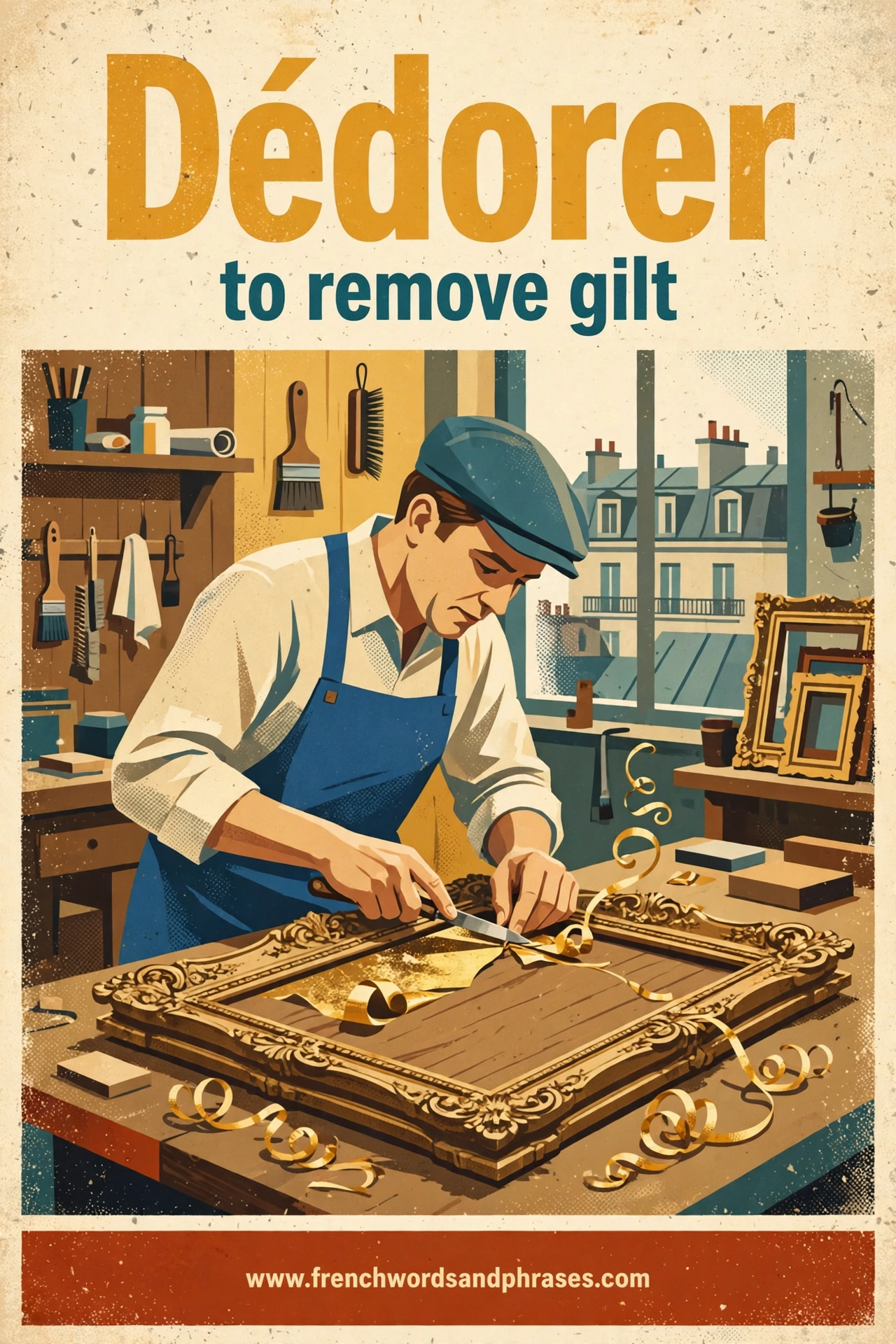
Dédorer means to remove gilt — to take the gilding off a surface.
A mirror frame gone dull, a picture rail stripped back to bare wood, gold leaf flaking into a restorer’s tray — dédorer is the quiet verb of ungilding, of taking the shine of gold off the things it once covered.
In this guide, you’ll learn how to conjugate dédorer in all the major French tenses and moods. Explore complete conjugation tables, French examples, English translations, and practice quizzes.
Understanding the French Verb Dédorer
Dédorer is a regular French verb belonging to the first group of verbs, those ending in -er.
It means to remove gilt. It is commonly used in restoration workshops for stripping gilding from frames, furniture and church ornaments before repair, for the natural wearing away of gold leaf over centuries, and figuratively for anything that loses its golden shine — une réputation qui se dédore, a reputation tarnishing.
Verb classification: First group (-er)
Auxiliary verb: Avoir
Past participle: dédoré
Present participle: dédorant
English equivalents: To remove gilt, to ungild; dorer — to gild; la dorure — gilding; un doreur — a gilder.
One important detail: dédorer is simply dorer, to gild, with the reversing prefix dé- — where dorer puts the gold on, dédorer takes it off. Restorers dédorent old frames before re-gilding them, and time itself does the same work: un cadre dédoré is a frame whose gilding has worn away. French even keeps the phrase dédorer la pilule‘s opposite famous: dorer la pilule, to gild the pill — to make something unpleasant easier to swallow.
Experience the Word
Dédorer is the verb of gold in retreat — the shine comes off, and the plain wood underneath tells the truth.
Imagine a restorer’s workshop in Florence or Paris. On the bench, a Baroque frame blackened by candle smoke; with cotton, solvent and infinite patience, the restorer dédore the corners that cannot be saved, down to the pale gesso, so that new gold can one day shine there.
The frame has lost its splendour for a while. It has been ungilded — dédoré, stripped back to honesty.
How to Conjugate Dédorer: Complete French Conjugation Guide
Let’s explore every major conjugation of dédorer, beginning with the indicative mood.
How to Conjugate Dédorer in the Indicative Mood
The indicative mood is used to express facts, observations, actions, and events.
How to Conjugate Dédorer in the Present Tense (Présent)
Used for actions happening now, habitual actions, and general truths.
| Subject | Conjugation |
|---|---|
| je | dédore |
| tu | dédores |
| il / elle | dédore |
| nous | dédorons |
| vous | dédorez |
| ils / elles | dédorent |
Example
La restauratrice dédore le cadre avant de le restaurer.
The restorer removes the gilt from the frame before restoring it.
Quick Quiz 1
Complete the sentence:
Nous ______ les cadres de la galerie demain.
Reveal the answer
dédorerons
Nous dédorerons les cadres de la galerie demain.
We will strip the gallery frames tomorrow.
How to Conjugate Dédorer in the Passé Composé
Used for completed actions in the past. Dédorer takes the auxiliary verb avoir.
| Subject | Conjugation |
|---|---|
| j’ | ai dédoré |
| tu | as dédoré |
| il / elle | a dédoré |
| nous | avons dédoré |
| vous | avez dédoré |
| ils / elles | ont dédoré |
Example
Ils ont dédoré les boiseries du salon pendant les travaux.
They stripped the gilt from the drawing-room woodwork during the works.
How to Conjugate Dédorer in the Imparfait (Imperfect Tense)
Used for habitual past actions, descriptions, and ongoing situations in the past.
| Subject | Conjugation |
|---|---|
| je | dédorais |
| tu | dédorais |
| il / elle | dédorait |
| nous | dédorions |
| vous | dédoriez |
| ils / elles | dédoraient |
Example
Le temps dédorait lentement les anges de l’autel.
Time was slowly removing the gilt from the angels of the altar.
Quick Quiz 2
Choose the correct form:
They stripped the woodwork.
Ils ______ les boiseries. (ont dédoré / sont dédorés)
Reveal the answer
ont dédoré
Ils ont dédoré les boiseries.
Dédorer takes avoir.
How to Conjugate Dédorer in the Plus-que-parfait
Used to describe an action that had already been completed before another past event.
| Subject | Conjugation |
|---|---|
| j’ | avais dédoré |
| tu | avais dédoré |
| il / elle | avait dédoré |
| nous | avions dédoré |
| vous | aviez dédoré |
| ils / elles | avaient dédoré |
Example
L’artisan avait dédoré le miroir avant l’arrivée du client.
The craftsman had removed the gilt from the mirror before the client arrived.
How to Conjugate Dédorer in the Passé Simple
Primarily used in formal writing, literature, and historical narratives. It is rarely used in everyday conversation.
| Subject | Conjugation |
|---|---|
| je | dédorai |
| tu | dédoras |
| il / elle | dédora |
| nous | dédorâmes |
| vous | dédorâtes |
| ils / elles | dédorèrent |
Example
Le doreur dédora la console et la prépara pour une nouvelle dorure.
The gilder stripped the console table and prepared it for new gilding.
How to Conjugate Dédorer in the Passé Antérieur
A literary tense used to express an action completed immediately before another past action, generally in the passé simple.
| Subject | Conjugation |
|---|---|
| j’ | eus dédoré |
| tu | eus dédoré |
| il / elle | eut dédoré |
| nous | eûmes dédoré |
| vous | eûtes dédoré |
| ils / elles | eurent dédoré |
Example
Quand il eut dédoré les moulures, il ponça le bois à nu.
When he had removed the gilt from the mouldings, he sanded the bare wood.
How to Conjugate Dédorer in the Future Tense (Futur Simple)
Used to describe actions that will take place in the future.
| Subject | Conjugation |
|---|---|
| je | dédorerai |
| tu | dédoreras |
| il / elle | dédorera |
| nous | dédorerons |
| vous | dédorerez |
| ils / elles | dédoreront |
Example
Demain, nous dédorerons les cadres de la galerie.
Tomorrow, we will strip the gilt from the gallery frames.
How to Conjugate Dédorer in the Futur Antérieur (Future Perfect)
Used for an action that will have been completed before a particular point in the future.
| Subject | Conjugation |
|---|---|
| j’ | aurai dédoré |
| tu | auras dédoré |
| il / elle | aura dédoré |
| nous | aurons dédoré |
| vous | aurez dédoré |
| ils / elles | auront dédoré |
Example
À la fin du mois, l’atelier aura dédoré tous les meubles du château.
By the end of the month, the workshop will have ungilded all the castle furniture.
How to Conjugate Dédorer in the Near Future (Futur Proche)
Used to describe something that is going to happen soon. Formed with aller + infinitive.
| Subject | Conjugation |
|---|---|
| je | vais dédorer |
| tu | vas dédorer |
| il / elle | va dédorer |
| nous | allons dédorer |
| vous | allez dédorer |
| ils / elles | vont dédorer |
Example
Je vais dédorer ce petit cadre pour le repeindre.
I am going to strip the gilt from this little frame to repaint it.
How to Conjugate Dédorer in the Conditional Mood
The conditional mood expresses what would happen under certain circumstances. It is also frequently used to make polite requests or express wishes.
How to Conjugate Dédorer in the Present Conditional
| Subject | Conjugation |
|---|---|
| je | dédorerais |
| tu | dédorerais |
| il / elle | dédorerait |
| nous | dédorerions |
| vous | dédoreriez |
| ils / elles | dédoreraient |
Example
Avec plus de patience, on dédorerait sans abîmer le bois.
With more patience, we would remove the gilt without damaging the wood.
How to Conjugate Dédorer in the Past Conditional
| Subject | Conjugation |
|---|---|
| j’ | aurais dédoré |
| tu | aurais dédoré |
| il / elle | aurait dédoré |
| nous | aurions dédoré |
| vous | auriez dédoré |
| ils / elles | auraient dédoré |
Example
Elle aurait dédoré le miroir si le solvant avait suffi.
She would have removed the gilt from the mirror if there had been enough solvent.
Dédorer in the Literary Past Conditional Form
This less common literary form uses the imperfect subjunctive of avoir.
| Subject | Conjugation |
|---|---|
| j’ | eusse dédoré |
| tu | eusses dédoré |
| il / elle | eût dédoré |
| nous | eussions dédoré |
| vous | eussiez dédoré |
| ils / elles | eussent dédoré |
Example
L’antiquaire eût dédoré le cadre avant de le vendre.
The antique dealer would have stripped the frame before selling it.
How to Conjugate Dédorer in the Subjunctive Mood
The subjunctive is used to express wishes, emotions, doubts, necessity, and uncertainty. It frequently follows expressions such as il faut que (it is necessary that) or bien que (although).
How to Conjugate Dédorer in the Present Subjunctive
| Subject | Conjugation |
|---|---|
| que je | dédore |
| que tu | dédores |
| qu’il / qu’elle | dédore |
| que nous | dédorions |
| que vous | dédoriez |
| qu’ils / qu’elles | dédorent |
Example
Il faut que l’on dédore ces boiseries avec précaution.
We must remove the gilt from this woodwork carefully.
Quick Quiz 3
Complete the sentence using the subjunctive:
Il faut que vous ______ ce cadre avec précaution.
Reveal the answer
dédoriez
Il faut que vous dédoriez ce cadre avec précaution.
You must remove the gilt from this frame carefully.
How to Conjugate Dédorer in the Imperfect Subjunctive
A literary tense, rarely encountered in modern spoken French.
| Subject | Conjugation |
|---|---|
| que je | dédorasse |
| que tu | dédorasses |
| qu’il / qu’elle | dédorât |
| que nous | dédorassions |
| que vous | dédorassiez |
| qu’ils / qu’elles | dédorassent |
Example
Le client demandait que l’artisan dédorât le cadre entier.
The client asked the craftsman to strip the whole frame.
How to Conjugate Dédorer in the Pluperfect Subjunctive
A literary construction used to express an action completed before another past action.
| Subject | Conjugation |
|---|---|
| que j’ | eusse dédoré |
| que tu | eusses dédoré |
| qu’il / qu’elle | eût dédoré |
| que nous | eussions dédoré |
| que vous | eussiez dédoré |
| qu’ils / qu’elles | eussent dédoré |
Example
On regrettait qu’ils eussent dédoré les sculptures anciennes.
People regretted that they had stripped the gilt from the old sculptures.
How to Conjugate Dédorer in the Past Subjunctive
| Subject | Conjugation |
|---|---|
| que j’ | aie dédoré |
| que tu | aies dédoré |
| qu’il / qu’elle | ait dédoré |
| que nous | ayons dédoré |
| que vous | ayez dédoré |
| qu’ils / qu’elles | aient dédoré |
Example
Je suis étonné qu’ils aient dédoré un cadre si rare.
I am surprised they stripped such a rare frame.
How to Conjugate Dédorer in the Imperative
The imperative is used to give commands, instructions, invitations, or suggestions. Subject pronouns are omitted.
How to Conjugate Dédorer in the Present Imperative
| Person | Conjugation |
|---|---|
| (tu) | dédore |
| (nous) | dédorons |
| (vous) | dédorez |
Example
Dédore doucement, le bois est fragile !
Remove the gilt gently, the wood is fragile!
Quick Quiz 4
How would you say Remove the gilt gently (tu form)?
Reveal the answer
Dédore doucement !
French Participles of Dédorer
Participles are verb forms that can be used in compound tenses and other grammatical constructions.
Present Participle of Dédorer
dédorant
En dédorant le cadre, elle a retrouvé une signature cachée.
While removing the gilt from the frame, she found a hidden signature.
Past Participle of Dédorer
dédoré
Dédoré par les siècles, l’autel gardait une beauté grave.
Ungilded by the centuries, the altar kept a grave beauty.
Dédorer in Everyday French: Real-Life Examples
Now that you know the conjugations, let’s see how dédorer appears in everyday French.
Example 1 — Present
Le soleil dédore les lettres de l’enseigne.
The sun is fading the gilt letters of the sign.
Example 2 — Passé composé
Nous avons dédoré le vieux miroir de grand-mère.
We stripped the gilt from grandmother’s old mirror.
Example 3 — Imparfait
L’humidité dédorait les cadres de la chapelle.
The damp was removing the gilt from the chapel frames.
Example 4 — Future
L’atelier dédorera la console la semaine prochaine.
The workshop will strip the console table next week.
Example 5 — Conditional
Tu dédorerais ce cadre, toi, ou tu le garderais ?
Would you strip this frame, or keep it as it is?
Example 6 — Imperative
Ne dédorez jamais un meuble ancien sans avis !
Never strip an antique piece without advice!
Beyond Translation: The Meaning of Dédorer
English barely has this verb — ungild is a dictionary ghost; French dédorer is a working word of the restoration bench, because French churches and châteaux are full of gold that ages.
Every gilded thing is slowly being dédoré.
Time, smoke and damp do the work free of charge — and the restorers of France make their living answering them, one frame at a time.
How to Remember the French Verb Dédorer
Remember it this way: Dédorer is about gold in retreat — the frame stripped back to bare wood.
- Dorer = to gild, dédorer = to take the gilding off — dé- reverses the gold.
- Un cadre dédoré — a frame whose gilding has worn away.
- Regular -er: je dédore, nous dédorons, past participle dédoré.
The key idea is gold in retreat — the frame stripped back to bare wood.
Test Your Knowledge of Dédorer
Let’s see how much you’ve learned. Try answering these questions before revealing the answers.
Question 1
What is the opposite of dorer (to gild)?
Reveal the answer
Dédorer — to remove the gilt.
Question 2
How do you say The restorer removes the gilt from the frame in French?
Reveal the answer
La restauratrice dédore le cadre.
Question 3
Translate: We stripped the gilt from grandmother’s old mirror.
Reveal the answer
Nous avons dédoré le vieux miroir de grand-mère.
Question 4
What is the past participle of dédorer?
Reveal the answer
Dédoré.
Question 5
Complete the sentence:
Il faut que l’on ______ ces boiseries avec précaution.
Reveal the answer
dédore
Il faut que l’on dédore ces boiseries avec précaution.
We must remove the gilt from this woodwork carefully.
Your Final Challenge
Can You Use It?
How would you say this in French?
The restorer removes the gilt from the hundred-year-old frame, and the old wood reappears beneath the worn gold.
Reveal the answer
La restauratrice dédore le cadre centenaire, et le bois ancien réapparaît sous l’or usé.
The restorer removes the gilt from the hundred-year-old frame, and the old wood reappears beneath the worn gold.
A little French. A little curiosity. A richer everyday life.
LEARN FRENCH ONE WORD AT A TIME