A French Word to Live By
How to Conjugate Déconner in French
/de.kɔ.ne/
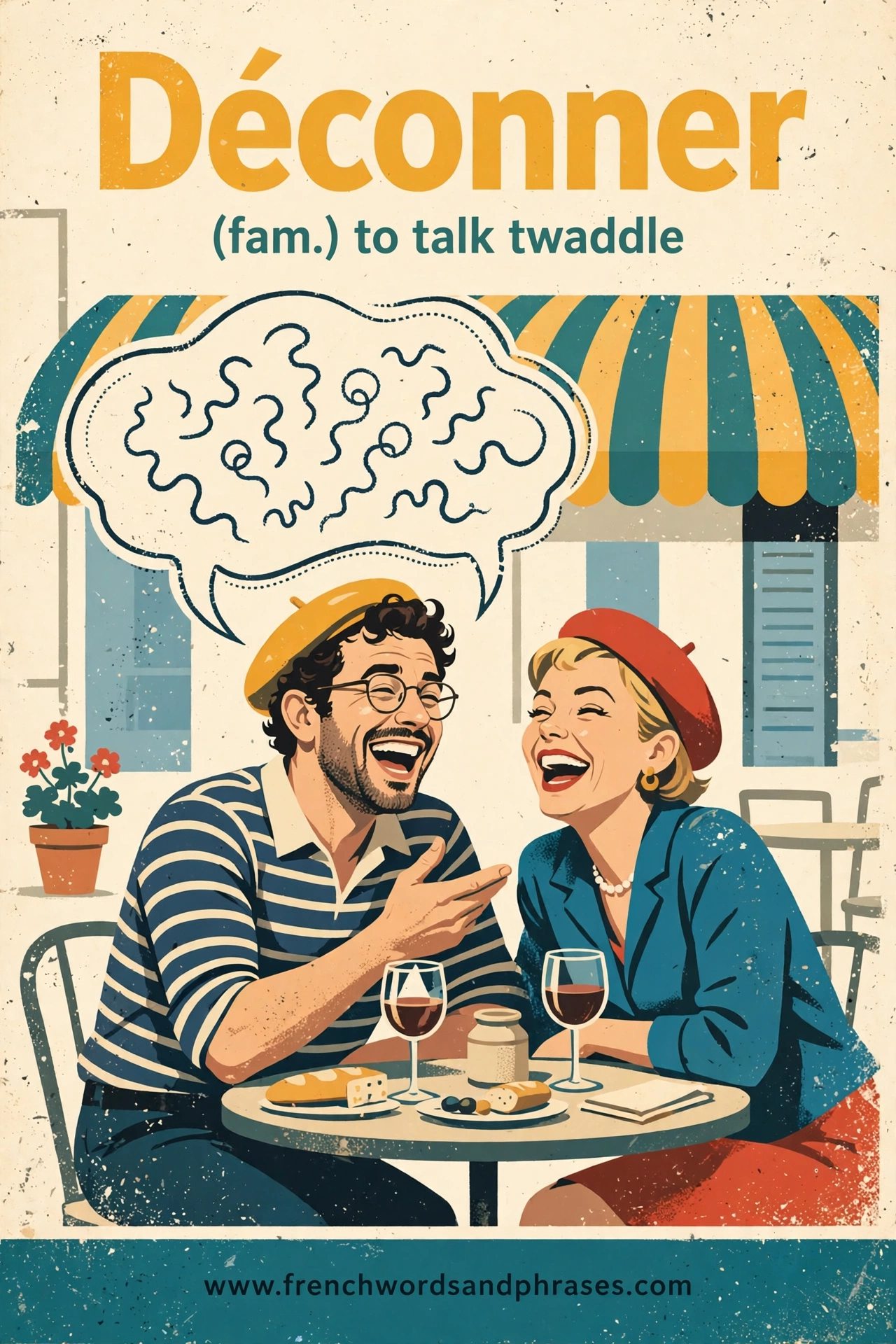
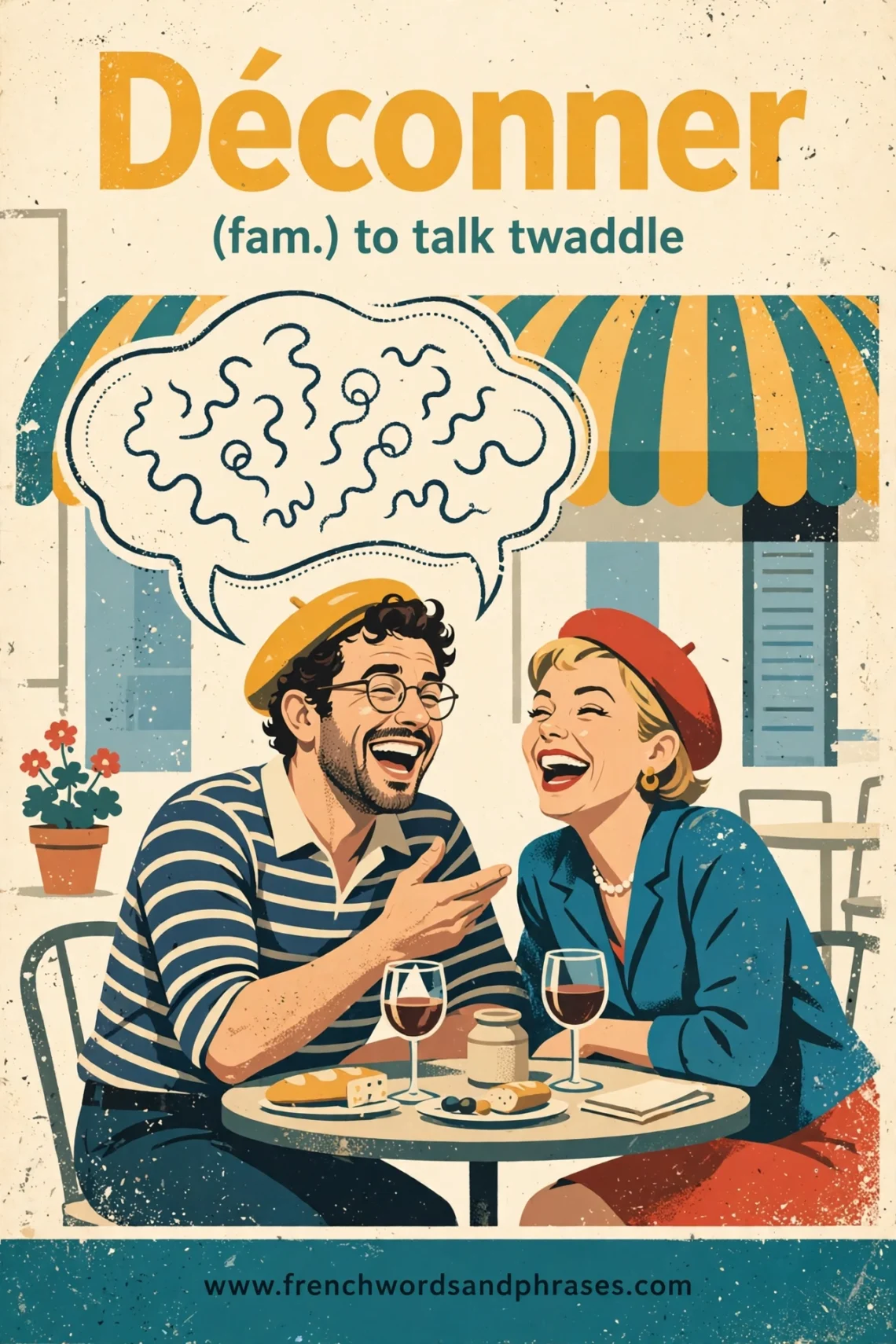
Déconner means to talk twaddle — familiar French for talking nonsense and messing around.
A grandfather telling whoppers at the dinner table, friends dissolving into giggles over nothing, an old printer that only works when it feels like it — déconner is familiar French for talking nonsense, fooling around, and (for machines) playing up.
In this guide, you’ll learn how to conjugate déconner in all the major French tenses and moods. Explore complete conjugation tables, French examples, English translations, and practice quizzes.
Understanding the French Verb Déconner
Déconner is a regular French verb belonging to the first group of verbs, those ending in -er.
It means (fam.) to talk twaddle. It is commonly used for talking cheerful nonsense among friends, for joking and fooling around instead of being serious, for telling someone to stop messing about, and for cars, computers and printers that refuse to work properly.
Verb classification: First group (-er)
Auxiliary verb: Avoir
Past participle: déconné
Present participle: déconnant
English equivalents: (Familiar) To talk nonsense, to kid around, to mess about; (of a machine) to play up, to act up; arrêter de déconner — to stop messing around.
One important detail: déconner is familiar French — register matters. Among friends it is affectionate: arrête de déconner ! means stop kidding around, and on a bien déconné reports an evening of pure nonsense and laughter. French also gives the verb to machines: mon imprimante déconne — my printer is playing up. You will hear it in cafés, films and family kitchens, never in a formal letter; the polite cousins are dire des bêtises and plaisanter.
Experience the Word
Déconner is the verb of nonsense with a grin — nothing it describes is meant to be taken seriously, and that is the point.
Imagine a long family lunch. The uncle starts a story that grows taller with every sentence, the children are helpless with laughter, and grandmother shakes her head: il déconne, comme toujours — he is talking twaddle, as always.
Nothing true has been said for ten minutes. And nobody would change a word of it.
How to Conjugate Déconner: Complete French Conjugation Guide
Let’s explore every major conjugation of déconner, beginning with the indicative mood.
How to Conjugate Déconner in the Indicative Mood
The indicative mood is used to express facts, observations, actions, and events.
How to Conjugate Déconner in the Present Tense (Présent)
Used for actions happening now, habitual actions, and general truths.
| Subject | Conjugation |
|---|---|
| je | déconne |
| tu | déconnes |
| il / elle | déconne |
| nous | déconnons |
| vous | déconnez |
| ils / elles | déconnent |
Example
Tu déconnes, ce n’est pas possible !
You are kidding, that cannot be true!
Quick Quiz 1
Complete the sentence:
Nous ______ au lieu de travailler.
Reveal the answer
déconnons
Nous déconnons au lieu de travailler.
We are messing around instead of working.
How to Conjugate Déconner in the Passé Composé
Used for completed actions in the past. Déconner takes the auxiliary verb avoir.
| Subject | Conjugation |
|---|---|
| j’ | ai déconné |
| tu | as déconné |
| il / elle | a déconné |
| nous | avons déconné |
| vous | avez déconné |
| ils / elles | ont déconné |
Example
On a déconné toute la soirée chez Karim.
We messed around all evening at Karim’s place.
How to Conjugate Déconner in the Imparfait (Imperfect Tense)
Used for habitual past actions, descriptions, and ongoing situations in the past.
| Subject | Conjugation |
|---|---|
| je | déconnais |
| tu | déconnais |
| il / elle | déconnait |
| nous | déconnions |
| vous | déconniez |
| ils / elles | déconnaient |
Example
À l’école, il déconnait au lieu d’écouter.
At school, he used to mess around instead of listening.
Quick Quiz 2
Choose the correct form:
We messed around all evening.
On ______ toute la soirée. (a déconné / est déconné)
Reveal the answer
a déconné
On a déconné toute la soirée.
Déconner takes avoir.
How to Conjugate Déconner in the Plus-que-parfait
Used to describe an action that had already been completed before another past event.
| Subject | Conjugation |
|---|---|
| j’ | avais déconné |
| tu | avais déconné |
| il / elle | avait déconné |
| nous | avions déconné |
| vous | aviez déconné |
| ils / elles | avaient déconné |
Example
Ils avaient déconné jusqu’à minuit passé.
They had been fooling around until past midnight.
How to Conjugate Déconner in the Passé Simple
Primarily used in formal writing, literature, and historical narratives. It is rarely used in everyday conversation.
| Subject | Conjugation |
|---|---|
| je | déconnai |
| tu | déconnas |
| il / elle | déconna |
| nous | déconnâmes |
| vous | déconnâtes |
| ils / elles | déconnèrent |
Example
Le vieil oncle déconna pendant tout le repas.
The old uncle talked twaddle throughout the whole meal.
How to Conjugate Déconner in the Passé Antérieur
A literary tense used to express an action completed immediately before another past action, generally in the passé simple.
| Subject | Conjugation |
|---|---|
| j’ | eus déconné |
| tu | eus déconné |
| il / elle | eut déconné |
| nous | eûmes déconné |
| vous | eûtes déconné |
| ils / elles | eurent déconné |
Example
Quand ils eurent déconné assez longtemps, le travail reprit.
When they had messed around long enough, work started again.
How to Conjugate Déconner in the Future Tense (Futur Simple)
Used to describe actions that will take place in the future.
| Subject | Conjugation |
|---|---|
| je | déconnerai |
| tu | déconneras |
| il / elle | déconnera |
| nous | déconnerons |
| vous | déconnerez |
| ils / elles | déconneront |
Example
Ce soir, on déconnera comme au bon vieux temps.
This evening, we will mess around like in the good old days.
How to Conjugate Déconner in the Futur Antérieur (Future Perfect)
Used for an action that will have been completed before a particular point in the future.
| Subject | Conjugation |
|---|---|
| j’ | aurai déconné |
| tu | auras déconné |
| il / elle | aura déconné |
| nous | aurons déconné |
| vous | aurez déconné |
| ils / elles | auront déconné |
Example
À la fin de la fête, ils auront déconné pendant des heures.
By the end of the party, they will have been fooling around for hours.
How to Conjugate Déconner in the Near Future (Futur Proche)
Used to describe something that is going to happen soon. Formed with aller + infinitive.
| Subject | Conjugation |
|---|---|
| je | vais déconner |
| tu | vas déconner |
| il / elle | va déconner |
| nous | allons déconner |
| vous | allez déconner |
| ils / elles | vont déconner |
Example
Ne l’écoute pas, il va encore déconner.
Do not listen to him, he is going to talk nonsense again.
How to Conjugate Déconner in the Conditional Mood
The conditional mood expresses what would happen under certain circumstances. It is also frequently used to make polite requests or express wishes.
How to Conjugate Déconner in the Present Conditional
| Subject | Conjugation |
|---|---|
| je | déconnerais |
| tu | déconnerais |
| il / elle | déconnerait |
| nous | déconnerions |
| vous | déconneriez |
| ils / elles | déconneraient |
Example
Sans le chef dans le bureau, on déconnerait toute la journée.
Without the boss in the office, we would mess around all day.
How to Conjugate Déconner in the Past Conditional
| Subject | Conjugation |
|---|---|
| j’ | aurais déconné |
| tu | aurais déconné |
| il / elle | aurait déconné |
| nous | aurions déconné |
| vous | auriez déconné |
| ils / elles | auraient déconné |
Example
Elle aurait déconné plus longtemps sans la sonnette.
She would have fooled around longer if not for the bell.
Déconner in the Literary Past Conditional Form
This less common literary form uses the imperfect subjunctive of avoir.
| Subject | Conjugation |
|---|---|
| j’ | eusse déconné |
| tu | eusses déconné |
| il / elle | eût déconné |
| nous | eussions déconné |
| vous | eussiez déconné |
| ils / elles | eussent déconné |
Example
Il eût déconné jusqu’au bout de la nuit.
He would have talked twaddle until the end of the night.
How to Conjugate Déconner in the Subjunctive Mood
The subjunctive is used to express wishes, emotions, doubts, necessity, and uncertainty. It frequently follows expressions such as il faut que (it is necessary that) or bien que (although).
How to Conjugate Déconner in the Present Subjunctive
| Subject | Conjugation |
|---|---|
| que je | déconne |
| que tu | déconnes |
| qu’il / qu’elle | déconne |
| que nous | déconnions |
| que vous | déconniez |
| qu’ils / qu’elles | déconnent |
Example
Il ne faut pas que tu déconnes pendant l’examen.
You must not mess around during the exam.
Quick Quiz 3
Complete the sentence using the subjunctive:
Il ne faut pas que vous ______ en classe.
Reveal the answer
déconniez
Il ne faut pas que vous déconniez en classe.
You must not mess around in class.
How to Conjugate Déconner in the Imperfect Subjunctive
A literary tense, rarely encountered in modern spoken French.
| Subject | Conjugation |
|---|---|
| que je | déconnasse |
| que tu | déconnasses |
| qu’il / qu’elle | déconnât |
| que nous | déconnassions |
| que vous | déconnassiez |
| qu’ils / qu’elles | déconnassent |
Example
Je craignais qu’il déconnât devant les invités.
I feared he might talk nonsense in front of the guests.
How to Conjugate Déconner in the Pluperfect Subjunctive
A literary construction used to express an action completed before another past action.
| Subject | Conjugation |
|---|---|
| que j’ | eusse déconné |
| que tu | eusses déconné |
| qu’il / qu’elle | eût déconné |
| que nous | eussions déconné |
| que vous | eussiez déconné |
| qu’ils / qu’elles | eussent déconné |
Example
On riait qu’ils eussent déconné si longtemps.
People laughed that they had fooled around for so long.
How to Conjugate Déconner in the Past Subjunctive
| Subject | Conjugation |
|---|---|
| que j’ | aie déconné |
| que tu | aies déconné |
| qu’il / qu’elle | ait déconné |
| que nous | ayons déconné |
| que vous | ayez déconné |
| qu’ils / qu’elles | aient déconné |
Example
Je suis sûr qu’il a déconné en racontant cette histoire.
I am sure he was kidding when he told that story.
How to Conjugate Déconner in the Imperative
The imperative is used to give commands, instructions, invitations, or suggestions. Subject pronouns are omitted.
How to Conjugate Déconner in the Present Imperative
| Person | Conjugation |
|---|---|
| (tu) | déconne |
| (nous) | déconnons |
| (vous) | déconnez |
Example
Ne déconne pas, c’est sérieux !
Stop messing around, this is serious!
Quick Quiz 4
How would you say Stop messing around (tu form)?
Reveal the answer
Arrête de déconner !
French Participles of Déconner
Participles are verb forms that can be used in compound tenses and other grammatical constructions.
Present Participle of Déconner
déconnant
En déconnant, il a fait rire toute la classe.
By fooling around, he made the whole class laugh.
Past Participle of Déconner
déconné
Après avoir déconné une heure, ils se sont mis au travail.
After messing around for an hour, they got down to work.
Déconner in Everyday French: Real-Life Examples
Now that you know the conjugations, let’s see how déconner appears in everyday French.
Example 1 — Present
Mon ordinateur déconne depuis ce matin.
My computer has been playing up since this morning.
Example 2 — Passé composé
On a bien déconné hier soir.
We had a right laugh messing around last night.
Example 3 — Imparfait
Il déconnait toujours pendant les cours.
He always used to mess around during lessons.
Example 4 — Future
Ce soir, on déconnera entre amis.
This evening, we will have a laugh among friends.
Example 5 — Conditional
Tu déconnerais moins avec un vrai chef.
You would mess around less with a real boss.
Example 6 — Imperative
Arrêtez de déconner, on commence !
Stop messing around, we are starting!
Beyond Translation: The Meaning of Déconner
English scatters this idea across kidding, messing around, talking rubbish, playing up; familiar French déconner covers the whole playground in one word.
Even the machines join in.
A printer that déconne is not broken exactly — it is misbehaving, like a schoolboy at the back of the class. The verb turns breakdown into naughtiness, and that is why the French love it.
How to Remember the French Verb Déconner
Remember it this way: Déconner is about nonsense with a grin — and printers that play up.
- Familiar register: déconner is for friends, films and family — never for formal letters.
- Arrête de déconner ! — stop messing around, the classic order.
- Regular -er: je déconne, nous déconnons, past participle déconné — note the double n.
The key idea is nonsense with a grin — and printers that play up.
Test Your Knowledge of Déconner
Let’s see how much you’ve learned. Try answering these questions before revealing the answers.
Question 1
What register is déconner?
Reveal the answer
Familiar — for friends and family; formal French says plaisanter or dire des bêtises.
Question 2
How do you say Stop messing around in French?
Reveal the answer
Arrête de déconner !
Question 3
Translate: My computer has been playing up since this morning.
Reveal the answer
Mon ordinateur déconne depuis ce matin.
Question 4
What is the past participle of déconner?
Reveal the answer
Déconné.
Question 5
Complete the sentence:
Il ne faut pas que tu ______ pendant l’examen.
Reveal the answer
déconnes
Il ne faut pas que tu déconnes pendant l’examen.
You must not mess around during the exam.
Your Final Challenge
Can You Use It?
How would you say this in French?
They messed around all evening, and nobody looked at the time.
Reveal the answer
Ils ont déconné toute la soirée, et personne n’a regardé l’heure.
They messed around all evening, and nobody looked at the time.
A little French. A little curiosity. A richer everyday life.
LEARN FRENCH ONE WORD AT A TIME