A French Word to Live By
How to Conjugate Déconcerter in French
/de.kɔ̃.sɛʁ.te/
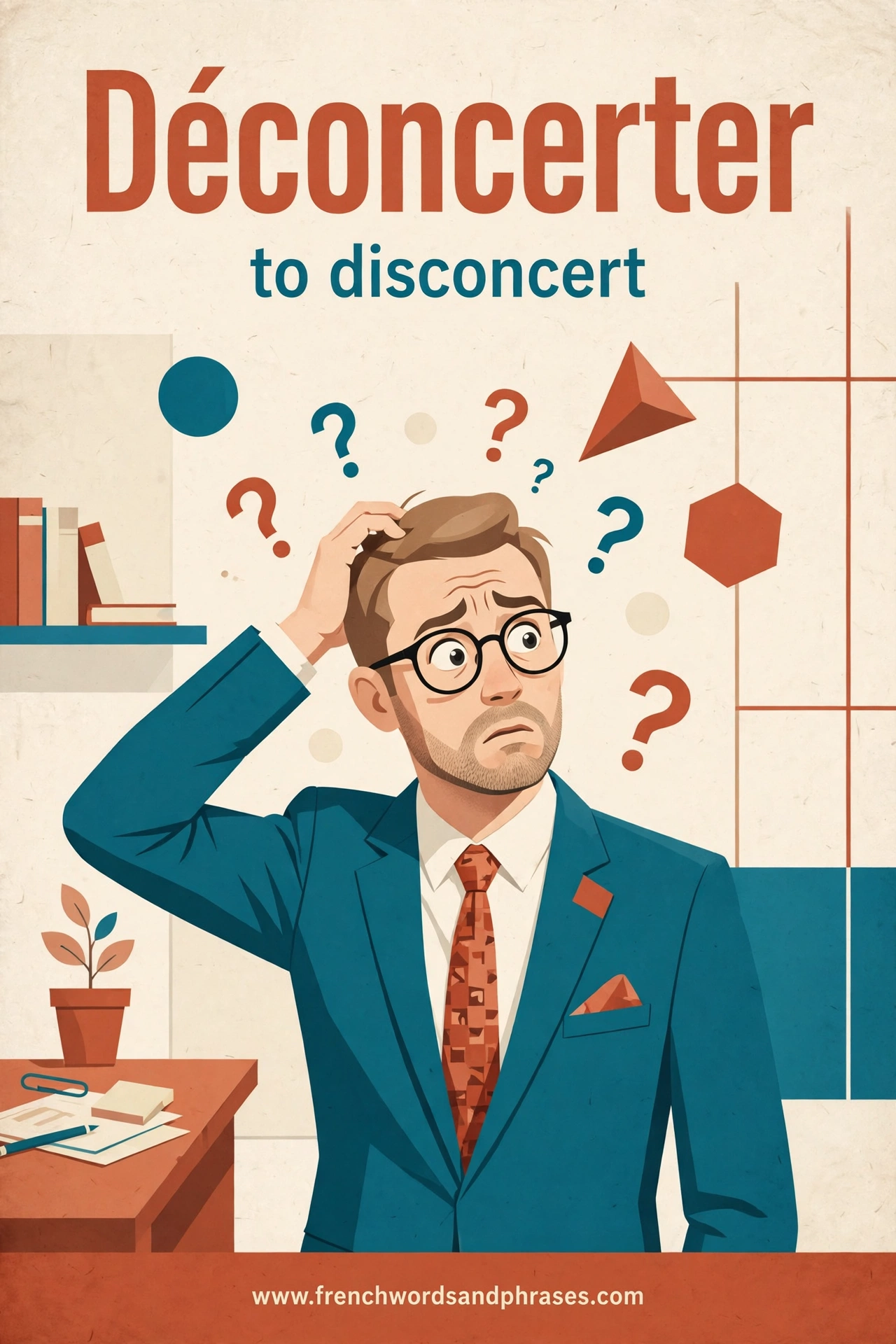
Déconcerter means to disconcert.
A question nobody expected, a smile that answers nothing, a chess move that breaks the plan — déconcerter is the verb of the unsettled moment, when confidence loses its footing for a second.
In this guide, you’ll learn how to conjugate déconcerter in all the major French tenses and moods. Explore complete conjugation tables, French examples, English translations, and practice quizzes.
Understanding the French Verb Déconcerter
Déconcerter is a regular French verb belonging to the first group of verbs, those ending in -er.
It means to disconcert. It is commonly used for questions, remarks and events that unsettle someone, for opponents thrown off in debate, sport or chess, and in the reflexive for people who visibly lose their composure — or proudly never do.
Verb classification: First group (-er)
Auxiliary verb: Avoir
Past participle: déconcerté
Present participle: déconcertant
English equivalents: To disconcert, to unsettle, to throw off balance; se déconcerter — to be disconcerted, to lose one’s composure; un air déconcerté — a disconcerted look.
One important detail: déconcerter once meant to break a concert — to put every instrument out of tune with the others — and the music is still inside the word. The base verb takes avoir: il a déconcerté son adversaire. But for the person affected, French often prefers the reflexive se déconcerter, to lose one’s composure: il ne se déconcerte jamais — nothing ever rattles him. Above all, learn the participle as an adjective: un sourire déconcerté, un regard déconcerté, a disconcerted smile, a baffled look.
Experience the Word
Déconcerter is the verb of the half-second wobble — the plan was ready, the speech was learned, and then one unexpected thing arrives.
Imagine a young chess player facing the club champion. She plays a move no book recommends. The champion stares, recalculates, stares again — déconcerté, just long enough for the game to change hands.
Nothing has been won yet. He has been disconcerted — unsettled, thrown off the line he had prepared.
How to Conjugate Déconcerter: Complete French Conjugation Guide
Let’s explore every major conjugation of déconcerter, beginning with the indicative mood.
How to Conjugate Déconcerter in the Indicative Mood
The indicative mood is used to express facts, observations, actions, and events.
How to Conjugate Déconcerter in the Present Tense (Présent)
Used for actions happening now, habitual actions, and general truths.
| Subject | Conjugation |
|---|---|
| je | déconcerte |
| tu | déconcertes |
| il / elle | déconcerte |
| nous | déconcertons |
| vous | déconcertez |
| ils / elles | déconcertent |
Example
Sa question déconcerte toujours les candidats.
Her question always disconcerts the candidates.
Quick Quiz 1
Complete the sentence:
Nous ne ______ jamais nos adversaires par hasard.
Reveal the answer
déconcertons
Nous ne déconcertons jamais nos adversaires par hasard.
We never disconcert our opponents by chance.
How to Conjugate Déconcerter in the Passé Composé
Used for completed actions in the past. Déconcerter takes the auxiliary verb avoir.
| Subject | Conjugation |
|---|---|
| j’ | ai déconcerté |
| tu | as déconcerté |
| il / elle | a déconcerté |
| nous | avons déconcerté |
| vous | avez déconcerté |
| ils / elles | ont déconcerté |
Example
Cette remarque a déconcerté toute l’assemblée.
That remark disconcerted the whole assembly.
How to Conjugate Déconcerter in the Imparfait (Imperfect Tense)
Used for habitual past actions, descriptions, and ongoing situations in the past.
| Subject | Conjugation |
|---|---|
| je | déconcertais |
| tu | déconcertais |
| il / elle | déconcertait |
| nous | déconcertions |
| vous | déconcertiez |
| ils / elles | déconcertaient |
Example
Son silence déconcertait les journalistes à chaque conférence.
His silence used to disconcert the journalists at every conference.
Quick Quiz 2
Choose the correct form:
The question disconcerted him.
La question ______ . (l’a déconcerté / s’est déconcertée)
Reveal the answer
l’a déconcerté
La question l’a déconcerté.
Déconcerter takes avoir.
How to Conjugate Déconcerter in the Plus-que-parfait
Used to describe an action that had already been completed before another past event.
| Subject | Conjugation |
|---|---|
| j’ | avais déconcerté |
| tu | avais déconcerté |
| il / elle | avait déconcerté |
| nous | avions déconcerté |
| vous | aviez déconcerté |
| ils / elles | avaient déconcerté |
Example
Elle avait déconcerté le jury par sa franchise.
She had disconcerted the jury with her frankness.
How to Conjugate Déconcerter in the Passé Simple
Primarily used in formal writing, literature, and historical narratives. It is rarely used in everyday conversation.
| Subject | Conjugation |
|---|---|
| je | déconcertai |
| tu | déconcertas |
| il / elle | déconcerta |
| nous | déconcertâmes |
| vous | déconcertâtes |
| ils / elles | déconcertèrent |
Example
Le jeune joueur déconcerta le champion par son audace.
The young player disconcerted the champion with his boldness.
How to Conjugate Déconcerter in the Passé Antérieur
A literary tense used to express an action completed immediately before another past action, generally in the passé simple.
| Subject | Conjugation |
|---|---|
| j’ | eus déconcerté |
| tu | eus déconcerté |
| il / elle | eut déconcerté |
| nous | eûmes déconcerté |
| vous | eûtes déconcerté |
| ils / elles | eurent déconcerté |
Example
Quand il eut déconcerté son adversaire, il gagna la partie.
When he had disconcerted his opponent, he won the game.
How to Conjugate Déconcerter in the Future Tense (Futur Simple)
Used to describe actions that will take place in the future.
| Subject | Conjugation |
|---|---|
| je | déconcerterai |
| tu | déconcerteras |
| il / elle | déconcertera |
| nous | déconcerterons |
| vous | déconcerterez |
| ils / elles | déconcerteront |
Example
Rien ne déconcertera cette avocate expérimentée.
Nothing will disconcert this experienced lawyer.
How to Conjugate Déconcerter in the Futur Antérieur (Future Perfect)
Used for an action that will have been completed before a particular point in the future.
| Subject | Conjugation |
|---|---|
| j’ | aurai déconcerté |
| tu | auras déconcerté |
| il / elle | aura déconcerté |
| nous | aurons déconcerté |
| vous | aurez déconcerté |
| ils / elles | auront déconcerté |
Example
À la fin du débat, il aura déconcerté tous ses rivaux.
By the end of the debate, he will have disconcerted all his rivals.
How to Conjugate Déconcerter in the Near Future (Futur Proche)
Used to describe something that is going to happen soon. Formed with aller + infinitive.
| Subject | Conjugation |
|---|---|
| je | vais déconcerter |
| tu | vas déconcerter |
| il / elle | va déconcerter |
| nous | allons déconcerter |
| vous | allez déconcerter |
| ils / elles | vont déconcerter |
Example
Attention, cette nouvelle va déconcerter le public.
Careful, this news is going to disconcert the public.
How to Conjugate Déconcerter in the Conditional Mood
The conditional mood expresses what would happen under certain circumstances. It is also frequently used to make polite requests or express wishes.
How to Conjugate Déconcerter in the Present Conditional
| Subject | Conjugation |
|---|---|
| je | déconcerterais |
| tu | déconcerterais |
| il / elle | déconcerterait |
| nous | déconcerterions |
| vous | déconcerteriez |
| ils / elles | déconcerteraient |
Example
Un mot de travers déconcerterait ce pianiste sensible.
One wrong word would disconcert this sensitive pianist.
How to Conjugate Déconcerter in the Past Conditional
| Subject | Conjugation |
|---|---|
| j’ | aurais déconcerté |
| tu | aurais déconcerté |
| il / elle | aurait déconcerté |
| nous | aurions déconcerté |
| vous | auriez déconcerté |
| ils / elles | auraient déconcerté |
Example
Tu aurais déconcerté le professeur avec une telle réponse.
You would have disconcerted the teacher with such an answer.
Déconcerter in the Literary Past Conditional Form
This less common literary form uses the imperfect subjunctive of avoir.
| Subject | Conjugation |
|---|---|
| j’ | eusse déconcerté |
| tu | eusses déconcerté |
| il / elle | eût déconcerté |
| nous | eussions déconcerté |
| vous | eussiez déconcerté |
| ils / elles | eussent déconcerté |
Example
Elle eût déconcerté la cour entière par son silence.
She would have disconcerted the whole court with her silence.
How to Conjugate Déconcerter in the Subjunctive Mood
The subjunctive is used to express wishes, emotions, doubts, necessity, and uncertainty. It frequently follows expressions such as il faut que (it is necessary that) or bien que (although).
How to Conjugate Déconcerter in the Present Subjunctive
| Subject | Conjugation |
|---|---|
| que je | déconcerte |
| que tu | déconcertes |
| qu’il / qu’elle | déconcerte |
| que nous | déconcertions |
| que vous | déconcertiez |
| qu’ils / qu’elles | déconcertent |
Example
Je ne veux pas que ce retard déconcerte les invités.
I do not want this delay to disconcert the guests.
Quick Quiz 3
Complete the sentence using the subjunctive:
Il craint que vous ______ les invités.
Reveal the answer
déconcertiez
Il craint que vous déconcertiez les invités.
He fears you may disconcert the guests.
How to Conjugate Déconcerter in the Imperfect Subjunctive
A literary tense, rarely encountered in modern spoken French.
| Subject | Conjugation |
|---|---|
| que je | déconcertasse |
| que tu | déconcertasses |
| qu’il / qu’elle | déconcertât |
| que nous | déconcertassions |
| que vous | déconcertassiez |
| qu’ils / qu’elles | déconcertassent |
Example
Il craignait que la question le déconcertât.
He feared the question might disconcert him.
How to Conjugate Déconcerter in the Pluperfect Subjunctive
A literary construction used to express an action completed before another past action.
| Subject | Conjugation |
|---|---|
| que j’ | eusse déconcerté |
| que tu | eusses déconcerté |
| qu’il / qu’elle | eût déconcerté |
| que nous | eussions déconcerté |
| que vous | eussiez déconcerté |
| qu’ils / qu’elles | eussent déconcerté |
Example
On raconta qu’elle eût déconcerté le ministre lui-même.
It was said she had disconcerted the minister himself.
How to Conjugate Déconcerter in the Past Subjunctive
| Subject | Conjugation |
|---|---|
| que j’ | aie déconcerté |
| que tu | aies déconcerté |
| qu’il / qu’elle | ait déconcerté |
| que nous | ayons déconcerté |
| que vous | ayez déconcerté |
| qu’ils / qu’elles | aient déconcerté |
Example
Je suis étonné que ce bruit vous ait déconcertés.
I am surprised this noise disconcerted you.
How to Conjugate Déconcerter in the Imperative
The imperative is used to give commands, instructions, invitations, or suggestions. Subject pronouns are omitted.
How to Conjugate Déconcerter in the Present Imperative
| Person | Conjugation |
|---|---|
| (tu) | déconcerte |
| (nous) | déconcertons |
| (vous) | déconcertez |
Example
Ne déconcerte pas les candidats avant l’épreuve !
Do not disconcert the candidates before the test!
Quick Quiz 4
How would you say Do not lose your composure (tu form)?
Reveal the answer
Ne te déconcerte pas !
French Participles of Déconcerter
Participles are verb forms that can be used in compound tenses and other grammatical constructions.
Present Participle of Déconcerter
déconcertant
En déconcertant son adversaire, elle a pris l’avantage.
By disconcerting her opponent, she gained the advantage.
Past Participle of Déconcerter
déconcerté
Déconcerté un instant, le champion a vite retrouvé son calme.
Disconcerted for a moment, the champion quickly regained his calm.
Déconcerter in Everyday French: Real-Life Examples
Now that you know the conjugations, let’s see how déconcerter appears in everyday French.
Example 1 — Present
Son calme déconcerte tout le monde.
His calm disconcerts everyone.
Example 2 — Passé composé
La question l’a déconcerté, mais il a bien répondu.
The question disconcerted him, but he answered well.
Example 3 — Imparfait
Elle ne se déconcertait jamais, même sous pression.
She never lost her composure, even under pressure.
Example 4 — Future
Cette annonce déconcertera les marchés demain.
This announcement will disconcert the markets tomorrow.
Example 5 — Conditional
Rien ne le déconcerterait, pas même un orage.
Nothing would disconcert him, not even a storm.
Example 6 — Imperative
Ne vous déconcertez pas pour si peu !
Do not lose your composure over so little!
Beyond Translation: The Meaning of Déconcerter
English disconcert is a formal, slightly bookish word; French déconcerter is an everyday pleasure.
It keeps its music inside it.
A concert is voices in agreement; to déconcerter someone is to strike the one note that puts the whole performance out of tune — a question, a silence, a smile.
How to Remember the French Verb Déconcerter
Remember it this way: Déconcerter is about the unsettled second — confidence losing its footing.
- From concert: to déconcerter is to throw the whole orchestra out of tune.
- Se déconcerter — to lose your composure; il ne se déconcerte jamais — nothing rattles him.
- Regular -er: je déconcerte, nous déconcertons, past participle déconcerté.
The key idea is the unsettled second — confidence losing its footing.
Test Your Knowledge of Déconcerter
Let’s see how much you’ve learned. Try answering these questions before revealing the answers.
Question 1
How do you say He never loses his composure in French?
Reveal the answer
Il ne se déconcerte jamais.
Question 2
How do you say Her question disconcerts the candidates in French?
Reveal the answer
Sa question déconcerte les candidats.
Question 3
Translate: That remark disconcerted the whole assembly.
Reveal the answer
Cette remarque a déconcerté toute l’assemblée.
Question 4
What is the past participle of déconcerter?
Reveal the answer
Déconcerté.
Question 5
Complete the sentence:
Je ne veux pas que ce retard ______ les invités.
Reveal the answer
déconcerte
Je ne veux pas que ce retard déconcerte les invités.
I do not want this delay to disconcert the guests.
Your Final Challenge
Can You Use It?
How would you say this in French?
Her question disconcerted the jury, then her smile put everything at ease.
Reveal the answer
Sa question a déconcerté le jury, puis son sourire a tout apaisé.
Her question disconcerted the jury, then her smile put everything at ease.
A little French. A little curiosity. A richer everyday life.
LEARN FRENCH ONE WORD AT A TIME