A French Word to Live By
How to Conjugate Décoloniser in French
/de.kɔ.lɔ.ni.ze/
Décoloniser means to decolonize.
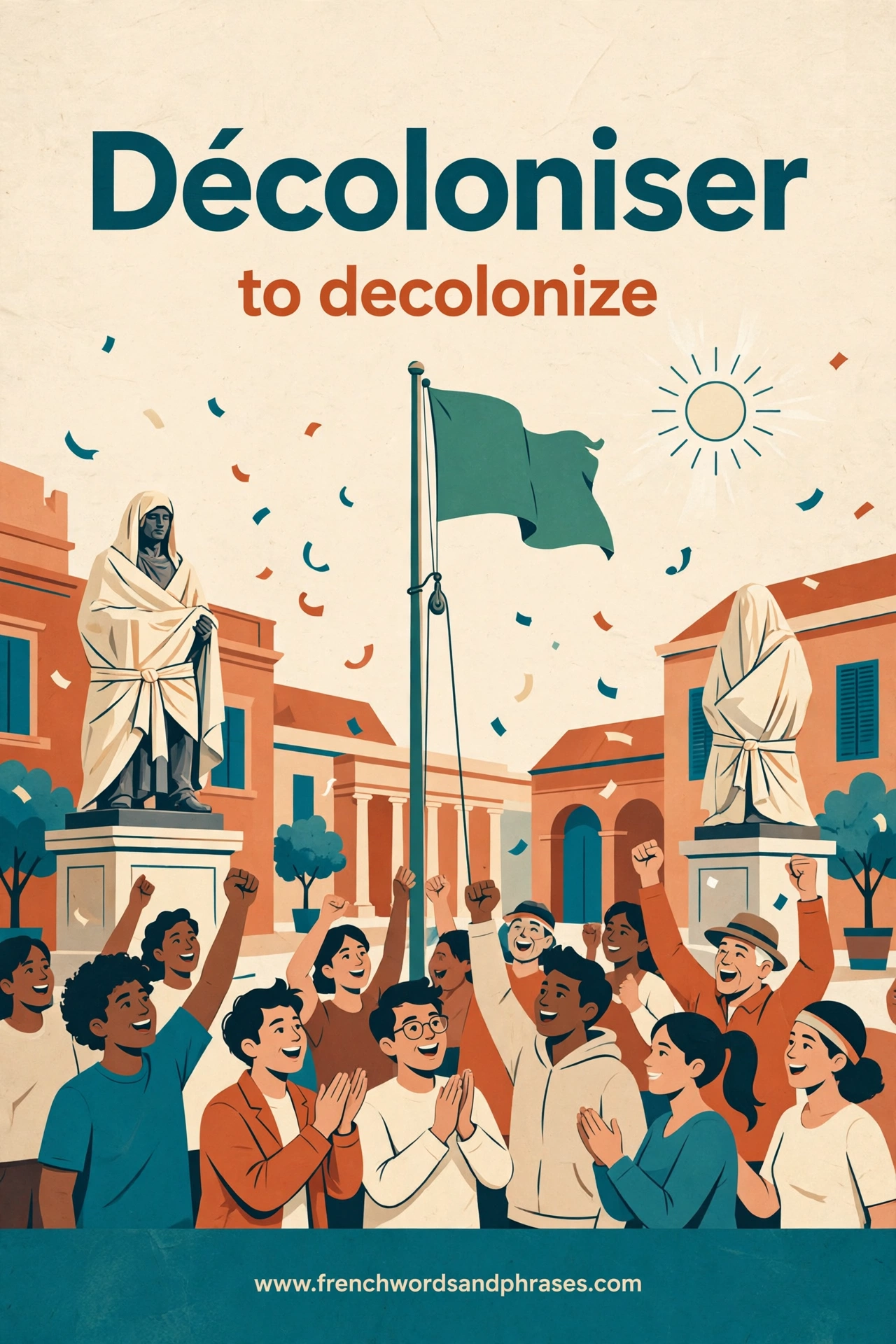
A flag lowered at midnight, a new name painted on the government house, a crowd singing in a square that finally belongs to them — décoloniser is the verb of empires ending: to free a territory from colonial rule.
In this guide, you’ll learn how to conjugate décoloniser in all the major French tenses and moods. Explore complete conjugation tables, French examples, English translations, and practice quizzes.
Understanding the French Verb Décoloniser
Décoloniser is a regular French verb belonging to the first group of verbs, those ending in -er.
It means to decolonize. It is commonly used in history for the independence of African and Asian nations (décoloniser l’Afrique, un pays décolonisé), in politics for the negotiations and referendums that ended colonial rule, and today in cultural debates about museums, universities and memory.
Verb classification: First group (-er)
Auxiliary verb: Avoir
Past participle: décolonisé
Present participle: décolonisant
English equivalents: To decolonize, to grant independence to a colony; la décolonisation — decolonization.
One important detail: décoloniser is coloniser reversed by dé- — the undoing of colonisation itself, and its noun la décolonisation names one of the great processes of the twentieth century, above all the years 1945–1975. Modern French also uses the verb figuratively: décoloniser les musées, décoloniser les esprits, décoloniser les programmes — to decolonize museums, minds and curricula, by returning objects, stories and viewpoints to the peoples they came from.
Experience the Word
Décoloniser is the verb of a transfer of destiny — a people taking its own affairs back into its own hands.
Imagine a capital city in 1960. At midnight the old flag comes down in silence, and a new one rises to drums and tears: the country is becoming independent, and everyone in the square knows their grandchildren will learn this date.
The land has not moved an inch. It has been decolonized — its rule returned to its people.
How to Conjugate Décoloniser: Complete French Conjugation Guide
Let’s explore every major conjugation of décoloniser, beginning with the indicative mood.
How to Conjugate Décoloniser in the Indicative Mood
The indicative mood is used to express facts, observations, actions, and events.
How to Conjugate Décoloniser in the Present Tense (Présent)
Used for actions happening now, habitual actions, and general truths.
| Subject | Conjugation |
|---|---|
| je | décolonise |
| tu | décolonises |
| il / elle | décolonise |
| nous | décolonisons |
| vous | décolonisez |
| ils / elles | décolonisent |
Example
Les historiens décolonisent peu à peu les archives de l’empire.
Historians are gradually decolonizing the empire’s archives.
Quick Quiz 1
Complete the sentence:
Nous ______ les archives de l’ancien empire.
Reveal the answer
décolonisons
Nous décolonisons les archives de l’ancien empire.
We are decolonizing the archives of the former empire.
How to Conjugate Décoloniser in the Passé Composé
Used for completed actions in the past. Décoloniser takes the auxiliary verb avoir.
| Subject | Conjugation |
|---|---|
| j’ | ai décolonisé |
| tu | as décolonisé |
| il / elle | a décolonisé |
| nous | avons décolonisé |
| vous | avez décolonisé |
| ils / elles | ont décolonisé |
Example
La France a décolonisé une grande partie de l’Afrique en 1960.
France decolonized a large part of Africa in 1960.
How to Conjugate Décoloniser in the Imparfait (Imperfect Tense)
Used for habitual past actions, descriptions, and ongoing situations in the past.
| Subject | Conjugation |
|---|---|
| je | décolonisais |
| tu | décolonisais |
| il / elle | décolonisait |
| nous | décolonisions |
| vous | décolonisiez |
| ils / elles | décolonisaient |
Example
Après la guerre, les puissances décolonisaient leurs empires les unes après les autres.
After the war, the powers were decolonizing their empires one after another.
Quick Quiz 2
Choose the correct form:
The museum decolonized its collection.
Le musée ______ sa collection. (a décolonisé / est décolonisé)
Reveal the answer
a décolonisé
Le musée a décolonisé sa collection.
Décoloniser takes avoir.
How to Conjugate Décoloniser in the Plus-que-parfait
Used to describe an action that had already been completed before another past event.
| Subject | Conjugation |
|---|---|
| j’ | avais décolonisé |
| tu | avais décolonisé |
| il / elle | avait décolonisé |
| nous | avions décolonisé |
| vous | aviez décolonisé |
| ils / elles | avaient décolonisé |
Example
Le pays avait décolonisé son administration avant l’indépendance officielle.
The country had decolonized its administration before official independence.
How to Conjugate Décoloniser in the Passé Simple
Primarily used in formal writing, literature, and historical narratives. It is rarely used in everyday conversation.
| Subject | Conjugation |
|---|---|
| je | décolonisai |
| tu | décolonisas |
| il / elle | décolonisa |
| nous | décolonisâmes |
| vous | décolonisâtes |
| ils / elles | décolonisèrent |
Example
Le congrès décolonisa le territoire par un vote solennel.
The congress decolonized the territory by a solemn vote.
How to Conjugate Décoloniser in the Passé Antérieur
A literary tense used to express an action completed immediately before another past action, generally in the passé simple.
| Subject | Conjugation |
|---|---|
| j’ | eus décolonisé |
| tu | eus décolonisé |
| il / elle | eut décolonisé |
| nous | eûmes décolonisé |
| vous | eûtes décolonisé |
| ils / elles | eurent décolonisé |
Example
Quand les puissances eurent décolonisé leurs dernières îles, une époque prit fin.
When the powers had decolonized their last islands, an era ended.
How to Conjugate Décoloniser in the Future Tense (Futur Simple)
Used to describe actions that will take place in the future.
| Subject | Conjugation |
|---|---|
| je | décoloniserai |
| tu | décoloniseras |
| il / elle | décolonisera |
| nous | décoloniserons |
| vous | décoloniserez |
| ils / elles | décoloniseront |
Example
Un jour, on décolonisera aussi les récits des manuels scolaires.
One day, people will decolonize the stories in school textbooks too.
How to Conjugate Décoloniser in the Futur Antérieur (Future Perfect)
Used for an action that will have been completed before a particular point in the future.
| Subject | Conjugation |
|---|---|
| j’ | aurai décolonisé |
| tu | auras décolonisé |
| il / elle | aura décolonisé |
| nous | aurons décolonisé |
| vous | aurez décolonisé |
| ils / elles | auront décolonisé |
Example
À la fin du siècle, le monde aura décolonisé presque toutes les anciennes colonies.
By the end of the century, the world will have decolonized almost all the former colonies.
How to Conjugate Décoloniser in the Near Future (Futur Proche)
Used to describe something that is going to happen soon. Formed with aller + infinitive.
| Subject | Conjugation |
|---|---|
| je | vais décoloniser |
| tu | vas décoloniser |
| il / elle | va décoloniser |
| nous | allons décoloniser |
| vous | allez décoloniser |
| ils / elles | vont décoloniser |
Example
Le musée va décoloniser sa collection en restituant ces œuvres.
The museum is going to decolonize its collection by returning these works.
How to Conjugate Décoloniser in the Conditional Mood
The conditional mood expresses what would happen under certain circumstances. It is also frequently used to make polite requests or express wishes.
How to Conjugate Décoloniser in the Present Conditional
| Subject | Conjugation |
|---|---|
| je | décoloniserais |
| tu | décoloniserais |
| il / elle | décoloniserait |
| nous | décoloniserions |
| vous | décoloniseriez |
| ils / elles | décoloniseraient |
Example
Un empire sage décoloniserait ses territoires avant qu’ils ne se révoltent.
A wise empire would decolonize its territories before they revolted.
How to Conjugate Décoloniser in the Past Conditional
| Subject | Conjugation |
|---|---|
| j’ | aurais décolonisé |
| tu | aurais décolonisé |
| il / elle | aurait décolonisé |
| nous | aurions décolonisé |
| vous | auriez décolonisé |
| ils / elles | auraient décolonisé |
Example
Ils auraient décolonisé le pays plus tôt sans les intérêts des colons.
They would have decolonized the country earlier if not for the settlers’ interests.
Décoloniser in the Literary Past Conditional Form
This less common literary form uses the imperfect subjunctive of avoir.
| Subject | Conjugation |
|---|---|
| j’ | eusse décolonisé |
| tu | eusses décolonisé |
| il / elle | eût décolonisé |
| nous | eussions décolonisé |
| vous | eussiez décolonisé |
| ils / elles | eussent décolonisé |
Example
La métropole eût décolonisé l’île dès 1950, sans la guerre froide.
The mother country would have decolonized the island as early as 1950, if not for the Cold War.
How to Conjugate Décoloniser in the Subjunctive Mood
The subjunctive is used to express wishes, emotions, doubts, necessity, and uncertainty. It frequently follows expressions such as il faut que (it is necessary that) or bien que (although).
How to Conjugate Décoloniser in the Present Subjunctive
| Subject | Conjugation |
|---|---|
| que je | décolonise |
| que tu | décolonises |
| qu’il / qu’elle | décolonise |
| que nous | décolonisions |
| que vous | décolonisiez |
| qu’ils / qu’elles | décolonisent |
Example
Il est temps que l’on décolonise enfin ces collections.
It is time to finally decolonize these collections.
Quick Quiz 3
Complete the sentence using the subjunctive:
Il est temps que vous ______ ces collections.
Reveal the answer
décolonisiez
Il est temps que vous décolonisiez ces collections.
It is time for you to decolonize these collections.
How to Conjugate Décoloniser in the Imperfect Subjunctive
A literary tense, rarely encountered in modern spoken French.
| Subject | Conjugation |
|---|---|
| que je | décolonisasse |
| que tu | décolonisasses |
| qu’il / qu’elle | décolonisât |
| que nous | décolonisassions |
| que vous | décolonisassiez |
| qu’ils / qu’elles | décolonisassent |
Example
Les délégués exigeaient que la puissance décolonisât le territoire sans délai.
The delegates demanded that the power decolonize the territory without delay.
How to Conjugate Décoloniser in the Pluperfect Subjunctive
A literary construction used to express an action completed before another past action.
| Subject | Conjugation |
|---|---|
| que j’ | eusse décolonisé |
| que tu | eusses décolonisé |
| qu’il / qu’elle | eût décolonisé |
| que nous | eussions décolonisé |
| que vous | eussiez décolonisé |
| qu’ils / qu’elles | eussent décolonisé |
Example
On regretta que l’empire n’eût pas décolonisé le pays dans la paix.
People regretted that the empire had not decolonized the country in peace.
How to Conjugate Décoloniser in the Past Subjunctive
| Subject | Conjugation |
|---|---|
| que j’ | aie décolonisé |
| que tu | aies décolonisé |
| qu’il / qu’elle | ait décolonisé |
| que nous | ayons décolonisé |
| que vous | ayez décolonisé |
| qu’ils / qu’elles | aient décolonisé |
Example
Je suis fier que ce musée ait décolonisé sa collection africaine.
I am proud that this museum has decolonized its African collection.
How to Conjugate Décoloniser in the Imperative
The imperative is used to give commands, instructions, invitations, or suggestions. Subject pronouns are omitted.
How to Conjugate Décoloniser in the Present Imperative
| Person | Conjugation |
|---|---|
| (tu) | décolonise |
| (nous) | décolonisons |
| (vous) | décolonisez |
Example
Décolonisez les esprits avant les frontières !
Decolonize minds before borders!
Quick Quiz 4
How would you say Decolonize minds first (vous form)?
Reveal the answer
Décolonisez les esprits d’abord !
French Participles of Décoloniser
Participles are verb forms that can be used in compound tenses and other grammatical constructions.
Present Participle of Décoloniser
décolonisant
En décolonisant ses archives, l’université a ouvert un débat nécessaire.
By decolonizing its archives, the university opened a necessary debate.
Past Participle of Décoloniser
décolonisé
Décolonisés dans les années soixante, ces pays ont gardé le français en héritage.
Decolonized in the nineteen-sixties, these countries kept French as a legacy.
Décoloniser in Everyday French: Real-Life Examples
Now that you know the conjugations, let’s see how décoloniser appears in everyday French.
Example 1 — Present
Les musées décolonisent leurs collections, œuvre après œuvre.
Museums are decolonizing their collections, work by work.
Example 2 — Passé composé
L’empire a décolonisé ses îles une à une.
The empire decolonized its islands one by one.
Example 3 — Imparfait
On décolonisait l’Afrique entière en quelques années.
They were decolonizing the whole of Africa in a few years.
Example 4 — Future
Demain, le musée décolonisera sa galerie africaine.
Tomorrow, the museum will decolonize its African gallery.
Example 5 — Conditional
Je décoloniserais les programmes d’histoire en premier.
I would decolonize the history curricula first.
Example 6 — Imperative
Décolonise ce récit, rends la parole aux témoins !
Decolonize this account, give the witnesses their voice back!
Beyond Translation: The Meaning of Décoloniser
English decolonize and French décoloniser march together through the history books, and French adds a second front: the mind.
Décoloniser les esprits — to decolonize minds.
For many thinkers the flags were only the beginning; the deeper work is returning stories, objects and dignity, in museums and classrooms, long after independence day.
How to Remember the French Verb Décoloniser
Remember it this way: Décoloniser is about empires ending — flags lowered, destinies returned.
- Dé- + coloniser: the great undoing — la décolonisation reshaped the world between 1945 and 1975.
- Modern figurative uses: décoloniser les musées, les esprits, les programmes.
- Regular -er: je décolonise, nous décolonisons, past participle décolonisé.
The key idea is empires ending — flags lowered, destinies returned.
Test Your Knowledge of Décoloniser
Let’s see how much you’ve learned. Try answering these questions before revealing the answers.
Question 1
What is la décolonisation?
Reveal the answer
Decolonization — the process of freeing colonies, above all in the decades after 1945.
Question 2
How do you say France decolonized a large part of Africa in French?
Reveal the answer
La France a décolonisé une grande partie de l’Afrique.
Question 3
Translate: It is time to decolonize these collections.
Reveal the answer
Il est temps de décoloniser ces collections.
Question 4
What is the past participle of décoloniser?
Reveal the answer
Décolonisé.
Question 5
Complete the sentence:
Il est temps que l’on ______ enfin ces archives.
Reveal the answer
décolonise
Il est temps que l’on décolonise enfin ces archives.
It is time to finally decolonize these archives.
Your Final Challenge
Can You Use It?
How would you say this in French?
Congress decolonized the territory, and a whole people raised its head.
Reveal the answer
Le congrès a décolonisé le territoire, et un peuple entier a relevé la tête.
Congress decolonized the territory, and a whole people raised its head.
A little French. A little curiosity. A richer everyday life.
LEARN FRENCH ONE WORD AT A TIME