
A French Word to Live By
How to Conjugate Mendier in French
/mɑ̃.dje/
Mendier means to beg.
An outstretched hand at a church door, a hat placed on the pavement of a busy street, a child pleading for one more story — mendier is the verb of asking with nothing to offer in return, the oldest request in any language.
In this guide, you’ll learn how to conjugate mendier in all the major French tenses and moods. Explore complete conjugation tables, French examples, English translations, and practice quizzes.
Understanding the French Verb Mendier
Mendier is a regular French verb belonging to the first group of verbs, those ending in -er.
It means to beg. It is commonly used for begging in the street or at doors (mendier dans la rue, mendier aux feux rouges), for begging for food, money or shelter (mendier son pain, mendier un repas), and figuratively for pleading humbly for something immaterial — mendier un regard, mendier l’attention, mendier un délai.
Verb classification: First group (-er)
Auxiliary verb: Avoir
Past participle: mendié
Present participle: mendiant
English equivalents: To beg; mendier sa vie — to beg for a living; un mendiant — a beggar.
One important detail: mendier ends in -ier, and that i doubles up in the nous and vous forms of the imperfect and the present subjunctive: nous mendiions, vous mendiiez — two i’s in a row, stem i plus ending i. The person who begs is un mendiant, une mendiante, and the act itself is la mendicité. Beyond the street corner, French uses the verb for any humble pleading: mendier un sourire, to beg for a smile; mendier son pain, to beg for one’s bread.
Experience the Word
Mendier is the verb of the open hand — no price, no bargain, only the hope that a stranger’s kindness is bigger than their hurry.
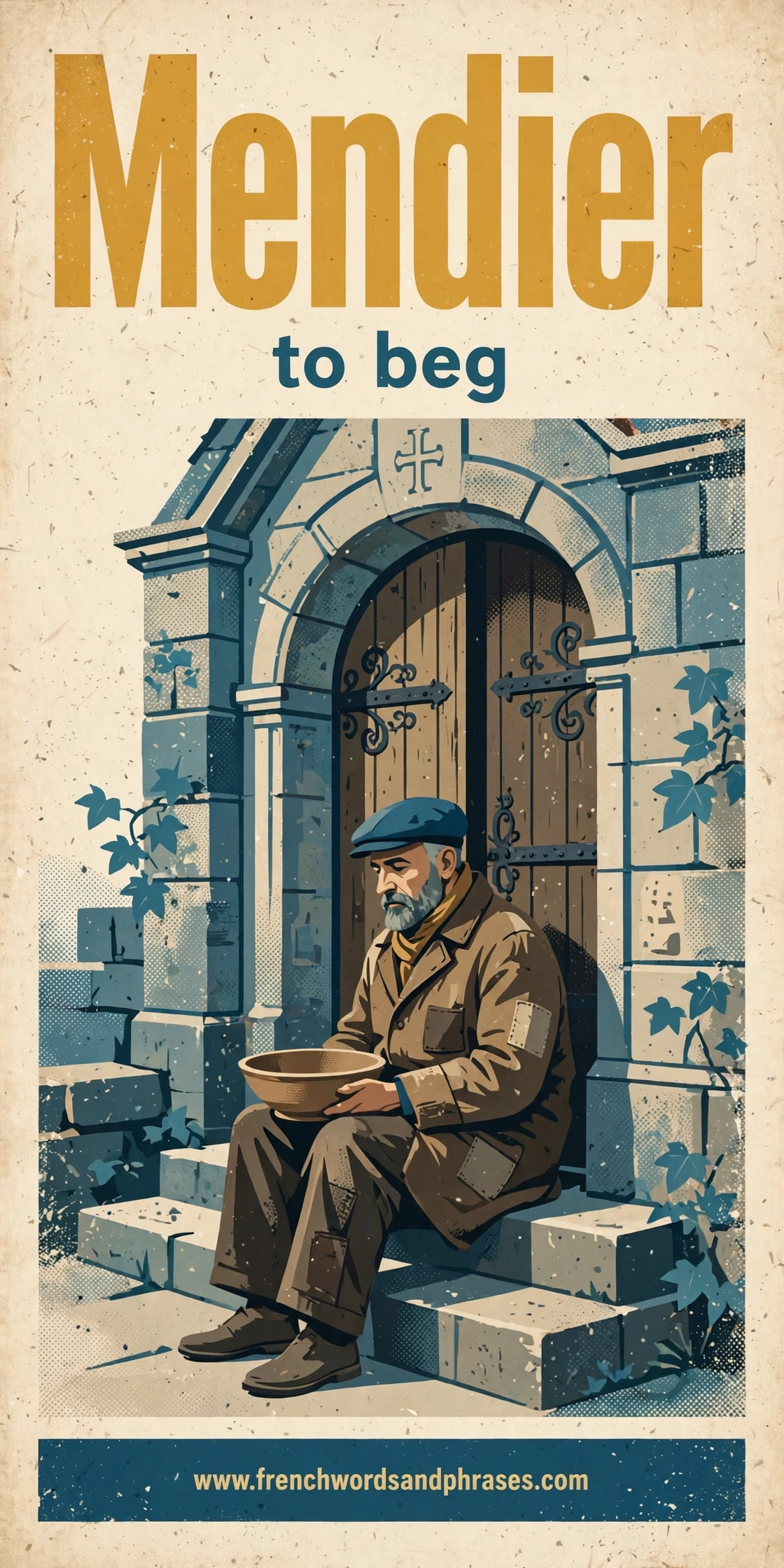
Imagine the steps of an old church on a winter morning. An old man sits where he always sits, his cap on the ground before him, and the regulars drop their coin without breaking stride — a small ceremony of the street.
Nothing has been sold and nothing bought. Something has been begged — and, coin by coin, given.
How to Conjugate Mendier: Complete French Conjugation Guide
Let’s explore every major conjugation of mendier, beginning with the indicative mood.
How to Conjugate Mendier in the Indicative Mood
The indicative mood is used to express facts, observations, actions, and events.
How to Conjugate Mendier in the Present Tense (Présent)
Used for actions happening now, habitual actions, and general truths.
| Subject | Conjugation |
|---|---|
| je | mendie |
| tu | mendies |
| il / elle | mendie |
| nous | mendions |
| vous | mendiez |
| ils / elles | mendient |
Example
Un vieil homme mendie à la sortie du métro.
An old man begs at the exit of the metro.
Quick Quiz 1
Complete the sentence:
Nous ______ aux passants quelques pièces.
Reveal the answer
mendions
Nous mendions aux passants quelques pièces.
We are begging a few coins from the passers-by.
How to Conjugate Mendier in the Passé Composé
Used for completed actions in the past. Mendier takes the auxiliary verb avoir.
| Subject | Conjugation |
|---|---|
| j’ | ai mendié |
| tu | as mendié |
| il / elle | a mendié |
| nous | avons mendié |
| vous | avez mendié |
| ils / elles | ont mendié |
Example
Elle a mendié un peu de pain à la boulangerie.
She begged a little bread at the bakery.
How to Conjugate Mendier in the Imparfait (Imperfect Tense)
Used for habitual past actions, descriptions, and ongoing situations in the past.
| Subject | Conjugation |
|---|---|
| je | mendiais |
| tu | mendiais |
| il / elle | mendiait |
| nous | mendiions |
| vous | mendiiez |
| ils / elles | mendiaient |
Example
Autrefois, les pauvres mendiaient à la porte des églises.
In the old days, the poor used to beg at church doors.
Quick Quiz 2
Choose the correct form:
She begged for shelter.
Elle ______ un abri. (a mendié / est mendiée)
Reveal the answer
a mendié
Elle a mendié un abri.
Mendier takes avoir.
How to Conjugate Mendier in the Plus-que-parfait
Used to describe an action that had already been completed before another past event.
| Subject | Conjugation |
|---|---|
| j’ | avais mendié |
| tu | avais mendié |
| il / elle | avait mendié |
| nous | avions mendié |
| vous | aviez mendié |
| ils / elles | avaient mendié |
Example
Il avait mendié toute la journée sans rien recevoir.
He had begged all day without receiving anything.
How to Conjugate Mendier in the Passé Simple
Primarily used in formal writing, literature, and historical narratives. It is rarely used in everyday conversation.
| Subject | Conjugation |
|---|---|
| je | mendiai |
| tu | mendias |
| il / elle | mendia |
| nous | mendiâmes |
| vous | mendiâtes |
| ils / elles | mendièrent |
Example
Le voyageur mendia un abri pour la nuit.
The traveller begged for shelter for the night.
How to Conjugate Mendier in the Passé Antérieur
A literary tense used to express an action completed immediately before another past action, generally in the passé simple.
| Subject | Conjugation |
|---|---|
| j’ | eus mendié |
| tu | eus mendié |
| il / elle | eut mendié |
| nous | eûmes mendié |
| vous | eûtes mendié |
| ils / elles | eurent mendié |
Example
Quand il eut mendié son pain de porte en porte, il rentra chez lui.
When he had begged his bread from door to door, he went home.
How to Conjugate Mendier in the Future Tense (Futur Simple)
Used to describe actions that will take place in the future.
| Subject | Conjugation |
|---|---|
| je | mendierai |
| tu | mendieras |
| il / elle | mendiera |
| nous | mendierons |
| vous | mendierez |
| ils / elles | mendieront |
Example
Sans travail, il mendiera pour nourrir sa famille.
Without work, he will beg to feed his family.
How to Conjugate Mendier in the Futur Antérieur (Future Perfect)
Used for an action that will have been completed before a particular point in the future.
| Subject | Conjugation |
|---|---|
| j’ | aurai mendié |
| tu | auras mendié |
| il / elle | aura mendié |
| nous | aurons mendié |
| vous | aurez mendié |
| ils / elles | auront mendié |
Example
À la fin du mois, elle aura mendié assez pour payer sa chambre.
By the end of the month, she will have begged enough to pay for her room.
How to Conjugate Mendier in the Near Future (Futur Proche)
Used to describe something that is going to happen soon. Formed with aller + infinitive.
| Subject | Conjugation |
|---|---|
| je | vais mendier |
| tu | vas mendier |
| il / elle | va mendier |
| nous | allons mendier |
| vous | allez mendier |
| ils / elles | vont mendier |
Example
Je vais mendier un sourire à ce bébé sérieux.
I am going to beg a smile from this serious baby.
How to Conjugate Mendier in the Conditional Mood
The conditional mood expresses what would happen under certain circumstances. It is also frequently used to make polite requests or express wishes.
How to Conjugate Mendier in the Present Conditional
| Subject | Conjugation |
|---|---|
| je | mendierais |
| tu | mendierais |
| il / elle | mendierait |
| nous | mendierions |
| vous | mendieriez |
| ils / elles | mendieraient |
Example
Personne ne mendierait si le travail suffisait.
Nobody would beg if work were enough.
How to Conjugate Mendier in the Past Conditional
| Subject | Conjugation |
|---|---|
| j’ | aurais mendié |
| tu | aurais mendié |
| il / elle | aurait mendié |
| nous | aurions mendié |
| vous | auriez mendié |
| ils / elles | auraient mendié |
Example
Il aurait mendié plutôt que de voler.
He would have begged rather than steal.
Mendier in the Literary Past Conditional Form
This less common literary form uses the imperfect subjunctive of avoir.
| Subject | Conjugation |
|---|---|
| j’ | eusse mendié |
| tu | eusses mendié |
| il / elle | eût mendié |
| nous | eussions mendié |
| vous | eussiez mendié |
| ils / elles | eussent mendié |
Example
Elle eût mendié son pain que personne ne l’eût su.
She would have begged for her bread and nobody would have known.
How to Conjugate Mendier in the Subjunctive Mood
The subjunctive is used to express wishes, emotions, doubts, necessity, and uncertainty. It frequently follows expressions such as il faut que (it is necessary that) or bien que (although).
How to Conjugate Mendier in the Present Subjunctive
| Subject | Conjugation |
|---|---|
| que je | mendie |
| que tu | mendies |
| qu’il / qu’elle | mendie |
| que nous | mendiions |
| que vous | mendiiez |
| qu’ils / qu’elles | mendient |
Example
Il est triste que des enfants mendient dans la rue.
It is sad that children beg in the street.
Quick Quiz 3
Complete the sentence using the subjunctive:
Il est triste que des enfants ______ dans la rue.
Reveal the answer
mendient
Il est triste que des enfants mendient dans la rue.
It is sad that children beg in the street.
How to Conjugate Mendier in the Imperfect Subjunctive
A literary tense, rarely encountered in modern spoken French.
| Subject | Conjugation |
|---|---|
| que je | mendiasse |
| que tu | mendiasses |
| qu’il / qu’elle | mendiât |
| que nous | mendiassions |
| que vous | mendiassiez |
| qu’ils / qu’elles | mendiassent |
Example
Le maire refusait que l’on mendiât devant la gare.
The mayor refused to allow begging in front of the station.
How to Conjugate Mendier in the Pluperfect Subjunctive
A literary construction used to express an action completed before another past action.
| Subject | Conjugation |
|---|---|
| que j’ | eusse mendié |
| que tu | eusses mendié |
| qu’il / qu’elle | eût mendié |
| que nous | eussions mendié |
| que vous | eussiez mendié |
| qu’ils / qu’elles | eussent mendié |
Example
Il regrettait que son père eût mendié autrefois.
He regretted that his father had once begged.
How to Conjugate Mendier in the Past Subjunctive
| Subject | Conjugation |
|---|---|
| que j’ | aie mendié |
| que tu | aies mendié |
| qu’il / qu’elle | ait mendié |
| que nous | ayons mendié |
| que vous | ayez mendié |
| qu’ils / qu’elles | aient mendié |
Example
Je suis touché qu’elle ait mendié un délai pour payer.
I am moved that she begged for more time to pay.
How to Conjugate Mendier in the Imperative
The imperative is used to give commands, instructions, invitations, or suggestions. Subject pronouns are omitted.
How to Conjugate Mendier in the Present Imperative
| Person | Conjugation |
|---|---|
| (tu) | mendie |
| (nous) | mendions |
| (vous) | mendiez |
Example
Ne mendie pas, travaille si tu peux !
Do not beg, work if you can!
Quick Quiz 4
How would you say Do not beg here (tu form)?
Reveal the answer
Ne mendie pas ici !
French Participles of Mendier
Participles are verb forms that can be used in compound tenses and other grammatical constructions.
Present Participle of Mendier
mendiant
En mendiant aux feux rouges, il risque sa vie chaque jour.
By begging at the traffic lights, he risks his life every day.
Past Participle of Mendier
mendié
Mendié sou par sou, l’argent du billet lui a pris un mois.
Begged coin by coin, the money for the ticket took him a month.
Mendier in Everyday French: Real-Life Examples
Now that you know the conjugations, let’s see how mendier appears in everyday French.
Example 1 — Present
Un mendiant mendie à la sortie de la gare.
A beggar begs outside the station.
Example 2 — Passé composé
Elle a mendié quelques pièces aux passants.
She begged a few coins from passers-by.
Example 3 — Imparfait
Il mendiait toujours au même coin de rue.
He always used to beg on the same street corner.
Example 4 — Future
Le chien mendiera un morceau de fromage à table.
The dog will beg for a piece of cheese at the table.
Example 5 — Conditional
Tu mendierais un sourire à n’importe qui, toi !
You would beg a smile from anyone, you!
Example 6 — Imperative
Ne mendiez pas ici, la terrasse est aux clients !
Do not beg here, the terrace is for customers!
Beyond Translation: The Meaning of Mendier
English beg has softened into politeness — I beg your pardon; French mendier keeps the hard original sense of the outstretched hand, and keeps it dignified.
It names a whole world in one family.
Un mendiant begs, la mendicité is his condition, and the orders of friars who lived by alms were les ordres mendiants — the mendicant orders, who made begging a rule of life.
How to Remember the French Verb Mendier
Remember it this way: Mendier is about the open hand — coins, bread and begged-for smiles.
- Verbs in -ier double the i: nous mendiions, vous mendiiez in the imperfect and subjunctive.
- Un mendiant, une mendiante — the beggar; la mendicité — begging itself.
- Regular -ier: je mendie, nous mendions, past participle mendié.
The key idea is the open hand — coins, bread and begged-for smiles.
Test Your Knowledge of Mendier
Let’s see how much you’ve learned. Try answering these questions before revealing the answers.
Question 1
What is un mendiant?
Reveal the answer
A beggar — une mendiante for a woman.
Question 2
How do you say He begs at the church door in French?
Reveal the answer
Il mendie à la porte de l’église.
Question 3
Translate: She begged a little bread at the bakery.
Reveal the answer
Elle a mendié un peu de pain à la boulangerie.
Question 4
What is the past participle of mendier?
Reveal the answer
Mendié.
Question 5
Complete the sentence:
Autrefois, nous ______ à la porte des églises.
Reveal the answer
mendiions
Autrefois, nous mendiions à la porte des églises.
In the old days, we used to beg at church doors. Note the double i in mendiions.
Your Final Challenge
Can You Use It?
How would you say this in French?
The dog begs for a piece of bread, and Grandfather always ends up giving in.
Reveal the answer
Le chien mendie un morceau de pain, et grand-père finit toujours par céder.
The dog begs for a piece of bread, and Grandfather always ends up giving in.
A little French. A little curiosity. A richer everyday life.
LEARN FRENCH ONE WORD AT A TIME




