
A French Word to Live By
How to Conjugate Médailler in French
/me.da.je/
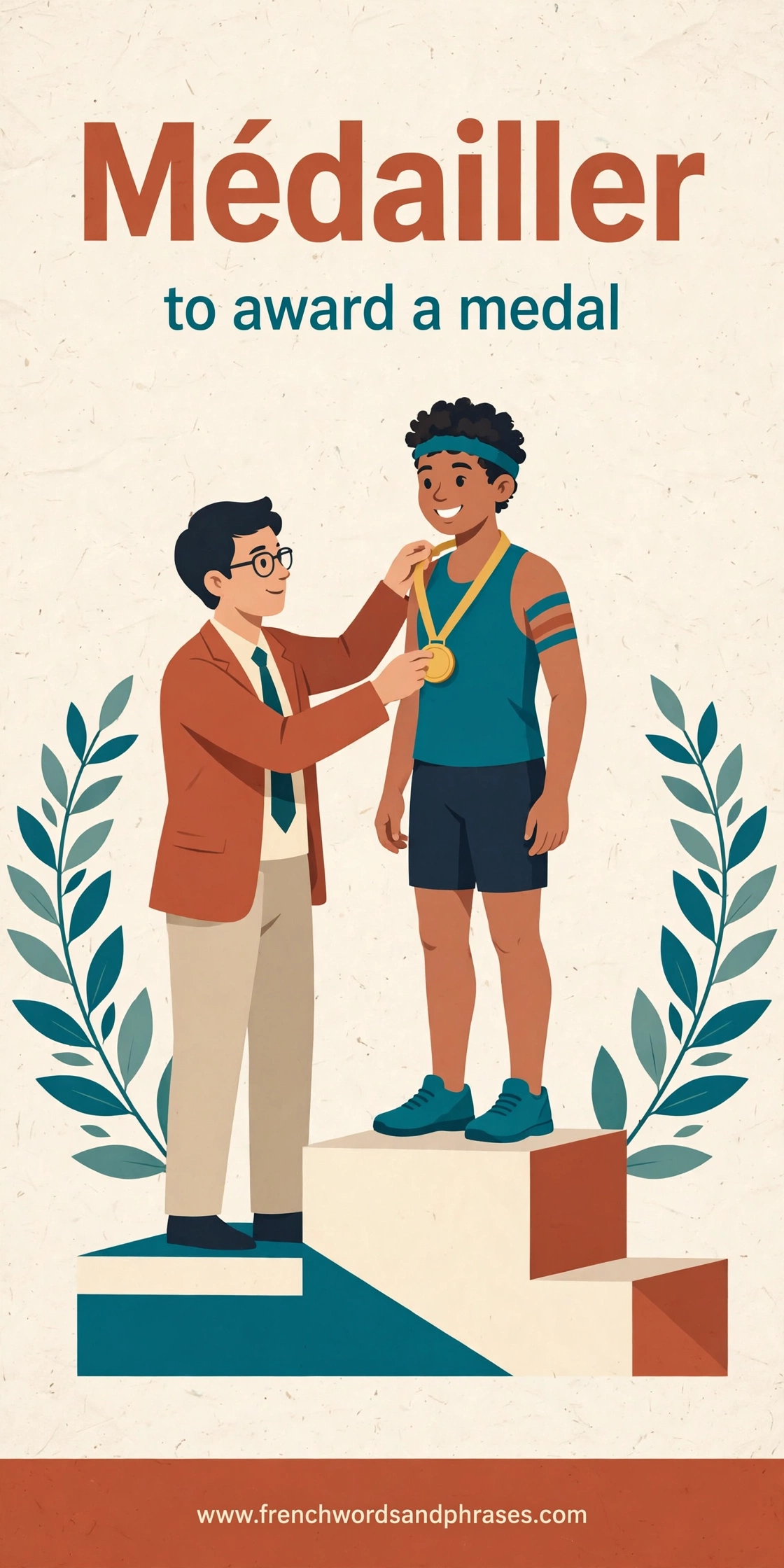
Médailler means to award a medal.
A champion climbs the podium, bends her head, and the ribbon settles around her neck — médailler is the verb of that small ceremony: to honour an athlete, a soldier or a winemaker with a medal.
In this guide, you’ll learn how to conjugate médailler in all the major French tenses and moods. Explore complete conjugation tables, French examples, English translations, and practice quizzes.
Understanding the French Verb Médailler
Médailler is a regular French verb belonging to the first group of verbs, those ending in -er.
It means to award a medal. It is commonly used for Olympic and championship podiums (médailler un champion), for military and civic honours, and for award ceremonies far from sport — agricultural shows and wine competitions médaillent their winners too.
Verb classification: First group (-er)
Auxiliary verb: Avoir
Past participle: médaillé
Present participle: médaillant
English equivalents: To award a medal to, to decorate with a medal; un médaillé — a medallist, someone who has been awarded one.
One important detail: médailler is transitive — you médailler someone, you do not simply médailler. The person honoured becomes un médaillé or une médaillée, and the participle agrees like an adjective: une athlète médaillée d’or, a gold-medal-winning athlete. That participle is the word sports pages use all summer long.
Experience the Word
Médailler is the verb of the podium moment — thirty seconds of ceremony that crown years of training.
Imagine a village fête on a warm evening. The mayor pins a medal on the firefighter who has served thirty years, the band plays, and the whole square applauds a man who is suddenly shy.
The medal weighs almost nothing. What it means weighs a career.
How to Conjugate Médailler: Complete French Conjugation Guide
Let’s explore every major conjugation of médailler, beginning with the indicative mood.
How to Conjugate Médailler in the Indicative Mood
The indicative mood is used to express facts, observations, actions, and events.
How to Conjugate Médailler in the Present Tense (Présent)
Used for actions happening now, habitual actions, and general truths.
| Subject | Conjugation |
|---|---|
| je | médaille |
| tu | médailles |
| il / elle | médaille |
| nous | médaillons |
| vous | médaillez |
| ils / elles | médaillent |
Example
Le jury médaille les trois premiers de chaque épreuve.
The jury awards medals to the first three in each event.
Quick Quiz 1
Complete the sentence:
Nous ______ les vainqueurs ce soir.
Reveal the answer
médaillons
Nous médaillons les vainqueurs ce soir.
We are awarding medals to the winners this evening.
How to Conjugate Médailler in the Passé Composé
Used for completed actions in the past. Médailler takes the auxiliary verb avoir.
| Subject | Conjugation |
|---|---|
| j’ | ai médaillé |
| tu | as médaillé |
| il / elle | a médaillé |
| nous | avons médaillé |
| vous | avez médaillé |
| ils / elles | ont médaillé |
Example
La fédération a médaillé la championne dès son retour.
The federation awarded the champion a medal as soon as she returned.
How to Conjugate Médailler in the Imparfait (Imperfect Tense)
Used for habitual past actions, descriptions, and ongoing situations in the past.
| Subject | Conjugation |
|---|---|
| je | médaillais |
| tu | médaillais |
| il / elle | médaillait |
| nous | médaillions |
| vous | médailliez |
| ils / elles | médaillaient |
Example
Chaque été, le village médaillait ses meilleurs vignerons.
Every summer, the village awarded medals to its best winemakers.
Quick Quiz 2
Choose the correct form:
The federation awarded the champion a medal.
La fédération ______ la championne. (a médaillé / est médaillée)
Reveal the answer
a médaillé
La fédération a médaillé la championne.
Médailler takes avoir.
How to Conjugate Médailler in the Plus-que-parfait
Used to describe an action that had already been completed before another past event.
| Subject | Conjugation |
|---|---|
| j’ | avais médaillé |
| tu | avais médaillé |
| il / elle | avait médaillé |
| nous | avions médaillé |
| vous | aviez médaillé |
| ils / elles | avaient médaillé |
Example
On avait médaillé le vétéran avant la cérémonie officielle.
The veteran had been awarded his medal before the official ceremony.
How to Conjugate Médailler in the Passé Simple
Primarily used in formal writing, literature, and historical narratives. It is rarely used in everyday conversation.
| Subject | Conjugation |
|---|---|
| je | médaillai |
| tu | médaillas |
| il / elle | médailla |
| nous | médaillâmes |
| vous | médaillâtes |
| ils / elles | médaillèrent |
Example
Le ministre médailla les sauveteurs devant les caméras.
The minister awarded medals to the rescuers in front of the cameras.
How to Conjugate Médailler in the Passé Antérieur
A literary tense used to express an action completed immediately before another past action, generally in the passé simple.
| Subject | Conjugation |
|---|---|
| j’ | eus médaillé |
| tu | eus médaillé |
| il / elle | eut médaillé |
| nous | eûmes médaillé |
| vous | eûtes médaillé |
| ils / elles | eurent médaillé |
Example
Quand le président eut médaillé le dernier athlète, l’hymne retentit.
When the president had awarded a medal to the last athlete, the anthem rang out.
How to Conjugate Médailler in the Future Tense (Futur Simple)
Used to describe actions that will take place in the future.
| Subject | Conjugation |
|---|---|
| je | médaillerai |
| tu | médailleras |
| il / elle | médaillera |
| nous | médaillerons |
| vous | médaillerez |
| ils / elles | médailleront |
Example
Demain, le comité médaillera les vainqueurs du marathon.
Tomorrow, the committee will award medals to the marathon winners.
How to Conjugate Médailler in the Futur Antérieur (Future Perfect)
Used for an action that will have been completed before a particular point in the future.
| Subject | Conjugation |
|---|---|
| j’ | aurai médaillé |
| tu | auras médaillé |
| il / elle | aura médaillé |
| nous | aurons médaillé |
| vous | aurez médaillé |
| ils / elles | auront médaillé |
Example
À la fin des Jeux, on aura médaillé des centaines d’athlètes.
By the end of the Games, hundreds of athletes will have been awarded medals.
How to Conjugate Médailler in the Near Future (Futur Proche)
Used to describe something that is going to happen soon. Formed with aller + infinitive.
| Subject | Conjugation |
|---|---|
| je | vais médailler |
| tu | vas médailler |
| il / elle | va médailler |
| nous | allons médailler |
| vous | allez médailler |
| ils / elles | vont médailler |
Example
Le maire va médailler les pompiers volontaires ce soir.
The mayor is going to award medals to the volunteer firefighters this evening.
How to Conjugate Médailler in the Conditional Mood
The conditional mood expresses what would happen under certain circumstances. It is also frequently used to make polite requests or express wishes.
How to Conjugate Médailler in the Present Conditional
| Subject | Conjugation |
|---|---|
| je | médaillerais |
| tu | médaillerais |
| il / elle | médaillerait |
| nous | médaillerions |
| vous | médailleriez |
| ils / elles | médailleraient |
Example
Le jury médaillerait davantage de jeunes si le règlement le permettait.
The jury would award medals to more young people if the rules allowed it.
How to Conjugate Médailler in the Past Conditional
| Subject | Conjugation |
|---|---|
| j’ | aurais médaillé |
| tu | aurais médaillé |
| il / elle | aurait médaillé |
| nous | aurions médaillé |
| vous | auriez médaillé |
| ils / elles | auraient médaillé |
Example
On aurait médaillé toute l’équipe pour ce sauvetage.
The whole team would have been awarded medals for that rescue.
Médailler in the Literary Past Conditional Form
This less common literary form uses the imperfect subjunctive of avoir.
| Subject | Conjugation |
|---|---|
| j’ | eusse médaillé |
| tu | eusses médaillé |
| il / elle | eût médaillé |
| nous | eussions médaillé |
| vous | eussiez médaillé |
| ils / elles | eussent médaillé |
Example
Il eût médaillé chaque soldat de la garnison.
He would have awarded a medal to every soldier in the garrison.
How to Conjugate Médailler in the Subjunctive Mood
The subjunctive is used to express wishes, emotions, doubts, necessity, and uncertainty. It frequently follows expressions such as il faut que (it is necessary that) or bien que (although).
How to Conjugate Médailler in the Present Subjunctive
| Subject | Conjugation |
|---|---|
| que je | médaille |
| que tu | médailles |
| qu’il / qu’elle | médaille |
| que nous | médaillions |
| que vous | médailliez |
| qu’ils / qu’elles | médaillent |
Example
Il est juste que le comité médaille aussi les entraîneurs.
It is fair that the committee should also award medals to the coaches.
Quick Quiz 3
Complete the sentence using the subjunctive:
Il est juste que vous ______ les bénévoles.
Reveal the answer
médailliez
Il est juste que vous médailliez les bénévoles.
It is fair that you award medals to the volunteers.
How to Conjugate Médailler in the Imperfect Subjunctive
A literary tense, rarely encountered in modern spoken French.
| Subject | Conjugation |
|---|---|
| que je | médaillasse |
| que tu | médaillasses |
| qu’il / qu’elle | médaillât |
| que nous | médaillassions |
| que vous | médaillassiez |
| qu’ils / qu’elles | médaillassent |
Example
Le public attendait que l’on médaillât enfin la doyenne du club.
The crowd was waiting for the club’s oldest member to finally be awarded her medal.
How to Conjugate Médailler in the Pluperfect Subjunctive
A literary construction used to express an action completed before another past action.
| Subject | Conjugation |
|---|---|
| que j’ | eusse médaillé |
| que tu | eusses médaillé |
| qu’il / qu’elle | eût médaillé |
| que nous | eussions médaillé |
| que vous | eussiez médaillé |
| qu’ils / qu’elles | eussent médaillé |
Example
Elle était fière que le jury eût médaillé son élève.
She was proud that the jury had awarded a medal to her pupil.
How to Conjugate Médailler in the Past Subjunctive
| Subject | Conjugation |
|---|---|
| que j’ | aie médaillé |
| que tu | aies médaillé |
| qu’il / qu’elle | ait médaillé |
| que nous | ayons médaillé |
| que vous | ayez médaillé |
| qu’ils / qu’elles | aient médaillé |
Example
Je suis heureux que la ville ait médaillé ces bénévoles.
I am glad the town awarded medals to these volunteers.
How to Conjugate Médailler in the Imperative
The imperative is used to give commands, instructions, invitations, or suggestions. Subject pronouns are omitted.
How to Conjugate Médailler in the Present Imperative
| Person | Conjugation |
|---|---|
| (tu) | médaille |
| (nous) | médaillons |
| (vous) | médaillez |
Example
Médaille les champions, ils l’ont bien mérité !
Award medals to the champions, they have truly earned it!
Quick Quiz 4
How would you say Award medals to the champions (tu form)?
Reveal the answer
Médaille les champions !
French Participles of Médailler
Participles are verb forms that can be used in compound tenses and other grammatical constructions.
Present Participle of Médailler
médaillant
En médaillant les vainqueurs, le maire a salué leurs entraîneurs.
In awarding medals to the winners, the mayor praised their coaches.
Past Participle of Médailler
médaillé
Médaillée d’or à vingt ans, elle est devenue l’idole du village.
Awarded a gold medal at twenty, she became the village idol.
Médailler in Everyday French: Real-Life Examples
Now that you know the conjugations, let’s see how médailler appears in everyday French.
Example 1 — Present
Le comité médaille les vainqueurs à la fin de la journée.
The committee awards medals to the winners at the end of the day.
Example 2 — Passé composé
Elle a médaillé trois athlètes de son club.
She awarded medals to three athletes from her club.
Example 3 — Imparfait
Autrefois, le roi médaillait ses généraux après chaque victoire.
In the old days, the king used to award medals to his generals after each victory.
Example 4 — Future
On médaillera les meilleurs vins du salon demain.
The best wines of the show will be awarded medals tomorrow.
Example 5 — Conditional
Le jury médaillerait ce fromage sans hésiter.
The jury would award a medal to this cheese without hesitating.
Example 6 — Imperative
Médaillez les bénévoles, ils le méritent !
Award medals to the volunteers, they deserve it!
Beyond Translation: The Meaning of Médailler
English says to award a medal, a whole phrase; French médailler folds the ceremony into one verb, and its participle walks straight onto the sports pages.
Un médaillé olympique needs no explanation.
Once you know médailler, the headline writes itself: the verb gives the medal, the participle names the hero.
How to Remember the French Verb Médailler
Remember it this way: Médailler is about the podium verb — to put a medal around someone’s neck.
- Transitive — you médailler someone: médailler un champion, un soldat, un vin.
- The honoured person is un médaillé, une médaillée — the participle agrees.
- Regular -er: je médaille, nous médaillons, past participle médaillé.
The key idea is the podium verb — to put a medal around someone’s neck.
Test Your Knowledge of Médailler
Let’s see how much you’ve learned. Try answering these questions before revealing the answers.
Question 1
What do you call someone who has been awarded a medal?
Reveal the answer
Un médaillé (une médaillée for a woman) — a medallist.
Question 2
How do you say The mayor awarded a medal to the firefighter in French?
Reveal the answer
Le maire a médaillé le pompier.
Question 3
Translate: The jury awards medals to the first three.
Reveal the answer
Le jury médaille les trois premiers.
Question 4
What is the past participle of médailler?
Reveal the answer
Médaillé.
Question 5
Complete the sentence:
Il est juste que le comité ______ aussi les entraîneurs.
Reveal the answer
médaille
Il est juste que le comité médaille aussi les entraîneurs.
It is fair that the committee should also award medals to the coaches.
Your Final Challenge
Can You Use It?
How would you say this in French?
The mayor awards the champion her medal, and the whole village applauds.
Reveal the answer
Le maire médaille la championne, et tout le village applaudit.
The mayor awards the champion her medal, and the whole village applauds.
A little French. A little curiosity. A richer everyday life.
LEARN FRENCH ONE WORD AT A TIME




