A French Word to Live By
How to Conjugate Mastiquer in French
/mas.ti.ke/
Mastiquer means to chew.
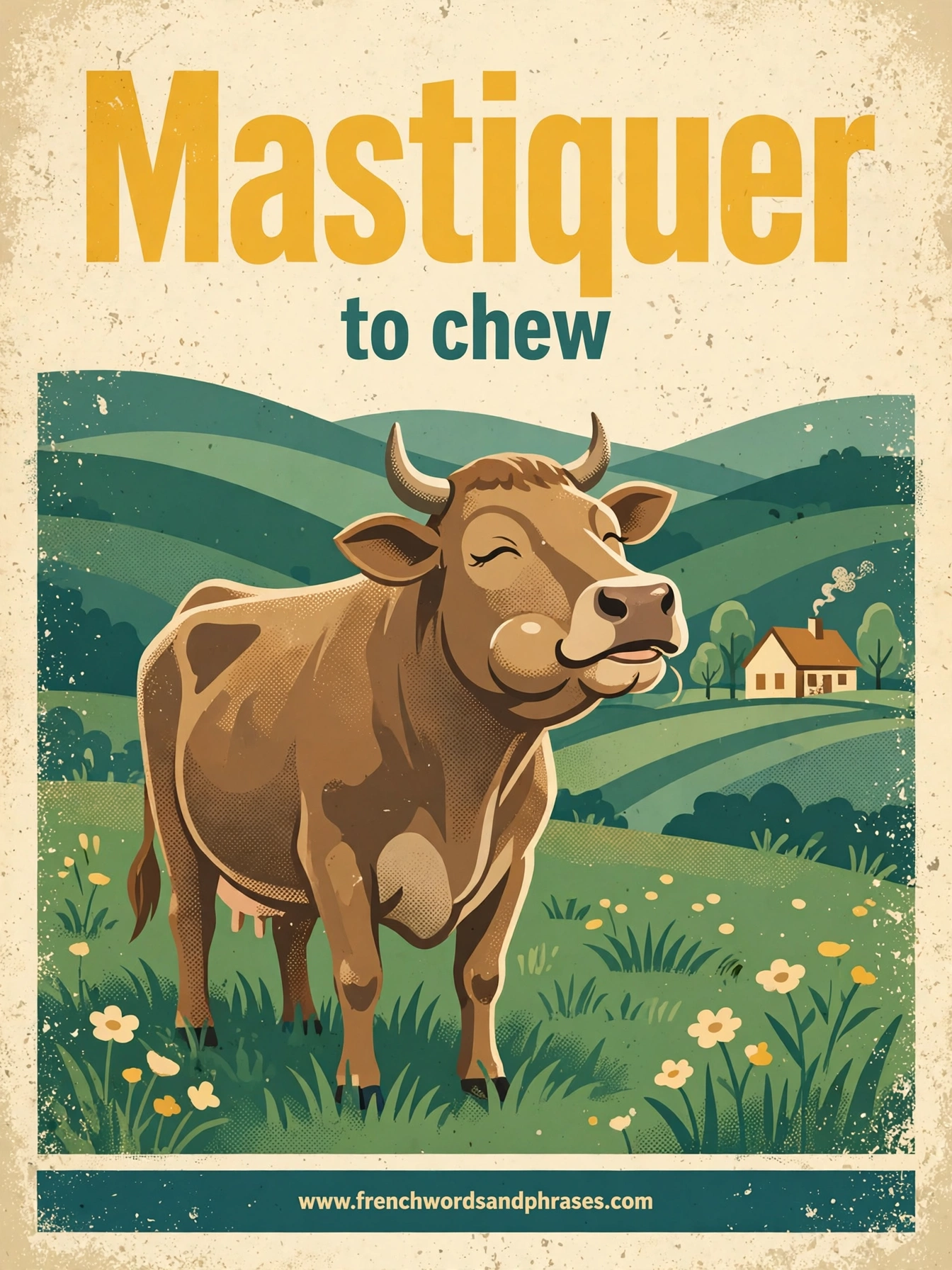
A cow working through the afternoon in a green field, a child chewing thoughtfully on a crust, a glazier pressing soft putty into a window frame — mastiquer is the verb of the working jaw, and of the builder’s sealing paste that shares its name.
In this guide, you’ll learn how to conjugate mastiquer in all the major French tenses and moods. Explore complete conjugation tables, French examples, English translations, and practice quizzes.
Understanding the French Verb Mastiquer
Mastiquer is a regular French verb belonging to the first group of verbs, those ending in -er.
It means to chew. It is commonly used for chewing food thoroughly and slowly, in health advice to children and patients, for animals chewing the cud, and in building for sealing windows, joints and cracks with mastic or putty.
Verb classification: First group (-er)
Auxiliary verb: Avoir
Past participle: mastiqué
Present participle: mastiquant
English equivalents: To chew, to masticate; to fill or seal with mastic (putty, cement).
One important detail: mastiquer is a -quer verb — je mastique, nous mastiquons — and it too leads a double life. At the table it means to chew, slowly and properly: doctors and grandmothers agree, il faut bien mastiquer. On the building site it means to fill and seal with le mastic — the glazier’s putty, the roofer’s cement: mastiquer une vitre, to putty a windowpane; mastiquer les joints, to seal the joints. One root, two trades: the jaw and the trowel.
Experience the Word
Mastiquer is the verb of patience at the table — bite, work, wait: the jaw doing its slow, honest labour before the swallow.
Imagine a farmhouse lunch that refuses to hurry. The grandfather mastique chaque bouchée — chews every mouthful — twenty times, in silence, while the clock ticks and the soup cools, because that is how his own grandfather taught him to eat.
The food has not just been eaten. It has been chewed — properly, completely, the way digestion deserves.
How to Conjugate Mastiquer: Complete French Conjugation Guide
Let’s explore every major conjugation of mastiquer, beginning with the indicative mood.
How to Conjugate Mastiquer in the Indicative Mood
The indicative mood is used to express facts, observations, actions, and events.
How to Conjugate Mastiquer in the Present Tense (Présent)
Used for actions happening now, habitual actions, and general truths.
| Subject | Conjugation |
|---|---|
| je | mastique |
| tu | mastiques |
| il / elle | mastique |
| nous | mastiquons |
| vous | mastiquez |
| ils / elles | mastiquent |
Example
Elle mastique lentement chaque bouchée.
She chews every mouthful slowly.
Quick Quiz 1
Complete the sentence:
Nous ______ chaque bouchée avec patience.
Reveal the answer
mastiquons
Nous mastiquons chaque bouchée avec patience.
We chew every mouthful patiently.
How to Conjugate Mastiquer in the Passé Composé
Used for completed actions in the past. Mastiquer takes the auxiliary verb avoir.
| Subject | Conjugation |
|---|---|
| j’ | ai mastiqué |
| tu | as mastiqué |
| il / elle | a mastiqué |
| nous | avons mastiqué |
| vous | avez mastiqué |
| ils / elles | ont mastiqué |
Example
Le vitrier a mastiqué la fenêtre avant l’hiver.
The glazier sealed the window with putty before winter.
How to Conjugate Mastiquer in the Imparfait (Imperfect Tense)
Used for habitual past actions, descriptions, and ongoing situations in the past.
| Subject | Conjugation |
|---|---|
| je | mastiquais |
| tu | mastiquais |
| il / elle | mastiquait |
| nous | mastiquions |
| vous | mastiquiez |
| ils / elles | mastiquaient |
Example
Les vaches mastiquaient l’herbe dans le pré.
The cows were chewing the grass in the meadow.
Quick Quiz 2
Choose the correct form:
The glazier sealed the window.
Le vitrier ______ la fenêtre. (a mastiqué / est mastiqué)
Reveal the answer
a mastiqué
Le vitrier a mastiqué la fenêtre.
Mastiquer takes avoir.
How to Conjugate Mastiquer in the Plus-que-parfait
Used to describe an action that had already been completed before another past event.
| Subject | Conjugation |
|---|---|
| j’ | avais mastiqué |
| tu | avais mastiqué |
| il / elle | avait mastiqué |
| nous | avions mastiqué |
| vous | aviez mastiqué |
| ils / elles | avaient mastiqué |
Example
Nous avions mastiqué les joints de la toiture.
We had sealed the roof joints with mastic.
How to Conjugate Mastiquer in the Passé Simple
Primarily used in formal writing, literature, and historical narratives. It is rarely used in everyday conversation.
| Subject | Conjugation |
|---|---|
| je | mastiquai |
| tu | mastiquas |
| il / elle | mastiqua |
| nous | mastiquâmes |
| vous | mastiquâtes |
| ils / elles | mastiquèrent |
Example
Il mastiqua son pain en regardant la pluie.
He chewed his bread while watching the rain.
How to Conjugate Mastiquer in the Passé Antérieur
A literary tense used to express an action completed immediately before another past action, generally in the passé simple.
| Subject | Conjugation |
|---|---|
| j’ | eus mastiqué |
| tu | eus mastiqué |
| il / elle | eut mastiqué |
| nous | eûmes mastiqué |
| vous | eûtes mastiqué |
| ils / elles | eurent mastiqué |
Example
Quand elle eut mastiqué sa bouchée, elle répondit enfin.
When she had chewed her mouthful, she finally answered.
How to Conjugate Mastiquer in the Future Tense (Futur Simple)
Used to describe actions that will take place in the future.
| Subject | Conjugation |
|---|---|
| je | mastiquerai |
| tu | mastiqueras |
| il / elle | mastiquera |
| nous | mastiquerons |
| vous | mastiquerez |
| ils / elles | mastiqueront |
Example
Le médecin dit que tu mastiqueras plus lentement.
The doctor says you will chew more slowly.
How to Conjugate Mastiquer in the Futur Antérieur (Future Perfect)
Used for an action that will have been completed before a particular point in the future.
| Subject | Conjugation |
|---|---|
| j’ | aurai mastiqué |
| tu | auras mastiqué |
| il / elle | aura mastiqué |
| nous | aurons mastiqué |
| vous | aurez mastiqué |
| ils / elles | auront mastiqué |
Example
À la fin du repas, ils auront mastiqué en silence, comme toujours.
By the end of the meal, they will have chewed in silence, as always.
How to Conjugate Mastiquer in the Near Future (Futur Proche)
Used to describe something that is going to happen soon. Formed with aller + infinitive.
| Subject | Conjugation |
|---|---|
| je | vais mastiquer |
| tu | vas mastiquer |
| il / elle | va mastiquer |
| nous | allons mastiquer |
| vous | allez mastiquer |
| ils / elles | vont mastiquer |
Example
Je vais mastiquer cette fissure avant de peindre.
I am going to fill this crack with mastic before painting.
How to Conjugate Mastiquer in the Conditional Mood
The conditional mood expresses what would happen under certain circumstances. It is also frequently used to make polite requests or express wishes.
How to Conjugate Mastiquer in the Present Conditional
| Subject | Conjugation |
|---|---|
| je | mastiquerais |
| tu | mastiquerais |
| il / elle | mastiquerait |
| nous | mastiquerions |
| vous | mastiqueriez |
| ils / elles | mastiqueraient |
Example
Avec de meilleures dents, il mastiquerait sans peine.
With better teeth, he would chew without difficulty.
How to Conjugate Mastiquer in the Past Conditional
| Subject | Conjugation |
|---|---|
| j’ | aurais mastiqué |
| tu | aurais mastiqué |
| il / elle | aurait mastiqué |
| nous | aurions mastiqué |
| vous | auriez mastiqué |
| ils / elles | auraient mastiqué |
Example
Elle aurait mastiqué les joints si elle avait eu le temps.
She would have sealed the joints with mastic if she had had the time.
Mastiquer in the Literary Past Conditional Form
This less common literary form uses the imperfect subjunctive of avoir.
| Subject | Conjugation |
|---|---|
| j’ | eusse mastiqué |
| tu | eusses mastiqué |
| il / elle | eût mastiqué |
| nous | eussions mastiqué |
| vous | eussiez mastiqué |
| ils / elles | eussent mastiqué |
Example
Il eût mastiqué chaque bouchée comme un cérémonial.
He would have chewed every mouthful like a ceremony.
How to Conjugate Mastiquer in the Subjunctive Mood
The subjunctive is used to express wishes, emotions, doubts, necessity, and uncertainty. It frequently follows expressions such as il faut que (it is necessary that) or bien que (although).
How to Conjugate Mastiquer in the Present Subjunctive
| Subject | Conjugation |
|---|---|
| que je | mastique |
| que tu | mastiques |
| qu’il / qu’elle | mastique |
| que nous | mastiquions |
| que vous | mastiquiez |
| qu’ils / qu’elles | mastiquent |
Example
Il faut que l’enfant mastique bien sa viande.
The child must chew his meat properly.
Quick Quiz 3
Complete the sentence using the subjunctive:
Il faut que vous ______ plus lentement.
Reveal the answer
mastiquiez
Il faut que vous mastiquiez plus lentement.
You must chew more slowly.
How to Conjugate Mastiquer in the Imperfect Subjunctive
A literary tense, rarely encountered in modern spoken French.
| Subject | Conjugation |
|---|---|
| que je | mastiquasse |
| que tu | mastiquasses |
| qu’il / qu’elle | mastiquât |
| que nous | mastiquassions |
| que vous | mastiquassiez |
| qu’ils / qu’elles | mastiquassent |
Example
Je voulais qu’il mastiquât plus lentement.
I wanted him to chew more slowly.
How to Conjugate Mastiquer in the Pluperfect Subjunctive
A literary construction used to express an action completed before another past action.
| Subject | Conjugation |
|---|---|
| que j’ | eusse mastiqué |
| que tu | eusses mastiqué |
| qu’il / qu’elle | eût mastiqué |
| que nous | eussions mastiqué |
| que vous | eussiez mastiqué |
| qu’ils / qu’elles | eussent mastiqué |
Example
Il regrettait que nous eussions mastiqué les fenêtres si vite.
He regretted that we had puttied the windows so quickly.
How to Conjugate Mastiquer in the Past Subjunctive
| Subject | Conjugation |
|---|---|
| que j’ | aie mastiqué |
| que tu | aies mastiqué |
| qu’il / qu’elle | ait mastiqué |
| que nous | ayons mastiqué |
| que vous | ayez mastiqué |
| qu’ils / qu’elles | aient mastiqué |
Example
Je suis content que tu aies mastiqué la fissure du mur.
I am glad you filled the crack in the wall with mastic.
How to Conjugate Mastiquer in the Imperative
The imperative is used to give commands, instructions, invitations, or suggestions. Subject pronouns are omitted.
How to Conjugate Mastiquer in the Present Imperative
| Person | Conjugation |
|---|---|
| (tu) | mastique |
| (nous) | mastiquons |
| (vous) | mastiquez |
Example
Mastique bien avant d’avaler !
Chew properly before swallowing!
Quick Quiz 4
How would you say Chew properly (tu form)?
Reveal the answer
Mastique bien !
French Participles of Mastiquer
Participles are verb forms that can be used in compound tenses and other grammatical constructions.
Present Participle of Mastiquer
mastiquant
En mastiquant doucement, la vache regardait passer le train.
Chewing gently, the cow watched the train go by.
Past Participle of Mastiquer
mastiqué
Mastiquée avec soin, la vitre ne bougera plus.
Sealed carefully with putty, the pane will not move again.
Mastiquer in Everyday French: Real-Life Examples
Now that you know the conjugations, let’s see how mastiquer appears in everyday French.
Example 1 — Present
Je mastique toujours lentement, comme grand-père.
I always chew slowly, like Grandfather.
Example 2 — Passé composé
Il a mastiqué les joints de la salle de bain.
He sealed the bathroom joints with mastic.
Example 3 — Imparfait
Les enfants mastiquaient leur pain en silence.
The children used to chew their bread in silence.
Example 4 — Future
Nous mastiquerons la fenêtre avant l’hiver.
We will putty the window before winter.
Example 5 — Conditional
Tu mastiquerais mieux avec moins de hâte.
You would chew better with less haste.
Example 6 — Imperative
Mastiquez chaque bouchée, c’est meilleur pour la digestion !
Chew every mouthful, it is better for digestion!
Beyond Translation: The Meaning of Mastiquer
English masticate sounds like a dentist’s lecture; French mastiquer is the everyday word at the table — and then it walks onto the building site.
The jaw and the trowel share one verb.
Le mastic is the soft paste that yields under pressure and then sets hard — not unlike a mouthful well chewed. Mastiquer une vitre and mastiquer une bouchée are cousins: work something soft until it does its job.
How to Remember the French Verb Mastiquer
Remember it this way: Mastiquer is about the working jaw — and the glazier’s putty beside it.
- Two senses: mastiquer une bouchée (chew) and mastiquer une vitre (seal with putty).
- Le mastic — the glazier’s putty and the builder’s sealing paste.
- Regular -er in -quer dress: je mastique, nous mastiquons, past participle mastiqué.
The key idea is the working jaw — and the glazier’s putty beside it.
Test Your Knowledge of Mastiquer
Let’s see how much you’ve learned. Try answering these questions before revealing the answers.
Question 1
What are the two senses of mastiquer?
Reveal the answer
To chew food — and to fill or seal with mastic, like a glazier puttying a window.
Question 2
How do you say The child must chew his meat properly in French?
Reveal the answer
L’enfant doit bien mastiquer sa viande.
Question 3
Translate: The glazier sealed the window with putty before winter.
Reveal the answer
Le vitrier a mastiqué la fenêtre avant l’hiver.
Question 4
What is the past participle of mastiquer?
Reveal the answer
Mastiqué.
Question 5
Complete the sentence:
Il faut que tu ______ bien ta viande.
Reveal the answer
mastiques
Il faut que tu mastiques bien ta viande.
You must chew your meat properly.
Your Final Challenge
Can You Use It?
How would you say this in French?
He chews slowly, and the meal becomes a little ceremony.
Reveal the answer
Il mastique lentement, et le repas devient une petite cérémonie.
He chews slowly, and the meal becomes a little ceremony.
A little French. A little curiosity. A richer everyday life.
LEARN FRENCH ONE WORD AT A TIME