
A French Word to Live By
How to Conjugate Marmonner in French
/maʁ.mɔ.ne/
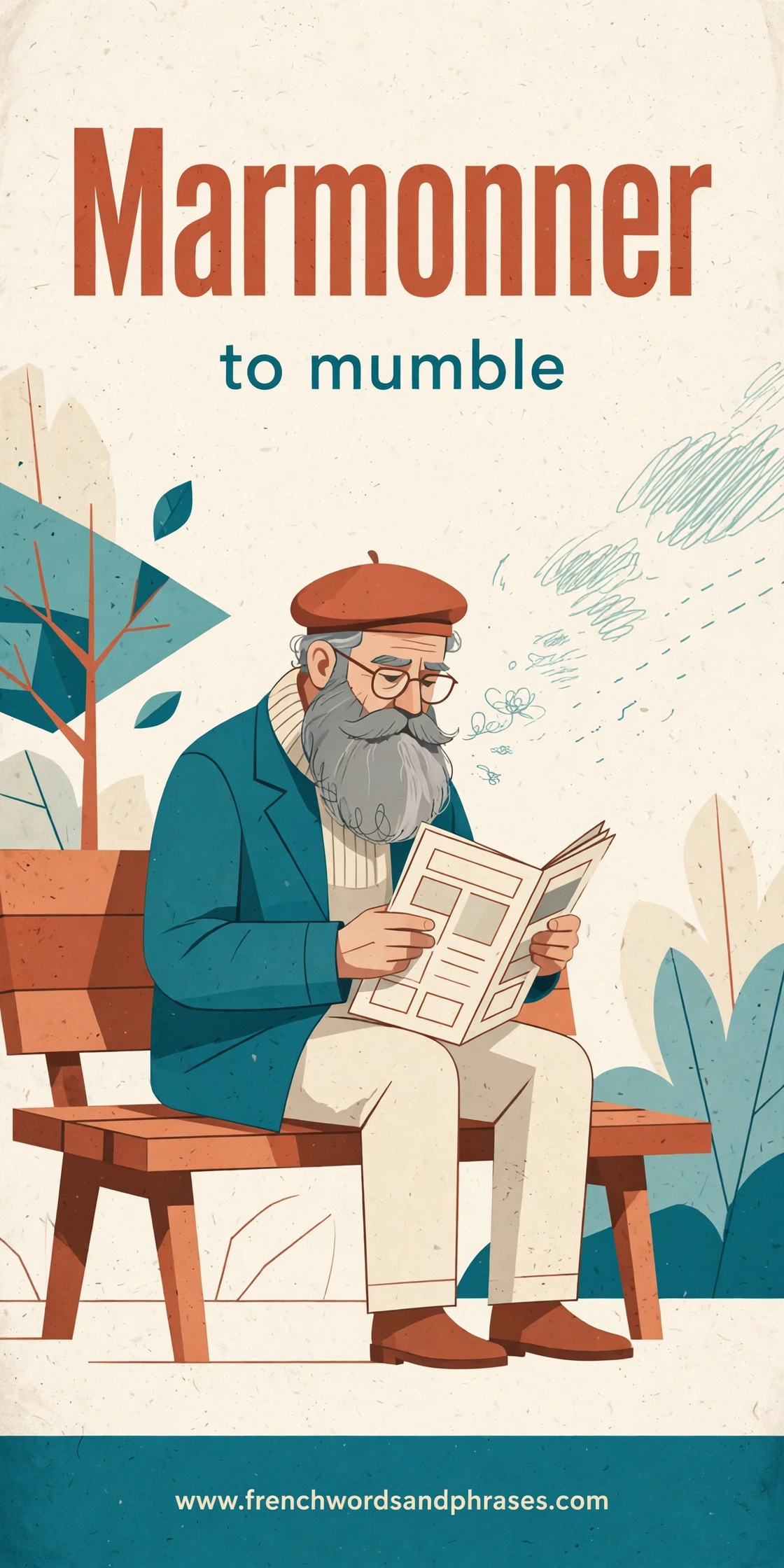
Marmonner means to mumble.
Words half-swallowed, a complaint kept under the breath, a speech rehearsed to no one — marmonner is the verb of the low, continuous mumble that nobody is quite meant to hear.
In this guide, you’ll learn how to conjugate marmonner in all the major French tenses and moods. Explore complete conjugation tables, French examples, English translations, and practice quizzes.
Understanding the French Verb Marmonner
Marmonner is a regular French verb belonging to the first group of verbs, those ending in -er.
It means to mumble. It is commonly used for mumbling excuses and apologies, for rehearsing speeches and lessons under the breath, for old people mumbling prayers, and in the classic phrase marmonner dans sa barbe.
Verb classification: First group (-er)
Auxiliary verb: Avoir
Past participle: marmonné
Present participle: marmonnant
English equivalents: To mumble, to mutter under one’s breath; marmonner dans sa barbe — to mumble into one’s beard.
One important detail: marmonner keeps its double n in every form — je marmonne, nous marmonnons, marmonné — a small drone built into the spelling itself. Its home phrase is marmonner dans sa barbe, to mumble into one’s beard: the words are spoken, but the audience is not invited. Its close cousin marmotter breaks the words into shorter pieces; marmonner is the long, low stream.
Experience the Word
Marmonner is the verb of speech turned down low — the volume of a secret, a complaint or a lesson learned by heart.
Imagine a student on the morning bus, lips moving over a page of notes. Nobody can hear a word, but the whole journey marmonne with him towards the exam.
Nothing has been declared. It has been mumbled — kept warm under the breath until it is ready, or forgotten.
How to Conjugate Marmonner: Complete French Conjugation Guide
Let’s explore every major conjugation of marmonner, beginning with the indicative mood.
How to Conjugate Marmonner in the Indicative Mood
The indicative mood is used to express facts, observations, actions, and events.
How to Conjugate Marmonner in the Present Tense (Présent)
Used for actions happening now, habitual actions, and general truths.
| Subject | Conjugation |
|---|---|
| je | marmonne |
| tu | marmonnes |
| il / elle | marmonne |
| nous | marmonnons |
| vous | marmonnez |
| ils / elles | marmonnent |
Example
Il marmonne une excuse sans lever les yeux.
He mumbles an excuse without looking up.
Quick Quiz 1
Complete the sentence:
Nous ______ nos prières à voix basse.
Reveal the answer
marmonnons
Nous marmonnons nos prières à voix basse.
We mumble our prayers in a low voice.
How to Conjugate Marmonner in the Passé Composé
Used for completed actions in the past. Marmonner takes the auxiliary verb avoir.
| Subject | Conjugation |
|---|---|
| j’ | ai marmonné |
| tu | as marmonné |
| il / elle | a marmonné |
| nous | avons marmonné |
| vous | avez marmonné |
| ils / elles | ont marmonné |
Example
Elle a marmonné quelques mots que personne n’a compris.
She mumbled a few words that nobody understood.
How to Conjugate Marmonner in the Imparfait (Imperfect Tense)
Used for habitual past actions, descriptions, and ongoing situations in the past.
| Subject | Conjugation |
|---|---|
| je | marmonnais |
| tu | marmonnais |
| il / elle | marmonnait |
| nous | marmonnions |
| vous | marmonniez |
| ils / elles | marmonnaient |
Example
Le vieil homme marmonnait ses prières près de la fenêtre.
The old man used to mumble his prayers by the window.
Quick Quiz 2
Choose the correct form:
She mumbled an excuse.
Elle ______ une excuse. (a marmonné / est marmonnée)
Reveal the answer
a marmonné
Elle a marmonné une excuse.
Marmonner takes avoir.
How to Conjugate Marmonner in the Plus-que-parfait
Used to describe an action that had already been completed before another past event.
| Subject | Conjugation |
|---|---|
| j’ | avais marmonné |
| tu | avais marmonné |
| il / elle | avait marmonné |
| nous | avions marmonné |
| vous | aviez marmonné |
| ils / elles | avaient marmonné |
Example
Elle avait marmonné la réponse avant même la fin de la question.
She had mumbled the answer before the question was even finished.
How to Conjugate Marmonner in the Passé Simple
Primarily used in formal writing, literature, and historical narratives. It is rarely used in everyday conversation.
| Subject | Conjugation |
|---|---|
| je | marmonnai |
| tu | marmonnas |
| il / elle | marmonna |
| nous | marmonnâmes |
| vous | marmonnâtes |
| ils / elles | marmonnèrent |
Example
Il marmonna une plainte et sortit de la pièce.
He mumbled a complaint and left the room.
How to Conjugate Marmonner in the Passé Antérieur
A literary tense used to express an action completed immediately before another past action, generally in the passé simple.
| Subject | Conjugation |
|---|---|
| j’ | eus marmonné |
| tu | eus marmonné |
| il / elle | eut marmonné |
| nous | eûmes marmonné |
| vous | eûtes marmonné |
| ils / elles | eurent marmonné |
Example
Quand il eut marmonné son texte, l’acteur quitta la scène.
When he had mumbled his lines, the actor left the stage.
How to Conjugate Marmonner in the Future Tense (Futur Simple)
Used to describe actions that will take place in the future.
| Subject | Conjugation |
|---|---|
| je | marmonnerai |
| tu | marmonneras |
| il / elle | marmonnera |
| nous | marmonnerons |
| vous | marmonnerez |
| ils / elles | marmonneront |
Example
Demain, tu marmonneras encore ton discours dans le train.
Tomorrow, you will be mumbling your speech again on the train.
How to Conjugate Marmonner in the Futur Antérieur (Future Perfect)
Used for an action that will have been completed before a particular point in the future.
| Subject | Conjugation |
|---|---|
| j’ | aurai marmonné |
| tu | auras marmonné |
| il / elle | aura marmonné |
| nous | aurons marmonné |
| vous | aurez marmonné |
| ils / elles | auront marmonné |
Example
À la fin du cours, les élèves auront marmonné la leçon dix fois.
By the end of the lesson, the pupils will have mumbled the lesson ten times.
How to Conjugate Marmonner in the Near Future (Futur Proche)
Used to describe something that is going to happen soon. Formed with aller + infinitive.
| Subject | Conjugation |
|---|---|
| je | vais marmonner |
| tu | vas marmonner |
| il / elle | va marmonner |
| nous | allons marmonner |
| vous | allez marmonner |
| ils / elles | vont marmonner |
Example
Il va marmonner une excuse, comme toujours.
He is going to mumble an excuse, as always.
How to Conjugate Marmonner in the Conditional Mood
The conditional mood expresses what would happen under certain circumstances. It is also frequently used to make polite requests or express wishes.
How to Conjugate Marmonner in the Present Conditional
| Subject | Conjugation |
|---|---|
| je | marmonnerais |
| tu | marmonnerais |
| il / elle | marmonnerait |
| nous | marmonnerions |
| vous | marmonneriez |
| ils / elles | marmonneraient |
Example
Sans ce bruit, on l’entendrait marmonner dans sa barbe.
Without this noise, you could hear him mumbling into his beard.
How to Conjugate Marmonner in the Past Conditional
| Subject | Conjugation |
|---|---|
| j’ | aurais marmonné |
| tu | aurais marmonné |
| il / elle | aurait marmonné |
| nous | aurions marmonné |
| vous | auriez marmonné |
| ils / elles | auraient marmonné |
Example
Elle aurait marmonné plus fort si elle avait osé.
She would have mumbled louder if she had dared.
Marmonner in the Literary Past Conditional Form
This less common literary form uses the imperfect subjunctive of avoir.
| Subject | Conjugation |
|---|---|
| j’ | eusse marmonné |
| tu | eusses marmonné |
| il / elle | eût marmonné |
| nous | eussions marmonné |
| vous | eussiez marmonné |
| ils / elles | eussent marmonné |
Example
Il eût marmonné ses prières jusqu’au bout de la nuit.
He would have mumbled his prayers until the end of the night.
How to Conjugate Marmonner in the Subjunctive Mood
The subjunctive is used to express wishes, emotions, doubts, necessity, and uncertainty. It frequently follows expressions such as il faut que (it is necessary that) or bien que (although).
How to Conjugate Marmonner in the Present Subjunctive
| Subject | Conjugation |
|---|---|
| que je | marmonne |
| que tu | marmonnes |
| qu’il / qu’elle | marmonne |
| que nous | marmonnions |
| que vous | marmonniez |
| qu’ils / qu’elles | marmonnent |
Example
Je déteste qu’il marmonne au lieu de répondre clairement.
I hate it when he mumbles instead of answering clearly.
Quick Quiz 3
Complete the sentence using the subjunctive:
Il faut que vous ______ votre texte.
Reveal the answer
marmonniez
Il faut que vous marmonniez votre texte.
You must mumble your lines.
How to Conjugate Marmonner in the Imperfect Subjunctive
A literary tense, rarely encountered in modern spoken French.
| Subject | Conjugation |
|---|---|
| que je | marmonnasse |
| que tu | marmonnasses |
| qu’il / qu’elle | marmonnât |
| que nous | marmonnassions |
| que vous | marmonnassiez |
| qu’ils / qu’elles | marmonnassent |
Example
Le professeur exigeait que l’élève marmonnât moins et parlât plus fort.
The teacher demanded that the pupil mumble less and speak louder.
How to Conjugate Marmonner in the Pluperfect Subjunctive
A literary construction used to express an action completed before another past action.
| Subject | Conjugation |
|---|---|
| que j’ | eusse marmonné |
| que tu | eusses marmonné |
| qu’il / qu’elle | eût marmonné |
| que nous | eussions marmonné |
| que vous | eussiez marmonné |
| qu’ils / qu’elles | eussent marmonné |
Example
On racontait qu’il eût marmonné la vérité sans s’en rendre compte.
They said he had mumbled the truth without realising it.
How to Conjugate Marmonner in the Past Subjunctive
| Subject | Conjugation |
|---|---|
| que j’ | aie marmonné |
| que tu | aies marmonné |
| qu’il / qu’elle | ait marmonné |
| que nous | ayons marmonné |
| que vous | ayez marmonné |
| qu’ils / qu’elles | aient marmonné |
Example
Je suis étonné qu’elle ait marmonné la réponse si vite.
I am surprised she mumbled the answer so quickly.
How to Conjugate Marmonner in the Imperative
The imperative is used to give commands, instructions, invitations, or suggestions. Subject pronouns are omitted.
How to Conjugate Marmonner in the Present Imperative
| Person | Conjugation |
|---|---|
| (tu) | marmonne |
| (nous) | marmonnons |
| (vous) | marmonnez |
Example
Ne marmonne pas, parle plus fort !
Do not mumble, speak up!
Quick Quiz 4
How would you say Mumble your poem (tu form)?
Reveal the answer
Marmonne ton poème !
French Participles of Marmonner
Participles are verb forms that can be used in compound tenses and other grammatical constructions.
Present Participle of Marmonner
marmonnant
En marmonnant sa leçon, il marchait de long en large.
Mumbling his lesson, he paced up and down.
Past Participle of Marmonner
marmonné
Marmonnée entre ses dents, la phrase restait incompréhensible.
Mumbled between her teeth, the sentence remained incomprehensible.
Marmonner in Everyday French: Real-Life Examples
Now that you know the conjugations, let’s see how marmonner appears in everyday French.
Example 1 — Present
Il marmonne toujours quand il est contrarié.
He always mumbles when he is annoyed.
Example 2 — Passé composé
Elle a marmonné merci et elle est partie.
She mumbled thank you and left.
Example 3 — Imparfait
Grand-père marmonnait en lisant son journal.
Grandfather used to mumble while reading his newspaper.
Example 4 — Future
Je marmonnerai mon discours dans le bus.
I will mumble my speech on the bus.
Example 5 — Conditional
Tu marmonnerais moins si tu connaissais ton texte.
You would mumble less if you knew your lines.
Example 6 — Imperative
Marmonne ton poème encore une fois !
Mumble your poem one more time!
Beyond Translation: The Meaning of Marmonner
English mumble and French marmonner are sound-pictures of the same low drone.
Dans sa barbe is where it lives.
Marmonner dans sa barbe — to mumble into one’s beard — is the set phrase: the words are real, the audience is not invited.
How to Remember the French Verb Marmonner
Remember it this way: Marmonner is about the low drone — words swallowed into the beard.
- Marmonner dans sa barbe — to mumble into one’s beard.
- The double n never changes: marmonne, marmonnons, marmonné.
- Regular -er: je marmonne, nous marmonnons, past participle marmonné.
The key idea is the low drone — words swallowed into the beard.
Test Your Knowledge of Marmonner
Let’s see how much you’ve learned. Try answering these questions before revealing the answers.
Question 1
What does marmonner dans sa barbe mean?
Reveal the answer
To mumble into one’s beard — to grumble under one’s breath.
Question 2
How do you say He mumbles an excuse in French?
Reveal the answer
Il marmonne une excuse.
Question 3
Translate: Do not mumble, speak up!
Reveal the answer
Ne marmonne pas, parle plus fort !
Question 4
What is the past participle of marmonner?
Reveal the answer
Marmonné.
Question 5
Complete the sentence:
Je déteste qu’il ______ au lieu de répondre.
Reveal the answer
marmonne
Je déteste qu’il marmonne au lieu de répondre.
I hate it when he mumbles instead of answering.
Your Final Challenge
Can You Use It?
How would you say this in French?
He mumbles his speech into his beard, then he walks into the room.
Reveal the answer
Il marmonne son discours dans sa barbe, puis il entre dans la salle.
He mumbles his speech into his beard, then he walks into the room.
A little French. A little curiosity. A richer everyday life.
LEARN FRENCH ONE WORD AT A TIME




