
A French Word to Live By
How to Conjugate Égoutter in French
/e.ɡu.te/
Égoutter means to drain or to strain.
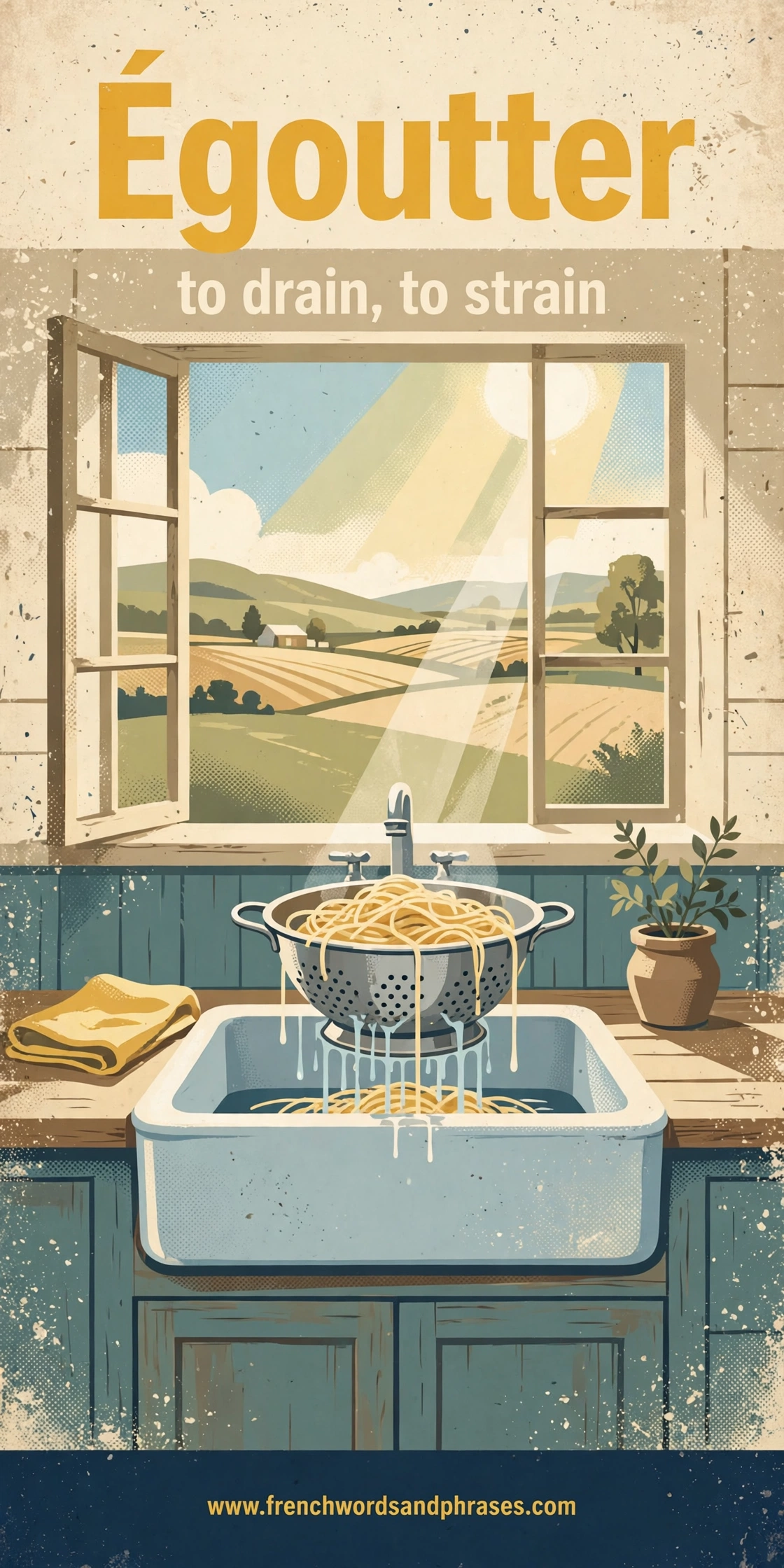
Pasta tipped into a colander over a steaming sink, salad leaves shaken dry, fresh cheese dripping slowly in its cloth — égoutter is the kitchen verb of water leaving food, drop by patient drop.
In this guide, you’ll learn how to conjugate égoutter in all the major French tenses and moods. Explore complete conjugation tables, French examples, English translations, and practice quizzes.
Understanding the French Verb Égoutter
Égoutter is a regular French verb belonging to the first group of verbs, those ending in -er.
It means to drain, to strain. It is commonly used for draining pasta, rice and vegetables in a colander (une passoire), for letting cheese, yoghurt and washed salad drip dry, and for dishes left draining on the rack — l’égouttoir.
Verb classification: First group (-er)
Auxiliary verb: Avoir
Past participle: égoutté
Present participle: égouttant
English equivalents: To drain, to strain, to let drip dry; un égouttoir — a draining rack, a dish rack.
One important detail: égoutter is built on goutte, a drop — to égoutter is to let the drops fall away. Do not confuse it with its dark cousin un égout, a sewer: same old root, very different kitchen. The classic instruction is laisser égoutter — leave it to drain: laisse égoutter les pâtes deux minutes. The double t never changes: j’égoutte, nous égouttons.
Experience the Word
Égoutter is the verb of the pause between cooking and eating — the quiet minute when the water leaves and the food becomes itself.
Imagine a farmhouse kitchen at noon. The pasta pot comes off the stove, the colander rattles in the sink, steam fills the window — and the cook shakes the passoire twice, firmly, the way her mother taught her.
Nothing is cooked any more. It is simply drained — égoutté — and ready for the sauce.
How to Conjugate Égoutter: Complete French Conjugation Guide
Let’s explore every major conjugation of égoutter, beginning with the indicative mood.
How to Conjugate Égoutter in the Indicative Mood
The indicative mood is used to express facts, observations, actions, and events.
How to Conjugate Égoutter in the Present Tense (Présent)
Used for actions happening now, habitual actions, and general truths.
| Subject | Conjugation |
|---|---|
| je | égoutte |
| tu | égouttes |
| il / elle | égoutte |
| nous | égouttons |
| vous | égouttez |
| ils / elles | égouttent |
Example
Elle égoutte les pâtes dans la passoire.
She drains the pasta in the colander.
Quick Quiz 1
Complete the sentence:
Nous ______ les haricots dans la passoire.
Reveal the answer
égouttons
Nous égouttons les haricots dans la passoire.
We drain the beans in the colander.
How to Conjugate Égoutter in the Passé Composé
Used for completed actions in the past. Égoutter takes the auxiliary verb avoir.
| Subject | Conjugation |
|---|---|
| j’ | ai égoutté |
| tu | as égoutté |
| il / elle | a égoutté |
| nous | avons égoutté |
| vous | avez égoutté |
| ils / elles | ont égoutté |
Example
Il a égoutté la salade avant de l’assaisonner.
He drained the salad before dressing it.
How to Conjugate Égoutter in the Imparfait (Imperfect Tense)
Used for habitual past actions, descriptions, and ongoing situations in the past.
| Subject | Conjugation |
|---|---|
| je | égouttais |
| tu | égouttais |
| il / elle | égouttait |
| nous | égouttions |
| vous | égouttiez |
| ils / elles | égouttaient |
Example
Autrefois, on égouttait le fromage frais dans un linge.
In the old days, people used to drain fresh cheese in a cloth.
Quick Quiz 2
Choose the correct form:
He drained the rice.
Il ______ le riz. (a égoutté / est égoutté)
Reveal the answer
a égoutté
Il a égoutté le riz.
Égoutter takes avoir.
How to Conjugate Égoutter in the Plus-que-parfait
Used to describe an action that had already been completed before another past event.
| Subject | Conjugation |
|---|---|
| j’ | avais égoutté |
| tu | avais égoutté |
| il / elle | avait égoutté |
| nous | avions égoutté |
| vous | aviez égoutté |
| ils / elles | avaient égoutté |
Example
Nous avions égoutté les haricots quand la sauce fut prête.
We had drained the beans when the sauce was ready.
How to Conjugate Égoutter in the Passé Simple
Primarily used in formal writing, literature, and historical narratives. It is rarely used in everyday conversation.
| Subject | Conjugation |
|---|---|
| je | égouttai |
| tu | égouttas |
| il / elle | égoutta |
| nous | égouttâmes |
| vous | égouttâtes |
| ils / elles | égouttèrent |
Example
La cuisinière égoutta les pâtes et les versa dans le plat.
The cook drained the pasta and poured it into the dish.
How to Conjugate Égoutter in the Passé Antérieur
A literary tense used to express an action completed immediately before another past action, generally in the passé simple.
| Subject | Conjugation |
|---|---|
| j’ | eus égoutté |
| tu | eus égoutté |
| il / elle | eut égoutté |
| nous | eûmes égoutté |
| vous | eûtes égoutté |
| ils / elles | eurent égoutté |
Example
Quand il eut égoutté le riz, il le couvrit d’un linge.
When he had drained the rice, he covered it with a cloth.
How to Conjugate Égoutter in the Future Tense (Futur Simple)
Used to describe actions that will take place in the future.
| Subject | Conjugation |
|---|---|
| je | égoutterai |
| tu | égoutteras |
| il / elle | égouttera |
| nous | égoutterons |
| vous | égoutterez |
| ils / elles | égoutteront |
Example
Tu égoutteras les épinards en les pressant bien.
You will drain the spinach by pressing it well.
How to Conjugate Égoutter in the Futur Antérieur (Future Perfect)
Used for an action that will have been completed before a particular point in the future.
| Subject | Conjugation |
|---|---|
| j’ | aurai égoutté |
| tu | auras égoutté |
| il / elle | aura égoutté |
| nous | aurons égoutté |
| vous | aurez égoutté |
| ils / elles | auront égoutté |
Example
À midi, elle aura égoutté toutes les salades.
By noon, she will have drained all the salads.
How to Conjugate Égoutter in the Near Future (Futur Proche)
Used to describe something that is going to happen soon. Formed with aller + infinitive.
| Subject | Conjugation |
|---|---|
| je | vais égoutter |
| tu | vas égoutter |
| il / elle | va égoutter |
| nous | allons égoutter |
| vous | allez égoutter |
| ils / elles | vont égoutter |
Example
Je vais égoutter les pâtes, mets la table !
I am going to drain the pasta, set the table!
How to Conjugate Égoutter in the Conditional Mood
The conditional mood expresses what would happen under certain circumstances. It is also frequently used to make polite requests or express wishes.
How to Conjugate Égoutter in the Present Conditional
| Subject | Conjugation |
|---|---|
| je | égoutterais |
| tu | égoutterais |
| il / elle | égoutterait |
| nous | égoutterions |
| vous | égoutteriez |
| ils / elles | égoutteraient |
Example
Sans passoire, je n’égoutterais jamais les pâtes correctement.
Without a colander, I would never drain pasta properly.
How to Conjugate Égoutter in the Past Conditional
| Subject | Conjugation |
|---|---|
| j’ | aurais égoutté |
| tu | aurais égoutté |
| il / elle | aurait égoutté |
| nous | aurions égoutté |
| vous | auriez égoutté |
| ils / elles | auraient égoutté |
Example
Elle aurait égoutté le fromage plus longtemps.
She would have drained the cheese for longer.
Égoutter in the Literary Past Conditional Form
This less common literary form uses the imperfect subjunctive of avoir.
| Subject | Conjugation |
|---|---|
| j’ | eusse égoutté |
| tu | eusses égoutté |
| il / elle | eût égoutté |
| nous | eussions égoutté |
| vous | eussiez égoutté |
| ils / elles | eussent égoutté |
Example
Il eût égoutté les légumes avant de les servir.
He would have drained the vegetables before serving them.
How to Conjugate Égoutter in the Subjunctive Mood
The subjunctive is used to express wishes, emotions, doubts, necessity, and uncertainty. It frequently follows expressions such as il faut que (it is necessary that) or bien que (although).
How to Conjugate Égoutter in the Present Subjunctive
| Subject | Conjugation |
|---|---|
| que je | égoutte |
| que tu | égouttes |
| qu’il / qu’elle | égoutte |
| que nous | égouttions |
| que vous | égouttiez |
| qu’ils / qu’elles | égouttent |
Example
Il faut que tu égouttes bien la salade.
You must drain the salad well.
Quick Quiz 3
Complete the sentence using the subjunctive:
Il faut que vous ______ les épinards.
Reveal the answer
égouttiez
Il faut que vous égouttiez les épinards.
You must drain the spinach.
How to Conjugate Égoutter in the Imperfect Subjunctive
A literary tense, rarely encountered in modern spoken French.
| Subject | Conjugation |
|---|---|
| que je | égouttasse |
| que tu | égouttasses |
| qu’il / qu’elle | égouttât |
| que nous | égouttassions |
| que vous | égouttassiez |
| qu’ils / qu’elles | égouttassent |
Example
Je voulais qu’elle égouttât le riz à l’avance.
I wanted her to drain the rice in advance.
How to Conjugate Égoutter in the Pluperfect Subjunctive
A literary construction used to express an action completed before another past action.
| Subject | Conjugation |
|---|---|
| que j’ | eusse égoutté |
| que tu | eusses égoutté |
| qu’il / qu’elle | eût égoutté |
| que nous | eussions égoutté |
| que vous | eussiez égoutté |
| qu’ils / qu’elles | eussent égoutté |
Example
Il regrettait que nous eussions égoutté les pâtes trop tôt.
He regretted that we had drained the pasta too early.
How to Conjugate Égoutter in the Past Subjunctive
| Subject | Conjugation |
|---|---|
| que j’ | aie égoutté |
| que tu | aies égoutté |
| qu’il / qu’elle | ait égoutté |
| que nous | ayons égoutté |
| que vous | ayez égoutté |
| qu’ils / qu’elles | aient égoutté |
Example
Je suis content que tu aies égoutté les épinards.
I am glad you drained the spinach.
How to Conjugate Égoutter in the Imperative
The imperative is used to give commands, instructions, invitations, or suggestions. Subject pronouns are omitted.
How to Conjugate Égoutter in the Present Imperative
| Person | Conjugation |
|---|---|
| (tu) | égoutte |
| (nous) | égouttons |
| (vous) | égouttez |
Example
Égoutte les pâtes, vite, elles collent !
Drain the pasta, quick, it is sticking!
Quick Quiz 4
How would you say Drain them (tu form)?
Reveal the answer
Égoutte-les !
French Participles of Égoutter
Participles are verb forms that can be used in compound tenses and other grammatical constructions.
Present Participle of Égoutter
égouttant
En égouttant la salade, elle a renversé un peu d’eau.
While draining the salad, she spilled a little water.
Past Participle of Égoutter
égoutté
Bien égouttée, la salade garde sa vinaigrette.
Well drained, the salad keeps its dressing.
Égoutter in Everyday French: Real-Life Examples
Now that you know the conjugations, let’s see how égoutter appears in everyday French.
Example 1 — Present
J’égoutte toujours les pâtes dans l’évier.
I always drain the pasta in the sink.
Example 2 — Passé composé
Elle a égoutté le riz avant de le servir.
She drained the rice before serving it.
Example 3 — Imparfait
Ma mère égouttait le fromage dans un torchon.
My mother used to drain the cheese in a tea towel.
Example 4 — Future
Nous égoutterons les légumes à la fin.
We will drain the vegetables at the end.
Example 5 — Conditional
Tu égoutterais mieux avec une essoreuse.
You would drain better with a salad spinner.
Example 6 — Imperative
Égouttez les pâtes et ajoutez l’huile d’olive !
Drain the pasta and add the olive oil!
Beyond Translation: The Meaning of Égoutter
English drain sounds like plumbing; French égoutter keeps the drop inside it — goutte à goutte, drop by drop, is how cheese, salad and pasta all surrender their water.
The recipe books live by it.
Égoutter et réserver — drain and set aside — is one of the great refrains of French cookery writing, the small instruction that separates a watery sauce from a good one.
How to Remember the French Verb Égoutter
Remember it this way: Égoutter is about letting the drops go — pasta, salad and cheese.
- Built on goutte, a drop — égoutter lets the drops fall away: laisser égoutter, leave to drain.
- The tool words: une passoire, a colander; un égouttoir, a draining rack.
- Regular -er with double t everywhere: j’égoutte, nous égouttons, past participle égoutté.
The key idea is letting the drops go — pasta, salad and cheese.
Test Your Knowledge of Égoutter
Let’s see how much you’ve learned. Try answering these questions before revealing the answers.
Question 1
What little word hides inside égoutter?
Reveal the answer
Goutte — a drop. To égoutter is to let the drops fall away from the food.
Question 2
How do you say She drains the pasta in French?
Reveal the answer
Elle égoutte les pâtes.
Question 3
Translate: Leave the cheese to drain.
Reveal the answer
Laisse égoutter le fromage.
Question 4
What is the past participle of égoutter?
Reveal the answer
Égoutté.
Question 5
Complete the sentence:
Il faut que tu ______ bien la salade.
Reveal the answer
égouttes
Il faut que tu égouttes bien la salade.
You must drain the salad well.
Your Final Challenge
Can You Use It?
How would you say this in French?
Drain the pasta, add the sauce, and everyone to the table.
Reveal the answer
Égoutte les pâtes, ajoute la sauce, et tout le monde à table.
Drain the pasta, add the sauce, and everyone to the table.
A little French. A little curiosity. A richer everyday life.
LEARN FRENCH ONE WORD AT A TIME




