A French Word to Live By
How to Conjugate Casser in French
/ka.se/
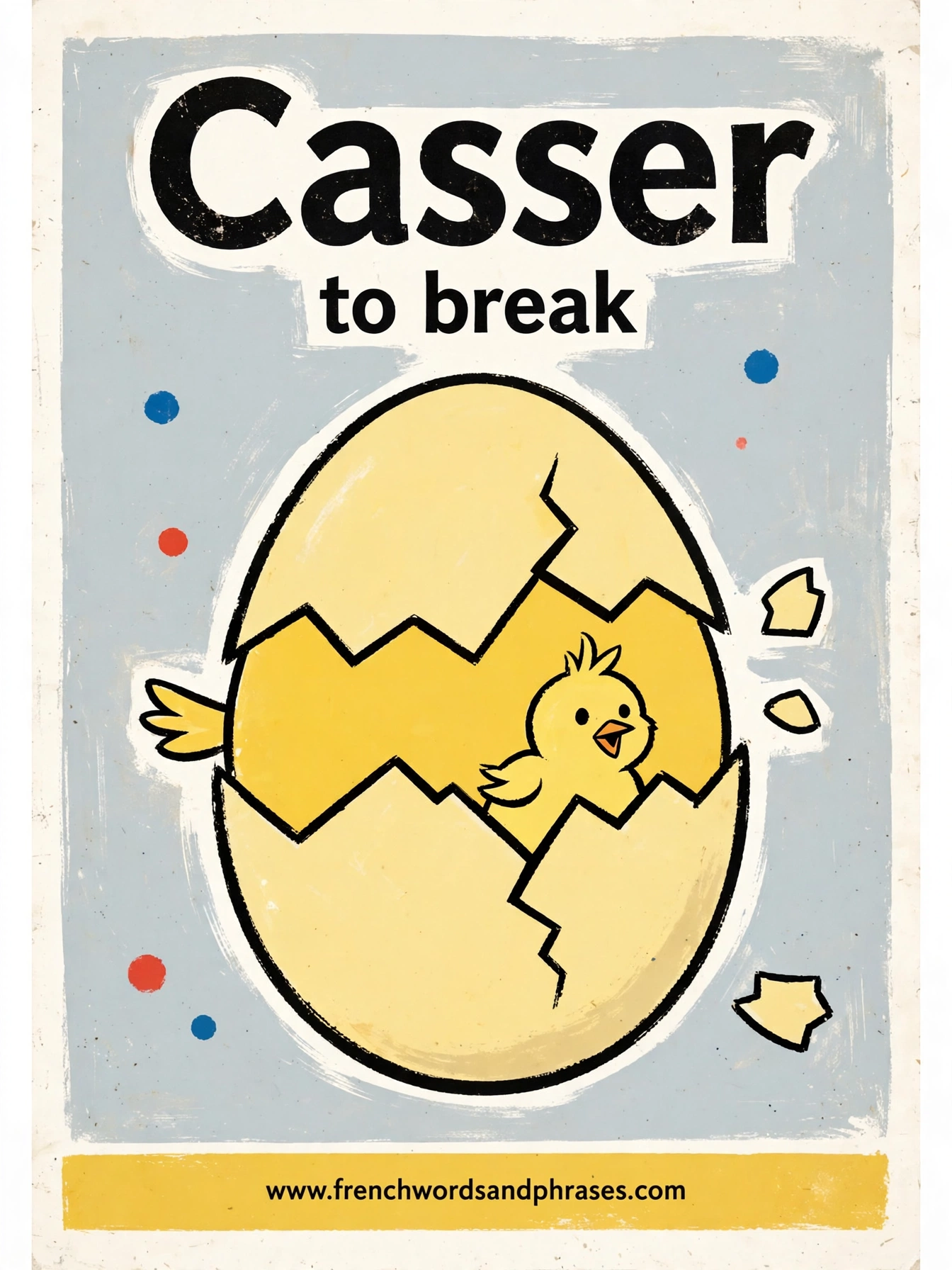
Casser means to break.
An egg against the rim of a bowl, chocolate snapped into squares, walnuts under the nutcracker — in the kitchen, casser is the happy sound of things broken on purpose, exactly where they should break.
In this guide, you’ll learn how to conjugate casser in all the major French tenses and moods. Explore complete conjugation tables, French examples, English translations, and practice quizzes.
Understanding the French Verb Casser
Casser is a regular French verb belonging to the first group of verbs, those ending in -er.
It means to break. It is commonly used for cracking eggs and nuts, breaking chocolate and bread crusts, breaking sticks and toys by accident, and in friendly phrases — casser la croûte, to have a bite to eat, and casser les prix, to slash prices.
Verb classification: First group (-er)
Auxiliary verb: Avoir
Past participle: cassé
Present participle: cassant
English equivalents: To break, to crack, to snap; (se) to break (a limb), to leave.
One important detail: in the kitchen, casser is precise work — casser un œuf is to crack an egg open, casser les noix to crack nuts, casser le chocolat en morceaux to break chocolate into pieces. The tool for nuts is un casse-noix, a nutcracker. Things also break by themselves, with se: le verre s’est cassé, the glass broke — and se casser la jambe, to break one’s leg.
Experience the Word
Casser is the verb of the clean break — the sharp little sound that separates before from after: whole, then open.
Imagine a small boy at his grandmother’s table, allowed to crack the eggs for the omelette for the very first time. One tap too many, shell everywhere — and grand-mère laughs: casser des œufs, ça s’apprend.
The egg is broken. But it is broken for a reason — breakfast.
How to Conjugate Casser: Complete French Conjugation Guide
Let’s explore every major conjugation of casser, beginning with the indicative mood.
How to Conjugate Casser in the Indicative Mood
The indicative mood is used to express facts, observations, actions, and events.
How to Conjugate Casser in the Present Tense (Présent)
Used for actions happening now, habitual actions, and general truths.
| Subject | Conjugation |
|---|---|
| je | casse |
| tu | casses |
| il / elle | casse |
| nous | cassons |
| vous | cassez |
| ils / elles | cassent |
Example
Elle casse les œufs dans un grand bol.
She cracks the eggs into a large bowl.
Quick Quiz 1
Complete the sentence:
Nous ______ les noix pour le gâteau.
Reveal the answer
cassons
Nous cassons les noix pour le gâteau.
We crack the nuts for the cake.
How to Conjugate Casser in the Passé Composé
Used for completed actions in the past. Casser takes the auxiliary verb avoir.
| Subject | Conjugation |
|---|---|
| j’ | ai cassé |
| tu | as cassé |
| il / elle | a cassé |
| nous | avons cassé |
| vous | avez cassé |
| ils / elles | ont cassé |
Example
Il a cassé le chocolat en morceaux pour le gâteau.
He broke the chocolate into pieces for the cake.
How to Conjugate Casser in the Imparfait (Imperfect Tense)
Used for habitual past actions, descriptions, and ongoing situations in the past.
| Subject | Conjugation |
|---|---|
| je | cassais |
| tu | cassais |
| il / elle | cassait |
| nous | cassions |
| vous | cassiez |
| ils / elles | cassaient |
Example
Chaque matin, le boulanger cassait les œufs pour les brioches.
Every morning, the baker used to crack the eggs for the brioches.
Quick Quiz 2
Choose the correct form:
He broke the chocolate.
Il ______ le chocolat. (a cassé / est cassé)
Reveal the answer
a cassé
Il a cassé le chocolat.
Casser takes avoir.
How to Conjugate Casser in the Plus-que-parfait
Used to describe an action that had already been completed before another past event.
| Subject | Conjugation |
|---|---|
| j’ | avais cassé |
| tu | avais cassé |
| il / elle | avait cassé |
| nous | avions cassé |
| vous | aviez cassé |
| ils / elles | avaient cassé |
Example
Nous avions cassé les noix avant de commencer la recette.
We had cracked the walnuts before starting the recipe.
How to Conjugate Casser in the Passé Simple
Primarily used in formal writing, literature, and historical narratives. It is rarely used in everyday conversation.
| Subject | Conjugation |
|---|---|
| je | cassai |
| tu | cassas |
| il / elle | cassa |
| nous | cassâmes |
| vous | cassâtes |
| ils / elles | cassèrent |
Example
D’un coup de marteau, il cassa la noix de coco.
With one blow of the hammer, he cracked the coconut.
How to Conjugate Casser in the Passé Antérieur
A literary tense used to express an action completed immediately before another past action, generally in the passé simple.
| Subject | Conjugation |
|---|---|
| j’ | eus cassé |
| tu | eus cassé |
| il / elle | eut cassé |
| nous | eûmes cassé |
| vous | eûtes cassé |
| ils / elles | eurent cassé |
Example
Quand elle eut cassé les œufs, elle ajouta la farine.
When she had cracked the eggs, she added the flour.
How to Conjugate Casser in the Future Tense (Futur Simple)
Used to describe actions that will take place in the future.
| Subject | Conjugation |
|---|---|
| je | casserai |
| tu | casseras |
| il / elle | cassera |
| nous | casserons |
| vous | casserez |
| ils / elles | casseront |
Example
Tu casseras le sucre en morceaux pour le caramel.
You will break the sugar into pieces for the caramel.
How to Conjugate Casser in the Futur Antérieur (Future Perfect)
Used for an action that will have been completed before a particular point in the future.
| Subject | Conjugation |
|---|---|
| j’ | aurai cassé |
| tu | auras cassé |
| il / elle | aura cassé |
| nous | aurons cassé |
| vous | aurez cassé |
| ils / elles | auront cassé |
Example
À la fin du repas, les enfants auront cassé toutes les noix.
By the end of the meal, the children will have cracked all the nuts.
How to Conjugate Casser in the Near Future (Futur Proche)
Used to describe something that is going to happen soon. Formed with aller + infinitive.
| Subject | Conjugation |
|---|---|
| je | vais casser |
| tu | vas casser |
| il / elle | va casser |
| nous | allons casser |
| vous | allez casser |
| ils / elles | vont casser |
Example
Attention, le verre va se casser !
Careful, the glass is going to break!
How to Conjugate Casser in the Conditional Mood
The conditional mood expresses what would happen under certain circumstances. It is also frequently used to make polite requests or express wishes.
How to Conjugate Casser in the Present Conditional
| Subject | Conjugation |
|---|---|
| je | casserais |
| tu | casserais |
| il / elle | casserait |
| nous | casserions |
| vous | casseriez |
| ils / elles | casseraient |
Example
Avec un casse-noix, tu casserais les noisettes facilement.
With a nutcracker, you would crack the hazelnuts easily.
How to Conjugate Casser in the Past Conditional
| Subject | Conjugation |
|---|---|
| j’ | aurais cassé |
| tu | aurais cassé |
| il / elle | aurait cassé |
| nous | aurions cassé |
| vous | auriez cassé |
| ils / elles | auraient cassé |
Example
Elle aurait cassé le jeûne avec un verre d’eau fraîche.
She would have broken the fast with a glass of fresh water.
Casser in the Literary Past Conditional Form
This less common literary form uses the imperfect subjunctive of avoir.
| Subject | Conjugation |
|---|---|
| j’ | eusse cassé |
| tu | eusses cassé |
| il / elle | eût cassé |
| nous | eussions cassé |
| vous | eussiez cassé |
| ils / elles | eussent cassé |
Example
Il eût cassé la glace dès la première phrase.
He would have broken the ice from the very first sentence.
How to Conjugate Casser in the Subjunctive Mood
The subjunctive is used to express wishes, emotions, doubts, necessity, and uncertainty. It frequently follows expressions such as il faut que (it is necessary that) or bien que (although).
How to Conjugate Casser in the Present Subjunctive
| Subject | Conjugation |
|---|---|
| que je | casse |
| que tu | casses |
| qu’il / qu’elle | casse |
| que nous | cassions |
| que vous | cassiez |
| qu’ils / qu’elles | cassent |
Example
Il faut que tu casses les œufs un par un.
You must crack the eggs one by one.
Quick Quiz 3
Complete the sentence using the subjunctive:
Il faut que vous ______ les œufs un par un.
Reveal the answer
cassiez
Il faut que vous cassiez les œufs un par un.
You must crack the eggs one by one.
How to Conjugate Casser in the Imperfect Subjunctive
A literary tense, rarely encountered in modern spoken French.
| Subject | Conjugation |
|---|---|
| que je | cassasse |
| que tu | cassasses |
| qu’il / qu’elle | cassât |
| que nous | cassassions |
| que vous | cassassiez |
| qu’ils / qu’elles | cassassent |
Example
Je craignais qu’elle cassât l’assiette de porcelaine.
I feared she might break the porcelain plate.
How to Conjugate Casser in the Pluperfect Subjunctive
A literary construction used to express an action completed before another past action.
| Subject | Conjugation |
|---|---|
| que j’ | eusse cassé |
| que tu | eusses cassé |
| qu’il / qu’elle | eût cassé |
| que nous | eussions cassé |
| que vous | eussiez cassé |
| qu’ils / qu’elles | eussent cassé |
Example
Il regrettait que nous eussions cassé le vieux moulin à café.
He regretted that we had broken the old coffee grinder.
How to Conjugate Casser in the Past Subjunctive
| Subject | Conjugation |
|---|---|
| que j’ | aie cassé |
| que tu | aies cassé |
| qu’il / qu’elle | ait cassé |
| que nous | ayons cassé |
| que vous | ayez cassé |
| qu’ils / qu’elles | aient cassé |
Example
Je suis désolé que tu aies cassé ton verre préféré.
I am sorry you broke your favourite glass.
How to Conjugate Casser in the Imperative
The imperative is used to give commands, instructions, invitations, or suggestions. Subject pronouns are omitted.
How to Conjugate Casser in the Present Imperative
| Person | Conjugation |
|---|---|
| (tu) | casse |
| (nous) | cassons |
| (vous) | cassez |
Example
Casse les œufs dans le saladier !
Crack the eggs into the mixing bowl!
Quick Quiz 4
How would you say Crack the eggs (tu form)?
Reveal the answer
Casse les œufs !
French Participles of Casser
Participles are verb forms that can be used in compound tenses and other grammatical constructions.
Present Participle of Casser
cassant
En cassant les noix, il écoutait les nouvelles.
While cracking the nuts, he listened to the news.
Past Participle of Casser
cassé
Le chocolat, une fois cassé en carrés, fondait lentement.
The chocolate, once broken into squares, melted slowly.
Casser in Everyday French: Real-Life Examples
Now that you know the conjugations, let’s see how casser appears in everyday French.
Example 1 — Present
Je casse les œufs pour l’omelette.
I crack the eggs for the omelette.
Example 2 — Passé composé
Elle a cassé le chocolat en petits morceaux.
She broke the chocolate into small pieces.
Example 3 — Imparfait
Les enfants cassaient les noix après le dîner.
The children used to crack the nuts after dinner.
Example 4 — Future
Nous casserons la croûte vers midi.
We will have a bite to eat around noon.
Example 5 — Conditional
Tu casserais les noisettes avec ce casse-noix.
You would crack the hazelnuts with this nutcracker.
Example 6 — Imperative
Cassez les œufs un par un !
Crack the eggs one by one!
Beyond Translation: The Meaning of Casser
English break sprawls across a hundred phrases; French casser keeps the same appetite — it breaks eggs, ice, prices, fasts and silences, and then, as casser la croûte, it sits down to eat.
Breaking, in French, is often the start of the meal.
You cannot make an omelette, says the proverb every French cook knows, without casser des œufs — some breakages are simply the price of breakfast.
How to Remember the French Verb Casser
Remember it this way: Casser is about breaking on purpose — eggs, nuts and chocolate.
- Casser un œuf — to crack an egg: the kitchen’s gentlest breakage.
- Un casse-noix cracks the nuts; le verre se casse when the glass breaks by itself.
- Regular -er: je casse, nous cassons, past participle cassé.
The key idea is breaking on purpose — eggs, nuts and chocolate.
Test Your Knowledge of Casser
Let’s see how much you’ve learned. Try answering these questions before revealing the answers.
Question 1
What does casser un œuf mean, exactly?
Reveal the answer
To crack an egg open — in the kitchen, casser is a clean, deliberate break, not a disaster.
Question 2
How do you say She cracks the eggs in French?
Reveal the answer
Elle casse les œufs.
Question 3
Translate: He broke the chocolate into pieces.
Reveal the answer
Il a cassé le chocolat en morceaux.
Question 4
What is the past participle of casser?
Reveal the answer
Cassé.
Question 5
Complete the sentence:
Il faut que tu ______ les œufs un par un.
Reveal the answer
casses
Il faut que tu casses les œufs un par un.
You must crack the eggs one by one.
Your Final Challenge
Can You Use It?
How would you say this in French?
Crack the eggs into the bowl, the omelette is waiting.
Reveal the answer
Casse les œufs dans le bol, l’omelette attend.
Crack the eggs into the bowl, the omelette is waiting.
A little French. A little curiosity. A richer everyday life.
LEARN FRENCH ONE WORD AT A TIME