A French Word to Live By
Translate Plage to English
/plaʒ/
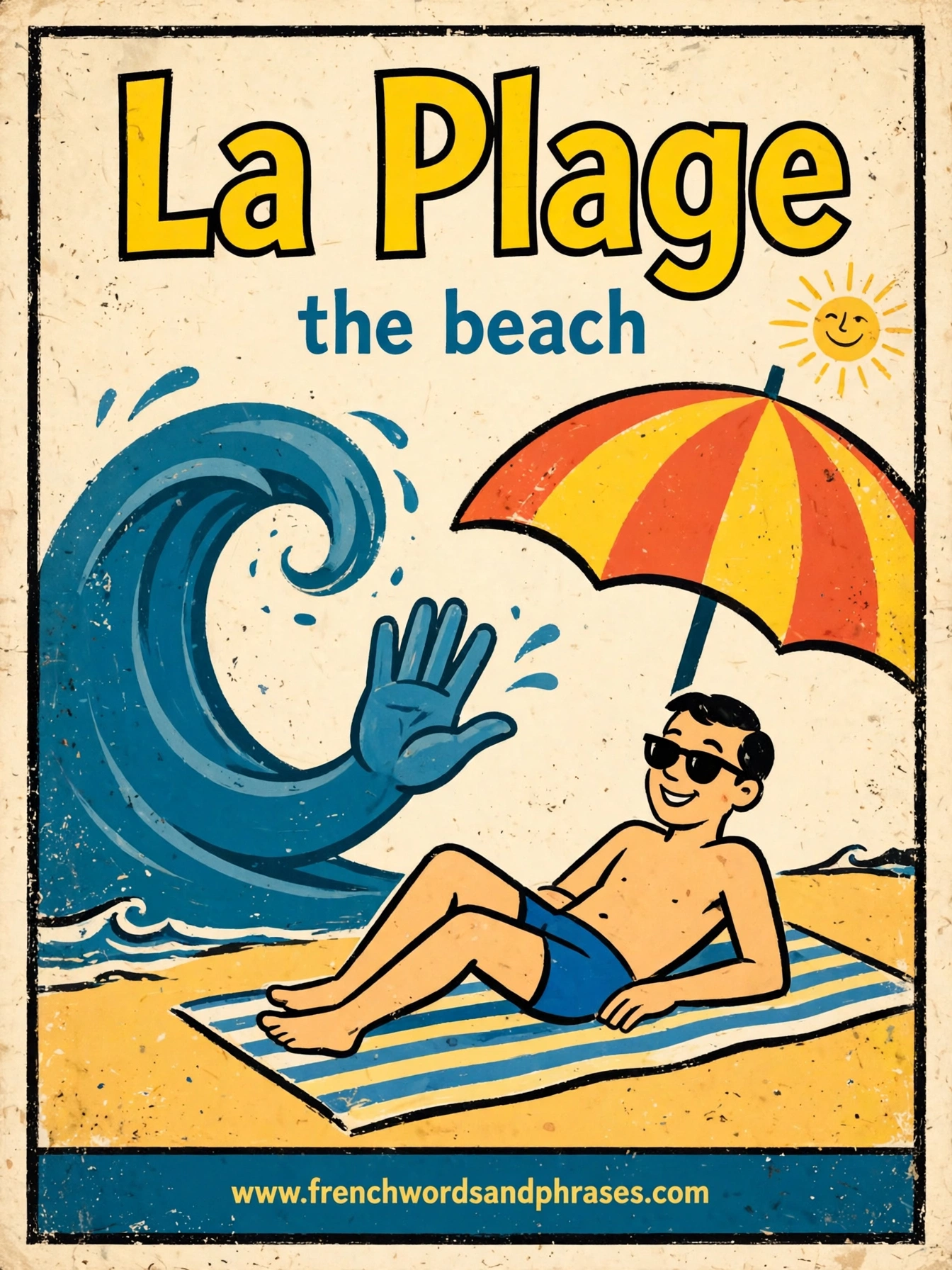
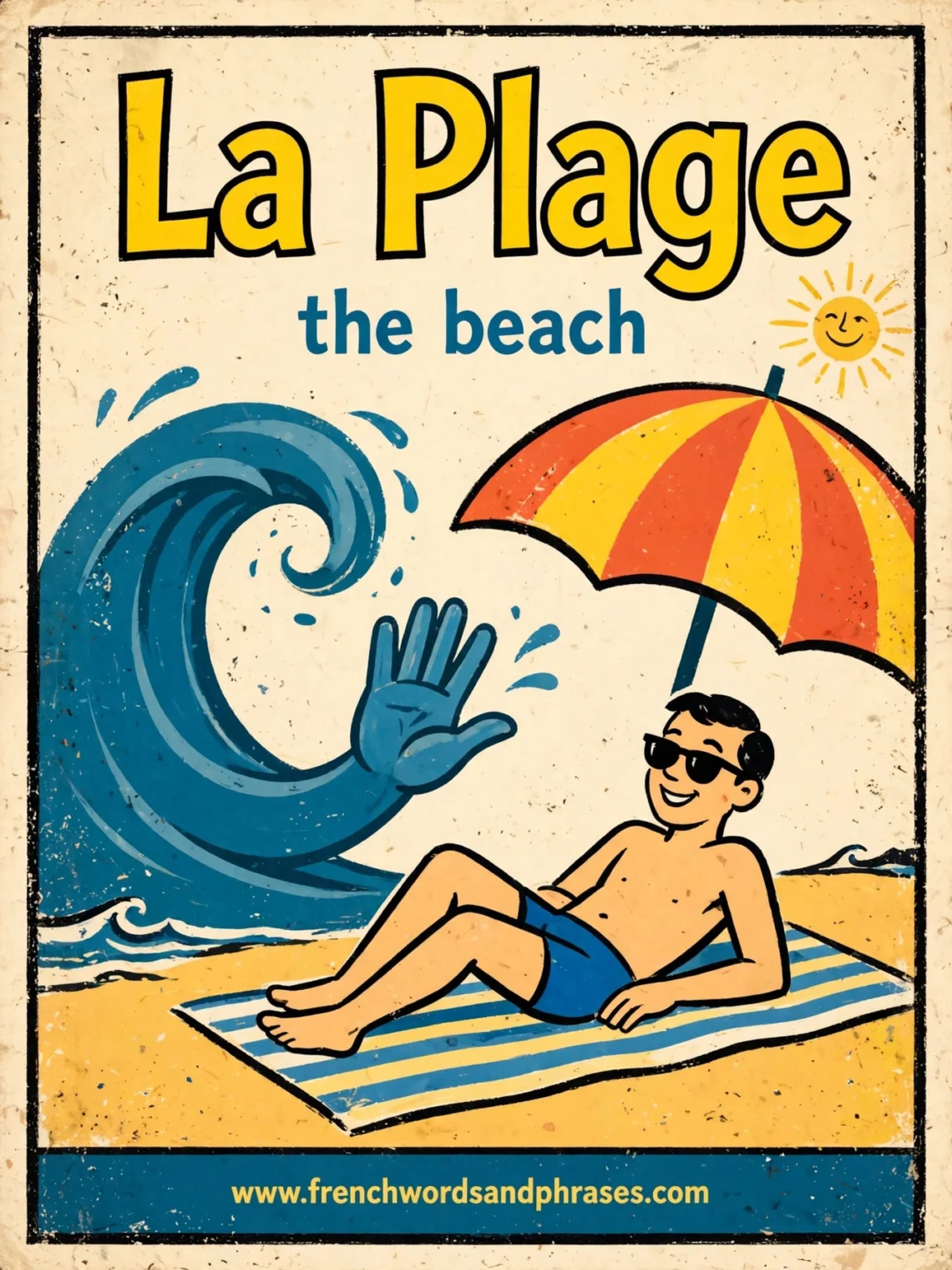
La plage means the beach.
Ten o’clock, and the ritual is already under way: towels unrolled in a row, the parasol planted at an angle, the first brave swimmers testing the water with one foot. Summer in France happens in one place — la plage.
In this guide, you’ll learn what plage means in English, how to use it with its articles, how to form its plural, and how it appears in everyday French. Explore French examples, English translations, and practice quizzes.
Understanding the French Noun Plage
Plage is a feminine French noun. It is learned together with its article: la plage, une plage. It names the sandy shore where land meets sea — and, by extension, the whole institution of the French seaside day.
It means the beach — the stretch of sand (sometimes pebbles: une plage de galets) along the sea or a lake, with its sable, its parasols and its swimmers. You go there — aller à la plage — to swim, to sunbathe (bronzer), to read, and to do gloriously little. A small second sense hides in everyday speech: une plage horaire is a time slot — the beach of the timetable.
Gender: Feminine
Definite article: la — la plage (the beach)
Indefinite article: une — une plage (a beach)
Plural: les plages
English equivalents: The beach. (In une plage horaire: a time slot.)
One important usage detail: French goes à la plage — to the beach — with à, never « dans la plage ». And the sand matters to the word: une plage de sable is a sandy beach, while the famous shore at Nice is une plage de galets, a pebble beach. The same word also timetables your day: choisir une plage horaire, to choose a time slot.
Experience the Word
Plage is more than a shore. It is the stage of the French summer — the one place where the whole country agrees to slow down at the same time.
Imagine the late afternoon: the heat softening, the sand still warm, a last swim in water gone gold, and nowhere at all to be until dinner.
You have not just visited the seaside. You have taken your place in the great French art of doing nothing, beautifully.
How to Use Plage in French: Complete Guide
Let’s explore how plage works in French, beginning with its articles.
Plage with the Definite Article (La, Les)
Used for the beach everyone knows — the one below the village, the one from your childhood summers.
| Number | French |
|---|---|
| Singular | la plage |
| Plural | les plages |
Example
La plage est à cinq minutes à pied de la maison.
The beach is five minutes’ walk from the house.
Plage with the Indefinite Article (Une, Des)
Used for a beach in general — the one in the brochure, the quiet one you are hunting for.
| Number | French |
|---|---|
| Singular | une plage |
| Plural | des plages |
Example
Ils cherchent une plage tranquille, loin des foules.
They are looking for a quiet beach, far from the crowds.
On the Plage: a Day at the Beach
Sand, towels and parasols — the furniture of the seaside day.
| French | In English |
|---|---|
| le sable | the sand |
| la serviette de plage | the beach towel |
| le parasol | the beach umbrella |
| le maillot de bain | the swimsuit |
| la crème solaire | the sun cream |
| les lunettes de soleil | the sunglasses |
Example
Elle étend sa serviette de plage près du parasol.
She spreads her beach towel near the parasol.
Quick Quiz 1
What is le parasol?
Reveal the answer
The beach umbrella — the shade every French beach day is organised around.
Le parasol penche un peu, mais il fait de l’ombre.
The parasol leans a bit, but it gives shade.
The Plural of Plage
Plage adds an -s in the plural — les plages, the beaches of a whole coastline.
| Number | French |
|---|---|
| Singular | la plage |
| Plural | les plages |
Example
Les plages de la côte sont bondées en août.
The beaches of the coast are packed in August.
Plage with Possessive Adjectives (Ma, Ta, Sa…)
Possessives agree with the noun, not with the owner — and plage is feminine, so it takes ma, ta, sa.
| Owner | French |
|---|---|
| my | ma plage |
| your (tu) | ta plage |
| his / her | sa plage |
| our | notre plage |
| your (vous) | votre plage |
| their | leur plage |
Example
Notre plage préférée se cache après les dunes.
Our favourite beach hides behind the dunes.
Quick Quiz 2
Complete the sentence:
______ plage est déserte le matin. (Their)
Reveal the answer
Leur
Leur plage est déserte le matin.
Their beach is deserted in the morning.
Plage with Demonstrative Adjectives (Cette, Ces)
Used to point: this beach here, those beaches there.
| Number | French |
|---|---|
| Singular | cette plage |
| Plural | ces plages |
Example
Cette plage est parfaite pour les enfants.
This beach is perfect for children.
Plage with Adjectives
Adjectives agree with plage, feminine — belle, tranquille, bondée.
| Adjective | With Plage |
|---|---|
| belle (beautiful) | une belle plage |
| tranquille (quiet) | une plage tranquille |
| bondée (packed) | une plage bondée |
| de sable (sandy) | une plage de sable |
| de galets (pebbly) | une plage de galets |
Example
En septembre, la plage bondée de juillet devient tranquille.
In September, July’s packed beach turns quiet.
Quick Quiz 3
Complete the sentence:
Nous allons à ______ plage tous les jours. (the)
Reveal the answer
la
Nous allons à la plage tous les jours.
We go to the beach every day.
Everyday Expressions with Plage
Swims, sun and siestas — the plage phrases of the summer.
| Expression | In English |
|---|---|
| aller à la plage | to go to the beach |
| une journée à la plage | a day at the beach |
| bronzer sur la plage | to sunbathe on the beach |
| une plage de sable fin | a beach of fine sand |
| le bord de la mer | the seaside |
| une plage horaire | a time slot (a ‘beach’ of hours) |
Example
Demain, si le soleil est là, journée à la plage !
Tomorrow, if the sun is out — a day at the beach!
Words from the Same Family as Plage
Sea, sand and summer — the words that travel with plage.
| French | In English |
|---|---|
| la mer | the sea |
| le soleil | the sun |
| nager | to swim |
| le sable | the sand |
| la vague | the wave |
| l’été | the summer |
Example
Les enfants courent vers les vagues dès l’arrivée à la plage.
The children run to the waves as soon as they reach the beach.
Quick Quiz 4
At work, a colleague asks you to choose « une plage horaire ». Where is the beach?
Reveal the answer
There is none — une plage horaire is a time slot, a free stretch in the schedule.
Choisissez une plage horaire pour la réunion.
Choose a time slot for the meeting.
Plage in Everyday French: Real-Life Examples
Now that you know the word, let’s see how plage appears in everyday French.
Example 1 — Morning plan
Aujourd’hui, nous passons la journée à la plage.
Today, we are spending the day at the beach.
Example 2 — Packing
N’oublie pas la crème solaire pour la plage.
Don’t forget the sun cream for the beach.
Example 3 — Swimming
Les enfants nagent près du bord de la plage.
The children swim near the edge of the beach.
Example 4 — Quiet corner
Cette petite plage est calme, même en août.
This little beach is calm, even in August.
Example 5 — Sunset
Le soir, nous marchons le long de la plage.
In the evening, we walk along the beach.
Example 6 — Pebbles
À Nice, la plage est couverte de galets.
In Nice, the beach is covered with pebbles.
Beyond Translation: The Meaning of Plage
The plage is a French invention as much as a place: the paid holidays of 1936 sent the whole country to the seaside for the first time, and the beach towel has marked out its small republic of sand ever since — parasol as flag, picnic as constitution. From the galets of Nice to the endless sand of the Atlantic, la plage is where France goes to be equal.
To say plage is to smell the salt and hear the lifeguard’s whistle.
It evokes the first morning’s pale shoulders and the last evening’s golden ones, the sand in the car for a month afterwards — the shore where the French summer is measured out, one day at a time.
How to Remember the French Noun Plage
Remember it this way: Plage is the beach — feminine, with la and une; you go à la plage, and its timetable cousin is une plage horaire.
- You set off — nous allons à la plage.
- You settle in — la serviette, le parasol, la plage de sable.
- You dodge the trap — une plage horaire est un créneau, pas du sable.
The key idea is la plage borders the sea — la plage horaire borders the meeting.
Test Your Knowledge of Plage
Let’s see how much you’ve learned. Try answering these questions before revealing the answers.
Question 1
Is plage masculine or feminine?
Reveal the answer
Feminine — la plage, une plage.
Question 2
How do you say ‘to go to the beach’?
Reveal the answer
Aller à la plage — with à, always.
Question 3
Translate: The beach is five minutes from here.
Reveal the answer
La plage est à cinq minutes d’ici.
Question 4
What is une plage de galets?
Reveal the answer
A pebble beach — galets are the smooth stones, like those at Nice.
Question 5
Complete the sentence:
Les enfants jouent sur ______ plage.
Reveal the answer
la
Les enfants jouent sur la plage.
The children play on the beach.
Your Final Challenge
Can You Use It?
How would you say this in French?
“Tomorrow, we are spending the whole day at the beach.”
Reveal the answer
Demain, nous passons toute la journée à la plage.
Tomorrow, we are spending the whole day at the beach.
A little French. A little curiosity. A richer everyday life.
LEARN FRENCH ONE WORD AT A TIME