A French Word to Live By
Translate Vraiment to English
/vʁɛ.mɑ̃/
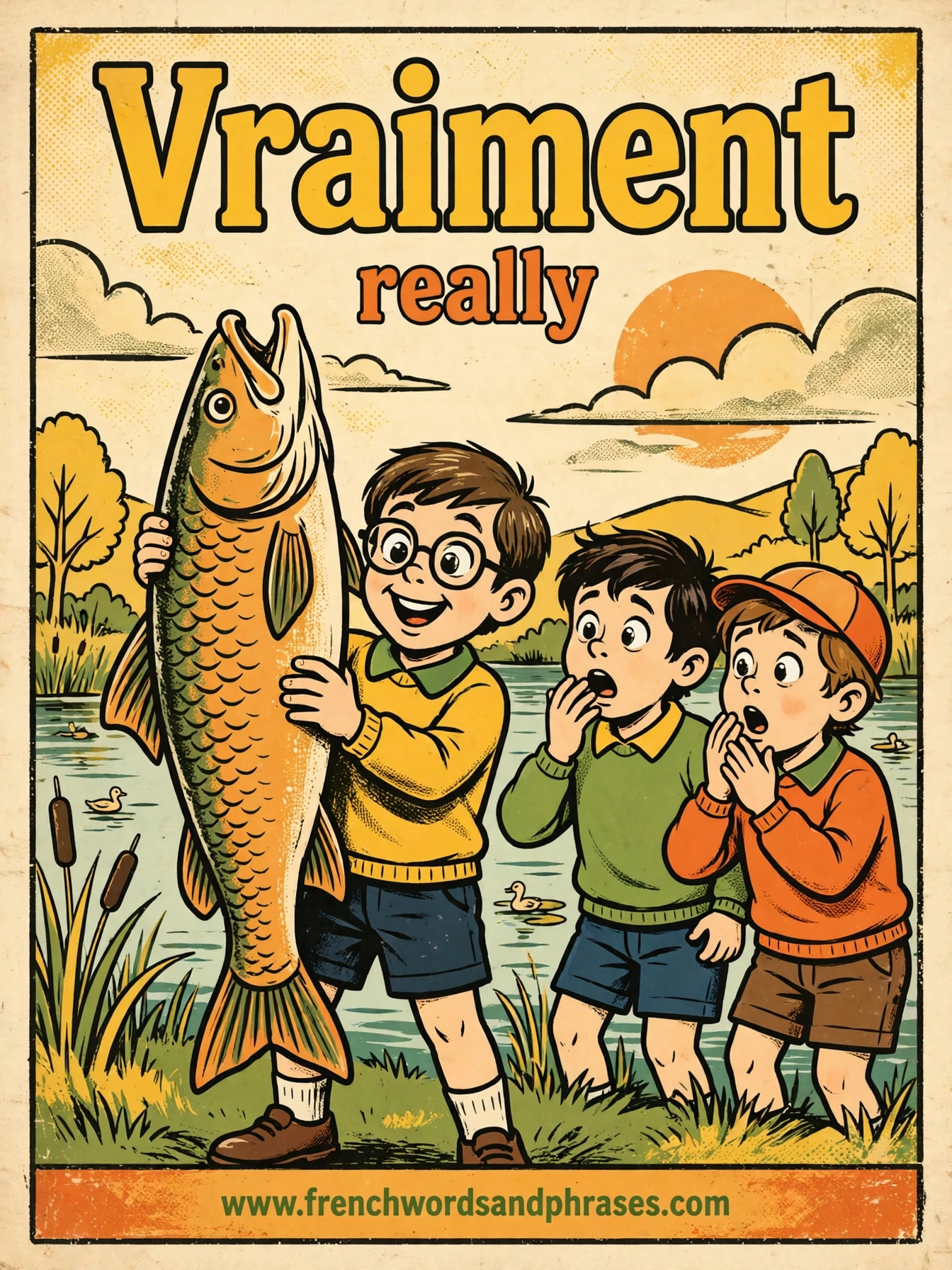
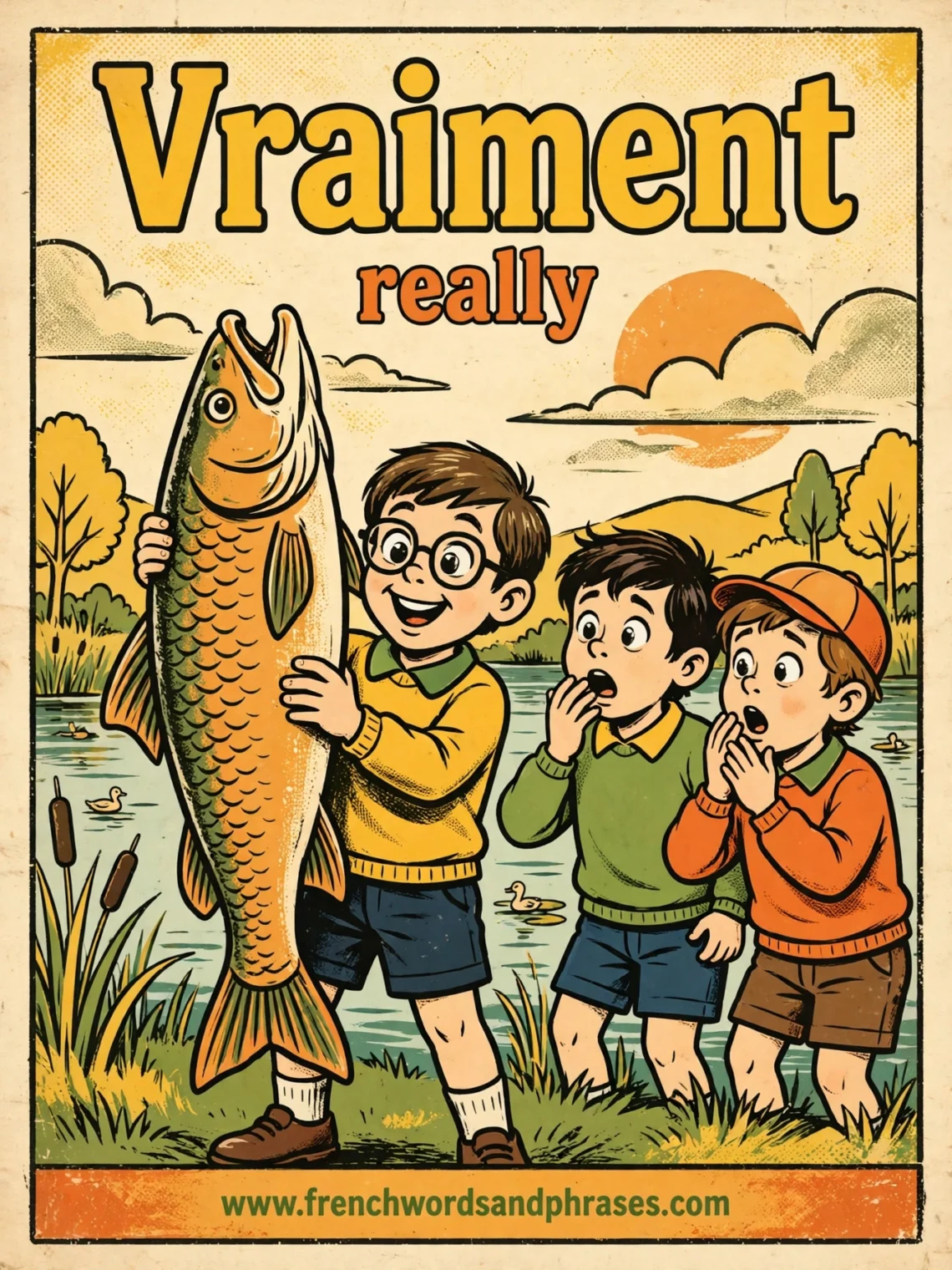
Vraiment means really.
« Tu aimes ? » — « Vraiment. » The waiter hovers, the cook peeks round the door, and one small word carries the whole review. Vraiment is French sincerity in a single breath: not just yes, but yes, really.
In this guide, you’ll learn what vraiment means in English, where it sits in the sentence, how it differs from très, and how pas vraiment softens a no. Explore French examples, English translations, and practice quizzes.
Understanding the French Conjunction Vraiment
Vraiment is a French adverb of degree and sincerity — the language’s volume knob. It strengthens adjectives, adverbs and verbs, and it adds a promise: this is not politeness, this is the truth.
It means really, truly. Vraiment says more than très (very): c’est très bon is a judgement, c’est vraiment bon is a judgement with a hand on the heart. It can also stand alone as a question — vraiment ? — really?!
Type: Adverb — degree and sincerity
Answers the question: À quel point ? — How much, how truly?
What it modifies: Adjectives, adverbs and verbs
Register: Everyday — speech and writing alike
One important usage detail: in a compound tense, vraiment slips between the helper and the participle — j’ai vraiment aimé ce film, I really loved that film. And its negative twin, pas vraiment, is the softest ‘no’ in French: not really.
Experience the Word
Vraiment is the adverb of the honest answer — the word that turns a compliment into a conviction.
Imagine the cook at the market stall, watching you taste his cheese. « Il est bon ? » You could say très bon and be polite. You say vraiment bon, slowly, and his whole face changes: you have not graded the cheese, you have believed in it.
You have not just strengthened a sentence. You have signed it.
How to Use Vraiment in French: Complete Guide
Let’s explore how vraiment works in French, beginning with the whole word on one card.
Vraiment at a Glance
Before the details, here is the whole word on one card.
The Whole Word on One Card
Meaning, job, reach and register — vraiment in four lines.
| Point | Vraiment |
|---|---|
| Meaning | really, truly |
| Job | turns the volume up — and swears it means it |
| What it modifies | adjectives, adverbs, verbs, whole sentences |
| Position | flexible — before adjectives, after verbs, inside compound tenses |
Example
Ce fromage est vraiment excellent.
This cheese is really excellent.
How Vraiment Links: Turning the Volume Up
Vraiment attaches itself to the word it strengthens — an adjective, an adverb, or the verb itself.
| Pattern | Example |
|---|---|
| before an adjective | un film vraiment drôle — a really funny film |
| before an adverb | elle court vraiment vite — she runs really fast |
| after a simple verb | je comprends vraiment — I really do understand |
| at the head of a sentence | Vraiment, je ne sais pas quoi dire — Really, I don’t know what to say |
Example
Tu travailles vraiment bien.
You work really well.
Quick Quiz 1
Where does vraiment go in j’ai ___ aimé ce film (I really loved that film)?
Reveal the answer
Between the helper and the participle — j’ai vraiment aimé ce film.
Nous avons vraiment ri.
We really laughed.
The Degree Scale: Très, Vraiment, Trop
Three little words, three different jobs. Très measures, vraiment insists, trop overflows.
| Word | Example |
|---|---|
| très — very (plain degree) | elle est très contente — she is very happy |
| vraiment — really (degree + sincerity) | elle est vraiment contente — she is really happy, and she means it |
| trop — too (excess) | elle est trop contente pour travailler — she is too happy to work |
| si / tellement — so | elle est si contente ! — she is so happy! |
Example
Il fait très froid, mais je suis vraiment content d’être là.
It’s very cold, but I’m really glad to be here.
Where Vraiment Goes: A Travelling Adverb
Unlike très, which is glued in front of adjectives, vraiment travels — and each stop changes the emphasis a little.
| Position | Example |
|---|---|
| Before an adjective | une histoire vraiment triste — a really sad story |
| After a simple verb | je veux vraiment partir — I really want to leave |
| Inside a compound tense | tu as vraiment bien dormi — you really slept well |
| Alone, as a question | — Je démissionne. — Vraiment ? — I’m resigning. — Really? |
Example
Vraiment ? Tu as vraiment gagné ?
Really? Did you really win?
Quick Quiz 2
Très or vraiment for ‘I really must go now’ — je dois ___ partir?
Reveal the answer
vraiment — très can only stand before adjectives and adverbs, never with a verb phrase.
Je dois vraiment partir.
I really must go.
Everyday Expressions with Vraiment
Vraiment lives in compliments, surprises and one very useful soft refusal.
| Expression | In English |
|---|---|
| pas vraiment | not really — the gentle no |
| vraiment pas | really not — the firm version |
| c’est vraiment dommage | it’s a real shame |
| vraiment bien | really good |
| tu crois vraiment ? | do you really think so? |
| merci vraiment | thank you, truly |
Example
— Tu es fâché ? — Non, pas vraiment.
— Are you angry? — No, not really.
Close Cousins: Vraiment, Très, Réellement, Sincèrement
Four ways to say ‘really’ and ‘very’ — each with its own territory.
| Word | The difference |
|---|---|
| très | ‘very’ — plain degree; only before adjectives and adverbs |
| vraiment | ‘really’ — degree plus sincerity; works with verbs too |
| réellement | ‘really, in fact’ — a touch formal, states reality |
| sincèrement | ‘sincerely, frankly’ — honesty about opinions; also signs off letters |
Example
Sincèrement, ce tableau est très beau, vraiment.
Frankly, this painting is very beautiful, truly.
Quick Quiz 3
Which cousin of vraiment can never follow a verb — très or réellement?
Reveal the answer
très — it lives only in front of adjectives and adverbs.
Je comprends très bien, et je te crois vraiment.
I understand very well, and I really believe you.
Vraiment and Its Neighbours
Inside vraiment sleeps the adjective vrai, true — and the family is worth meeting.
| French | In English |
|---|---|
| vrai | true — the adjective inside vraiment |
| vraiment vrai | really true |
| à vrai dire | to tell the truth |
| en vrai | in real life (familiar) |
| pour de vrai | for real |
Example
À vrai dire, en vrai, il est encore plus gentil.
To tell the truth, in real life he’s even kinder.
Watch Out: The Traps Around Vraiment
Three traps: an English ‘very’ in disguise, a verb in the wrong place, and a negative that changes its meaning.
| Trap | The truth |
|---|---|
| every English ‘very’ becomes vraiment | before a plain adjective, ‘very’ is usually très: très grand, very big — vraiment adds insistence |
| vraiment before a simple verb | not in French: the verb comes first — je veux vraiment, never ‘je vraiment veux’ |
| pas vraiment = ‘not very’ | no: pas vraiment = not really; ‘not very’ is pas très — pas très fatigué, not very tired |
| vraiment to sign a letter | letters sign off with sincèrement — vraiment is for speech and emphasis |
Example
Il est très grand, et vraiment gentil.
He is very tall, and really kind.
Quick Quiz 4
‘Not very tired’ — pas vraiment fatigué or pas très fatigué?
Reveal the answer
pas très fatigué — pas vraiment would mean ‘not really tired’.
Je suis fatigué, mais pas très fatigué.
I’m tired, but not very tired.
Vraiment in Everyday French: Real-Life Examples
Now that you know the word, let’s see how vraiment appears in everyday French.
Example 1 — At the cinema
Ce film est vraiment beau, je vais le revoir.
This film is really beautiful, I’m going to see it again.
Example 2 — Honest talk
Je te crois, vraiment, tu n’as pas à t’inquiéter.
I believe you, really, you don’t need to worry.
Example 3 — At the market
Ces pêches sont vraiment mûres, goûtez.
These peaches are really ripe, have a taste.
Example 4 — The soft no
— Tu viens dimanche ? — Pas vraiment, je travaille.
— Are you coming Sunday? — Not really, I’m working.
Example 5 — Surprise
Tu as vraiment fait tout ça tout seul ?
Did you really do all that by yourself?
Example 6 — At work
Elle a vraiment bien présenté le projet.
She presented the project really well.
Beyond Translation: The Meaning of Vraiment
English says really for the meaning of vraiment — but the French word shows its parentage: it is built on vrai, true. Every vraiment is a small oath: not just more, but true.
To say vraiment is to put your name to the sentence.
That is why pas vraiment is such a gentle refusal — it does not attack the idea, it simply declines to swear to it.
How to Remember the French Conjunction Vraiment
Remember it this way: Vraiment is vrai with its sleeves rolled up — the truth-word that strengthens whatever it touches.
- You hear vrai inside it — vraiment always swears the sentence is true.
- You park it next to its target — before adjectives, after verbs, inside compound tenses.
- You keep très for plain ‘very’ — vraiment is for when you mean it.
The key idea is vraiment means really — degree with sincerity, built on vrai, true.
Test Your Knowledge of Vraiment
Let’s see how much you’ve learned. Try answering these questions before revealing the answers.
Question 1
What does vraiment mean?
Reveal the answer
Really, truly — degree with a promise of sincerity.
Question 2
Where does vraiment go in a compound tense?
Reveal the answer
Between the helper and the participle — j’ai vraiment aimé.
Question 3
Translate: This soup is really good.
Reveal the answer
Cette soupe est vraiment bonne.
Question 4
What does pas vraiment mean?
Reveal the answer
Not really — the softest refusal in French.
Question 5
Complete the sentence:
Je suis ______ content de te voir.
Reveal the answer
vraiment
Je suis vraiment content de te voir.
I’m really glad to see you.
Your Final Challenge
Can You Use It?
How would you say this in French?
“This cake is really delicious.”
Reveal the answer
Ce gâteau est vraiment délicieux.
This cake is really delicious.
A little French. A little curiosity. A richer everyday life.
LEARN FRENCH ONE WORD AT A TIME