A French Word to Live By
Translate Je pars maintenant to English
/ʒə paʁ mɛ̃t.nɑ̃/
Je pars maintenant means I’m leaving now.
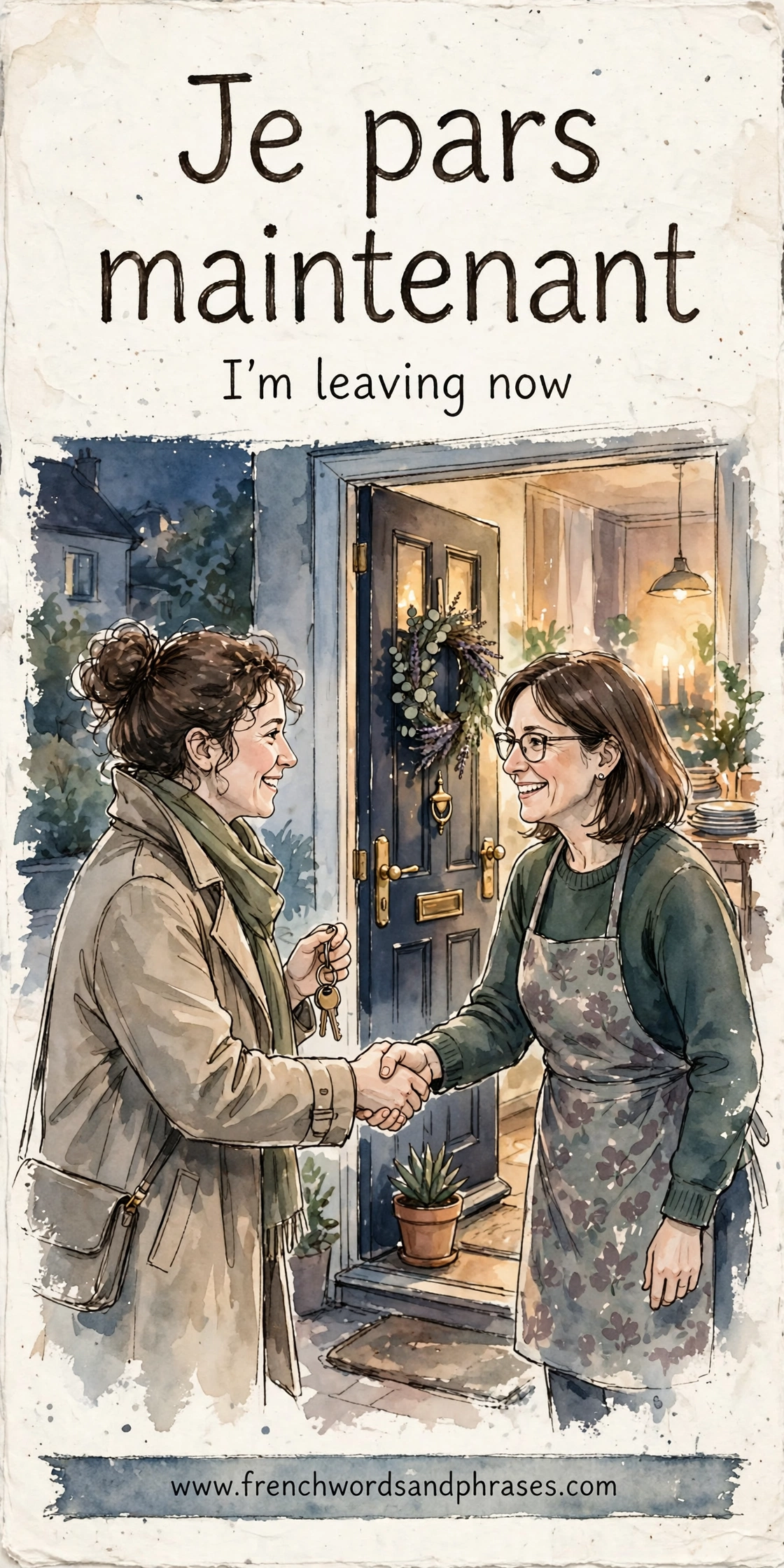
Coats are on, the last coffee is finished, and the evening has reached its natural end. You stand at your friends’ door, keys in hand, and say the sentence that closes a French evening politely: Je pars maintenant.
Let’s explore how je pars maintenant works in French, beginning with the whole phrase on one card.
Understanding the French Phrase Je pars maintenant
Je pars maintenant is a French everyday phrase — the present tense of partir (to leave) plus maintenant, now. Partir is the departure verb par excellence: where English ‘leaves’, French partir sets off, and its past is built with être.
It means I’m leaving now — the polite announcement that the visit, the evening or the workday is over. English ‘leave’ is quiet about direction; French partir is a setting-off, the first step of a journey. Maintenant, now, does the polite work: it says the decision is made, kindly, and the door is next.
Type: Everyday phrase — present tense of partir (to leave) + maintenant (now)
Answers the need: Announcing your departure politely — closing a visit, an evening or a workday
Register: Neutral and polite — hosts, colleagues and friends alike
Strength: Everyday — doorways, offices, stations and the ends of evenings
One important usage detail: partir takes être in the past — je suis parti(e), I left. And its twin s’en aller (je m’en vais) means the same thing with a shade more ‘I’m off now’ finality; hosts hear both a hundred times a year.
Experience the Word
Je pars maintenant is the full stop at the end of a French evening — said at doors, in hallways, halfway into coats.
Imagine the choreography it starts: the thanks, the kisses, the ‘you shouldn’t have’, the door held open against the night. The phrase is small, but it is the signal the whole dance waits for — nobody begins the goodbyes until someone is brave enough to say it.
Maintenant is its kindness. Without it, je pars can sound abrupt; with it, the leaving becomes a fact of the clock rather than a judgement on the company.
How to Use Je pars maintenant in French: Complete Guide
Let’s explore how je pars maintenant works in French, beginning with the whole phrase on one card.
Je pars maintenant at a Glance
The Whole Phrase on One Card
Real meaning, literal building blocks, English twin and register — je pars maintenant in five lines.
| Point | Je pars maintenant |
|---|---|
| What it really means | I’m leaving now — the polite announcement of departure |
| Word for word | I leave now (je pars + maintenant) |
| English equivalent | I’m leaving now / I’m off now |
| Register | neutral and polite — safe everywhere |
| Use it for | ending a visit, leaving work, catching a train, closing an evening |
Example
Je pars maintenant, merci pour cette belle soirée.
I’m leaving now, thank you for a lovely evening.
Word by Word: Building the Departure
Two pieces — a verb of setting off, and the ‘now’ that makes it polite.
| Word | Literal meaning | Its job in the phrase |
|---|---|---|
| je pars | I leave / I am leaving | the present tense of partir — the great French verb of departures |
| maintenant | now | the time word that turns a decision into a polite announcement |
Example
Il part maintenant, son train est dans vingt minutes.
He’s leaving now, his train is in twenty minutes.
Quick Quiz 1
Partir builds its past with which helper — j’ai parti or je suis parti?
Reveal the answer
Je suis parti — partir belongs to the être family of movement verbs.
Je suis parti à sept heures ce matin.
I left at seven this morning.
When You Say It: The Departure Moments
Je pars maintenant belongs to the ends of things — evenings, shifts and visits.
| Situation | Example |
|---|---|
| Ending a dinner | je pars maintenant, il est tard et demain je travaille — I’m leaving now, it’s late and I’m working tomorrow |
| Leaving the office | je pars maintenant, à demain tout le monde — I’m leaving now, see you all tomorrow |
| Catching transport | je pars maintenant, mon bus est dans dix minutes — I’m leaving now, my bus is in ten minutes |
| A child at a party | maman dit qu’on part maintenant — Mum says we’re leaving now |
| Softened with thanks | je pars maintenant, merci pour tout — I’m leaving now, thanks for everything |
Example
On part maintenant, les enfants, dites au revoir.
We’re leaving now, children, say goodbye.
Make It Yours: Bending the Departure
The announcement bends — other people, other times, and the s’en aller twin.
| Form | French | In English |
|---|---|---|
| For a group | on part maintenant | we’re leaving now |
| With a time | je pars à sept heures | I’m leaving at seven |
| The twin | je m’en vais | I’m off / I’m going now |
| Leaving from a place | je pars de Paris demain | I’m leaving Paris tomorrow |
| Leaving for a place | je pars pour Lyon | I’m leaving for Lyon |
| The past | je suis parti(e) tôt | I left early |
Example
Je m’en vais, je pars pour Lyon dans une heure.
I’m off, I’m leaving for Lyon in an hour.
Quick Quiz 2
Which sounds more final at a party — je reviens or je pars maintenant?
Reveal the answer
Je pars maintenant — reviens promises a return in minutes; pars maintenant closes the evening.
Je pars maintenant, mais je reviens dimanche !
I’m leaving now, but I’m coming back on Sunday!
Everyday Expressions: Building on the Departure
Partir grows a whole family of leaving frames — learn these and every goodbye is handled.
| Frame | In English |
|---|---|
| je pars maintenant | I’m leaving now |
| on part ? | shall we go? / are we leaving? |
| je m’en vais | I’m off now |
| partir en vacances | to go away on holiday |
| partir de + place | to leave (from) a place |
| c’est parti ! | off we go! / here we go! |
Example
Le moteur tourne, tout le monde est là — c’est parti !
The engine’s running, everyone’s here — off we go!
Close Cousins: The Other Goodbye Starters
French grades its leavings — each cousin opens a different kind of goodbye.
| Expression | The difference |
|---|---|
| je m’en vais | I’m off — the same departure, with a shade more finality and shrug |
| j’y vais | I’m going (there) — announces heading somewhere, not just leaving |
| je dois y aller | I have to go — the departure explained by duty |
| je file | I’m off — familiar and quick, the speedy exit |
| bon, je vous laisse | well, I’ll leave you — the gentle work-and-visit closer |
Example
Je dois y aller, mon train n’attend pas.
I have to go, my train won’t wait.
Quick Quiz 3
At the end of a work meeting at a client’s office, which cousin closes most gracefully — je file or bon, je vous laisse?
Reveal the answer
Bon, je vous laisse — je file is familiar and speedy; je vous laisse thanks the room as it leaves it.
Bon, je vous laisse, merci pour votre accueil.
Well, I’ll leave you, thank you for your welcome.
Je pars maintenant and Its Neighbours
The partir family at a glance — departures in every direction.
| French | In English |
|---|---|
| je pars | I’m leaving |
| on part | we’re leaving |
| je suis parti(e) | I left / I’ve gone |
| je partirai | I will leave |
| pars ! | go! / off you go! (to a friend) |
| le départ | the departure |
Example
Le départ est à huit heures, pars à sept heures et demie.
Departure is at eight, leave at half past seven.
Watch Out: The Traps Around Je pars maintenant
Three traps wait at the door of this phrase — step round them.
| Trap | The truth |
|---|---|
| Building the past with avoir | partir takes être: je suis parti(e) — never ‘j’ai parti’ |
| Confusing partir and quitter | quitter takes a direct object (je quitte Paris, je te quitte); partir stands alone or with de/pour |
| Confusing partir and laisser | laisser means to leave something behind or let; people departing use partir |
| Dropping maintenant at a party | bare je pars can sound abrupt — maintenant (or a merci) keeps the exit kind |
Example
Je quitte le bureau à six heures, mais je pars de la maison à sept.
I leave the office at six, but I leave home at seven.
Quick Quiz 4
True or false: c’est parti ! means ‘it’s broken’.
Reveal the answer
False — c’est parti ! is the starter’s cry: off we go, here we go!
Trois, deux, un… c’est parti !
Three, two, one… off we go!
Je pars maintenant in Everyday French: Real-Life Examples
Now that you know the word, let’s see how je pars maintenant appears in everyday French.
Example 1 — The dinner party
Je pars maintenant, merci pour ce merveilleux dîner.
I’m leaving now, thank you for this wonderful dinner.
Example 2 — The office door
Je pars maintenant, le rapport est sur ton bureau.
I’m leaving now, the report is on your desk.
Example 3 — The station dash
Je pars maintenant, sinon je rate mon train.
I’m leaving now, otherwise I’ll miss my train.
Example 4 — The family exit
On part maintenant, les enfants, manteaux et chaussures !
We’re leaving now, children, coats and shoes!
Example 5 — The twin
Bon, je m’en vais, il est presque minuit.
Well, I’m off, it’s nearly midnight.
Example 6 — The holiday
Je pars en vacances demain, je pars de la maison à cinq heures.
I’m going on holiday tomorrow, I’m leaving home at five.
Beyond Translation: The Meaning of Je pars maintenant
Partir is one of the great French verbs of life: one parts for holidays, parts from cities, parts into the world — and in the phrase partir, tout court, French also says its final goodbye, for partir is the gentle verb used when someone dies: il est parti, he has gone. The everyday doorway sentence and the last farewell share a word, and French finds that fitting: every leaving is a small rehearsal, every return a small gift.
How to Remember the French Phrase Je pars maintenant
Remember it this way: Je pars maintenant is a coat going on — partir sets off, and maintenant gives the company a kind, clock-based reason.
- You hear partir and picture a first step, not a door closing — French leaves by setting off.
- You build its past with être: je suis parti — departures belong to the être family.
- You soften with maintenant or a merci — the exit stays kind.
The key idea is je pars maintenant means I’m leaving now — partir (to leave, past with être) + maintenant (now).
Test Your Knowledge of Je pars maintenant
Let’s see how much you’ve learned. Try answering these questions before revealing the answers.
Question 1
What does je pars maintenant mean?
Reveal the answer
I’m leaving now — the polite announcement of departure.
Question 2
How do you say ‘I left early’?
Reveal the answer
Je suis parti(e) tôt — partir builds its past with être.
Question 3
What is the twin phrase je m’en vais?
Reveal the answer
I’m off / I’m going now — the same departure, a shade more final.
Question 4
Partir or quitter for ‘I’m leaving Paris tomorrow’?
Reveal the answer
Both work, differently framed — je pars de Paris (setting off from) or je quitte Paris (leaving it behind, direct object).
Question 5
Complete the sentence:
Je ______ maintenant, merci pour la soirée. (I’m leaving now, thanks for the evening.)
Reveal the answer
pars — Je pars maintenant, merci pour la soirée.
Your Final Challenge
Can You Use It?
How would you say this in French?
“I’m leaving now, thank you for a lovely evening.”
Reveal the answer
Je pars maintenant, merci pour cette belle soirée.
I’m leaving now, thank you for a lovely evening.
A little French. A little curiosity. A richer everyday life.
LEARN FRENCH ONE WORD AT A TIME