A French Word to Live By
Translate Je suis gelé to English
/ʒə sɥi ʒə.le/
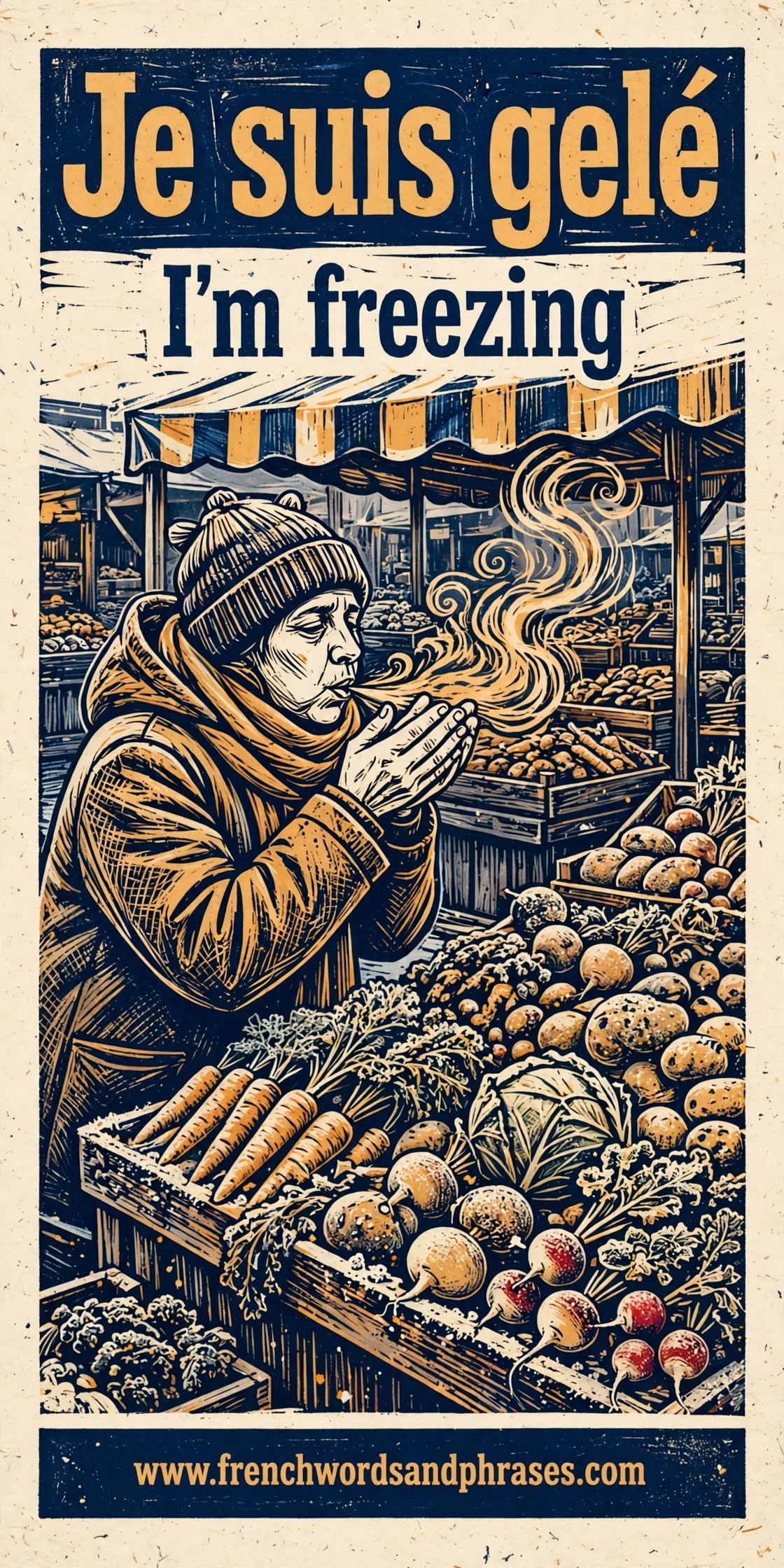
Je suis gelé means I’m freezing.
The market square, eight in the morning, minus three degrees. You have forgotten your gloves, your fingers have stopped answering, and the cheese seller laughs as you blow on your hands: Je suis gelé !
Let’s explore how je suis gelé works in French, beginning with the whole phrase on one card.
Understanding the French Phrase Je suis gelé
Je suis gelé is a French everyday phrase — être (to be) plus gelé, the past participle of geler (to freeze) used as an adjective. A woman says je suis gelée, with an extra -e. It is the strong form of cold: not just chilly, but frozen stiff.
It means I’m freezing — said with chattering teeth at bus stops and market stalls. English freezes the person; French does too, but it keeps a cooler everyday option beside it: j’ai froid, I have cold, for ordinary cold. Gelé is the stage beyond — when the cold has won and you are, officially, frozen.
Type: Everyday phrase — être + gelé (frozen), participle of geler used as an adjective
Answers the need: Announcing that you are frozen stiff — and pleading for warmth, gloves or indoors
Register: Neutral and lively — streets, markets, mountains and football terraces
Strength: Strong — beyond j’ai froid; this is cold that has won
One important usage detail: French people have cold before they are frozen. J’ai froid is the everyday report; je suis gelé is the escalation. Weather, meanwhile, belongs to the verb itself: il gèle, it is freezing (there is a frost).
Experience the Word
Je suis gelé is winter’s punchline in France — said at Christmas markets with a vin chaud in both hands, half complaint, half celebration of being alive in the cold.
Imagine the honesty of its scale. J’ai froid asks for a jumper. Je suis gelé asks for a fire, a soup, a rescue. The word gelé borrows the dignity of frozen lakes and January vineyards and lends it to your fingers.
And the phrase always expects an answer — a scarf offered, a door opened, a hot drink appearing. It is cold, performed socially, so that warmth can be shared.
How to Use Je suis gelé in French: Complete Guide
Let’s explore how je suis gelé works in French, beginning with the whole phrase on one card.
Je suis gelé at a Glance
The Whole Phrase on One Card
Real meaning, literal building blocks, English twin and register — je suis gelé in five lines.
| Point | Je suis gelé |
|---|---|
| What it really means | I’m freezing — frozen stiff, beyond ordinary cold |
| Word for word | I am frozen (je suis + gelé, frozen) |
| English equivalent | I’m freezing / I’m frozen stiff |
| Register | neutral and lively — safe everywhere |
| Use it for | winter streets, forgotten gloves, cold houses, mountain weather |
Example
Je suis gelé, on rentre au chaud ?
I’m freezing, shall we go in where it’s warm?
Word by Word: Building the Freeze
Two pieces — a verb of being, and a participle borrowed from frozen lakes.
| Word | Literal meaning | Its job in the phrase |
|---|---|---|
| je suis | I am | the present tense of être — the state you are in |
| gelé | frozen | the past participle of geler (to freeze) working as an adjective — a woman writes gelée |
Example
Le lac est gelé, on peut patiner dessus.
The lake is frozen, we can skate on it.
Quick Quiz 1
A woman says the phrase. What changes — je suis gelé or je suis gelée?
Reveal the answer
Je suis gelée — the adjective agrees with the speaker and takes an extra -e (the sound does not change).
Elle est gelée malgré son gros manteau.
She is freezing despite her thick coat.
When You Say It: The Freezing Moments
Je suis gelé belongs to the minutes when the cold stops being weather and becomes personal.
| Situation | Example |
|---|---|
| Forgotten gloves | je suis gelé, je ne sens plus mes doigts — I’m freezing, I can’t feel my fingers any more |
| A cold house | on est gelés ici, allume le chauffage — we’re freezing in here, turn the heating on |
| At the market | elle est gelée, la pauvre, sans écharpe — she’s freezing, poor thing, without a scarf |
| After skiing | je suis gelé, un chocolat chaud, vite ! — I’m freezing, a hot chocolate, quickly! |
| Watching football | deux heures debout dans le froid, on était gelés — two hours standing in the cold, we were frozen |
Example
Je suis gelé jusqu’aux os ce matin.
I’m frozen to the bone this morning.
Make It Yours: Bending the Freeze
The phrase bends — feminine, plural, parts of the body, and the weather itself.
| Form | French | In English |
|---|---|---|
| A woman speaking | je suis gelée | I’m freezing (female speaker) |
| For a group | on est gelés | we’re freezing |
| Frozen hands | j’ai les mains gelées | my hands are frozen |
| The weather | il gèle | it’s freezing (there’s a frost) |
| Stronger, familiar | je suis frigorifié | I’m frozen stiff (familiar) |
| Frozen through | je suis gelé jusqu’aux os | I’m frozen to the bone |
Example
Il gèle ce matin, la voiture est gelée aussi.
It’s freezing this morning, the car is frozen too.
Quick Quiz 2
The radio announces a hard frost. Which form reports the weather — je suis gelé or il gèle?
Reveal the answer
Il gèle — the verb alone reports the frost; je suis gelé is the person suffering it.
Il gèle à pierre fendre ce matin.
It’s freezing hard this morning.
Everyday Expressions: Building on the Cold
Geler grows a whole family of winter frames — learn these and every cold snap can be reported.
| Frame | In English |
|---|---|
| j’ai froid | I’m cold (I have cold) |
| je suis gelé(e) | I’m freezing |
| il gèle | it’s freezing / there’s a frost |
| j’ai les mains gelées | my hands are frozen |
| un froid de canard | bitter cold (a duck’s cold) |
| je claque des dents | my teeth are chattering |
Example
Un froid de canard ce soir, je claque des dents.
Bitter cold tonight, my teeth are chattering.
Close Cousins: The Other Cold Reports
French grades its cold carefully — each cousin reports a deeper degree.
| Expression | The difference |
|---|---|
| j’ai froid | I’m cold — the everyday report, one degree before gelé |
| je suis frigorifié | I’m frozen stiff — the familiar, humorous extreme |
| je suis glacé | I’m chilled to the bone — cold that has soaked through |
| j’ai les pieds gelés | my feet are frozen — the cold located in one place |
| il fait un froid de canard | it’s bitterly cold — the weather report with a duck in it |
Example
Après la baignade de janvier, on était frigorifiés.
After the January swim, we were frozen stiff.
Quick Quiz 3
You have been queueing in the snow for an hour and can no longer feel your toes. Which report fits — j’ai un peu froid or je suis gelé?
Reveal the answer
Je suis gelé — gelé is the escalation, cold that has won.
Je suis gelé, je ne sens plus mes orteils.
I’m freezing, I can’t feel my toes any more.
Je suis gelé and Its Neighbours
The cold family at a glance — from a shiver to a frost.
| French | In English |
|---|---|
| j’ai un peu froid | I’m a bit cold |
| j’ai froid | I’m cold |
| je suis gelé(e) | I’m freezing |
| il gèle | it’s freezing (frost) |
| un lac gelé | a frozen lake |
| au chaud | in the warm (the rescue) |
Example
Rentrons au chaud, on est tous gelés.
Let’s go in where it’s warm, we’re all freezing.
Watch Out: The Traps Around Je suis gelé
Three traps wait in the snow around this phrase — step round them.
| Trap | The truth |
|---|---|
| Saying ‘je suis froid’ for cold weather feelings | a person who is froid sounds cold-hearted; for temperature say j’ai froid or je suis gelé |
| Forgetting the feminine -e | a woman writes je suis gelée — same sound, extra letter, and French eyes notice |
| Confusing geler and glacer | geler is freezing solid (lakes, fingers); glacer is icing or chilling (a cake, a drink, a stare) |
| Using it for a mild evening | gelé is strong — for a cool evening, j’ai un peu froid tells the truth |
Example
Elle n’est pas froide, elle est juste gelée sans ses gants.
She isn’t cold-hearted, she’s just freezing without her gloves.
Quick Quiz 4
True or false: je suis froid is the ordinary way to say ‘I’m cold’.
Reveal the answer
False — je suis froid describes a cold personality. Temperature is j’ai froid, and the strong form is je suis gelé.
J’ai froid, mais je ne suis pas un homme froid !
I’m cold, but I’m not a cold man!
Je suis gelé in Everyday French: Real-Life Examples
Now that you know the word, let’s see how je suis gelé appears in everyday French.
Example 1 — The market
Je suis gelé, ce marché à huit heures, quelle idée !
I’m freezing, this market at eight in the morning, what an idea!
Example 2 — Forgotten gloves
J’ai les mains gelées, je ne peux même pas écrire.
My hands are frozen, I can’t even write.
Example 3 — The cold flat
On est gelés dans cet appartement, le chauffage est en panne.
We’re freezing in this flat, the heating is broken.
Example 4 — After the match
Elle était gelée sur le banc, la pauvre remplaçante.
She was freezing on the bench, the poor substitute.
Example 5 — The frost report
Il gèle ce matin, les routes sont dangereuses.
It’s freezing this morning, the roads are dangerous.
Example 6 — The rescue
Rentre, tu es gelé ! Je te fais un thé bien chaud.
Come in, you’re freezing! I’ll make you a nice hot tea.
Beyond Translation: The Meaning of Je suis gelé
French cold is a whole bestiary and bakery: un froid de canard (a duck’s cold, bitter), être frigorifié (to be turned into a fridge, in jest), des mains gelées borrowed from frozen lakes. Where English simply drops the temperature, French dresses the cold in pictures. Je suis gelé lends a person the stillness of a January lake — and expects, in return, a hot drink and a warm room.
How to Remember the French Phrase Je suis gelé
Remember it this way: Je suis gelé borrows the frozen lake: when j’ai froid is no longer enough, you declare yourself a surface of ice.
- You climb the ladder in order: j’ai froid first, je suis gelé when the cold has won.
- You add the silent -e when a woman speaks: gelée — the eye hears what the ear cannot.
- You give the weather to the verb: il gèle — and keep gelé for the people and the lakes.
The key idea is je suis gelé means I’m freezing — être + gelé (frozen); a woman says gelée, and plain cold is j’ai froid.
Test Your Knowledge of Je suis gelé
Let’s see how much you’ve learned. Try answering these questions before revealing the answers.
Question 1
What does je suis gelé mean?
Reveal the answer
I’m freezing — frozen stiff, beyond ordinary cold.
Question 2
How does a woman write the phrase?
Reveal the answer
Je suis gelée — with an extra -e; the sound stays the same.
Question 3
What is the everyday, weaker way to say ‘I’m cold’?
Reveal the answer
J’ai froid — French has cold: avoir froid.
Question 4
How do you report a frost — the weather itself?
Reveal the answer
Il gèle — the verb geler on its own reports the frost.
Question 5
Complete the sentence:
Elle est ______ malgré son manteau. (She is freezing despite her coat.)
Reveal the answer
gelée — Elle est gelée malgré son manteau.
Your Final Challenge
Can You Use It?
How would you say this in French?
“I’m freezing, I can’t feel my fingers any more.”
Reveal the answer
Je suis gelé, je ne sens plus mes doigts.
I’m freezing, I can’t feel my fingers any more.
A little French. A little curiosity. A richer everyday life.
LEARN FRENCH ONE WORD AT A TIME