
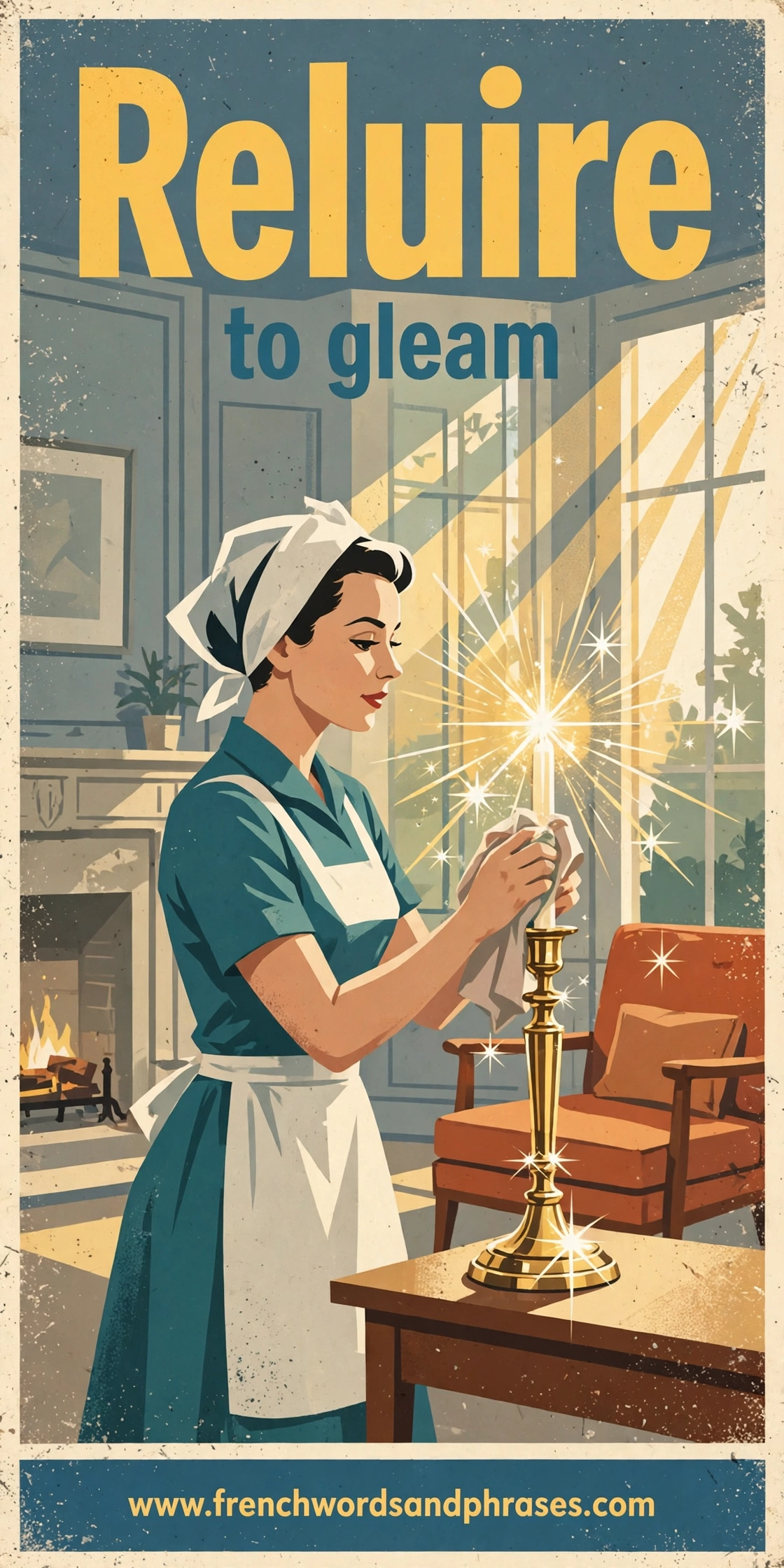
A French Word to Live By
How to Conjugate Reluire in French
/ʁə.lɥiʁ/
Reluire means to shine or to gleam — polished bright.
Silver polished for a wedding, a parquet floor after wax, brass handles glowing in a café — reluire is luire with elbow grease: the shine of things made bright by care.
In this guide, you’ll learn how to conjugate reluire in all the major French tenses and moods. Explore complete conjugation tables, French examples, English translations, and practice quizzes.
Understanding the French Verb Reluire
Reluire is a French verb belonging to the third group of verbs, those ending in -ire.
It means to shine, to gleam. It is commonly used for silverware, brass and copper gleaming, floors and furniture after polishing, shoes and helmets shining, and in the proud household phrase tout reluit — everything is gleaming.
Verb classification: Third group (-ire)
Auxiliary verb: Avoir
Past participle: relui
Present participle: reluisant
English equivalents: To shine, to gleam, to be polished bright; faire reluire, to polish up, to make shine.
One important detail: reluire is luire with the prefix re- — and it keeps the family rules: je reluis, il reluit, nous reluisons, and a past participle relui that never changes: les cuivres ont relui. In the kitchen and the dining room you will mostly hear faire reluire: faire reluire l’argenterie, to polish the silver until it shines.
Experience the Word
Reluire is the verb of the satisfied polish — the shine that answers back when you breathe on the silver and rub.
Imagine a grandmother’s dining room the morning of a wedding. The silver has been polished since dawn, the glasses stand in a row, and the whole room reluit like it is proud of itself.
The objects were always beautiful. Now they shine — you have made them reluire.
How to Conjugate Reluire: Complete French Conjugation Guide
Let’s explore every major conjugation of reluire, beginning with the indicative mood.
How to Conjugate Reluire in the Indicative Mood
The indicative mood is used to express facts, observations, actions, and events.
How to Conjugate Reluire in the Present Tense (Présent)
Used for actions happening now, habitual actions, and general truths.
| Subject | Conjugation |
|---|---|
| je | reluis |
| tu | reluis |
| il / elle | reluit |
| nous | reluisons |
| vous | reluisez |
| ils / elles | reluisent |
Example
L’argenterie reluit sur la table de fête.
The silverware gleams on the party table.
Quick Quiz 1
Complete the sentence:
Les cuivres ______ au soleil.
Reveal the answer
reluisent
Les cuivres reluisent au soleil.
The brass gleams in the sun.
How to Conjugate Reluire in the Passé Composé
Used for completed actions in the past. Reluire takes the auxiliary verb avoir.
| Subject | Conjugation |
|---|---|
| j’ | ai relui |
| tu | as relui |
| il / elle | a relui |
| nous | avons relui |
| vous | avez relui |
| ils / elles | ont relui |
Example
Les cuivres ont relui après le polissage.
The brass gleamed after polishing.
How to Conjugate Reluire in the Imparfait (Imperfect Tense)
Used for habitual past actions, descriptions, and ongoing situations in the past.
| Subject | Conjugation |
|---|---|
| je | reluisais |
| tu | reluisais |
| il / elle | reluisait |
| nous | reluisions |
| vous | reluisiez |
| ils / elles | reluisaient |
Example
Le parquet reluisait après la cire.
The parquet floor used to shine after waxing.
Quick Quiz 2
Choose the correct form:
The silverware gleamed.
L’argenterie ______ . (a relui / a reluie)
Reveal the answer
a relui
L’argenterie a relui.
The participle relui never changes.
How to Conjugate Reluire in the Plus-que-parfait
Used to describe an action that had already been completed before another past event.
| Subject | Conjugation |
|---|---|
| j’ | avais relui |
| tu | avais relui |
| il / elle | avait relui |
| nous | avions relui |
| vous | aviez relui |
| ils / elles | avaient relui |
Example
Les casques avaient relui au soleil de midi.
The helmets had gleamed in the midday sun.
How to Conjugate Reluire in the Passé Simple
Primarily used in formal writing, literature, and historical narratives. It is rarely used in everyday conversation.
| Subject | Conjugation |
|---|---|
| je | reluisis |
| tu | reluisis |
| il / elle | reluisit |
| nous | reluisîmes |
| vous | reluisîtes |
| ils / elles | reluisirent |
Example
Le fleuve reluisit sous la lune.
The river gleamed beneath the moon.
How to Conjugate Reluire in the Passé Antérieur
A literary tense used to express an action completed immediately before another past action, generally in the passé simple.
| Subject | Conjugation |
|---|---|
| j’ | eus relui |
| tu | eus relui |
| il / elle | eut relui |
| nous | eûmes relui |
| vous | eûtes relui |
| ils / elles | eurent relui |
Example
Quand la lampe eut relui dans la nuit, ils la virent de loin.
When the lamp had gleamed in the night, they saw it from afar.
How to Conjugate Reluire in the Future Tense (Futur Simple)
Used to describe actions that will take place in the future.
| Subject | Conjugation |
|---|---|
| je | reluirai |
| tu | reluiras |
| il / elle | reluira |
| nous | reluirons |
| vous | reluirez |
| ils / elles | reluiront |
Example
Après le nettoyage, tout reluira.
After the cleaning, everything will shine.
How to Conjugate Reluire in the Futur Antérieur (Future Perfect)
Used for an action that will have been completed before a particular point in the future.
| Subject | Conjugation |
|---|---|
| j’ | aurai relui |
| tu | auras relui |
| il / elle | aura relui |
| nous | aurons relui |
| vous | aurez relui |
| ils / elles | auront relui |
Example
À la fin du ménage, les cuivres auront relui comme neufs.
By the end of the cleaning, the brass will have gleamed like new.
How to Conjugate Reluire in the Near Future (Futur Proche)
Used to describe something that is going to happen soon. Formed with aller + infinitive.
| Subject | Conjugation |
|---|---|
| je | vais reluire |
| tu | vas reluire |
| il / elle | va reluire |
| nous | allons reluire |
| vous | allez reluire |
| ils / elles | vont reluire |
Example
Le parquet va reluire après la cire.
The floor is going to shine after the wax.
How to Conjugate Reluire in the Conditional Mood
The conditional mood expresses what would happen under certain circumstances. It is also frequently used to make polite requests or express wishes.
How to Conjugate Reluire in the Present Conditional
| Subject | Conjugation |
|---|---|
| je | reluirais |
| tu | reluirais |
| il / elle | reluirait |
| nous | reluirions |
| vous | reluiriez |
| ils / elles | reluiraient |
Example
Sans poussière, le meuble reluirait.
Without dust, the furniture would gleam.
How to Conjugate Reluire in the Past Conditional
| Subject | Conjugation |
|---|---|
| j’ | aurais relui |
| tu | aurais relui |
| il / elle | aurait relui |
| nous | aurions relui |
| vous | auriez relui |
| ils / elles | auraient relui |
Example
Le casque aurait relui avec un meilleur polissage.
The helmet would have shone with a better polish.
Reluire in the Literary Past Conditional Form
This less common literary form uses the imperfect subjunctive of avoir.
| Subject | Conjugation |
|---|---|
| j’ | eusse relui |
| tu | eusses relui |
| il / elle | eût relui |
| nous | eussions relui |
| vous | eussiez relui |
| ils / elles | eussent relui |
Example
L’argent eût relui à la lueur des cierges.
The silver would have gleamed in the candlelight.
How to Conjugate Reluire in the Subjunctive Mood
The subjunctive is used to express wishes, emotions, doubts, necessity, and uncertainty. It frequently follows expressions such as il faut que (it is necessary that) or bien que (although).
How to Conjugate Reluire in the Present Subjunctive
| Subject | Conjugation |
|---|---|
| que je | reluise |
| que tu | reluises |
| qu’il / qu’elle | reluise |
| que nous | reluisions |
| que vous | reluisiez |
| qu’ils / qu’elles | reluisent |
Example
Il faut que tout reluise pour la visite.
Everything must gleam for the visit.
Quick Quiz 3
Complete the sentence using the subjunctive:
Il faut que le parquet ______.
Reveal the answer
reluise
Il faut que le parquet reluise.
The floor must shine.
How to Conjugate Reluire in the Imperfect Subjunctive
A literary tense, rarely encountered in modern spoken French.
| Subject | Conjugation |
|---|---|
| que je | reluisse |
| que tu | reluisses |
| qu’il / qu’elle | reluisît |
| que nous | reluissions |
| que vous | reluissiez |
| qu’ils / qu’elles | reluissent |
Example
Je voulais que le parquet reluisît comme un miroir.
I wanted the floor to shine like a mirror.
How to Conjugate Reluire in the Pluperfect Subjunctive
A literary construction used to express an action completed before another past action.
| Subject | Conjugation |
|---|---|
| que j’ | eusse relui |
| que tu | eusses relui |
| qu’il / qu’elle | eût relui |
| que nous | eussions relui |
| que vous | eussiez relui |
| qu’ils / qu’elles | eussent relui |
Example
Il semblait que tout eût relui la veille.
It seemed everything had gleamed the day before.
How to Conjugate Reluire in the Past Subjunctive
| Subject | Conjugation |
|---|---|
| que j’ | aie relui |
| que tu | aies relui |
| qu’il / qu’elle | ait relui |
| que nous | ayons relui |
| que vous | ayez relui |
| qu’ils / qu’elles | aient relui |
Example
Je suis content que l’argenterie ait relui à la fête.
I am glad the silverware gleamed at the party.
How to Conjugate Reluire in the Imperative
The imperative is used to give commands, instructions, invitations, or suggestions. Subject pronouns are omitted.
How to Conjugate Reluire in the Present Imperative
| Person | Conjugation |
|---|---|
| (tu) | reluis |
| (nous) | reluisons |
| (vous) | reluisez |
Example
Reluis, argenterie, pour la fête !
Shine, silverware, for the party!
Quick Quiz 4
How would you say Shine (tu form)?
Reveal the answer
Reluis !
French Participles of Reluire
Participles are verb forms that can be used in compound tenses and other grammatical constructions.
Present Participle of Reluire
reluisant
En reluisant sous la lampe, le vase attirait l’œil.
Gleaming under the lamp, the vase caught the eye.
Past Participle of Reluire
relui
Après des heures de polissage, l’argenterie a relui comme jamais.
After hours of polishing, the silverware gleamed like never before.
Reluire in Everyday French: Real-Life Examples
Now that you know the conjugations, let’s see how reluire appears in everyday French.
Example 1 — Present
Tout reluit après le grand ménage.
Everything gleams after the big clean.
Example 2 — Passé composé
Le parquet a relui après la cire.
The floor shone after the wax.
Example 3 — Imparfait
L’argenterie reluisait dans la vitrine.
The silverware used to gleam in the cabinet.
Example 4 — Future
Les cuivres reluiront demain.
The brass will shine tomorrow.
Example 5 — Conditional
Le miroir reluirait sans la buée.
The mirror would gleam without the steam.
Example 6 — Subjunctive
Il faut que tout reluise !
Everything must gleam!
Beyond Translation: The Meaning of Reluire
English shine does not care how the shine arrived; French reluire quietly implies the polishing — it is the shine of silver, floors and brass that somebody worked for.
It is luire, earned.
The sun luit for free; the silver reluit because grandmother polished it. Two verbs, two kinds of light: given, and made.
How to Remember the French Verb Reluire
Remember it this way: Reluire is about the polished shine — luire with elbow grease.
- Faire reluire — to polish up: faire reluire l’argenterie.
- Past participle relui never agrees — les cuivres ont relui.
- Tout reluit ! — the proud verdict after a big clean.
The key idea is the polished shine — luire with elbow grease.
Test Your Knowledge of Reluire
Let’s see how much you’ve learned. Try answering these questions before revealing the answers.
Question 1
What does faire reluire l’argenterie mean?
Reveal the answer
To polish the silverware until it shines.
Question 2
How do you say Everything gleams after the big clean in French?
Reveal the answer
Tout reluit après le grand ménage.
Question 3
Translate: The floor shone after the wax.
Reveal the answer
Le parquet a relui après la cire.
Question 4
What is the past participle of reluire?
Reveal the answer
Relui — invariable, like lui and nui.
Question 5
Complete the sentence:
Il faut que tout ______ pour la visite.
Reveal the answer
reluise
Il faut que tout reluise pour la visite.
Everything must gleam for the visit.
Your Final Challenge
Can You Use It?
How would you say this in French?
Before the party, everything gleams: the silverware, the floor, the glasses.
Reveal the answer
Avant la fête, tout reluit : l’argenterie, le parquet, les verres.
Before the party, everything gleams: the silverware, the floor, the glasses.
A little French. A little curiosity. A richer everyday life.
LEARN FRENCH ONE WORD AT A TIME




