
A French Word to Live By
How to Conjugate Éconduire in French
/e.kɔ̃.dɥiʁ/
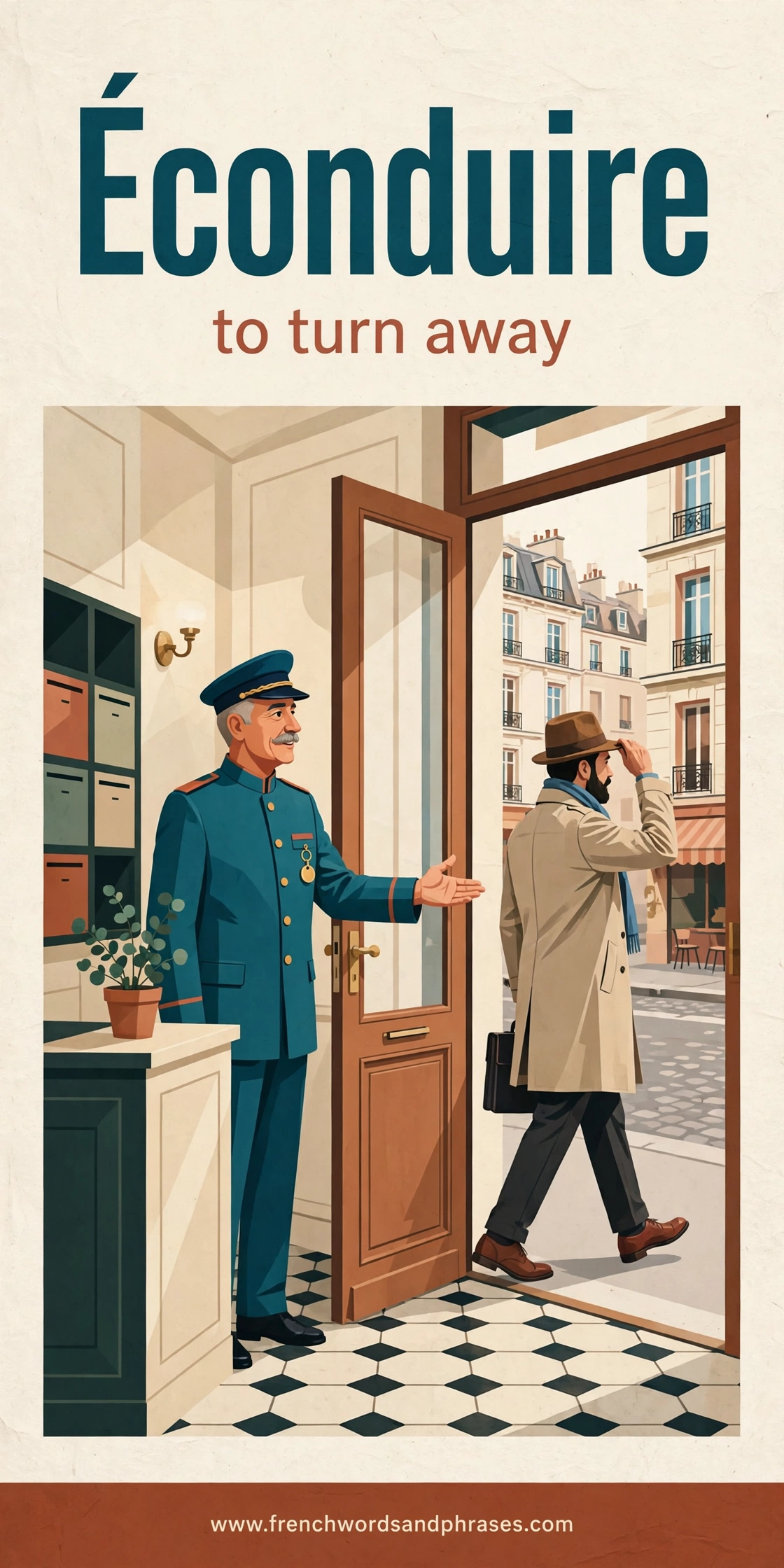
Éconduire means to show someone out — politely, but finally.
The unwanted salesman at the door, the suitor whose flowers are refused, the visitor who has stayed one hour too long — éconduire is conduire’s most diplomatic child: it leads people not to a place, but out of one.
In this guide, you’ll learn how to conjugate éconduire in all the major French tenses and moods. Explore complete conjugation tables, French examples, English translations, and practice quizzes.
Understanding the French Verb Éconduire
Éconduire is a regular French verb belonging to the third group of verbs, those ending in -uire.
It means to dismiss, to show out. It is commonly used for hosts seeing off unwanted guests, officials turning away petitioners, women politely rejecting suitors (éconduire un prétendant is a classic of French novels), and anyone dismissing door-to-door sellers.
Verb classification: Third group (-uire)
Auxiliary verb: Avoir
Past participle: éconduit
Present participle: éconduisant
English equivalents: To show out, to send away, to turn away politely; to reject (a suitor).
One important detail: éconduire belongs to formal, polished French — the butler’s verb, the diplomat’s verb. It is conduire aimed at the exit: you lead the person out so smoothly they barely notice being dismissed. Its favourite reflexive frame is se faire éconduire — to get shown the door, to be turned away.
Experience the Word
Éconduire is the verb of the velvet door — refusal performed so gracefully that the refused almost say thank you.
Imagine a Paris salon in 1890. A young suitor arrives with roses and rehearsed compliments; the lady of the house listens, smiles, praises the flowers — and within ten minutes he is on the stairs, hat in hand, éconduit with perfect courtesy and no idea how it happened.
Nobody was rude. He was simply éconduit — led, smiling, to the door.
How to Conjugate Éconduire: Complete French Conjugation Guide
Let’s explore every major conjugation of éconduire, beginning with the indicative mood.
How to Conjugate Éconduire in the Indicative Mood
The indicative mood is used to express facts, observations, actions, and events.
How to Conjugate Éconduire in the Present Tense (Présent)
Used for actions happening now, habitual actions, and general truths.
| Subject | Conjugation |
|---|---|
| je | éconduis |
| tu | éconduis |
| il / elle | éconduit |
| nous | éconduisons |
| vous | éconduisez |
| ils / elles | éconduisent |
Example
Le majordome éconduit les visiteurs importuns.
The butler shows unwelcome visitors out.
Quick Quiz 1
Complete the sentence:
Nous ______ les importuns sans bruit.
Reveal the answer
éconduisons
Nous éconduisons les importuns sans bruit.
We show unwelcome visitors out quietly.
How to Conjugate Éconduire in the Passé Composé
Used for completed actions in the past. Éconduire takes the auxiliary verb avoir.
| Subject | Conjugation |
|---|---|
| j’ | ai éconduit |
| tu | as éconduit |
| il / elle | a éconduit |
| nous | avons éconduit |
| vous | avez éconduit |
| ils / elles | ont éconduit |
Example
Elle a éconduit son prétendant avec un sourire.
She sent her suitor away with a smile.
How to Conjugate Éconduire in the Imparfait (Imperfect Tense)
Used for habitual past actions, descriptions, and ongoing situations in the past.
| Subject | Conjugation |
|---|---|
| je | éconduisais |
| tu | éconduisais |
| il / elle | éconduisait |
| nous | éconduisions |
| vous | éconduisiez |
| ils / elles | éconduisaient |
Example
Le directeur éconduisait les journalistes sans un mot.
The director used to dismiss the journalists without a word.
Quick Quiz 2
Choose the correct form:
She sent her suitor away.
Elle ______ son prétendant. (a éconduit / est éconduite)
Reveal the answer
a éconduit
Elle a éconduit son prétendant.
Éconduire takes avoir.
How to Conjugate Éconduire in the Plus-que-parfait
Used to describe an action that had already been completed before another past event.
| Subject | Conjugation |
|---|---|
| j’ | avais éconduit |
| tu | avais éconduit |
| il / elle | avait éconduit |
| nous | avions éconduit |
| vous | aviez éconduit |
| ils / elles | avaient éconduit |
Example
Nous avions éconduit l’importun avant le dîner.
We had shown the nuisance out before dinner.
How to Conjugate Éconduire in the Passé Simple
Primarily used in formal writing, literature, and historical narratives. It is rarely used in everyday conversation.
| Subject | Conjugation |
|---|---|
| je | éconduisis |
| tu | éconduisis |
| il / elle | éconduisit |
| nous | éconduisîmes |
| vous | éconduisîtes |
| ils / elles | éconduisirent |
Example
D’un geste poli, elle éconduisit le visiteur.
With a polite gesture, she showed the visitor out.
How to Conjugate Éconduire in the Passé Antérieur
A literary tense used to express an action completed immediately before another past action, generally in the passé simple.
| Subject | Conjugation |
|---|---|
| j’ | eus éconduit |
| tu | eus éconduit |
| il / elle | eut éconduit |
| nous | eûmes éconduit |
| vous | eûtes éconduit |
| ils / elles | eurent éconduit |
Example
Quand il eut éconduit le dernier invité, il souffla enfin.
When he had seen the last guest out, he finally breathed out.
How to Conjugate Éconduire in the Future Tense (Futur Simple)
Used to describe actions that will take place in the future.
| Subject | Conjugation |
|---|---|
| je | éconduirai |
| tu | éconduiras |
| il / elle | éconduira |
| nous | éconduirons |
| vous | éconduirez |
| ils / elles | éconduiront |
Example
Le secrétaire éconduira les curieux.
The secretary will turn the curious away.
How to Conjugate Éconduire in the Futur Antérieur (Future Perfect)
Used for an action that will have been completed before a particular point in the future.
| Subject | Conjugation |
|---|---|
| j’ | aurai éconduit |
| tu | auras éconduit |
| il / elle | aura éconduit |
| nous | aurons éconduit |
| vous | aurez éconduit |
| ils / elles | auront éconduit |
Example
À midi, elle aura éconduit trois démarcheurs.
By noon, she will have sent three cold-callers away.
How to Conjugate Éconduire in the Near Future (Futur Proche)
Used to describe something that is going to happen soon. Formed with aller + infinitive.
| Subject | Conjugation |
|---|---|
| je | vais éconduire |
| tu | vas éconduire |
| il / elle | va éconduire |
| nous | allons éconduire |
| vous | allez éconduire |
| ils / elles | vont éconduire |
Example
Je vais éconduire ce vendeur à la porte.
I am going to show this salesman to the door.
How to Conjugate Éconduire in the Conditional Mood
The conditional mood expresses what would happen under certain circumstances. It is also frequently used to make polite requests or express wishes.
How to Conjugate Éconduire in the Present Conditional
| Subject | Conjugation |
|---|---|
| je | éconduirais |
| tu | éconduirais |
| il / elle | éconduirait |
| nous | éconduirions |
| vous | éconduiriez |
| ils / elles | éconduiraient |
Example
Un bon diplomate éconduirait tout le monde sans blesser personne.
A good diplomat would send everyone away without offending anyone.
How to Conjugate Éconduire in the Past Conditional
| Subject | Conjugation |
|---|---|
| j’ | aurais éconduit |
| tu | aurais éconduit |
| il / elle | aurait éconduit |
| nous | aurions éconduit |
| vous | auriez éconduit |
| ils / elles | auraient éconduit |
Example
Il aurait éconduit le visiteur plus tôt s’il avait osé.
He would have shown the visitor out earlier if he had dared.
Éconduire in the Literary Past Conditional Form
This less common literary form uses the imperfect subjunctive of avoir.
| Subject | Conjugation |
|---|---|
| j’ | eusse éconduit |
| tu | eusses éconduit |
| il / elle | eût éconduit |
| nous | eussions éconduit |
| vous | eussiez éconduit |
| ils / elles | eussent éconduit |
Example
Elle eût éconduit le prince lui-même avec grâce.
She would have sent the prince himself away, gracefully.
How to Conjugate Éconduire in the Subjunctive Mood
The subjunctive is used to express wishes, emotions, doubts, necessity, and uncertainty. It frequently follows expressions such as il faut que (it is necessary that) or bien que (although).
How to Conjugate Éconduire in the Present Subjunctive
| Subject | Conjugation |
|---|---|
| que je | éconduise |
| que tu | éconduises |
| qu’il / qu’elle | éconduise |
| que nous | éconduisions |
| que vous | éconduisiez |
| qu’ils / qu’elles | éconduisent |
Example
Il faut que tu éconduises ce monsieur poliment.
You must show this gentleman out politely.
Quick Quiz 3
Complete the sentence using the subjunctive:
Il faut que vous ______ ce visiteur.
Reveal the answer
éconduisiez
Il faut que vous éconduisiez ce visiteur.
You must show this visitor out.
How to Conjugate Éconduire in the Imperfect Subjunctive
A literary tense, rarely encountered in modern spoken French.
| Subject | Conjugation |
|---|---|
| que je | éconduisse |
| que tu | éconduisses |
| qu’il / qu’elle | éconduisît |
| que nous | éconduissions |
| que vous | éconduissiez |
| qu’ils / qu’elles | éconduissent |
Example
Je craignais qu’elle éconduisît son dernier admirateur.
I feared she might send her last admirer away.
How to Conjugate Éconduire in the Pluperfect Subjunctive
A literary construction used to express an action completed before another past action.
| Subject | Conjugation |
|---|---|
| que j’ | eusse éconduit |
| que tu | eusses éconduit |
| qu’il / qu’elle | eût éconduit |
| que nous | eussions éconduit |
| que vous | eussiez éconduit |
| qu’ils / qu’elles | eussent éconduit |
Example
Il semblait que tout le monde eût éconduit le malheureux.
It seemed everyone had turned the poor man away.
How to Conjugate Éconduire in the Past Subjunctive
| Subject | Conjugation |
|---|---|
| que j’ | aie éconduit |
| que tu | aies éconduit |
| qu’il / qu’elle | ait éconduit |
| que nous | ayons éconduit |
| que vous | ayez éconduit |
| qu’ils / qu’elles | aient éconduit |
Example
Je suis surpris qu’elle ait éconduit un si bon parti.
I am surprised she turned away such a good match.
How to Conjugate Éconduire in the Imperative
The imperative is used to give commands, instructions, invitations, or suggestions. Subject pronouns are omitted.
How to Conjugate Éconduire in the Present Imperative
| Person | Conjugation |
|---|---|
| (tu) | éconduis |
| (nous) | éconduisons |
| (vous) | éconduisez |
Example
Éconduis-le poliment, mais fermement !
Show him out politely, but firmly!
Quick Quiz 4
How would you say Show him out (tu form)?
Reveal the answer
Éconduis-le !
French Participles of Éconduire
Participles are verb forms that can be used in compound tenses and other grammatical constructions.
Present Participle of Éconduire
éconduisant
En éconduisant les importuns, elle gardait toujours le sourire.
While showing unwelcome visitors out, she always kept her smile.
Past Participle of Éconduire
éconduit
Éconduit à la porte, le démarcheur n’insista pas.
Shown to the door, the cold-caller did not insist.
Éconduire in Everyday French: Real-Life Examples
Now that you know the conjugations, let’s see how éconduire appears in everyday French.
Example 1 — Present
Le concierge éconduit les démarcheurs.
The caretaker turns the cold-callers away.
Example 2 — Passé composé
Elle s’est fait éconduire à l’entrée.
She got turned away at the entrance.
Example 3 — Imparfait
Il éconduisait les importuns avec courtoisie.
He used to show unwelcome visitors out courteously.
Example 4 — Future
Je l’éconduirai sans un mot de trop.
I will see him out without one word too many.
Example 5 — Conditional
Un majordome éconduirait ce monsieur en silence.
A butler would show this gentleman out in silence.
Example 6 — Imperative
Éconduisez ce visiteur, s’il vous plaît !
Please show this visitor out!
Beyond Translation: The Meaning of Éconduire
English show out and turn away sound blunt; French éconduire wraps the refusal in ceremony — it is conduire, the leading verb, pointed at the door.
French novels run on it.
Éconduire un prétendant — to dismiss a suitor — is one of the great set scenes of French literature: the flowers accepted, the compliment returned, the young man somehow already outside.
How to Remember the French Verb Éconduire
Remember it this way: Éconduire is about the velvet door — éconduire un visiteur.
- Conduire to the exit: j’éconduis, nous éconduisons, participle éconduit.
- Se faire éconduire — to get shown the door, turned away.
- Register matters: éconduire is the polite, formal way to dismiss someone.
The key idea is the velvet door — éconduire un visiteur.
Test Your Knowledge of Éconduire
Let’s see how much you’ve learned. Try answering these questions before revealing the answers.
Question 1
What does se faire éconduire mean?
Reveal the answer
To get shown the door — to be turned away, politely but finally.
Question 2
How do you say She sent her suitor away in French?
Reveal the answer
Elle a éconduit son prétendant.
Question 3
Translate: The butler shows unwelcome visitors out.
Reveal the answer
Le majordome éconduit les visiteurs importuns.
Question 4
What is the past participle of éconduire?
Reveal the answer
Éconduit.
Question 5
Complete the sentence:
Il faut que tu ______ ce monsieur poliment.
Reveal the answer
éconduises
Il faut que tu éconduises ce monsieur poliment.
You must show this gentleman out politely.
Your Final Challenge
Can You Use It?
How would you say this in French?
With a polite smile, she shows the salesman to the door.
Reveal the answer
Avec un sourire poli, elle éconduit le vendeur à la porte.
With a polite smile, she shows the salesman to the door.
A little French. A little curiosity. A richer everyday life.
LEARN FRENCH ONE WORD AT A TIME




