A French Word to Live By
How to Conjugate Cuire in French
/kɥiʁ/
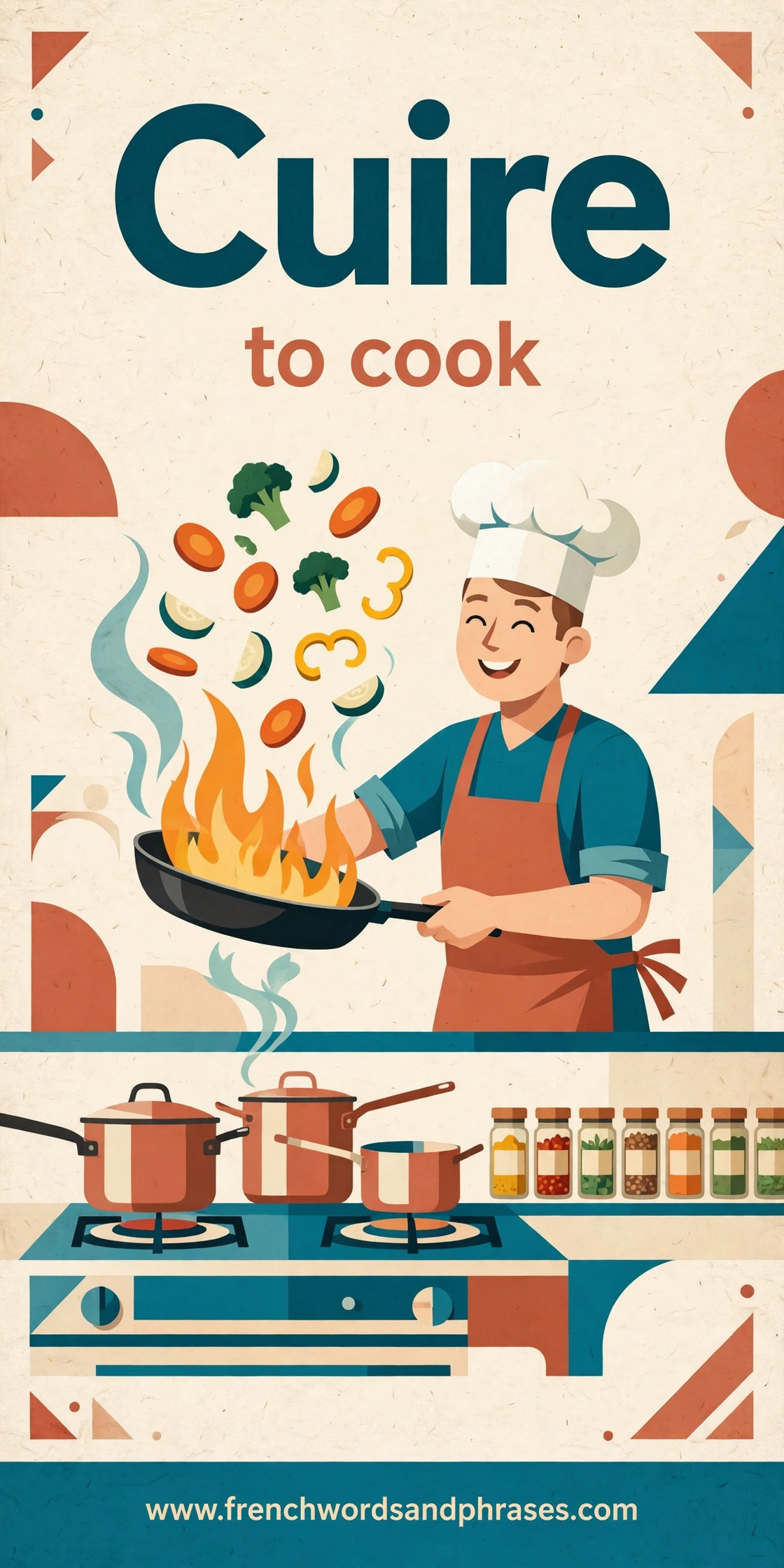
Cuire means to cook or to bake.
Bread turning gold in the oven, a chicken roasting slowly on a Sunday, your shoulders warming a little too much under the July sun — cuire is the verb of heat doing its patient work.
In this guide, you’ll learn how to conjugate cuire in all the major French tenses and moods. Explore complete conjugation tables, French examples, English translations, and practice quizzes.
Understanding the French Verb Cuire
Cuire is a regular French verb belonging to the third group of verbs, those ending in -uire.
It means to cook, to bake. It is commonly used for bread, cakes, meat and vegetables cooking, for cooking times (cuire à feu doux, over a low heat), for sun-scorched skin — and in the summer cry on cuit ici !, it’s baking in here!
Verb classification: Third group (-uire)
Auxiliary verb: Avoir
Past participle: cuit
Present participle: cuisant
English equivalents: To cook, to bake, to roast; (of the sun) to bake, to scorch.
One important detail: cuire works both ways — things cook by themselves (le pain cuit au four, the bread is baking) and you cook them (je cuis un poulet). With faire it becomes the everyday kitchen order: fais cuire les pâtes dix minutes. Its participle cuit doubles as the cook’s word for done: bien cuit, well done, à point, medium.
Experience the Word
Cuire is the verb of the kitchen clock — nothing is ready yet, everything is on its way, and the smell keeps promising.
Imagine a farmhouse kitchen in Gascony. A chicken turns slowly in the oven, potatoes bake in its juices, and nobody is allowed to open the door to peek. When it finally opens, the whole house understands why patience matters.
You have not hurried anything. You have let the heat cuire — and dinner is perfect.
How to Conjugate Cuire: Complete French Conjugation Guide
Let’s explore every major conjugation of cuire, beginning with the indicative mood.
How to Conjugate Cuire in the Indicative Mood
The indicative mood is used to express facts, observations, actions, and events.
How to Conjugate Cuire in the Present Tense (Présent)
Used for actions happening now, habitual actions, and general truths.
| Subject | Conjugation |
|---|---|
| je | cuis |
| tu | cuis |
| il / elle | cuit |
| nous | cuisons |
| vous | cuisez |
| ils / elles | cuisent |
Example
Le pain cuit dans le four chaud.
The bread is baking in the hot oven.
Quick Quiz 1
Complete the sentence:
Nous ______ le poulet au four.
Reveal the answer
cuisons
Nous cuisons le poulet au four.
We are cooking the chicken in the oven.
How to Conjugate Cuire in the Passé Composé
Used for completed actions in the past. Cuire takes the auxiliary verb avoir.
| Subject | Conjugation |
|---|---|
| j’ | ai cuit |
| tu | as cuit |
| il / elle | a cuit |
| nous | avons cuit |
| vous | avez cuit |
| ils / elles | ont cuit |
Example
Elle a cuit les pommes de terre à la vapeur.
She cooked the potatoes in steam.
How to Conjugate Cuire in the Imparfait (Imperfect Tense)
Used for habitual past actions, descriptions, and ongoing situations in the past.
| Subject | Conjugation |
|---|---|
| je | cuisais |
| tu | cuisais |
| il / elle | cuisait |
| nous | cuisions |
| vous | cuisiez |
| ils / elles | cuisaient |
Example
Le rôti cuisait à feu doux.
The roast was cooking over a low heat.
Quick Quiz 2
Choose the correct form:
The rice cooked in ten minutes.
Le riz ______ en dix minutes. (a cuit / est cuit)
Reveal the answer
a cuit
Le riz a cuit en dix minutes.
Cuire takes avoir in the passé composé (est cuit would mean ‘is cooked’, a state).
How to Conjugate Cuire in the Plus-que-parfait
Used to describe an action that had already been completed before another past event.
| Subject | Conjugation |
|---|---|
| j’ | avais cuit |
| tu | avais cuit |
| il / elle | avait cuit |
| nous | avions cuit |
| vous | aviez cuit |
| ils / elles | avaient cuit |
Example
Nous avions cuit le pain avant l’arrivée des invités.
We had baked the bread before the guests arrived.
How to Conjugate Cuire in the Passé Simple
Primarily used in formal writing, literature, and historical narratives. It is rarely used in everyday conversation.
| Subject | Conjugation |
|---|---|
| je | cuisis |
| tu | cuisis |
| il / elle | cuisit |
| nous | cuisîmes |
| vous | cuisîtes |
| ils / elles | cuisirent |
Example
Le boulanger cuisit ses pains avant l’aube.
The baker baked his loaves before dawn.
How to Conjugate Cuire in the Passé Antérieur
A literary tense used to express an action completed immediately before another past action, generally in the passé simple.
| Subject | Conjugation |
|---|---|
| j’ | eus cuit |
| tu | eus cuit |
| il / elle | eut cuit |
| nous | eûmes cuit |
| vous | eûtes cuit |
| ils / elles | eurent cuit |
Example
Quand le gâteau eut cuit, elle le sortit du four.
When the cake had baked, she took it out of the oven.
How to Conjugate Cuire in the Future Tense (Futur Simple)
Used to describe actions that will take place in the future.
| Subject | Conjugation |
|---|---|
| je | cuirai |
| tu | cuiras |
| il / elle | cuira |
| nous | cuirons |
| vous | cuirez |
| ils / elles | cuiront |
Example
Le poulet cuira pendant une heure.
The chicken will cook for an hour.
How to Conjugate Cuire in the Futur Antérieur (Future Perfect)
Used for an action that will have been completed before a particular point in the future.
| Subject | Conjugation |
|---|---|
| j’ | aurai cuit |
| tu | auras cuit |
| il / elle | aura cuit |
| nous | aurons cuit |
| vous | aurez cuit |
| ils / elles | auront cuit |
Example
À midi, le pain aura cuit.
By noon, the bread will have baked.
How to Conjugate Cuire in the Near Future (Futur Proche)
Used to describe something that is going to happen soon. Formed with aller + infinitive.
| Subject | Conjugation |
|---|---|
| je | vais cuire |
| tu | vas cuire |
| il / elle | va cuire |
| nous | allons cuire |
| vous | allez cuire |
| ils / elles | vont cuire |
Example
Je vais cuire des œufs pour le petit déjeuner.
I am going to cook some eggs for breakfast.
How to Conjugate Cuire in the Conditional Mood
The conditional mood expresses what would happen under certain circumstances. It is also frequently used to make polite requests or express wishes.
How to Conjugate Cuire in the Present Conditional
| Subject | Conjugation |
|---|---|
| je | cuirais |
| tu | cuirais |
| il / elle | cuirait |
| nous | cuirions |
| vous | cuiriez |
| ils / elles | cuiraient |
Example
À feu doux, la viande cuirait mieux.
Over a low heat, the meat would cook better.
How to Conjugate Cuire in the Past Conditional
| Subject | Conjugation |
|---|---|
| j’ | aurais cuit |
| tu | aurais cuit |
| il / elle | aurait cuit |
| nous | aurions cuit |
| vous | auriez cuit |
| ils / elles | auraient cuit |
Example
Le riz aurait cuit plus vite avec un couvercle.
The rice would have cooked faster with a lid.
Cuire in the Literary Past Conditional Form
This less common literary form uses the imperfect subjunctive of avoir.
| Subject | Conjugation |
|---|---|
| j’ | eusse cuit |
| tu | eusses cuit |
| il / elle | eût cuit |
| nous | eussions cuit |
| vous | eussiez cuit |
| ils / elles | eussent cuit |
Example
Le pain eût cuit plus lentement dans le vieux four de pierre.
The bread would have baked more slowly in the old stone oven.
How to Conjugate Cuire in the Subjunctive Mood
The subjunctive is used to express wishes, emotions, doubts, necessity, and uncertainty. It frequently follows expressions such as il faut que (it is necessary that) or bien que (although).
How to Conjugate Cuire in the Present Subjunctive
| Subject | Conjugation |
|---|---|
| que je | cuise |
| que tu | cuises |
| qu’il / qu’elle | cuise |
| que nous | cuisions |
| que vous | cuisiez |
| qu’ils / qu’elles | cuisent |
Example
Il faut que la viande cuise à point.
The meat must cook to perfection.
Quick Quiz 3
Complete the sentence using the subjunctive:
Il faut que les pâtes ______ vite.
Reveal the answer
cuisent
Il faut que les pâtes cuisent vite.
The pasta must cook quickly.
How to Conjugate Cuire in the Imperfect Subjunctive
A literary tense, rarely encountered in modern spoken French.
| Subject | Conjugation |
|---|---|
| que je | cuisse |
| que tu | cuisses |
| qu’il / qu’elle | cuisît |
| que nous | cuissions |
| que vous | cuissiez |
| qu’ils / qu’elles | cuissent |
Example
Je craignais que le poisson cuisît trop.
I feared the fish might overcook.
How to Conjugate Cuire in the Pluperfect Subjunctive
A literary construction used to express an action completed before another past action.
| Subject | Conjugation |
|---|---|
| que j’ | eusse cuit |
| que tu | eusses cuit |
| qu’il / qu’elle | eût cuit |
| que nous | eussions cuit |
| que vous | eussiez cuit |
| qu’ils / qu’elles | eussent cuit |
Example
Il semblait que le pain eût cuit trop vite.
It seemed the bread had baked too fast.
How to Conjugate Cuire in the Past Subjunctive
| Subject | Conjugation |
|---|---|
| que j’ | aie cuit |
| que tu | aies cuit |
| qu’il / qu’elle | ait cuit |
| que nous | ayons cuit |
| que vous | ayez cuit |
| qu’ils / qu’elles | aient cuit |
Example
Je suis content que tu aies cuit ce beau gâteau.
I am glad you baked this beautiful cake.
How to Conjugate Cuire in the Imperative
The imperative is used to give commands, instructions, invitations, or suggestions. Subject pronouns are omitted.
How to Conjugate Cuire in the Present Imperative
| Person | Conjugation |
|---|---|
| (tu) | cuis |
| (nous) | cuisons |
| (vous) | cuisez |
Example
Cuis les légumes à feu doux !
Cook the vegetables over a low heat!
Quick Quiz 4
How would you say Cook the vegetables (tu form)?
Reveal the answer
Cuis les légumes !
French Participles of Cuire
Participles are verb forms that can be used in compound tenses and other grammatical constructions.
Present Participle of Cuire
cuisant
En cuisant, le pain emplit la maison d’une bonne odeur.
As it bakes, the bread fills the house with a lovely smell.
Past Participle of Cuire
cuit
Bien cuit, le steak fond dans la bouche.
Well cooked, the steak melts in the mouth.
Cuire in Everyday French: Real-Life Examples
Now that you know the conjugations, let’s see how cuire appears in everyday French.
Example 1 — Present
Le riz cuit en dix minutes.
The rice cooks in ten minutes.
Example 2 — Passé composé
J’ai cuit un poulet entier.
I cooked a whole chicken.
Example 3 — Imparfait
Le dimanche, un rôti cuisait au four.
On Sundays, a roast used to cook in the oven.
Example 4 — Future
Les pâtes cuiront vite.
The pasta will cook quickly.
Example 5 — Too hot
On cuit ici, ouvre la fenêtre !
It’s baking in here, open the window!
Example 6 — Imperative
Cuisez les œufs six minutes !
Cook the eggs for six minutes!
Beyond Translation: The Meaning of Cuire
English needs cook, bake, roast and boil; French lets cuire stand behind all of them — the heat verb itself, with the method added around it: cuire au four, cuire à la vapeur, cuire à feu doux.
Its participle runs the restaurant.
Order a steak in France and cuit does the talking: bleu, saignant, à point, bien cuit — and if a person is cuit, slang says he is done for, cooked in every sense.
How to Remember the French Verb Cuire
Remember it this way: Cuire is about heat at work — le pain cuit, bien cuit.
- Same family as conduire: je cuis, nous cuisons, participle cuit.
- Faire cuire — the everyday way to say you are cooking something: fais cuire les pâtes.
- Bien cuit — well done; les carottes sont cuites — it’s all over (the carrots are cooked!).
The key idea is heat at work — le pain cuit, bien cuit.
Test Your Knowledge of Cuire
Let’s see how much you’ve learned. Try answering these questions before revealing the answers.
Question 1
How do you say The bread is baking in French?
Reveal the answer
Le pain cuit.
Question 2
What does bien cuit mean for a steak?
Reveal the answer
Well done — cuit, the participle of cuire, is the cook’s word for cooked through.
Question 3
Translate: I am going to cook some eggs.
Reveal the answer
Je vais cuire des œufs.
Question 4
What is the past participle of cuire?
Reveal the answer
Cuit.
Question 5
Complete the sentence:
Il faut que la viande ______ à point.
Reveal the answer
cuise
Il faut que la viande cuise à point.
The meat must cook to perfection.
Your Final Challenge
Can You Use It?
How would you say this in French?
While the bread is baking, the kitchen smells wonderful.
Reveal the answer
Pendant que le pain cuit, la cuisine sent merveilleusement bon.
While the bread is baking, the kitchen smells wonderful.
A little French. A little curiosity. A richer everyday life.
LEARN FRENCH ONE WORD AT A TIME