A French Word to Live By
How to Conjugate Skier in French
/skje/
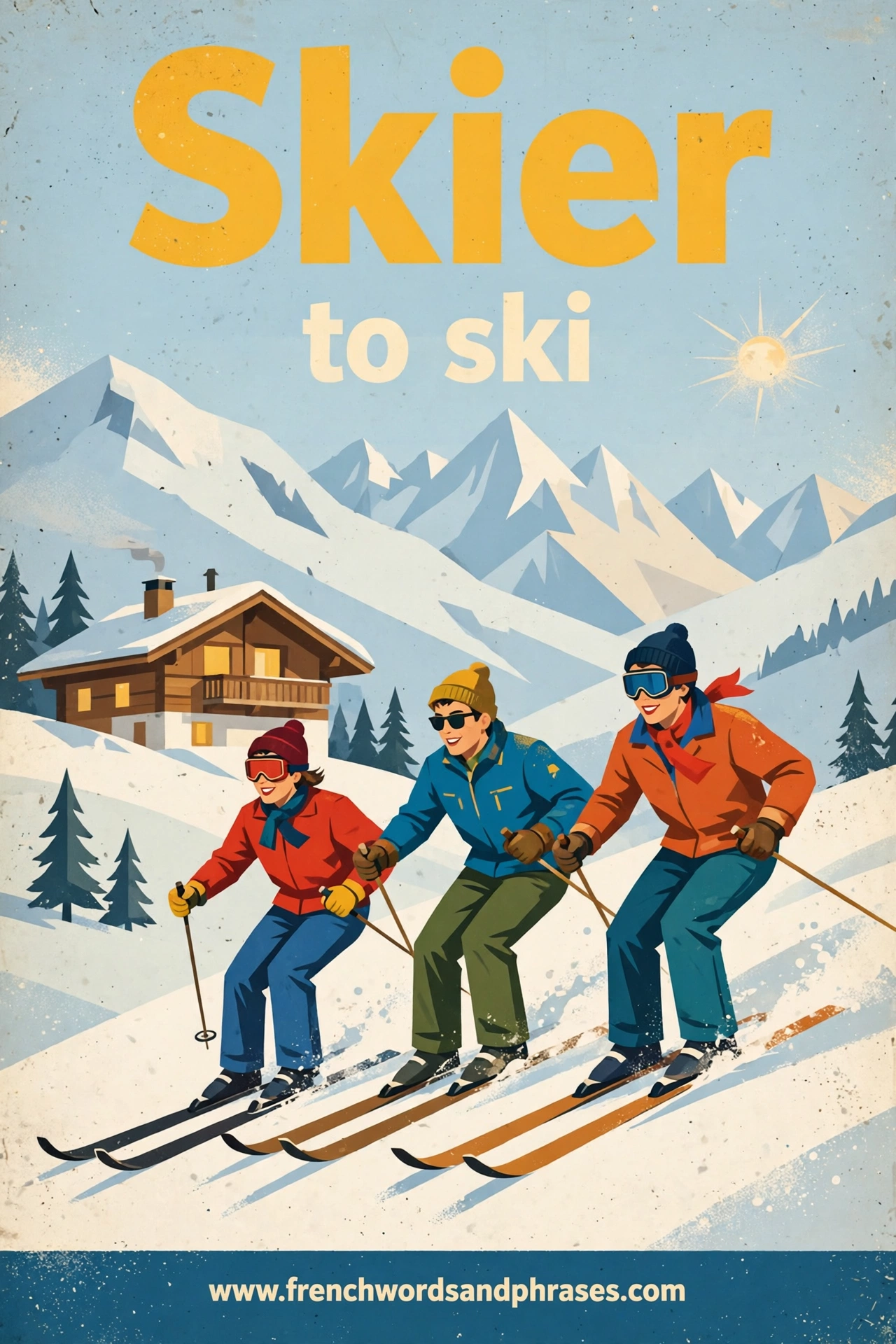
Skier means to ski.
Fresh snow on an Alpine slope, the hiss of skis, the lift climbing into blue sky — skier is the winter verb of a country where the February school holidays are planned around the mountains.
In this guide, you’ll learn how to conjugate skier in all the major French tenses and moods. Explore complete conjugation tables, French examples, English translations, and practice quizzes.
Understanding the French Verb Skier
Skier is a regular French verb belonging to the first group of verbs, those ending in -er.
It means to ski. It is commonly used for downhill and cross-country days on the snow, for resorts, pistes and seasons. French also loves the noun phrase faire du ski for the activity itself, but when a true verb is needed, skier steps forward.
Verb classification: First group (-er)
Auxiliary verb: Avoir
Past participle: skié
Present participle: skiant
English equivalents: To ski.
One important detail: skier ends in -ier, and its i doubles wherever the ending itself begins with i. In the present, nous skions, vous skiez keep a single i; but in the imperfect and the subjunctive you write two: nous skiions, vous skiiez — il faut que vous skiiez. It looks like a stutter on the page; it is perfectly correct.
Experience the Word
Skier is the verb of the mountain morning — cold air, white silence, and gravity doing the joyful half of the work.
Imagine a small resort in Savoie at nine o’clock. The lifts creak into life, the first tracks cut the fresh slope, and by ten the whole mountain is a page being written and erased all day long.
You have not just come down a mountain. You have skied it — a very different verb.
How to Conjugate Skier: Complete French Conjugation Guide
Let’s explore every major conjugation of skier, beginning with the indicative mood.
How to Conjugate Skier in the Indicative Mood
The indicative mood is used to express facts, observations, actions, and events.
How to Conjugate Skier in the Present Tense (Présent)
Used for actions happening now, habitual actions, and general truths.
| Subject | Conjugation |
|---|---|
| je | skie |
| tu | skies |
| il / elle | skie |
| nous | skions |
| vous | skiez |
| ils / elles | skient |
Example
En février, nous skions dans les Alpes.
In February, we ski in the Alps.
Quick Quiz 1
Complete the sentence:
Autrefois, nous ______ dès décembre.
Reveal the answer
skiions
Autrefois, nous skiions dès décembre.
In the old days, we used to ski from December — two i’s in the imperfect.
How to Conjugate Skier in the Passé Composé
Used for completed actions in the past. Skier takes the auxiliary verb avoir.
| Subject | Conjugation |
|---|---|
| j’ | ai skié |
| tu | as skié |
| il / elle | a skié |
| nous | avons skié |
| vous | avez skié |
| ils / elles | ont skié |
Example
Ils ont skié toute la journée sous le soleil.
They skied all day in the sunshine.
How to Conjugate Skier in the Imparfait (Imperfect Tense)
Used for habitual past actions, descriptions, and ongoing situations in the past.
| Subject | Conjugation |
|---|---|
| je | skiais |
| tu | skiais |
| il / elle | skiait |
| nous | skiions |
| vous | skiiez |
| ils / elles | skiaient |
Example
Vous skiiez déjà très bien à dix ans.
You already skied very well at ten years old.
Quick Quiz 2
Choose the correct form:
I skied yesterday.
J’______ hier. (ai skié / suis skié)
Reveal the answer
ai skié
J’ai skié hier.
Skier takes avoir.
How to Conjugate Skier in the Plus-que-parfait
Used to describe an action that had already been completed before another past event.
| Subject | Conjugation |
|---|---|
| j’ | avais skié |
| tu | avais skié |
| il / elle | avait skié |
| nous | avions skié |
| vous | aviez skié |
| ils / elles | avaient skié |
Example
Elle avait skié sur cette piste avant la tempête.
She had skied on this slope before the storm.
How to Conjugate Skier in the Passé Simple
Primarily used in formal writing, literature, and historical narratives. It is rarely used in everyday conversation.
| Subject | Conjugation |
|---|---|
| je | skiai |
| tu | skias |
| il / elle | skia |
| nous | skiâmes |
| vous | skiâtes |
| ils / elles | skièrent |
Example
Le champion skia la descente en deux minutes.
The champion skied the descent in two minutes.
How to Conjugate Skier in the Passé Antérieur
A literary tense used to express an action completed immediately before another past action, generally in the passé simple.
| Subject | Conjugation |
|---|---|
| j’ | eus skié |
| tu | eus skié |
| il / elle | eut skié |
| nous | eûmes skié |
| vous | eûtes skié |
| ils / elles | eurent skié |
Example
Quand ils eurent skié jusqu’au refuge, ils burent un chocolat chaud.
When they had skied to the refuge, they drank a hot chocolate.
How to Conjugate Skier in the Future Tense (Futur Simple)
Used to describe actions that will take place in the future.
| Subject | Conjugation |
|---|---|
| je | skierai |
| tu | skieras |
| il / elle | skiera |
| nous | skierons |
| vous | skierez |
| ils / elles | skieront |
Example
Cet hiver, tu skieras sur des pistes rouges.
This winter, you will ski on red runs.
How to Conjugate Skier in the Futur Antérieur (Future Perfect)
Used for an action that will have been completed before a particular point in the future.
| Subject | Conjugation |
|---|---|
| j’ | aurai skié |
| tu | auras skié |
| il / elle | aura skié |
| nous | aurons skié |
| vous | aurez skié |
| ils / elles | auront skié |
Example
À la fin de la semaine, nous aurons skié sur toutes les pistes.
By the end of the week, we will have skied on all the runs.
How to Conjugate Skier in the Near Future (Futur Proche)
Used to describe something that is going to happen soon. Formed with aller + infinitive.
| Subject | Conjugation |
|---|---|
| je | vais skier |
| tu | vas skier |
| il / elle | va skier |
| nous | allons skier |
| vous | allez skier |
| ils / elles | vont skier |
Example
Regarde les flocons : on va skier demain !
Look at the snowflakes: we are going to ski tomorrow!
How to Conjugate Skier in the Conditional Mood
The conditional mood expresses what would happen under certain circumstances. It is also frequently used to make polite requests or express wishes.
How to Conjugate Skier in the Present Conditional
| Subject | Conjugation |
|---|---|
| je | skierais |
| tu | skierais |
| il / elle | skierait |
| nous | skierions |
| vous | skieriez |
| ils / elles | skieraient |
Example
Avec plus de neige, je skierais jusqu’au village.
With more snow, I would ski down to the village.
How to Conjugate Skier in the Past Conditional
| Subject | Conjugation |
|---|---|
| j’ | aurais skié |
| tu | aurais skié |
| il / elle | aurait skié |
| nous | aurions skié |
| vous | auriez skié |
| ils / elles | auraient skié |
Example
Il aurait skié plus longtemps sans le brouillard.
He would have skied longer without the fog.
Skier in the Literary Past Conditional Form
This less common literary form uses the imperfect subjunctive of avoir.
| Subject | Conjugation |
|---|---|
| j’ | eusse skié |
| tu | eusses skié |
| il / elle | eût skié |
| nous | eussions skié |
| vous | eussiez skié |
| ils / elles | eussent skié |
Example
Elle eût skié toute la journée sans la nuit tombante.
She would have skied all day if night had not fallen.
How to Conjugate Skier in the Subjunctive Mood
The subjunctive is used to express wishes, emotions, doubts, necessity, and uncertainty. It frequently follows expressions such as il faut que (it is necessary that) or bien que (although).
How to Conjugate Skier in the Present Subjunctive
| Subject | Conjugation |
|---|---|
| que je | skie |
| que tu | skies |
| qu’il / qu’elle | skie |
| que nous | skiions |
| que vous | skiiez |
| qu’ils / qu’elles | skient |
Example
Il faut que vous skiiez avec un casque.
You must ski with a helmet.
Quick Quiz 3
Complete the sentence using the subjunctive:
Il faut que vous ______ avec un casque.
Reveal the answer
skiiez
Il faut que vous skiiez avec un casque.
You must ski with a helmet.
How to Conjugate Skier in the Imperfect Subjunctive
A literary tense, rarely encountered in modern spoken French.
| Subject | Conjugation |
|---|---|
| que je | skiasse |
| que tu | skiasses |
| qu’il / qu’elle | skiât |
| que nous | skiassions |
| que vous | skiassiez |
| qu’ils / qu’elles | skiassent |
Example
Je voulais qu’il skiât prudemment.
I wanted him to ski carefully.
How to Conjugate Skier in the Pluperfect Subjunctive
A literary construction used to express an action completed before another past action.
| Subject | Conjugation |
|---|---|
| que j’ | eusse skié |
| que tu | eusses skié |
| qu’il / qu’elle | eût skié |
| que nous | eussions skié |
| que vous | eussiez skié |
| qu’ils / qu’elles | eussent skié |
Example
Elle doutait que nous eussions skié si vite.
She doubted that we had skied so fast.
How to Conjugate Skier in the Past Subjunctive
| Subject | Conjugation |
|---|---|
| que j’ | aie skié |
| que tu | aies skié |
| qu’il / qu’elle | ait skié |
| que nous | ayons skié |
| que vous | ayez skié |
| qu’ils / qu’elles | aient skié |
Example
Je suis ravi que tu aies skié aujourd’hui.
I am delighted you skied today.
How to Conjugate Skier in the Imperative
The imperative is used to give commands, instructions, invitations, or suggestions. Subject pronouns are omitted.
How to Conjugate Skier in the Present Imperative
| Person | Conjugation |
|---|---|
| (tu) | skie |
| (nous) | skions |
| (vous) | skiez |
Example
Skiez lentement près de l’école de ski !
Ski slowly near the ski school!
Quick Quiz 4
How would you say Ski carefully (tu form)?
Reveal the answer
Skie prudemment !
French Participles of Skier
Participles are verb forms that can be used in compound tenses and other grammatical constructions.
Present Participle of Skier
skiant
En skiant chaque hiver, ils sont devenus experts.
By skiing every winter, they became experts.
Past Participle of Skier
skié
La descente, skiée en deux minutes par le champion, semblait facile.
The descent, skied in two minutes by the champion, looked easy.
Skier in Everyday French: Real-Life Examples
Now that you know the conjugations, let’s see how skier appears in everyday French.
Example 1 — Present
Nous skions dans les Alpes chaque hiver.
We ski in the Alps every winter.
Example 2 — Passé composé
J’ai skié pour la première fois à sept ans.
I skied for the first time at seven.
Example 3 — Imparfait
Autrefois, nous skiions dès le mois de décembre.
In the old days, we used to ski from December onwards.
Example 4 — Future
Ils skieront demain si le temps le permet.
They will ski tomorrow if the weather allows.
Example 5 — Conditional
Je skierais bien toute la semaine.
I would gladly ski all week.
Example 6 — Imperative
Skie prudemment, la piste est verglacée !
Ski carefully, the slope is icy!
Beyond Translation: The Meaning of Skier
English ski is a Scandinavian loanword that never quite became a French-style verb; French took the same word and naturalised it completely as skier, double-i spellings and all.
French also loves the noun.
Where English says to go skiing, French very often says faire du ski — but when the verb itself steps forward, it is skier, with its i’s doubled exactly where the grammar asks for them.
How to Remember the French Verb Skier
Remember it this way: Skier is about the mountain verb — skiions with two i’s.
- Single i in the present — nous skions, vous skiez; double i in the imperfect and subjunctive — nous skiions, vous skiiez.
- Past participle skié — j’ai skié toute la journée.
- Faire du ski is the everyday noun phrase; skier is the verb when you need one.
The key idea is the mountain verb — skiions with two i’s.
Test Your Knowledge of Skier
Let’s see how much you’ve learned. Try answering these questions before revealing the answers.
Question 1
How do you write we used to ski, in the imperfect nous form?
Reveal the answer
Nous skiions — the stem’s i and the ending’s i make two.
Question 2
How do you say They skied all day in French?
Reveal the answer
Ils ont skié toute la journée.
Question 3
Translate: You must ski with a helmet.
Reveal the answer
Il faut que vous skiiez avec un casque.
Question 4
What is the past participle of skier?
Reveal the answer
Skié.
Question 5
Complete the sentence:
En février, nous ______ dans les Alpes.
Reveal the answer
skions
En février, nous skions dans les Alpes.
In February, we ski in the Alps — one i in the present.
Your Final Challenge
Can You Use It?
How would you say this in French?
Every winter, we ski together in the Alps.
Reveal the answer
Chaque hiver, nous skions ensemble dans les Alpes.
Every winter, we ski together in the Alps.
A little French. A little curiosity. A richer everyday life.
LEARN FRENCH ONE WORD AT A TIME