A French Word to Live By
How to Conjugate Saisir in French
/sɛ.ziʁ/
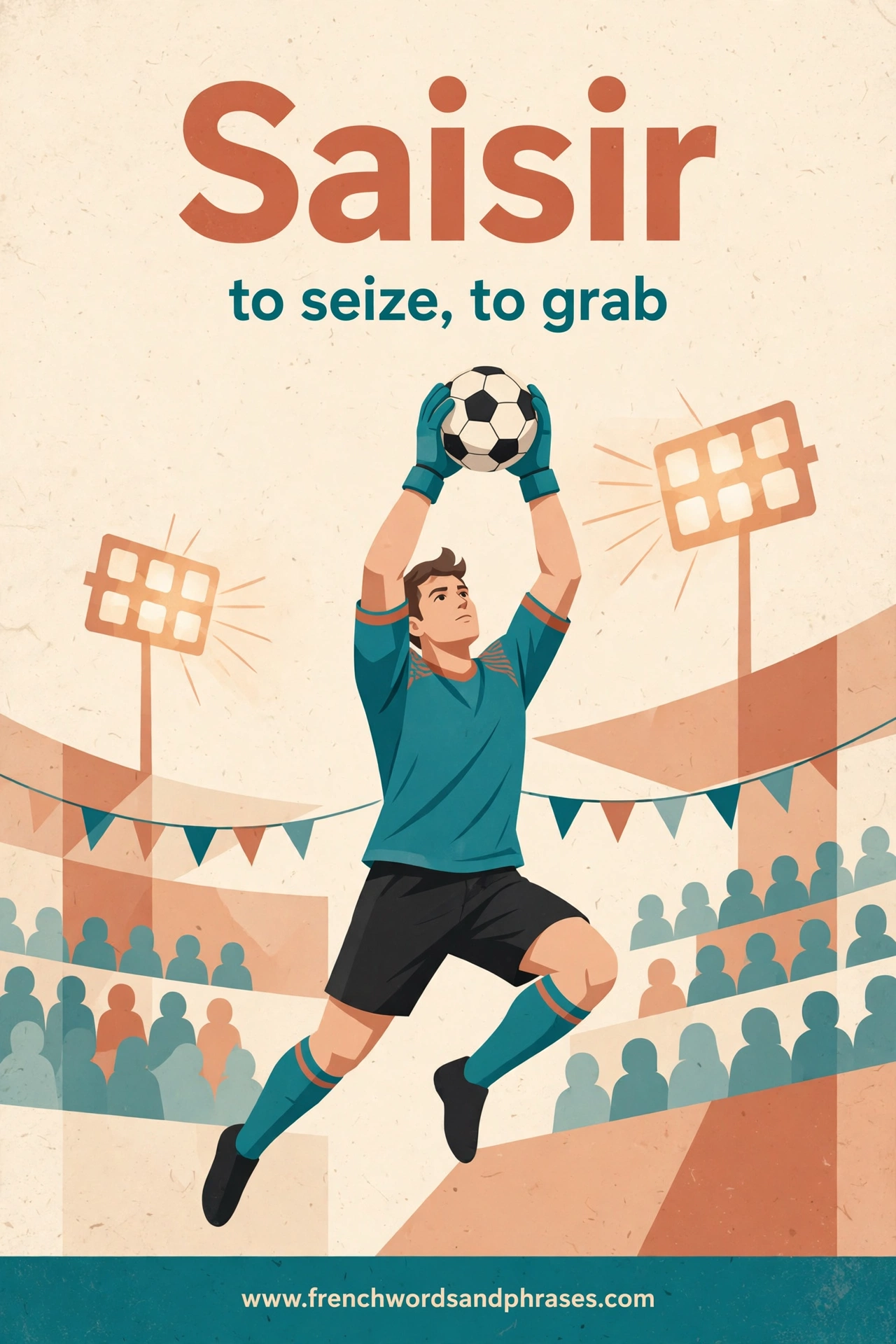
Saisir means to seize or to grab — with the hand, or with the mind.
A hand closing fast on a rope, a traveller grabbing his one chance, a student suddenly seeing the point — saisir is the verb of the quick, firm grip, in the fingers and in the understanding alike.
In this guide, you’ll learn how to conjugate saisir in all the major French tenses and moods. Explore complete conjugation tables, French examples, English translations, and practice quizzes.
Understanding the French Verb Saisir
Saisir is a regular French verb belonging to the second group of verbs, those ending in -ir.
It means to seize, to grab; to grasp, to understand. It is commonly used for grabbing ropes, hands and railings, seizing chances and moments, grasping ideas and explanations, and for cold or fear that seizes a person — le froid le saisit.
Verb classification: Second group (-ir)
Auxiliary verb: Avoir
Past participle: saisi
Present participle: saisissant
English equivalents: To seize, to grab, to grasp; to understand (je saisis); (law) to seize (assets), to bring before a court.
One important detail: saisir grips with the mind as naturally as with the hand — je saisis simply means I get it, I follow. Its most famous partner is chance itself: saisir une occasion, to seize an opportunity, even saisir l’occasion par les cheveux, to seize it by the forelock before it escapes. In law, saisir le tribunal is to bring a case before the court, and officers saisissent des biens — seize property.
Experience the Word
Saisir is the verb of no hesitation — the instant between seeing your chance and having it in your hand.
Imagine a platform in a Paris station. The last train is announced, the crowd stirs, and one woman steps forward, case in hand, exactly as the doors open. She did not run. She simply saisit her moment.
The chance has not been studied. It has been seized — and that is why it is yours.
How to Conjugate Saisir: Complete French Conjugation Guide
Let’s explore every major conjugation of saisir, beginning with the indicative mood.
How to Conjugate Saisir in the Indicative Mood
The indicative mood is used to express facts, observations, actions, and events.
How to Conjugate Saisir in the Present Tense (Présent)
Used for actions happening now, habitual actions, and general truths.
| Subject | Conjugation |
|---|---|
| je | saisis |
| tu | saisis |
| il / elle | saisit |
| nous | saisissons |
| vous | saisissez |
| ils / elles | saisissent |
Example
Il saisit la corde à deux mains.
He grabs the rope with both hands.
Quick Quiz 1
Complete the sentence:
Nous ______ l’occasion dès qu’elle se présente.
Reveal the answer
saisissons
Nous saisissons l’occasion dès qu’elle se présente.
We seize the opportunity as soon as it appears.
How to Conjugate Saisir in the Passé Composé
Used for completed actions in the past. Saisir takes the auxiliary verb avoir.
| Subject | Conjugation |
|---|---|
| j’ | ai saisi |
| tu | as saisi |
| il / elle | a saisi |
| nous | avons saisi |
| vous | avez saisi |
| ils / elles | ont saisi |
Example
Elle a saisi l’occasion dès qu’elle s’est présentée.
She seized the opportunity as soon as it appeared.
How to Conjugate Saisir in the Imparfait (Imperfect Tense)
Used for habitual past actions, descriptions, and ongoing situations in the past.
| Subject | Conjugation |
|---|---|
| je | saisissais |
| tu | saisissais |
| il / elle | saisissait |
| nous | saisissions |
| vous | saisissiez |
| ils / elles | saisissaient |
Example
Le froid nous saisissait dès la porte franchie.
The cold used to grip us as soon as we stepped through the door.
Quick Quiz 2
Choose the correct form:
She seized the opportunity.
Elle ______ l’occasion. (a saisi / est saisie)
Reveal the answer
a saisi
Elle a saisi l’occasion.
Saisir takes avoir.
How to Conjugate Saisir in the Plus-que-parfait
Used to describe an action that had already been completed before another past event.
| Subject | Conjugation |
|---|---|
| j’ | avais saisi |
| tu | avais saisi |
| il / elle | avait saisi |
| nous | avions saisi |
| vous | aviez saisi |
| ils / elles | avaient saisi |
Example
Ils avaient saisi tous les documents du bureau.
They had seized all the documents in the office.
How to Conjugate Saisir in the Passé Simple
Primarily used in formal writing, literature, and historical narratives. It is rarely used in everyday conversation.
| Subject | Conjugation |
|---|---|
| je | saisis |
| tu | saisis |
| il / elle | saisit |
| nous | saisîmes |
| vous | saisîtes |
| ils / elles | saisirent |
Example
Il saisit le bras de son ami au bord du vide.
He grabbed his friend’s arm at the edge of the drop.
How to Conjugate Saisir in the Passé Antérieur
A literary tense used to express an action completed immediately before another past action, generally in the passé simple.
| Subject | Conjugation |
|---|---|
| j’ | eus saisi |
| tu | eus saisi |
| il / elle | eut saisi |
| nous | eûmes saisi |
| vous | eûtes saisi |
| ils / elles | eurent saisi |
Example
Dès qu’elle eut saisi l’idée, elle se mit à écrire.
As soon as she had grasped the idea, she started writing.
How to Conjugate Saisir in the Future Tense (Futur Simple)
Used to describe actions that will take place in the future.
| Subject | Conjugation |
|---|---|
| je | saisirai |
| tu | saisiras |
| il / elle | saisira |
| nous | saisirons |
| vous | saisirez |
| ils / elles | saisiront |
Example
Tu saisiras ta chance quand elle viendra.
You will seize your chance when it comes.
How to Conjugate Saisir in the Futur Antérieur (Future Perfect)
Used for an action that will have been completed before a particular point in the future.
| Subject | Conjugation |
|---|---|
| j’ | aurai saisi |
| tu | auras saisi |
| il / elle | aura saisi |
| nous | aurons saisi |
| vous | aurez saisi |
| ils / elles | auront saisi |
Example
À la fin de la réunion, vous aurez saisi l’essentiel.
By the end of the meeting, you will have grasped the main points.
How to Conjugate Saisir in the Near Future (Futur Proche)
Used to describe something that is going to happen soon. Formed with aller + infinitive.
| Subject | Conjugation |
|---|---|
| je | vais saisir |
| tu | vas saisir |
| il / elle | va saisir |
| nous | allons saisir |
| vous | allez saisir |
| ils / elles | vont saisir |
Example
Je vais saisir cette occasion unique.
I am going to seize this unique opportunity.
How to Conjugate Saisir in the Conditional Mood
The conditional mood expresses what would happen under certain circumstances. It is also frequently used to make polite requests or express wishes.
How to Conjugate Saisir in the Present Conditional
| Subject | Conjugation |
|---|---|
| je | saisirais |
| tu | saisirais |
| il / elle | saisirait |
| nous | saisirions |
| vous | saisiriez |
| ils / elles | saisiraient |
Example
Sans hésiter, elle saisirait la corde.
Without hesitating, she would grab the rope.
How to Conjugate Saisir in the Past Conditional
| Subject | Conjugation |
|---|---|
| j’ | aurais saisi |
| tu | aurais saisi |
| il / elle | aurait saisi |
| nous | aurions saisi |
| vous | auriez saisi |
| ils / elles | auraient saisi |
Example
Il aurait saisi l’occasion s’il l’avait vue passer.
He would have seized the opportunity if he had seen it go by.
Saisir in the Literary Past Conditional Form
This less common literary form uses the imperfect subjunctive of avoir.
| Subject | Conjugation |
|---|---|
| j’ | eusse saisi |
| tu | eusses saisi |
| il / elle | eût saisi |
| nous | eussions saisi |
| vous | eussiez saisi |
| ils / elles | eussent saisi |
Example
Il eût saisi l’occasion par les cheveux.
He would have seized the opportunity by the forelock.
How to Conjugate Saisir in the Subjunctive Mood
The subjunctive is used to express wishes, emotions, doubts, necessity, and uncertainty. It frequently follows expressions such as il faut que (it is necessary that) or bien que (although).
How to Conjugate Saisir in the Present Subjunctive
| Subject | Conjugation |
|---|---|
| que je | saisisse |
| que tu | saisisses |
| qu’il / qu’elle | saisisse |
| que nous | saisissions |
| que vous | saisissiez |
| qu’ils / qu’elles | saisissent |
Example
Il faut que tu saisisses ta chance.
You must seize your chance.
Quick Quiz 3
Complete the sentence using the subjunctive:
Il faut que vous ______ cette chance.
Reveal the answer
saisissiez
Il faut que vous saisissiez cette chance.
You must seize this chance.
How to Conjugate Saisir in the Imperfect Subjunctive
A literary tense, rarely encountered in modern spoken French.
| Subject | Conjugation |
|---|---|
| que je | saisisse |
| que tu | saisisses |
| qu’il / qu’elle | saisît |
| que nous | saisissions |
| que vous | saisissiez |
| qu’ils / qu’elles | saisissent |
Example
Je voulais qu’il saisît la main tendue.
I wanted him to grasp the outstretched hand.
How to Conjugate Saisir in the Pluperfect Subjunctive
A literary construction used to express an action completed before another past action.
| Subject | Conjugation |
|---|---|
| que j’ | eusse saisi |
| que tu | eusses saisi |
| qu’il / qu’elle | eût saisi |
| que nous | eussions saisi |
| que vous | eussiez saisi |
| qu’ils / qu’elles | eussent saisi |
Example
Elle regrettait que nous n’eussions pas saisi l’occasion.
She regretted that we had not seized the opportunity.
How to Conjugate Saisir in the Past Subjunctive
| Subject | Conjugation |
|---|---|
| que j’ | aie saisi |
| que tu | aies saisi |
| qu’il / qu’elle | ait saisi |
| que nous | ayons saisi |
| que vous | ayez saisi |
| qu’ils / qu’elles | aient saisi |
Example
Je suis sûr que vous avez saisi l’essentiel.
I am sure you have grasped the main points.
How to Conjugate Saisir in the Imperative
The imperative is used to give commands, instructions, invitations, or suggestions. Subject pronouns are omitted.
How to Conjugate Saisir in the Present Imperative
| Person | Conjugation |
|---|---|
| (tu) | saisis |
| (nous) | saisissons |
| (vous) | saisissez |
Example
Saisis ta chance !
Seize your chance!
Quick Quiz 4
How would you say Seize it (tu form, la chance)?
Reveal the answer
Saisis-la !
French Participles of Saisir
Participles are verb forms that can be used in compound tenses and other grammatical constructions.
Present Participle of Saisir
saisissant
En saisissant la rampe, elle évita la chute.
By grabbing the handrail, she avoided falling.
Past Participle of Saisir
saisi
Saisi par le froid, le voyageur s’arrêta net.
Seized by the cold, the traveller stopped short.
Saisir in Everyday French: Real-Life Examples
Now that you know the conjugations, let’s see how saisir appears in everyday French.
Example 1 — Present
Je saisis, merci, c’est clair maintenant.
I get it, thanks, it is clear now.
Example 2 — Passé composé
Elle a saisi l’occasion tout de suite.
She seized the opportunity straight away.
Example 3 — Imparfait
Il saisissait chaque occasion de plaisanter.
He used to seize every chance to joke.
Example 4 — Future
Tu saisiras vite le principe.
You will soon grasp the principle.
Example 5 — Conditional
À ta place, je saisirais cette offre.
In your place, I would seize that offer.
Example 6 — Imperative
Saisissez la corde à deux mains !
Grab the rope with both hands!
Beyond Translation: The Meaning of Saisir
English needs grab for hands and grasp for ideas; French saisir refuses to separate them — what the hand can hold, the mind can hold too, with the same quick grip.
Its family works in the courts.
Une saisie is a legal seizure of goods, and insaisissable — unseizable, ungraspable — describes both protected property and the most elusive of ideas.
How to Remember the French Verb Saisir
Remember it this way: Saisir is about the quick grip — ropes, chances and ideas.
- Je saisis — I get it: the mind gripping an idea like a hand.
- Saisir une occasion — to seize an opportunity, never to ‘take’ it.
- Regular -ir: je saisis, nous saisissons, past participle saisi.
The key idea is the quick grip — ropes, chances and ideas.
Test Your Knowledge of Saisir
Let’s see how much you’ve learned. Try answering these questions before revealing the answers.
Question 1
How do you say I get it with saisir?
Reveal the answer
Je saisis — the mind grips the idea like a hand.
Question 2
How do you say Seize your chance in French?
Reveal the answer
Saisis ta chance !
Question 3
Translate: She seized the opportunity straight away.
Reveal the answer
Elle a saisi l’occasion tout de suite.
Question 4
What is the past participle of saisir?
Reveal the answer
Saisi.
Question 5
Complete the sentence:
Il faut que tu ______ ta chance.
Reveal the answer
saisisses
Il faut que tu saisisses ta chance.
You must seize your chance.
Your Final Challenge
Can You Use It?
How would you say this in French?
Seize every opportunity; it does not always come back.
Reveal the answer
Saisis chaque occasion, elle ne revient pas toujours.
Seize every opportunity; it does not always come back.
A little French. A little curiosity. A richer everyday life.
LEARN FRENCH ONE WORD AT A TIME