
A French Word to Live By
How to Conjugate Rougir in French
/ʁu.ʒiʁ/
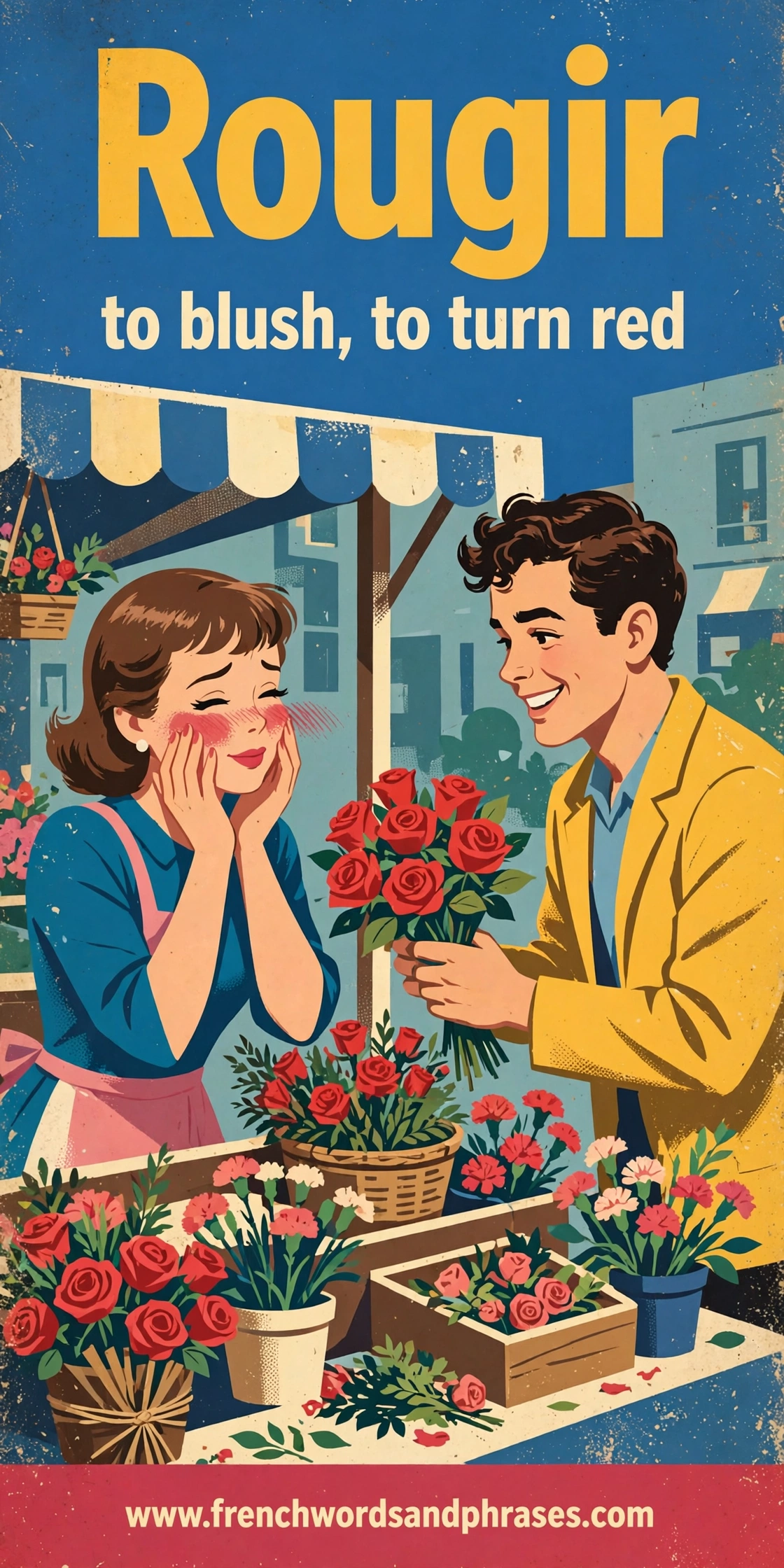
Rougir means to blush or to turn red.
Cheeks colouring at a compliment, apples reddening on the branch, the sky catching fire at sunset — rougir is the verb of redness arriving, on faces, fruit and horizons.
In this guide, you’ll learn how to conjugate rougir in all the major French tenses and moods. Explore complete conjugation tables, French examples, English translations, and practice quizzes.
Understanding the French Verb Rougir
Rougir is a regular French verb belonging to the second group of verbs, those ending in -ir.
It means to blush, to turn red. It is commonly used for blushing at compliments, praise and embarrassment, for faces flushing with effort or wine, and for fruit ripening, leaves turning and the evening sky reddening.
Verb classification: Second group (-ir)
Auxiliary verb: Avoir
Past participle: rougi
Present participle: rougissant
English equivalents: To blush, to go red, to flush; (fruit, leaves, sky) to turn red, to redden.
One important detail: rougir usually needs no object at all — the redness arrives by itself: elle rougit, les tomates rougissent. The reason rides along with de: rougir de honte, to blush with shame; rougir de plaisir, to flush with pleasure; rougir de colère, to go red with anger. To make someone else blush, French adds faire: ce compliment l’a fait rougir.
Experience the Word
Rougir is the verb of feelings made visible — the one reaction nobody can hide, rehearse or take back.
Imagine a school prize-giving in a village hall. The shy girl’s name is called, the whole room applauds, and her cheeks announce her joy before she says a single word.
She has said nothing. Her face has said everything — in red.
How to Conjugate Rougir: Complete French Conjugation Guide
Let’s explore every major conjugation of rougir, beginning with the indicative mood.
How to Conjugate Rougir in the Indicative Mood
The indicative mood is used to express facts, observations, actions, and events.
How to Conjugate Rougir in the Present Tense (Présent)
Used for actions happening now, habitual actions, and general truths.
| Subject | Conjugation |
|---|---|
| je | rougis |
| tu | rougis |
| il / elle | rougit |
| nous | rougissons |
| vous | rougissez |
| ils / elles | rougissent |
Example
Elle rougit dès qu’on la complimente.
She blushes as soon as anyone compliments her.
Quick Quiz 1
Complete the sentence:
Nous ______ rarement en public.
Reveal the answer
rougissons
Nous rougissons rarement en public.
We rarely blush in public.
How to Conjugate Rougir in the Passé Composé
Used for completed actions in the past. Rougir takes the auxiliary verb avoir.
| Subject | Conjugation |
|---|---|
| j’ | ai rougi |
| tu | as rougi |
| il / elle | a rougi |
| nous | avons rougi |
| vous | avez rougi |
| ils / elles | ont rougi |
Example
Il a rougi de honte devant toute la classe.
He blushed with shame in front of the whole class.
How to Conjugate Rougir in the Imparfait (Imperfect Tense)
Used for habitual past actions, descriptions, and ongoing situations in the past.
| Subject | Conjugation |
|---|---|
| je | rougissais |
| tu | rougissais |
| il / elle | rougissait |
| nous | rougissions |
| vous | rougissiez |
| ils / elles | rougissaient |
Example
Les pommes rougissaient sur les branches en septembre.
The apples used to turn red on the branches in September.
Quick Quiz 2
Choose the correct form:
He blushed with shame.
Il ______ de honte. (a rougi / est rougi)
Reveal the answer
a rougi
Il a rougi de honte.
Rougir takes avoir.
How to Conjugate Rougir in the Plus-que-parfait
Used to describe an action that had already been completed before another past event.
| Subject | Conjugation |
|---|---|
| j’ | avais rougi |
| tu | avais rougi |
| il / elle | avait rougi |
| nous | avions rougi |
| vous | aviez rougi |
| ils / elles | avaient rougi |
Example
Son visage avait rougi sous l’effort.
His face had gone red with the effort.
How to Conjugate Rougir in the Passé Simple
Primarily used in formal writing, literature, and historical narratives. It is rarely used in everyday conversation.
| Subject | Conjugation |
|---|---|
| je | rougis |
| tu | rougis |
| il / elle | rougit |
| nous | rougîmes |
| vous | rougîtes |
| ils / elles | rougirent |
Example
Elle rougit, puis elle éclata de rire.
She blushed, then burst out laughing.
How to Conjugate Rougir in the Passé Antérieur
A literary tense used to express an action completed immediately before another past action, generally in the passé simple.
| Subject | Conjugation |
|---|---|
| j’ | eus rougi |
| tu | eus rougi |
| il / elle | eut rougi |
| nous | eûmes rougi |
| vous | eûtes rougi |
| ils / elles | eurent rougi |
Example
Dès qu’elle eut rougi, tous comprirent.
As soon as she had blushed, everyone understood.
How to Conjugate Rougir in the Future Tense (Futur Simple)
Used to describe actions that will take place in the future.
| Subject | Conjugation |
|---|---|
| je | rougirai |
| tu | rougiras |
| il / elle | rougira |
| nous | rougirons |
| vous | rougirez |
| ils / elles | rougiront |
Example
Les tomates rougiront au soleil d’août.
The tomatoes will turn red in the August sun.
How to Conjugate Rougir in the Futur Antérieur (Future Perfect)
Used for an action that will have been completed before a particular point in the future.
| Subject | Conjugation |
|---|---|
| j’ | aurai rougi |
| tu | auras rougi |
| il / elle | aura rougi |
| nous | aurons rougi |
| vous | aurez rougi |
| ils / elles | auront rougi |
Example
À la fin du repas, ses joues auront rougi de plaisir.
By the end of the meal, her cheeks will have flushed with pleasure.
How to Conjugate Rougir in the Near Future (Futur Proche)
Used to describe something that is going to happen soon. Formed with aller + infinitive.
| Subject | Conjugation |
|---|---|
| je | vais rougir |
| tu | vas rougir |
| il / elle | va rougir |
| nous | allons rougir |
| vous | allez rougir |
| ils / elles | vont rougir |
Example
Regarde, il va rougir !
Look, he is going to blush!
How to Conjugate Rougir in the Conditional Mood
The conditional mood expresses what would happen under certain circumstances. It is also frequently used to make polite requests or express wishes.
How to Conjugate Rougir in the Present Conditional
| Subject | Conjugation |
|---|---|
| je | rougirais |
| tu | rougirais |
| il / elle | rougirait |
| nous | rougirions |
| vous | rougiriez |
| ils / elles | rougiraient |
Example
Sans ce compliment, elle ne rougirait pas.
Without that compliment, she would not be blushing.
How to Conjugate Rougir in the Past Conditional
| Subject | Conjugation |
|---|---|
| j’ | aurais rougi |
| tu | aurais rougi |
| il / elle | aurait rougi |
| nous | aurions rougi |
| vous | auriez rougi |
| ils / elles | auraient rougi |
Example
À sa place, j’aurais rougi de honte.
In his place, I would have blushed with shame.
Rougir in the Literary Past Conditional Form
This less common literary form uses the imperfect subjunctive of avoir.
| Subject | Conjugation |
|---|---|
| j’ | eusse rougi |
| tu | eusses rougi |
| il / elle | eût rougi |
| nous | eussions rougi |
| vous | eussiez rougi |
| ils / elles | eussent rougi |
Example
Elle eût rougi de ce compliment devant tous.
She would have blushed at that compliment in front of everyone.
How to Conjugate Rougir in the Subjunctive Mood
The subjunctive is used to express wishes, emotions, doubts, necessity, and uncertainty. It frequently follows expressions such as il faut que (it is necessary that) or bien que (although).
How to Conjugate Rougir in the Present Subjunctive
| Subject | Conjugation |
|---|---|
| que je | rougisse |
| que tu | rougisses |
| qu’il / qu’elle | rougisse |
| que nous | rougissions |
| que vous | rougissiez |
| qu’ils / qu’elles | rougissent |
Example
Il se peut qu’elle rougisse de plaisir.
She may well blush with pleasure.
Quick Quiz 3
Complete the sentence using the subjunctive:
Il se peut que vous ______ de plaisir.
Reveal the answer
rougissiez
Il se peut que vous rougissiez de plaisir.
You may well blush with pleasure.
How to Conjugate Rougir in the Imperfect Subjunctive
A literary tense, rarely encountered in modern spoken French.
| Subject | Conjugation |
|---|---|
| que je | rougisse |
| que tu | rougisses |
| qu’il / qu’elle | rougît |
| que nous | rougissions |
| que vous | rougissiez |
| qu’ils / qu’elles | rougissent |
Example
Il suffisait d’un mot pour qu’elle rougît.
One word was enough for her to blush.
How to Conjugate Rougir in the Pluperfect Subjunctive
A literary construction used to express an action completed before another past action.
| Subject | Conjugation |
|---|---|
| que j’ | eusse rougi |
| que tu | eusses rougi |
| qu’il / qu’elle | eût rougi |
| que nous | eussions rougi |
| que vous | eussiez rougi |
| qu’ils / qu’elles | eussent rougi |
Example
Je doutais qu’elle eût vraiment rougi.
I doubted that she had really blushed.
How to Conjugate Rougir in the Past Subjunctive
| Subject | Conjugation |
|---|---|
| que j’ | aie rougi |
| que tu | aies rougi |
| qu’il / qu’elle | ait rougi |
| que nous | ayons rougi |
| que vous | ayez rougi |
| qu’ils / qu’elles | aient rougi |
Example
Il est charmant qu’elle ait rougi de plaisir.
It is sweet that she blushed with pleasure.
How to Conjugate Rougir in the Imperative
The imperative is used to give commands, instructions, invitations, or suggestions. Subject pronouns are omitted.
How to Conjugate Rougir in the Present Imperative
| Person | Conjugation |
|---|---|
| (tu) | rougis |
| (nous) | rougissons |
| (vous) | rougissez |
Example
Ne rougis pas, c’était un compliment !
Do not blush, it was a compliment!
Quick Quiz 4
How would you say Do not blush (tu form)?
Reveal the answer
Ne rougis pas !
French Participles of Rougir
Participles are verb forms that can be used in compound tenses and other grammatical constructions.
Present Participle of Rougir
rougissant
Rougissant jusqu’aux oreilles, il avoua tout.
Blushing to the ears, he confessed everything.
Past Participle of Rougir
rougi
Les feuilles, une fois rougies, annoncent l’automne.
The leaves, once turned red, announce autumn.
Rougir in Everyday French: Real-Life Examples
Now that you know the conjugations, let’s see how rougir appears in everyday French.
Example 1 — Present
Elle rougit très facilement.
She blushes very easily.
Example 2 — Passé composé
Il a rougi de honte.
He blushed with shame.
Example 3 — Imparfait
Les cerises rougissaient en juin.
The cherries used to turn red in June.
Example 4 — Future
Les feuilles rougiront en octobre.
The leaves will turn red in October.
Example 5 — Conditional
À sa place, je rougirais aussi.
In his place, I would blush too.
Example 6 — Imperative
Ne rougissez pas, c’est un compliment !
Do not blush, it is a compliment!
Beyond Translation: The Meaning of Rougir
English blush belongs to faces alone; French rougir reddens the whole world — cheeks, cherries, wine-dark evenings and autumn woods all rougissent with the same verb.
Its noun is the blush itself.
Une rougeur is a blush or a red patch — and when a French face rougit, everyone in the room can read it like print.
How to Remember the French Verb Rougir
Remember it this way: Rougir is about turning red — cheeks, cherries and skies.
- The reason comes with de — rougir de honte, de plaisir, de colère.
- No object needed — faces, fruit and skies rougissent all by themselves.
- Regular -ir: je rougis, nous rougissons, past participle rougi.
The key idea is turning red — cheeks, cherries and skies.
Test Your Knowledge of Rougir
Let’s see how much you’ve learned. Try answering these questions before revealing the answers.
Question 1
Which preposition names the reason after rougir?
Reveal the answer
De — rougir de honte, rougir de plaisir.
Question 2
How do you say She blushes very easily in French?
Reveal the answer
Elle rougit très facilement.
Question 3
Translate: He blushed with shame.
Reveal the answer
Il a rougi de honte.
Question 4
What is the past participle of rougir?
Reveal the answer
Rougi.
Question 5
Complete the sentence:
Il se peut qu’elle ______ de plaisir.
Reveal the answer
rougisse
Il se peut qu’elle rougisse de plaisir.
She may well blush with pleasure.
Your Final Challenge
Can You Use It?
How would you say this in French?
She blushes with pleasure every time her poem is read.
Reveal the answer
Elle rougit de plaisir chaque fois qu’on lit son poème.
She blushes with pleasure every time her poem is read.
A little French. A little curiosity. A richer everyday life.
LEARN FRENCH ONE WORD AT A TIME




