
A French Word to Live By
How to Conjugate Étendre in French
/e.tɑ̃dʁ/
Étendre means to stretch out, to spread, or to extend.
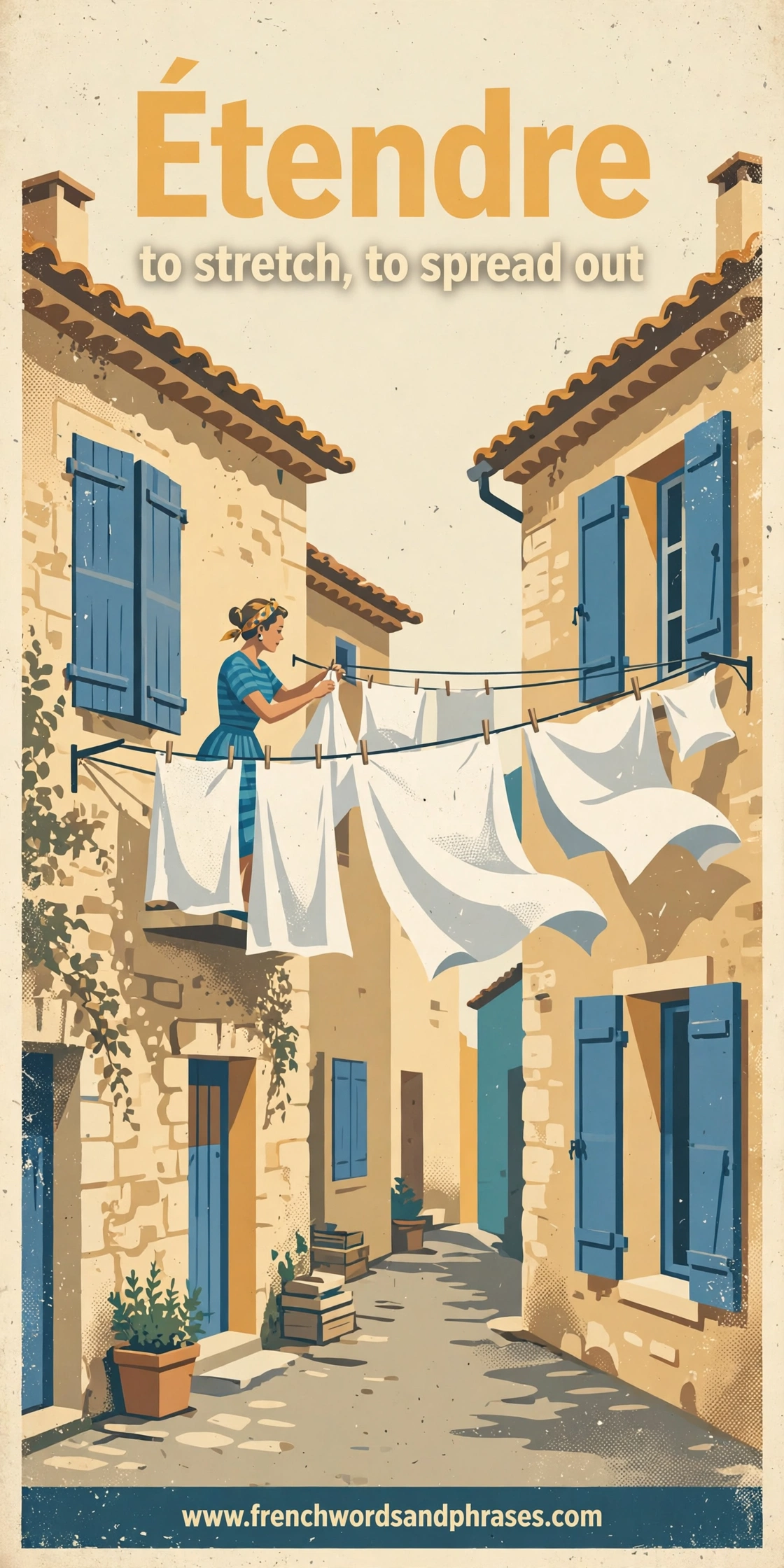
Washing spread on a line, a cat stretching in the sun, a plain stretching to the horizon — étendre is the verb of things opening out to their full length.
In this guide, you’ll learn how to conjugate étendre in all the major French tenses and moods. Explore complete conjugation tables, French examples, English translations, and practice quizzes.
Understanding the French Verb Étendre
Étendre is a regular French verb belonging to the third group of verbs, those ending in -re.
It means to stretch, to spread out, to extend. It is commonly used for hanging out laundry (étendre le linge), spreading a cloth or a map, extending a deadline or a law’s reach, and landscapes stretching away in the reflexive.
Verb classification: Third group (-re)
Auxiliary verb: Avoir
Past participle: étendu
Present participle: étendant
English equivalents: To stretch, to spread out, to extend, to lay out; (se) to stretch oneself, to stretch out (land).
One important detail: étendre works in both directions. You use it for the washing, the map, the butter; and land or water s’étend — stretches out — by itself: la plaine s’étend jusqu’à la mer. The reflexive form also serves for a person stretching out on the sofa.
Experience the Word
Étendre is the verb of opening out — of everything that was folded, rolled or cramped becoming wide and flat and free.
Imagine a balcony in Marseille on washday. Sheets billow over the railings of every floor, white sails above the street, each one étendu by practised hands before breakfast.
The cloth has not changed. It has simply been given its full size.
How to Conjugate Étendre: Complete French Conjugation Guide
Let’s explore every major conjugation of étendre, beginning with the indicative mood.
How to Conjugate Étendre in the Indicative Mood
The indicative mood is used to express facts, observations, actions, and events.
How to Conjugate Étendre in the Present Tense (Présent)
Used for actions happening now, habitual actions, and general truths.
| Subject | Conjugation |
|---|---|
| je | étends |
| tu | étends |
| il / elle | étend |
| nous | étendons |
| vous | étendez |
| ils / elles | étendent |
Example
Elle étend le linge sur le fil.
She hangs the washing out on the line.
Quick Quiz 1
Complete the sentence:
Nous ______ le linge sur le balcon.
Reveal the answer
étendons
Nous étendons le linge sur le balcon.
We hang the washing out on the balcony.
How to Conjugate Étendre in the Passé Composé
Used for completed actions in the past. Étendre takes the auxiliary verb avoir.
| Subject | Conjugation |
|---|---|
| j’ | ai étendu |
| tu | as étendu |
| il / elle | a étendu |
| nous | avons étendu |
| vous | avez étendu |
| ils / elles | ont étendu |
Example
Nous avons étendu la nappe sur la table.
We spread the cloth over the table.
How to Conjugate Étendre in the Imparfait (Imperfect Tense)
Used for habitual past actions, descriptions, and ongoing situations in the past.
| Subject | Conjugation |
|---|---|
| je | étendais |
| tu | étendais |
| il / elle | étendait |
| nous | étendions |
| vous | étendiez |
| ils / elles | étendaient |
Example
Le chat étendait ses pattes au soleil.
The cat used to stretch its paws in the sun.
Quick Quiz 2
Choose the correct form:
The lake stretched out beneath the mountain.
Le lac ______ sous la montagne. (s’étendait / étendait)
Reveal the answer
s’étendait
Le lac s’étendait sous la montagne.
Land stretching out uses the reflexive s’étendre.
How to Conjugate Étendre in the Plus-que-parfait
Used to describe an action that had already been completed before another past event.
| Subject | Conjugation |
|---|---|
| j’ | avais étendu |
| tu | avais étendu |
| il / elle | avait étendu |
| nous | avions étendu |
| vous | aviez étendu |
| ils / elles | avaient étendu |
Example
Ils avaient étendu la carte sur le sol.
They had spread the map out on the floor.
How to Conjugate Étendre in the Passé Simple
Primarily used in formal writing, literature, and historical narratives. It is rarely used in everyday conversation.
| Subject | Conjugation |
|---|---|
| je | étendis |
| tu | étendis |
| il / elle | étendit |
| nous | étendîmes |
| vous | étendîtes |
| ils / elles | étendirent |
Example
La plaine s’étendit devant eux à perte de vue.
The plain stretched out before them as far as the eye could see.
How to Conjugate Étendre in the Passé Antérieur
A literary tense used to express an action completed immediately before another past action, generally in the passé simple.
| Subject | Conjugation |
|---|---|
| j’ | eus étendu |
| tu | eus étendu |
| il / elle | eut étendu |
| nous | eûmes étendu |
| vous | eûtes étendu |
| ils / elles | eurent étendu |
Example
Quand elle eut étendu le linge, elle se reposa.
When she had hung out the washing, she rested.
How to Conjugate Étendre in the Future Tense (Futur Simple)
Used to describe actions that will take place in the future.
| Subject | Conjugation |
|---|---|
| je | étendrai |
| tu | étendras |
| il / elle | étendra |
| nous | étendrons |
| vous | étendrez |
| ils / elles | étendront |
Example
Demain, j’étendrai la pâte à pizza.
Tomorrow, I will roll out the pizza dough.
How to Conjugate Étendre in the Futur Antérieur (Future Perfect)
Used for an action that will have been completed before a particular point in the future.
| Subject | Conjugation |
|---|---|
| j’ | aurai étendu |
| tu | auras étendu |
| il / elle | aura étendu |
| nous | aurons étendu |
| vous | aurez étendu |
| ils / elles | auront étendu |
Example
À midi, elle aura étendu tout le linge.
By noon, she will have hung out all the washing.
How to Conjugate Étendre in the Near Future (Futur Proche)
Used to describe something that is going to happen soon. Formed with aller + infinitive.
| Subject | Conjugation |
|---|---|
| je | vais étendre |
| tu | vas étendre |
| il / elle | va étendre |
| nous | allons étendre |
| vous | allez étendre |
| ils / elles | vont étendre |
Example
Il va étendre ses jambes après le voyage.
He is going to stretch his legs after the journey.
How to Conjugate Étendre in the Conditional Mood
The conditional mood expresses what would happen under certain circumstances. It is also frequently used to make polite requests or express wishes.
How to Conjugate Étendre in the Present Conditional
| Subject | Conjugation |
|---|---|
| je | étendrais |
| tu | étendrais |
| il / elle | étendrait |
| nous | étendrions |
| vous | étendriez |
| ils / elles | étendraient |
Example
Sans vent, je n’étendrais pas le linge dehors.
Without wind, I would not hang the washing outside.
How to Conjugate Étendre in the Past Conditional
| Subject | Conjugation |
|---|---|
| j’ | aurais étendu |
| tu | aurais étendu |
| il / elle | aurait étendu |
| nous | aurions étendu |
| vous | auriez étendu |
| ils / elles | auraient étendu |
Example
Elle aurait étendu la couverture sur l’herbe.
She would have spread the blanket on the grass.
Étendre in the Literary Past Conditional Form
This less common literary form uses the imperfect subjunctive of avoir.
| Subject | Conjugation |
|---|---|
| j’ | eusse étendu |
| tu | eusses étendu |
| il / elle | eût étendu |
| nous | eussions étendu |
| vous | eussiez étendu |
| ils / elles | eussent étendu |
Example
La forêt se fût étendue jusqu’aux montagnes.
The forest would have stretched as far as the mountains.
How to Conjugate Étendre in the Subjunctive Mood
The subjunctive is used to express wishes, emotions, doubts, necessity, and uncertainty. It frequently follows expressions such as il faut que (it is necessary that) or bien que (although).
How to Conjugate Étendre in the Present Subjunctive
| Subject | Conjugation |
|---|---|
| que je | étende |
| que tu | étendes |
| qu’il / qu’elle | étende |
| que nous | étendions |
| que vous | étendiez |
| qu’ils / qu’elles | étendent |
Example
Il faut que tu étendes la nappe avant le dîner.
You must spread the cloth before dinner.
Quick Quiz 3
Complete the sentence using the subjunctive:
Il faut que vous ______ la nappe.
Reveal the answer
étendiez
Il faut que vous étendiez la nappe.
You must spread the cloth.
How to Conjugate Étendre in the Imperfect Subjunctive
A literary tense, rarely encountered in modern spoken French.
| Subject | Conjugation |
|---|---|
| que je | étendisse |
| que tu | étendisses |
| qu’il / qu’elle | étendît |
| que nous | étendissions |
| que vous | étendissiez |
| qu’ils / qu’elles | étendissent |
Example
Je voulais qu’il étendît la carte.
I wanted him to spread out the map.
How to Conjugate Étendre in the Pluperfect Subjunctive
A literary construction used to express an action completed before another past action.
| Subject | Conjugation |
|---|---|
| que j’ | eusse étendu |
| que tu | eusses étendu |
| qu’il / qu’elle | eût étendu |
| que nous | eussions étendu |
| que vous | eussiez étendu |
| qu’ils / qu’elles | eussent étendu |
Example
Il regrettait que la ville se fût étendue si vite.
He regretted that the town had spread so fast.
How to Conjugate Étendre in the Past Subjunctive
| Subject | Conjugation |
|---|---|
| que j’ | aie étendu |
| que tu | aies étendu |
| qu’il / qu’elle | ait étendu |
| que nous | ayons étendu |
| que vous | ayez étendu |
| qu’ils / qu’elles | aient étendu |
Example
Je suis content que tu aies étendu le linge.
I am glad you hung out the washing.
How to Conjugate Étendre in the Imperative
The imperative is used to give commands, instructions, invitations, or suggestions. Subject pronouns are omitted.
How to Conjugate Étendre in the Present Imperative
| Person | Conjugation |
|---|---|
| (tu) | étends |
| (nous) | étendons |
| (vous) | étendez |
Example
Étends la pâte finement !
Roll the dough out thinly!
Quick Quiz 4
How would you say Spread it out (tu form)?
Reveal the answer
Étends-la !
French Participles of Étendre
Participles are verb forms that can be used in compound tenses and other grammatical constructions.
Present Participle of Étendre
étendant
En étendant le linge, elle chantait.
While hanging out the washing, she was singing.
Past Participle of Étendre
étendu
Étendu sur le canapé, il lisait tranquillement.
Stretched out on the sofa, he was reading quietly.
Étendre in Everyday French: Real-Life Examples
Now that you know the conjugations, let’s see how étendre appears in everyday French.
Example 1 — Present
J’étends le linge le matin.
I hang out the washing in the morning.
Example 2 — Passé composé
Elle a étendu la carte sur la table.
She spread the map over the table.
Example 3 — Reflexive
La plaine s’étend jusqu’à la mer.
The plain stretches as far as the sea.
Example 4 — Imparfait
Le lac s’étendait sous la montagne.
The lake stretched out beneath the mountain.
Example 5 — Future
Nous étendrons la couverture ici.
We will spread the blanket here.
Example 6 — Imperative
Étendez vos jambes !
Stretch your legs!
Beyond Translation: The Meaning of Étendre
English needs stretch, spread, extend, hang out and roll out; French covers the whole family with étendre — one gesture of opening out.
Its reflexive paints landscapes.
La plaine s’étend, la forêt s’étend, la ville s’étend — French geography is written with s’étendre, the land stretching itself out before your eyes.
How to Remember the French Verb Étendre
Remember it this way: Étendre is about opening out — washing, maps and plains.
- Étendre le linge — THE everyday use: to hang out the washing.
- Land stretches reflexively — la plaine s’étend jusqu’à la mer.
- Regular -re: j’étends, il étend, past participle étendu.
The key idea is opening out — washing, maps and plains.
Test Your Knowledge of Étendre
Let’s see how much you’ve learned. Try answering these questions before revealing the answers.
Question 1
How do you say to hang out the washing with étendre?
Reveal the answer
Étendre le linge.
Question 2
How do you say The plain stretches as far as the sea in French?
Reveal the answer
La plaine s’étend jusqu’à la mer.
Question 3
Translate: We spread the map over the table.
Reveal the answer
Nous avons étendu la carte sur la table.
Question 4
What is the past participle of étendre?
Reveal the answer
Étendu.
Question 5
Complete the sentence:
Il faut que tu ______ le linge ce matin.
Reveal the answer
étendes
Il faut que tu étendes le linge ce matin.
You must hang out the washing this morning.
Your Final Challenge
Can You Use It?
How would you say this in French?
In the morning, she hangs out the washing while the coffee brews.
Reveal the answer
Le matin, elle étend le linge pendant que le café coule.
In the morning, she hangs out the washing while the coffee brews.
A little French. A little curiosity. A richer everyday life.
LEARN FRENCH ONE WORD AT A TIME




