A French Word to Live By
Translate Entrée to English
/ɑ̃.tʁe/
L’entrée means the entrance, the hall.
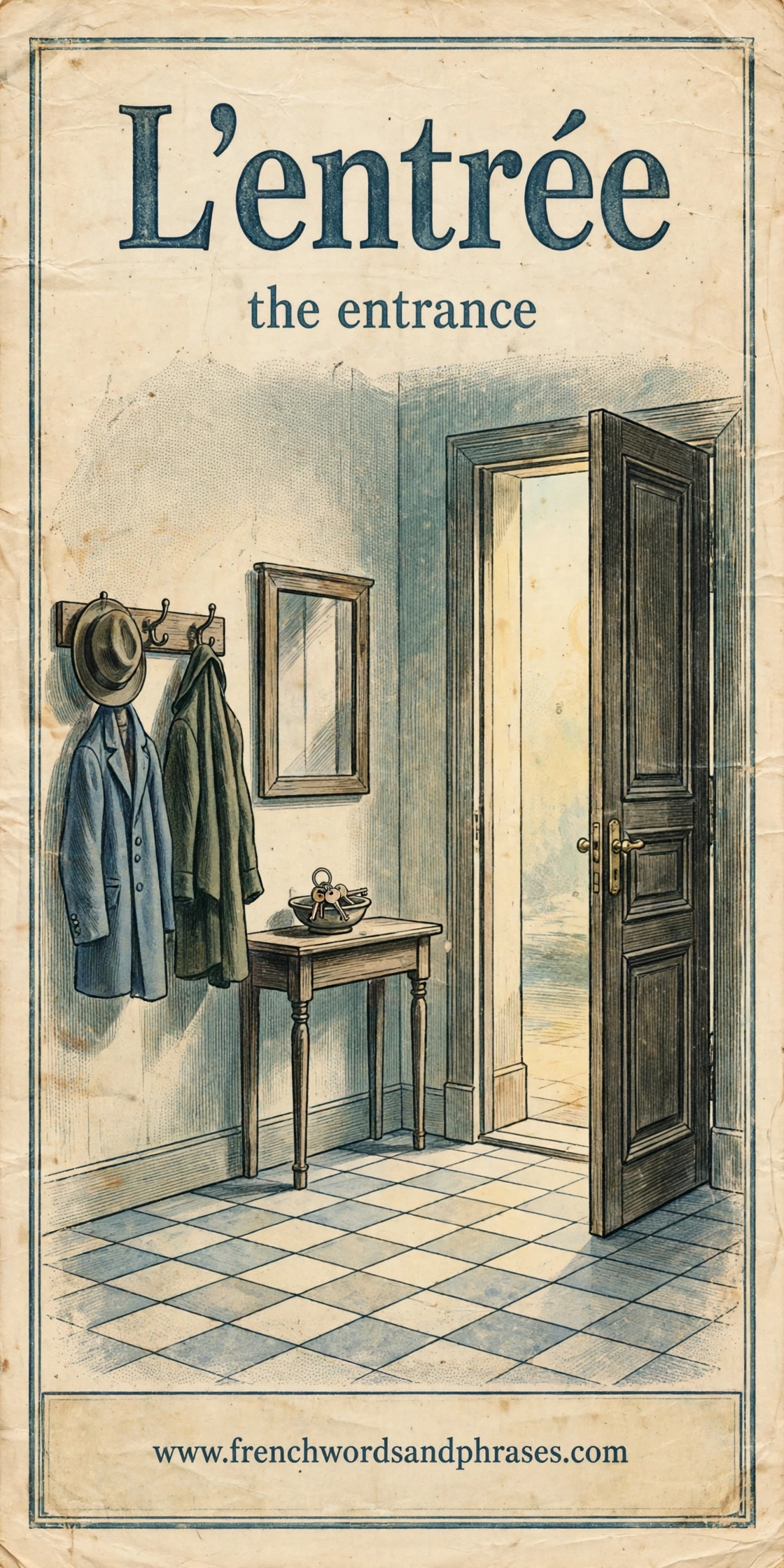
The key turns in the lock, the door swings open, shoes come off and coats land on the hooks. Before the living room, before the kitchen, every French home begins in the same small space — l’entrée.
In this guide, you’ll learn what entrée means in English, how to use it with its articles, how to form its plural, and how it appears in everyday French. Explore French examples, English translations, and practice quizzes.
Understanding the French Noun Entrée
Entrée is a feminine French noun. It is learned together with its article: l’entrée, une entrée. Because it begins with a vowel, the definite article shrinks to l’. The word comes from the verb entrer, to enter — it is the place of entering.
It means the entrance, the entrance hall — the first space of a house or flat, where you find le porte-manteau (the coat rack), un petit meuble (a small cabinet for keys and letters) and the shoes of the whole family. But the word has a second, delicious life: at the table, une entrée is the starter, the first course of the meal — the entrance of the dinner.
Gender: Feminine
Definite article: l’ — l’entrée (the entrance)
Indefinite article: une — une entrée (an entrance)
Plural: les entrées
English equivalents: The entrance, the hall; at a meal, a starter, a first course.
One important usage detail: the word works two shifts. At home, l’entrée is the hall; at the restaurant, en entrée introduces the first course — en entrée, je prends la soupe, as a starter, I’ll have the soup. You will also meet it on posters: entrée libre means free admission.
Experience the Word
Entrée is more than a corridor. It is the threshold of the home — the two square metres where the outside world is taken off, like a coat, and left at the door.
Imagine coming home in the rain: the umbrella dripping on the mat, the keys finding their hook, the smell of dinner already arriving from the kitchen. You are not inside yet, and you are already home.
You have not just crossed a doorway. You have made your entrée.
How to Use Entrée in French: Complete Guide
Let’s explore how entrée works in French, beginning with its articles.
Entrée with the Definite Article (L’, Les)
Entrée begins with a vowel, so le and la both shrink to l’ — l’entrée — while the plural is les entrées.
| Number | French |
|---|---|
| Singular | l’entrée |
| Plural | les entrées |
Example
L’entrée de la maison est peinte en bleu.
The entrance of the house is painted blue.
Entrée with the Indefinite Article (Une, Des)
Used for an entrance in general — the one in the advert, the one you wish were bigger.
| Number | French |
|---|---|
| Singular | une entrée |
| Plural | des entrées |
Example
C’est un petit appartement avec une entrée étroite.
It’s a small flat with a narrow entrance hall.
In the Entrée: the Hall at Home
Coats, keys and the little cabinet — the furniture of arriving home.
| French | In English |
|---|---|
| le porte-manteau | the coat rack |
| le petit meuble | the small cabinet |
| les clés | the keys |
| le tapis | the rug, the mat |
| accrocher son manteau | to hang up your coat |
| enlever ses chaussures | to take off your shoes |
Example
En rentrant, elle accroche son manteau dans l’entrée.
When she comes in, she hangs her coat up in the entrance hall.
Quick Quiz 1
What is le porte-manteau?
Reveal the answer
The coat rack — the hooks or stand in the entrée where coats are hung.
Le porte-manteau est juste derrière la porte.
The coat rack is just behind the door.
The Plural of Entrée
Entrée adds an -s in the plural — les entrées, the halls of many homes (or the starters of many dinners).
| Number | French |
|---|---|
| Singular | l’entrée |
| Plural | les entrées |
Example
Les entrées des immeubles parisiens ont souvent un grand miroir.
The entrance halls of Parisian buildings often have a big mirror.
Entrée with Possessive Adjectives (Mon, Ton, Son…)
A famous exception: entrée is feminine, but because it begins with a vowel it takes mon, ton, son — mon entrée, never « ma entrée ».
| Owner | French |
|---|---|
| my | mon entrée |
| your (tu) | ton entrée |
| his / her | son entrée |
| our | notre entrée |
| your (vous) | votre entrée |
| their | leur entrée |
Example
Mon entrée est trop petite pour un meuble.
My entrance hall is too small for a cabinet.
Quick Quiz 2
Complete the sentence:
Elle accroche son manteau dans ______ entrée.
Reveal the answer
son
Elle accroche son manteau dans son entrée.
She hangs her coat up in her entrance hall — son, not sa, because entrée begins with a vowel.
Entrée with Demonstrative Adjectives (Cette, Ces)
Used to point: this entrance here, those entrances there.
| Number | French |
|---|---|
| Singular | cette entrée |
| Plural | ces entrées |
Example
Cette entrée accueille les visiteurs avec des fleurs.
This entrance hall welcomes visitors with flowers.
Entrée with Adjectives
Adjectives agree with entrée, feminine — petite, étroite, accueillante.
| Adjective | With Entrée |
|---|---|
| petite (small) | une petite entrée |
| grande (big) | une grande entrée |
| étroite (narrow) | une entrée étroite |
| accueillante (welcoming) | une entrée accueillante |
| sombre (dark) | une entrée sombre |
Example
Une entrée accueillante donne le ton de la maison.
A welcoming entrance sets the tone of the house.
Quick Quiz 3
Complete the sentence:
C’est une entrée très ______. (welcoming)
Reveal the answer
accueillante
C’est une entrée très accueillante.
It’s a very welcoming entrance.
Everyday Expressions with Entrée
From the front door to the first course — the entrée phrases of the day.
| Expression | In English |
|---|---|
| en entrée | as a starter (at a meal) |
| entrée libre | free admission |
| l’entrée de la maison | the entrance of the house |
| faire son entrée | to make one’s entrance |
| entrée interdite | no entry |
| le prix d’entrée | the admission price |
Example
En entrée, je prends la salade de tomates.
As a starter, I’ll have the tomato salad.
Words from the Same Family as Entrée
Entering, doors and welcomes — the words that travel with entrée.
| French | In English |
|---|---|
| entrer | to enter |
| la porte | the door |
| la clé | the key |
| le manteau | the coat |
| la sortie | the exit |
| accueillir | to welcome |
Example
On entre par l’entrée et on sort par le jardin.
You come in through the entrance and go out through the garden.
Quick Quiz 4
At a restaurant, the waiter asks: « Et en entrée ? » What is he asking?
Reveal the answer
What you would like as a starter — at the table, une entrée is the first course of the meal.
En entrée, la soupe du jour, s’il vous plaît.
As a starter, the soup of the day, please.
Entrée in Everyday French: Real-Life Examples
Now that you know the word, let’s see how entrée appears in everyday French.
Example 1 — Coming home
En rentrant, il pose ses clés dans l’entrée.
When he comes in, he puts his keys down in the entrance hall.
Example 2 — Describing a flat
L’entrée donne directement sur le salon.
The entrance hall opens straight onto the living room.
Example 3 — At the restaurant
En entrée, nous prenons la soupe du jour.
As a starter, we’ll have the soup of the day.
Example 4 — At the museum
Aujourd’hui, l’entrée du musée est gratuite.
Today, admission to the museum is free.
Example 5 — Welcoming guests
Les invités laissent leurs manteaux dans l’entrée.
The guests leave their coats in the entrance hall.
Example 6 — House hunting
Je cherche un appartement avec une entrée plus grande.
I’m looking for a flat with a bigger entrance hall.
See l’entrée in a story: Around the House: French Vocabulary (Dans la Maison) — a visit to Camille’s house, room by room.
Beyond Translation: The Meaning of Entrée
Entrée is one of French’s great double words: the same syllables open a house and open a meal. The link is no accident — the starter is the meal’s front door, the first thing you cross before the plat arrives, and waiters have asked « Et en entrée ? » for as long as menus have existed.
To say entrée is to stand on the threshold — of a house, or of a meal.
It evokes the hooks by the door and the keys in their dish, the first small plate set down at a bistro table, the poster at the museum door — entrée libre — every beginning that French gathers into one word.
How to Remember the French Noun Entrée
Remember it this way: Entrée is the entrance — feminine with l’, the hall of the house and the starter of the meal.
- You come home — tu poses tes clés dans l’entrée.
- You dodge the exception — mon entrée, pas ma entrée, because of the vowel.
- You sit down to eat — en entrée, je prends la soupe.
The key idea is l’entrée opens the house — and the meal.
Test Your Knowledge of Entrée
Let’s see how much you’ve learned. Try answering these questions before revealing the answers.
Question 1
Is entrée masculine or feminine?
Reveal the answer
Feminine — but with l’: l’entrée, une entrée.
Question 2
Why do we say mon entrée and not ma entrée?
Reveal the answer
Because entrée begins with a vowel sound — feminine nouns starting with a vowel take mon, ton, son.
Question 3
Translate: As a starter, I have the soup.
Reveal the answer
En entrée, je prends la soupe.
Question 4
What does entrée libre mean?
Reveal the answer
Free admission — the words you hope to see on the museum poster.
Question 5
Complete the sentence:
______ entrée de la maison est en bois. (The)
Reveal the answer
L’
L’entrée de la maison est en bois.
The entrance of the house is made of wood.
Your Final Challenge
Can You Use It?
How would you say this in French?
“The guests hang their coats in the entrance hall.”
Reveal the answer
Les invités accrochent leurs manteaux dans l’entrée.
The guests hang their coats in the entrance hall.
A little French. A little curiosity. A richer everyday life.
LEARN FRENCH ONE WORD AT A TIME