A French Word to Live By
Translate C’est moi qui régale to English
/sɛ mwa ki ʁe.ɡal/
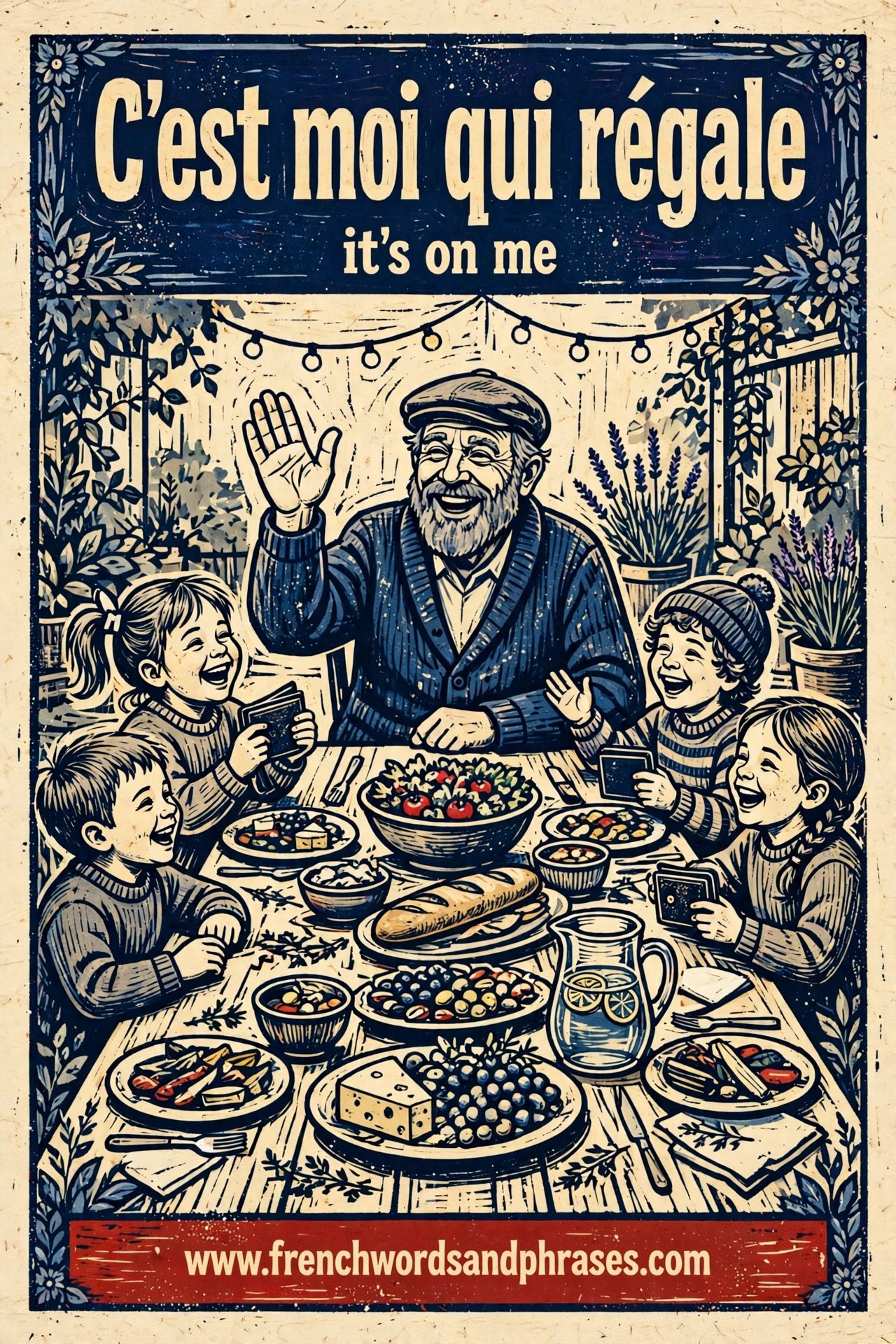
C’est moi qui régale means it’s on me — I’m paying (at a café or restaurant).
The lunch was perfect, the bill has just landed face-down on the table, and two hands are already diving for wallets. Yours is faster — you cover the bill with your palm, smile at your friend, and close the negotiation: « C’est moi qui régale. »
Let’s explore how c’est moi qui régale works in French, beginning with the whole phrase on one card.
Understanding the French Phrase C’est moi qui régale
C’est moi qui régale is a French treat-announcing phrase — the cleft structure c’est moi qui (it’s me who…) plus régaler, to treat someone to food and drink. The emphasis structure does the insisting: not you, not split — me.
It means it’s on me — I’m paying, at a café or restaurant. Régaler is warmer than payer: payer settles a bill, régaler gives a feast. The phrase carries generosity, not accounting — which is why it ends wallet arguments with a smile.
Type: Treat phrase — c’est moi qui + régaler (to treat someone to a meal)
Answers the need: Claiming the bill gracefully — and ending the wallet argument
Register: Warm, neutral-informal — among friends, family, colleagues
Strength: Generously firm — it is an announcement, not a suggestion
One important usage detail: the verb after qui agrees with the person named. C’est moi qui régale (moi = je, so régale, the je form); c’est nous qui régalons; c’est eux qui régalent. With -er verbs the je and il forms look alike, but with other verbs it shows: c’est moi qui ai payé, never ‘qui a payé’.
Experience the Word
C’est moi qui régale is the most elegant move in French social life — a whole negotiation about money, settled in five words and a smile.
Imagine your oldest friend, visiting from Lyon, reaching for the bill at the little bistro where you have celebrated everything for twenty years. You put your hand over it before she can even turn it over: « C’est moi qui régale. »
The phrase works because it is built like a spotlight: c’est moi qui — it’s me who. Generosity, in French, likes to announce exactly who is giving.
How to Use C’est moi qui régale in French: Complete Guide
Let’s explore how c’est moi qui régale works in French, beginning with the whole phrase on one card.
C’est moi qui régale at a Glance
The Whole Phrase on One Card
Real meaning, literal picture, English twin and register — c’est moi qui régale in five lines.
| Point | C’est moi qui régale |
|---|---|
| What it really means | it’s on me — I’m paying, my treat |
| Word for word | it’s me who treats (regales) |
| English equivalent | it’s on me / this one’s mine / my treat |
| Register | warm, friendly — cafés, restaurants, bars |
| Use it for | the moment the bill arrives, before anyone else pays |
Example
Non, non, c’est moi qui régale aujourd’hui.
No, no, it’s on me today.
Word by Word: Building the Phrase
Four pieces — a spotlight, a volunteer, a hinge, and a feast.
| Word | Literal meaning | Its job in the phrase |
|---|---|---|
| c’est | it’s | the spotlight switches on |
| moi | me | the stressed pronoun — the generous volunteer, underlined |
| qui | who | the hinge of the emphasis: it’s me WHO… |
| régale | treats / regales | régaler — to treat someone to food and drink |
Example
C’est moi qui régale, choisis ce que tu veux.
It’s on me, choose whatever you like.
Quick Quiz 1
Why does the phrase use moi and not je?
Reveal the answer
Because c’est… qui spotlights the person — after c’est, French uses the stressed pronoun: c’est moi, c’est toi, c’est lui. The verb then agrees with that person.
C’est toi qui régales ce soir ?
Is it your treat tonight?
When You Say It: The Bill Moments
C’est moi qui régale fires at moments like these — the bill lands, and you are faster than every other wallet.
| Situation | Example |
|---|---|
| The bill arrives | c’est moi qui régale, range ton portefeuille — it’s on me, put your wallet away |
| A friend grabs the bill first | trop tard pour toi, c’est moi qui régale ! — too late, it’s on me! |
| Celebrating good news | tu as eu le poste ? c’est moi qui régale ! — you got the job? This one’s on me! |
| Thanking someone for help | après tout ce que tu as fait, c’est moi qui régale — after all you’ve done, it’s on me |
| A birthday | c’est ton anniversaire, c’est moi qui régale — it’s your birthday, my treat |
Example
Assieds-toi, c’est moi qui régale, c’est la fête !
Sit down, it’s on me, we’re celebrating!
Make It Yours: Changing the Host
The spotlight swings to anyone — and the verb after qui swings with it.
| Form | French | In English |
|---|---|---|
| Asking the other | c’est toi qui régales ? | is it your treat? |
| He’s treating | c’est lui qui régale | it’s on him |
| We’re treating | c’est nous qui régalons | it’s on us |
| This time | cette fois, c’est moi qui régale | this time, it’s on me |
| Last time, past tense | hier, c’est moi qui ai régalé | yesterday, it was on me |
| Refusing a split | non, on ne partage pas, c’est moi qui régale | no, we’re not splitting, it’s on me |
Example
La dernière fois c’était toi, aujourd’hui c’est moi qui régale.
Last time it was you, today it’s on me.
Quick Quiz 2
How do you say “it’s on us”?
Reveal the answer
C’est nous qui régalons — the verb agrees with nous: régalons, not régale.
Ce soir, c’est nous qui régalons, les enfants !
Tonight it’s on us, kids!
Everyday Expressions: Building on the Phrase
C’est moi qui régale slots into these everyday frames — each one ready to end a wallet argument.
| Frame | In English |
|---|---|
| non non, c’est moi qui régale | no no, it’s on me (argument closed) |
| aujourd’hui, c’est moi qui régale | today, it’s on me |
| c’est moi qui régale, tu paieras la prochaine fois | it’s on me, you’ll pay next time |
| c’est moi qui régale, et c’est tout | it’s on me, and that’s that |
| allez, c’est moi qui régale ! | come on, it’s on me! |
Example
C’est moi qui régale, et je ne veux pas discuter !
It’s on me, and I won’t argue about it!
Close Cousins: The Other Ways to Pay
French generosity has several registers — c’est moi qui régale is the festive one; its cousins speak to waiters, rounds and plain facts.
| Expression | The difference |
|---|---|
| c’est moi qui régale | it’s on me — warm, festive, the treat announced |
| je t’invite | I’m treating you — the classic; in France ‘I invite you’ means I pay |
| c’est pour moi | this one’s on me — said to the waiter or barman, ordering the round |
| c’est ma tournée | it’s my round — drinks for the group, bar language |
| je paie | I’m paying — plain fact, no warmth, no feast |
| laissez, c’est pour moi | leave it, this one’s on me — said while reaching for the bill |
Example
Mettez tout sur ma note, c’est pour moi.
Put everything on my bill, it’s on me.
Quick Quiz 3
Your French friend says “je t’invite” for dinner. Who pays?
Reveal the answer
Your friend pays — in France, je t’invite at a restaurant means ‘you are my guest; it’s on me’, not a mere invitation to show up.
Je t’invite au restaurant samedi, c’est moi qui régale.
I’m taking you to a restaurant on Saturday, it’s on me.
C’est moi qui régale and Its Neighbours
The bill shelf around the phrase — from asking for the bill to splitting it.
| French | In English |
|---|---|
| l’addition, s’il vous plaît | the bill, please (the moment before) |
| c’est moi qui régale | it’s on me |
| à la vôtre ! | cheers! (glasses up) |
| merci, c’est très gentil | thank you, that’s very kind (the reply) |
| on partage ? | shall we split? (the opposite arrangement) |
| chacun paie sa part | everyone pays their share (the anti-treat) |
Example
L’addition ? Non — c’est moi qui régale, merci quand même.
The bill? No — it’s on me, thanks anyway.
Watch Out: The Traps Around C’est moi qui régale
The traps: a reflexive twin, a royal mirage, and a verb that must follow the spotlight.
| Trap | The truth |
|---|---|
| se régaler is a different animal | je me régale ! means I’m having a wonderful time (or: this food is delicious) — enjoying, not paying |
| régaler is not royal | régal looks like ‘royal’ but means a feast, a treat — un régal is a delight, not a crown |
| verb agreement after qui | the verb matches the named person: c’est moi qui ai payé, c’est nous qui payons |
| inviting means paying | je t’invite is a promise to pay — never say it if you expect to split |
| offering once is not enough | French politeness expects a small ritual protest — insist once, warmly, and the phrase does the insisting for you |
Example
Ce gâteau est un régal, je me régale !
This cake is a delight, I’m loving it!
Quick Quiz 4
Spot the mistake: “C’est moi qui a régalé hier.“
Reveal the answer
The verb must agree with moi (= je): c’est moi qui ai régalé. After c’est… qui, the verb follows the person named, not a default il.
C’est moi qui ai régalé hier, à toi aujourd’hui.
It was on me yesterday, your turn today.
C’est moi qui régale in Everyday French: Real-Life Examples
Now that you know the word, let’s see how c’est moi qui régale appears in everyday French.
Example Example 1 — At the bistro
C’est moi qui régale, c’est décidé.
It’s on me, it’s decided.
Example Example 2 — Stopping a friend
Range ta carte, c’est moi qui régale.
Put your card away, it’s on me.
Example Example 3 — Good news
Tu as réussi ton permis ? C’est moi qui régale !
You passed your driving test? It’s on me!
Example Example 4 — With parents
Papa, maman, ce soir c’est moi qui régale.
Dad, Mum, tonight it’s on me.
Example Example 5 — At the café counter
Deux cafés, et c’est moi qui régale.
Two coffees, and it’s on me.
Example Example 6 — Returning a favour
La semaine dernière c’était toi — aujourd’hui, c’est moi qui régale.
Last week it was you — today, it’s on me.
Beyond Translation: The Meaning of C’est moi qui régale
English puts the treat ‘on’ someone, like a weight kindly lifted. French stages it: c’est moi qui régale — a spotlight, a volunteer, a feast.
Régaler is not about money at all; it is about giving someone a moment of abundance.
That is why the phrase ends arguments so gracefully. You are not winning a contest about wallets — you are offering a small festival, and nobody argues with a festival.
How to Remember the French Phrase C’est moi qui régale
Remember it this way: Remember it this way: C’est moi qui régale puts you in the spotlight as the host of a tiny feast — moi does the volunteering, régale does the treating.
- You hear the spotlight — c’est moi qui, it’s ME who; the verb then agrees with moi.
- You separate the twins — régaler is to treat others; se régaler is to enjoy yourself.
- You remember je t’invite — in France, inviting means paying.
The key idea is c’est moi qui régale means it’s on me — a treat announced, with the verb agreeing with moi.
Test Your Knowledge of C’est moi qui régale
Let’s see how much you’ve learned. Try answering these questions before revealing the answers.
Question 1
What does c’est moi qui régale mean?
Reveal the answer
It’s on me — I’m paying (and treating you). Said at a café or restaurant when the bill comes.
Question 2
What does régaler literally evoke?
Reveal the answer
A treat, a feast — un régal is a delight. Régaler is warmer than payer: it gives a feast, not just settles a bill.
Question 3
How do you say ‘it’s on us’?
Reveal the answer
C’est nous qui régalons — after qui, the verb agrees with the person named: régalons for nous.
Question 4
Your friend says ‘je t’invite’ — who pays?
Reveal the answer
Your friend. In France je t’invite at a restaurant means you are the guest; the inviter pays.
Question 5
Complete the sentence:
C’est moi qui ______ payé hier. (It was me who paid yesterday.)
Reveal the answer
ai
C’est moi qui ai payé hier.
It was me who paid yesterday — the verb agrees with moi.
Your Final Challenge
Can You Use It?
How would you say this in French?
“How would you say this in French?”
Reveal the answer
Non, range ton argent — c’est moi qui régale !
No, put your money away — it’s on me!
A little French. A little curiosity. A richer everyday life.
LEARN FRENCH ONE WORD AT A TIME