
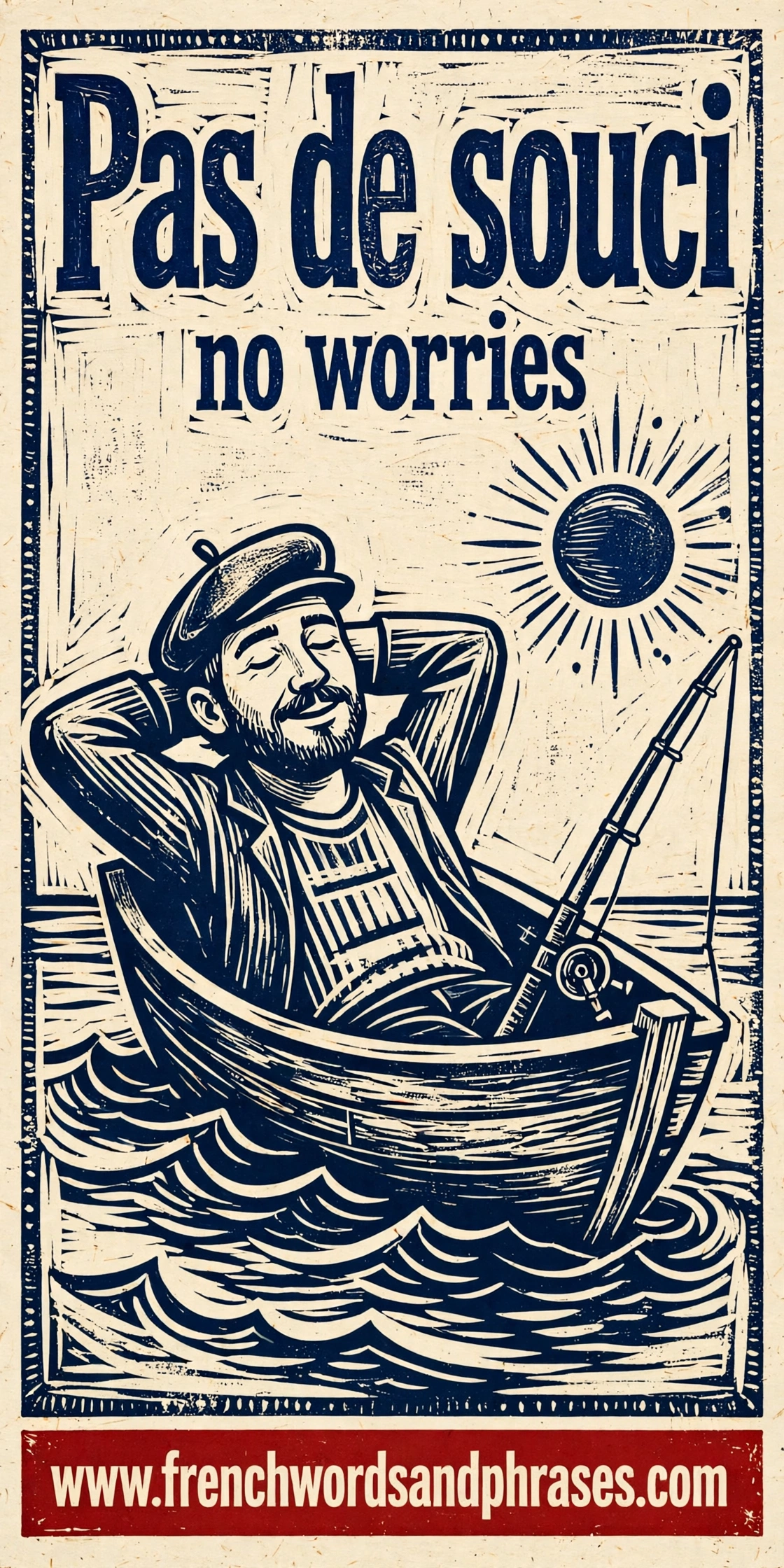
A French Word to Live By
Translate Pas de souci to English
/pa də su.si/
Pas de souci means no worries.
Your neighbour has watered your plants all week while you were away, and now you are thanking her for the third time in the doorway, still holding your suitcase. She waves every thanks away with the same two-handed smile: « Pas de souci ! » No worries — the favour has already vanished from her accounts.
Let’s explore how pas de souci works in French, beginning with the whole phrase on one card.
Understanding the French Phrase Pas de souci
Pas de souci is a French set reply phrase — a negation with no verb at all: pas de plus souci, a worry. It belongs to the family of pas de phrases (pas de problème, pas de temps) and lives its life as an answer: to thanks, to small apologies, to requests.
It means no worries, no problem at all — think nothing of it. A friend thanks you for a lift: pas de souci. A colleague apologises for a small delay: pas de souci. The phrase takes the debt or the guilt and cancels it on the spot.
Type: A set reply phrase — pas de plus a noun, with no verb at all
Answers the need: Brushing away thanks or a small apology — ‘think nothing of it’
Register: Friendly and informal-neutral — everywhere in daily life, a touch casual for grand occasions
Strength: Light and warm — it closes the subject with a smile
One important usage detail: pas de souci is an answer, not an opener. It replies to merci (for a favour), to pardon (for a small mishap) and to requests (tu peux m’aider ? — pas de souci). In very formal settings, French switches to the full courtesy: je vous en prie.
Experience the Word
Pas de souci is the sound of a favour being happily forgotten — the debt cancelled before it is even counted.
Imagine a baker who keeps your croissants aside every Saturday because you once mentioned them. You thank her like royalty; she shrugs: « Pas de souci. » That shrug is a whole philosophy.
It may be the most-used reply in modern French. Two words of negation that leave only goodwill standing.
How to Use Pas de souci in French: Complete Guide
Let’s explore how pas de souci works in French, beginning with the whole phrase on one card.
Pas de souci at a Glance
The Whole Phrase on One Card
Real meaning, literal build, English twin and register — pas de souci in five lines.
| Point | Pas de souci |
|---|---|
| What it really means | no worries — no problem at all, think nothing of it |
| Word for word | no worry |
| English equivalent | no worries / no problem / don’t mention it |
| Register | friendly, informal-neutral — everyday everywhere |
| Use it for | answering thanks, small apologies and requests |
Example
Merci pour ton aide ! — Pas de souci !
Thanks for your help! — No worries!
Word by Word: Building the Brush-Away
Three small pieces — and not one verb among them; the phrase is pure reply.
| Word | Literal meaning | Its job in the phrase |
|---|---|---|
| pas | no / not | the negation word, standing here without any verb |
| de | of | the shape the phrase takes before a noun — pas de plus a thing |
| souci | a worry, a care | the thing being waved away — there is none |
Example
Pas de souci, c’est avec plaisir.
No worries, it’s a pleasure.
Quick Quiz 1
What is un souci?
Reveal the answer
A worry, a care — pas de souci announces there is none: no worry at all.
Pas de souci, je m’en occupe.
No worries, I’ll take care of it.
When You Say It: The Thank-You Moments
Pas de souci fires at moments like these — someone thanks you or apologises, and you cancel the debt.
| Situation | Example |
|---|---|
| Thanks for a lift | merci pour le trajet ! — pas de souci ! — thanks for the ride! — no worries! |
| Thanks for watering plants | merci pour les plantes — pas de souci, avec plaisir — thanks for the plants — no worries, happy to |
| An apology for lateness | pardon pour le retard — pas de souci, on commence — sorry I’m late — no problem, let’s start |
| A request for help | tu peux m’aider ? — bien sûr, pas de souci — can you help me? — of course, no problem |
| Thanks at a shop counter | merci beaucoup ! — pas de souci, bonne journée ! — thank you! — no worries, have a good day! |
Example
Pas de souci, on se voit demain.
No worries, see you tomorrow.
Make It Yours: Variants and the Formal Switch
The phrase flexes — plural in the street, fuller for emphasis, and a formal costume for grand settings.
| Form | French | In English |
|---|---|---|
| The classic | pas de souci | no worries |
| The street variant | pas de soucis | no worries (with an s — widely heard) |
| Total emphasis | aucun souci | no worry whatsoever |
| With a promise | pas de souci, je m’en occupe | no worries, I’ll handle it |
| With a time gift | pas de souci, prends ton temps | no worries, take your time |
| The formal switch | je vous en prie | you’re welcome (formal — for grand settings) |
Example
Aucun souci, je serai là à huit heures.
No problem at all, I’ll be there at eight.
Quick Quiz 2
A friend thanks you warmly for a big favour. What is the natural two-word reply?
Reveal the answer
Pas de souci — it cancels the debt with a smile: think nothing of it.
Merci pour tout ! — Pas de souci !
Thanks for everything! — No worries!
Everyday Expressions: Building on the Phrase
Pas de souci slots into these everyday frames — each one ready to use as it stands.
| Frame | In English |
|---|---|
| pas de souci, avec plaisir | no worries, happy to help |
| pas de souci, c’est normal | no worries, it’s only natural |
| pas de souci pour le retard | no problem about the delay |
| pas de souci, on recommence | no worries, we’ll start again |
| pas de souci, ça arrive | no worries, these things happen |
Example
Pas de souci, c’est normal entre voisins.
No worries, it’s only natural between neighbours.
Close Cousins: The Other Polite Cancellations
French keeps several ways to cancel a debt — pas de souci is the friendly all-rounder; its cousins each specialise.
| Expression | The difference |
|---|---|
| pas de souci | no worries — answers thanks, apologies and requests alike |
| de rien | you’re welcome — the classic reply to thanks, a touch lighter |
| ce n’est pas grave | it’s no big deal — targets the mishap, not the thanks |
| il n’y a pas de problème | there’s no problem — the fuller version, a shade more formal |
| je vous en prie | you’re welcome — the formal costume, for vous and grand settings |
| avec plaisir | with pleasure — the warm upgrade, it says the favour was a joy |
Example
De rien — enfin, pas de souci !
You’re welcome — well, no worries!
Quick Quiz 3
Which cousin belongs at a formal ceremony — pas de souci or je vous en prie?
Reveal the answer
Je vous en prie — pas de souci is friendly and a touch casual; formal settings take the full courtesy.
Merci, monsieur le maire. — Je vous en prie.
Thank you, Mr Mayor. — You’re most welcome.
Pas de souci and Its Neighbours
The politeness shelf around the phrase — what it answers, and the replies that mean the opposite.
| French | In English |
|---|---|
| merci | thank you (what it answers) |
| pardon | sorry (the other thing it answers) |
| pas de souci | no worries (the cancellation) |
| volontiers | gladly (answering a request before it happens) |
| ça pose un problème | that IS a problem (the honest opposite) |
| ça ne va pas être possible | that won’t be possible (the polite refusal) |
Example
Merci ! — Pas de souci, volontiers.
Thank you! — No worries, gladly.
Watch Out: The Traps Around Pas de souci
The traps: a flower in disguise, a register ceiling, and using a reply as an opener.
| Trap | The truth |
|---|---|
| reading un bouquet de soucis as worries | un souci is also a marigold — a bouquet de soucis is a bunch of flowers, not anxieties |
| using it in very formal writing | it is a touch casual — formal letters take je vous en prie |
| opening with it | pas de souci answers something — thanks, an apology, a request; it does not start conversations |
| arguing over the s | pas de souci and pas de soucis both circulate — nobody will correct you either way |
| translating it as ‘no concern’ | English says no worries or no problem — ‘concern’ sounds like a board meeting |
Example
Pas de souci, et merci pour les soucis du jardin !
No worries, and thanks for the marigolds from the garden!
Quick Quiz 4
Your neighbour hands you un bouquet de soucis. What have you actually received?
Reveal the answer
A bunch of marigolds — souci is both a worry and a flower; in a bouquet, it is the flower.
Merci pour les soucis, ils sont magnifiques !
Thanks for the marigolds, they’re beautiful!
Pas de souci in Everyday French: Real-Life Examples
Now that you know the word, let’s see how pas de souci appears in everyday French.
Example Example 1 — A lift from a friend
Merci pour le trajet ! — Pas de souci !
Thanks for the ride! — No worries!
Example Example 2 — Watering the plants
Merci d’avoir arrosé mes plantes. — Pas de souci, avec plaisir.
Thanks for watering my plants. — No worries, happy to.
Example Example 3 — A late colleague
Pardon pour le retard. — Pas de souci, on commence.
Sorry for the delay. — No problem, let’s start.
Example Example 4 — Holding a door
Merci ! — Pas de souci.
Thank you! — No worries.
Example Example 5 — A borrowed charger
Tu me prêtes ton chargeur ? — Bien sûr, pas de souci.
Will you lend me your charger? — Of course, no problem.
Example Example 6 — At the bakery
Merci beaucoup, au revoir ! — Pas de souci, bonne journée !
Thank you very much, goodbye! — No worries, have a good day!
Beyond Translation: The Meaning of Pas de souci
Souci carries a double life. As a worry it descends from Latin sollicitus, restless and concerned; as a flower — the marigold — it comes from solsequium, the plant that follows the sun. Pas de souci keeps only the first life, and spends it generously.
To say pas de souci is to refuse payment for kindness.
That is why it has become the default reply of French daily life: it keeps favours light, apologies short, and friendships free of ledgers.
How to Remember the French Phrase Pas de souci
Remember it this way: Remember it this way: Pas de souci cancels the debt — pas de plus a worry that is simply not there.
- You picture the empty worry box — souci is a worry, and there is pas de, none of it.
- You use it as an answer — to merci, to pardon, to a request.
- You dress it up when needed — je vous en prie for formal ground.
The key idea is pas de souci means no worries — the friendly cancellation of thanks and apologies.
Test Your Knowledge of Pas de souci
Let’s see how much you’ve learned. Try answering these questions before revealing the answers.
Question 1
What does pas de souci mean?
Reveal the answer
No worries — no problem at all. It cancels thanks or a small apology on the spot.
Question 2
What does the word souci mean on its own?
Reveal the answer
A worry, a care — and, in a garden, a marigold.
Question 3
Name three things pas de souci can answer.
Reveal the answer
Thanks for a favour, a small apology, and a request for help — it is a reply phrase, not an opener.
Question 4
What is the formal alternative for grand settings?
Reveal the answer
Je vous en prie — the full-courtesy ‘you’re welcome’, where pas de souci would feel a touch casual.
Question 5
Complete the sentence:
— Merci pour ton aide ! — Pas de ______ ! (— Thanks for your help! — No worries!)
Reveal the answer
souci
Pas de souci !
No worries!
Your Final Challenge
Can You Use It?
How would you say this in French?
“How would you say this in French?”
Reveal the answer
Pas de souci, avec plaisir !
No worries, happy to help!
A little French. A little curiosity. A richer everyday life.
LEARN FRENCH ONE WORD AT A TIME




