A French Word to Live By
Translate Pas dans son assiette to English
/pa dɑ̃ sɔ̃.n‿a.sjɛt/
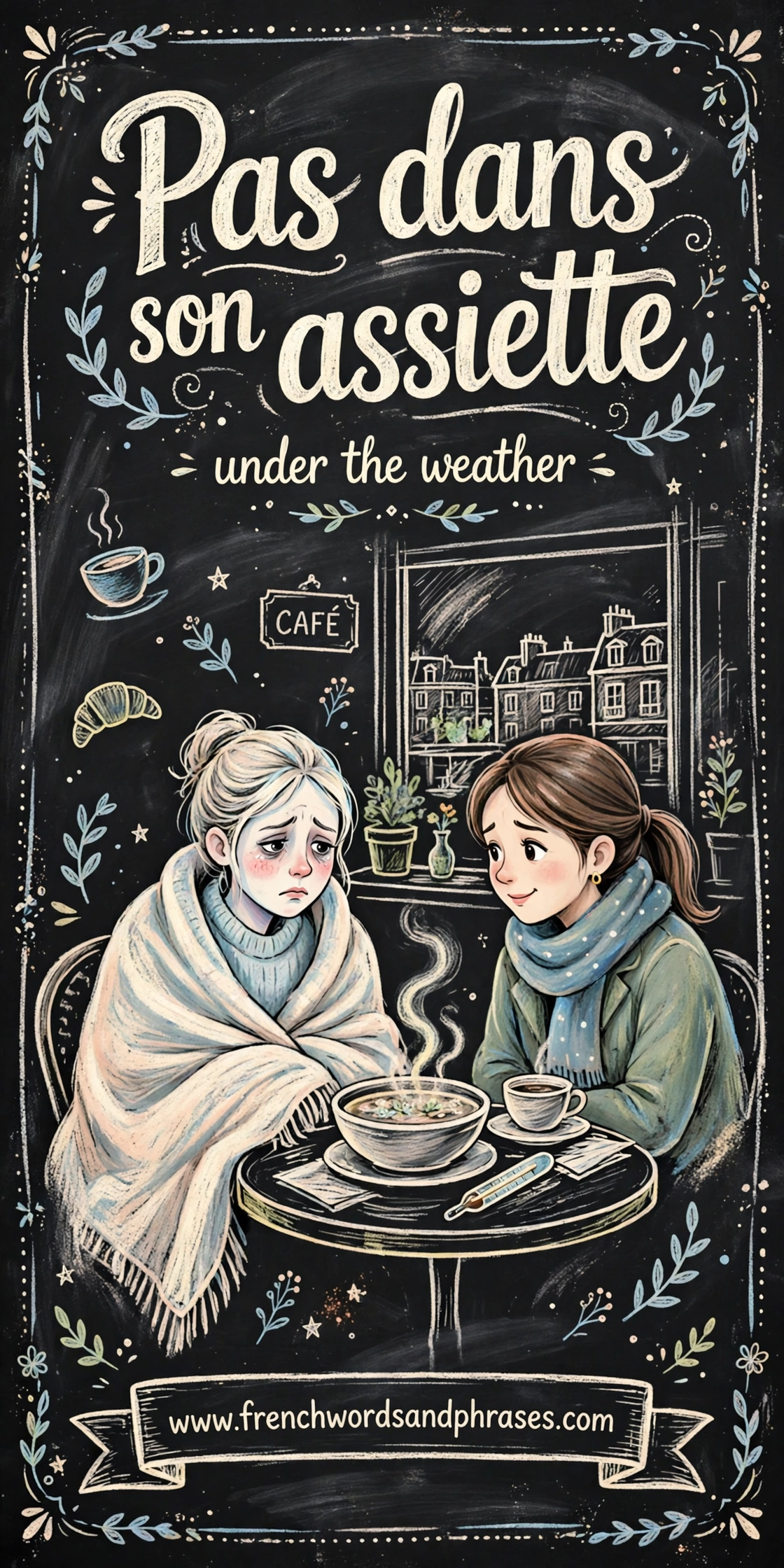
Pas dans son assiette means under the weather — not feeling well (full form: être pas dans son assiette).
Monday morning at the office, your colleague arrives pale and quiet, and picks at her croissant instead of eating it. She is not ill exactly — just not herself. The French diagnosis is gentle and precise: « Elle n’est pas dans son assiette. »
Let’s explore how pas dans son assiette works in French, beginning with the whole phrase on one card.
Understanding the French Phrase Pas dans son assiette
Pas dans son assiette is the heart of the French idiom être pas dans son assiette — to be ‘not in one’s assiette’. Assiette today means a plate, but the word first meant your seat, your base, your balance — and it is that older meaning the phrase keeps.
It means under the weather — not feeling well, or not quite yourself. Not seriously ill: just off-colour, tired, out of sorts. The picture is of a rider not settled in the saddle, of something not steady on its base — everything slightly out of place.
Type: Idiomatic expression — feeling unwell (être + assiette)
Answers the need: Saying someone is off-colour — gently, without alarming anyone
Register: Neutral to informal — kind, everyday French
Strength: Mild — a passing off-day, never a serious illness
One important usage detail: the possessive changes with the person. It is son assiette only for il or elle; for yourself it is mon assiette (je ne suis pas dans mon assiette), for tu it is ton assiette, for nous notre assiette, for vous votre assiette, and for ils or elles leur assiette. The plate, so to speak, belongs to whoever is unwell.
Experience the Word
Pas dans son assiette is the kindest diagnosis in French — it notices without dramatising.
Imagine a grandfather who always finishes his soup and asks for more, pushing his bowl away tonight and waving off dessert. Nobody calls the doctor. The family simply understands: il n’est pas dans son assiette.
French keeps a whole shelf of gentle phrases for grey days. This one says: something is off, and that is all we need to say.
How to Use Pas dans son assiette in French: Complete Guide
Let’s explore how pas dans son assiette works in French, beginning with the whole phrase on one card.
Pas dans son assiette at a Glance
The Whole Phrase on One Card
Real meaning, literal picture, English twin and register — pas dans son assiette in five lines.
| Point | Pas dans son assiette |
|---|---|
| What it really means | under the weather — not feeling well, not yourself |
| Word for word | not in his/her plate — but assiette first meant your seat, your base |
| English equivalent | under the weather / off-colour / out of sorts |
| Register | neutral to informal — gentle and everyday |
| Use it for | mild days: tired, queasy, low, not quite right |
Example
Elle n’est pas dans son assiette ce matin.
She’s under the weather this morning.
Word by Word: Building the Picture
Four small pieces — take them one by one and the older meaning of assiette does the work.
| Word | Literal meaning | Its job in the phrase |
|---|---|---|
| pas | not | the second half of the French negative (ne…pas) — it does the denying |
| dans | in | inside — the place where you are not settled |
| son | his / her / one’s | the possessive — it changes with the person: mon, ton, son, notre, votre, leur |
| assiette | plate — but first: your seat, your base | the old meaning is balance and position: to be out of your assiette is to be unsteady |
Example
Je ne suis pas dans mon assiette aujourd’hui.
I’m under the weather today.
Quick Quiz 1
What did assiette mean before it meant a plate?
Reveal the answer
Your seat, your base, your balance — the word named how a rider sits before it named what dinner is served on.
Il n’est pas dans son assiette depuis hier.
He’s been under the weather since yesterday.
When You Say It: The Off-Colour Moments
Pas dans son assiette fires at moments like these — a grey day, noticed kindly.
| Situation | Example |
|---|---|
| At work | elle n’est pas dans son assiette, elle est toute pâle — she’s under the weather, she’s ever so pale |
| About a child | le petit n’est pas dans son assiette, il n’a rien mangé — the little one is off-colour, he hasn’t eaten a thing |
| Explaining yourself | excuse-moi, je ne suis pas dans mon assiette — sorry, I’m not feeling myself |
| After a journey | il n’est pas dans son assiette depuis le retour — he’s been out of sorts since getting back |
| Checking on a friend | tu n’as pas l’air d’être dans ton assiette — you don’t seem yourself |
Example
Tu n’es pas dans ton assiette ? Tu es tout silencieux.
Are you not feeling well? You’re ever so quiet.
Make It Yours: A Plate for Every Person
Être conjugates, and the possessive travels with the person — this phrase has a form for everyone.
| Person | French | In English |
|---|---|---|
| I (je) | je ne suis pas dans mon assiette | I’m under the weather |
| You (tu) | tu n’es pas dans ton assiette | you’re under the weather |
| He / she | il / elle n’est pas dans son assiette | he’s / she’s under the weather |
| We (nous) | nous ne sommes pas dans notre assiette | we’re under the weather |
| You (vous) | vous n’êtes pas dans votre assiette | you’re under the weather |
| They (ils / elles) | ils / elles ne sont pas dans leur assiette | they’re under the weather |
Example
Nous ne sommes pas dans notre assiette après ce long voyage.
We’re all out of sorts after that long journey.
Quick Quiz 2
Say it about yourself: “I am under the weather.”
Reveal the answer
Je ne suis pas dans mon assiette — the possessive is mon, because the plate is yours.
Je ne suis pas dans mon assiette, je vais me coucher.
I’m under the weather, I’m going to bed.
Everyday Expressions: Building on the Phrase
Pas dans son assiette slots into these everyday frames — each one ready to use as it stands.
| Frame | In English |
|---|---|
| il n’est pas dans son assiette depuis lundi | he’s been under the weather since Monday |
| elle a l’air de ne pas être dans son assiette | she looks under the weather |
| il n’est vraiment pas dans son assiette | he’s really not himself |
| tu n’es pas dans ton assiette, toi, aujourd’hui ? | you’re not yourself today, are you? |
| pas dans mon assiette, je me couche tôt | not feeling great, I’m off to bed early |
Example
Depuis lundi, il n’est pas dans son assiette.
He’s been under the weather since Monday.
Close Cousins: The Other Ways to Feel Off
French has a whole shelf of off-day phrases — pas dans son assiette is the balanced classic; its cousins differ in colour and weight.
| Expression | The difference |
|---|---|
| ne pas être dans son assiette | under the weather — the classic, gentle and balanced |
| être patraque | off-colour — informal, a bit comic; grandmothers love it |
| ne pas être en forme | not in form — plain and neutral, about energy more than health |
| être mal fichu | feeling rough — informal, stronger than patraque |
| avoir un coup de barre | a sudden slump — a wave of tiredness, not a whole off-day |
Example
Après le repas, il a eu un petit coup de barre.
After the meal, he had a little slump.
Quick Quiz 3
Which cousin is a sudden wave of tiredness, not an off-day — être patraque or avoir un coup de barre?
Reveal the answer
Avoir un coup de barre — the slump arrives suddenly, like a blow from a bar.
Après le déjeuner, coup de barre général au bureau.
After lunch, a general slump in the office.
Pas dans son assiette and Its Neighbours
The wellbeing shelf around the phrase, from bursting with energy to genuinely ill.
| French | In English |
|---|---|
| péter la forme | bursting with energy — very informal, the opposite with fireworks |
| être en pleine forme | in great shape — the true opposite |
| se sentir bien | to feel well |
| pas dans son assiette | under the weather |
| être fatigué | to be tired — one symptom, plainly stated |
| être malade | to be ill — stronger, a real illness |
Example
Hier patraque, aujourd’hui en pleine forme !
Yesterday off-colour, today in great shape!
Watch Out: The Traps Around Pas dans son assiette
The traps: dropping être, freezing the possessive, and alarming people with a mild phrase.
| Trap | The truth |
|---|---|
| dropping être | the phrase cannot stand alone — it needs être in front: il est, elle n’est pas… |
| keeping son for everyone | the possessive follows the person — mon assiette for je, ton for tu, leur for ils |
| the dinner-plate trap | it is not about food or appetite, though a lost appetite is often the clue |
| strength | it is mild — for a real illness say être malade; pas dans son assiette never sounds an alarm |
Example
Non, pas malade — juste pas dans son assiette.
No, not ill — just under the weather.
Quick Quiz 4
Spot the mistake: “Je ne suis pas dans son assiette.“
Reveal the answer
Son should be mon — the possessive belongs to the person who is unwell.
Je ne suis pas dans mon assiette ce soir.
I’m not feeling myself tonight.
Pas dans son assiette in Everyday French: Real-Life Examples
Now that you know the word, let’s see how pas dans son assiette appears in everyday French.
Example Example 1 — An office colleague
Elle n’est pas dans son assiette, elle va rentrer tôt.
She’s under the weather, she’s going home early.
Example Example 2 — A child at breakfast
Le petit n’est pas dans son assiette, il n’a pas touché son petit déjeuner.
The little one is off-colour, he hasn’t touched his breakfast.
Example Example 3 — Excusing yourself
Pardon, je ne suis pas dans mon assiette aujourd’hui.
Sorry, I’m not feeling myself today.
Example Example 4 — Grandfather at dinner
Papy n’est pas dans son assiette, il n’a pas pris de dessert.
Grandad is under the weather, he didn’t have any dessert.
Example Example 5 — After a flight
Nous ne sommes pas dans notre assiette après ce vol de nuit.
We’re all out of sorts after that night flight.
Example Example 6 — A friend on the phone
Tu n’as pas l’air d’être dans ton assiette, tu veux que je passe ?
You don’t sound yourself, do you want me to come over?
Beyond Translation: The Meaning of Pas dans son assiette
Assiette lived two lives: first the rider’s seat — l’assiette du cavalier, how steadily a horseman sits — then the plate on the table. The idiom kept the first life. To be out of your assiette is to be unseated, unsteady, not balanced on your base.
To say pas dans son assiette is to check someone’s balance, not their temperature.
English goes to sea for the same feeling — under the weather. French goes to the saddle. Both languages agree it deserves a picture, not a diagnosis.
How to Remember the French Phrase Pas dans son assiette
Remember it this way: Remember it this way: Pas dans son assiette is the unsteady rider — off balance, off-colour, off for the day.
- You picture the saddle — assiette first meant your seat and your balance, long before it meant a plate.
- You move the possessive with the person — mon, ton, son, notre, votre, leur assiette.
- You keep it mild — for a real illness, the word is malade, not assiette.
The key idea is être pas dans son assiette means to be under the weather — and the possessive changes with the person.
Test Your Knowledge of Pas dans son assiette
Let’s see how much you’ve learned. Try answering these questions before revealing the answers.
Question 1
What does être pas dans son assiette mean?
Reveal the answer
To be under the weather — not feeling well, not quite yourself, without being seriously ill.
Question 2
What did assiette mean before it meant a plate?
Reveal the answer
Your seat, your base, your balance — as in the seat of a rider on a horse.
Question 3
How do you say ‘I am under the weather’?
Reveal the answer
Je ne suis pas dans mon assiette — with mon, because the possessive follows the person.
Question 4
Complete the sentence:
Ils ne sont pas dans ______ assiette. (They are under the weather.)
Reveal the answer
leur
Ils ne sont pas dans leur assiette.
They are under the weather.
Question 5
Is pas dans son assiette the phrase for a serious illness?
Reveal the answer
No — it is mild: an off-day. For a real illness, French says être malade.
Your Final Challenge
Can You Use It?
How would you say this in French?
“How would you say this in French?”
Reveal the answer
Elle n’est pas dans son assiette aujourd’hui.
She’s under the weather today.
A little French. A little curiosity. A richer everyday life.
LEARN FRENCH ONE WORD AT A TIME