A French Word to Live By
How to Conjugate Embellir in French
/ɑ̃.bɛ.liʁ/
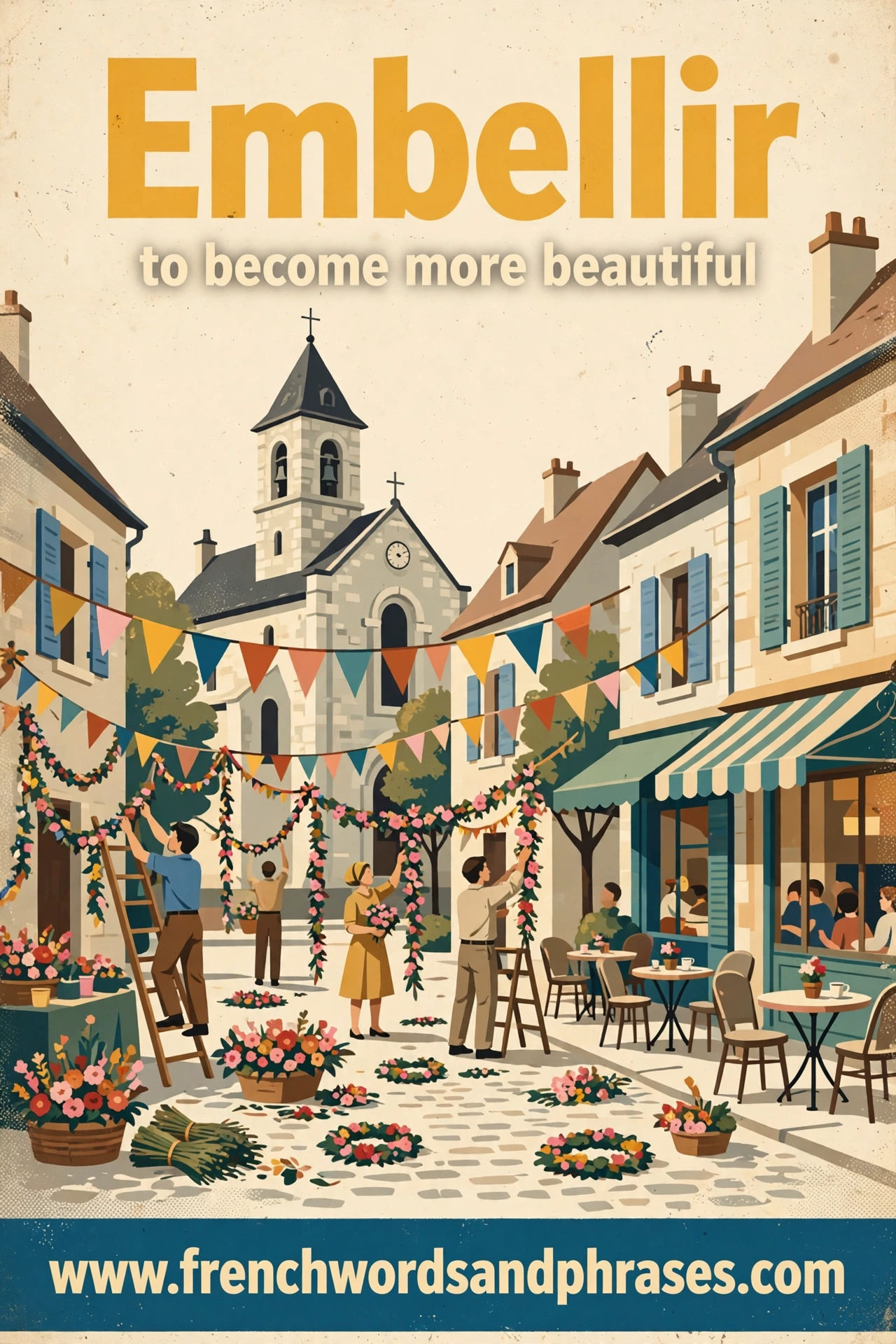
Embellir means to become more beautiful, or to make more beautiful.
A fresh coat of paint on an old house, a garden in May, a face after a happy summer — embellir is what happens when something becomes more beautiful, or when someone makes it so.
In this guide, you’ll learn how to conjugate embellir in all the major French tenses and moods. Explore complete conjugation tables, French examples, English translations, and practice quizzes.
Understanding the French Verb Embellir
Embellir is a regular French verb belonging to the second group of verbs, those ending in -ir.
It means to become more beautiful, or to make more beautiful. It is used for people who grow prettier, for houses, gardens and towns improved by care, and — with a smile — for stories that someone has ‘improved’ a little beyond the truth.
Verb classification: Second group (-ir)
Auxiliary verb: Avoir or être, depending on the construction
Past participle: embelli
Present participle: embellissant
English equivalents: To become more beautiful, to make more beautiful.
One important detail: embellir is a regular second-group -ir verb, and its auxiliary depends on how it is used. Used transitively — making something more beautiful — it always takes avoir: ce maquillage l’a embellie (this make-up made her prettier). Used intransitively, for the change itself, it also takes avoir: elle a beaucoup embelli en peu de temps (she has become much prettier in a short time). Être appears only to describe the resulting state, almost like an adjective: cette jeune fille est bien embellie. The tables on this page use avoir.
Experience the Word
Embellir is beauty in motion — not beauty that simply exists, but beauty that is arriving, day by day.
Imagine a neglected garden behind an old house. Someone clears the paths, plants roses along the wall, and paints the shutters blue. By June, neighbours slow down as they pass, just to look.
The garden was always there. Care has made it beautiful.
How to Conjugate Embellir: Complete French Conjugation Guide
Let’s explore every major conjugation of embellir, beginning with the indicative mood.
How to Conjugate Embellir in the Indicative Mood
The indicative mood is used to express facts, observations, actions, and events.
How to Conjugate Embellir in the Present Tense (Présent)
Used for actions happening now, habitual actions, and general truths.
| Subject | Conjugation |
|---|---|
| je | embellis |
| tu | embellis |
| il / elle | embellit |
| nous | embellissons |
| vous | embellissez |
| ils / elles | embellissent |
Example
Notre village embellit chaque année.
Our village grows more beautiful every year.
Quick Quiz 1
Complete the sentence:
Nous ______ le jardin pour la fête.
Reveal the answer
embellissons
Nous embellissons le jardin pour la fête.
We are making the garden prettier for the party.
How to Conjugate Embellir in the Passé Composé
Used for completed actions in the past. Embellir takes the auxiliary verb avoir or être, depending on the construction.
| Subject | Conjugation |
|---|---|
| j’ | ai embelli |
| tu | as embelli |
| il / elle | a embelli |
| nous | avons embelli |
| vous | avez embelli |
| ils / elles | ont embelli |
Example
Elle a beaucoup embelli pendant les vacances.
She became much prettier during the holidays.
How to Conjugate Embellir in the Imparfait (Imperfect Tense)
Used for habitual past actions, descriptions, and ongoing situations in the past.
| Subject | Conjugation |
|---|---|
| je | embellissais |
| tu | embellissais |
| il / elle | embellissait |
| nous | embellissions |
| vous | embellissiez |
| ils / elles | embellissaient |
Example
Le quartier embellissait peu à peu.
The neighbourhood was gradually becoming more beautiful.
Quick Quiz 2
Choose the correct form:
She has become much prettier in a year.
Elle ______ beaucoup en un an. (a embelli / est embellie)
Reveal the answer
a embelli
Elle a beaucoup embelli en un an.
The change itself takes avoir; est embellie would describe the resulting state.
How to Conjugate Embellir in the Plus-que-parfait
Used to describe an action that had already been completed before another past event.
| Subject | Conjugation |
|---|---|
| j’ | avais embelli |
| tu | avais embelli |
| il / elle | avait embelli |
| nous | avions embelli |
| vous | aviez embelli |
| ils / elles | avaient embelli |
Example
La ville avait embelli grâce aux travaux.
The town had become more beautiful thanks to the works.
How to Conjugate Embellir in the Passé Simple
Primarily used in formal writing, literature, and historical narratives. It is rarely used in everyday conversation.
| Subject | Conjugation |
|---|---|
| je | embellis |
| tu | embellis |
| il / elle | embellit |
| nous | embellîmes |
| vous | embellîtes |
| ils / elles | embellirent |
Example
Le parc embellit sous les soins du nouveau jardinier.
The park grew more beautiful under the new gardener’s care.
How to Conjugate Embellir in the Passé Antérieur
A literary tense used to express an action completed immediately before another past action, generally in the passé simple.
| Subject | Conjugation |
|---|---|
| j’ | eus embelli |
| tu | eus embelli |
| il / elle | eut embelli |
| nous | eûmes embelli |
| vous | eûtes embelli |
| ils / elles | eurent embelli |
Example
Dès que la place eut embelli, les cafés ouvrirent leurs terrasses.
As soon as the square had become more beautiful, the cafés opened their terraces.
How to Conjugate Embellir in the Future Tense (Futur Simple)
Used to describe actions that will take place in the future.
| Subject | Conjugation |
|---|---|
| je | embellirai |
| tu | embelliras |
| il / elle | embellira |
| nous | embellirons |
| vous | embellirez |
| ils / elles | embelliront |
Example
Ce quartier embellira encore.
This neighbourhood will become more beautiful still.
How to Conjugate Embellir in the Futur Antérieur (Future Perfect)
Used for an action that will have been completed before a particular point in the future.
| Subject | Conjugation |
|---|---|
| j’ | aurai embelli |
| tu | auras embelli |
| il / elle | aura embelli |
| nous | aurons embelli |
| vous | aurez embelli |
| ils / elles | auront embelli |
Example
À la fin des travaux, la maison aura embelli.
By the end of the works, the house will have become more beautiful.
How to Conjugate Embellir in the Near Future (Futur Proche)
Used to describe something that is going to happen soon. Formed with aller + infinitive.
| Subject | Conjugation |
|---|---|
| je | vais embellir |
| tu | vas embellir |
| il / elle | va embellir |
| nous | allons embellir |
| vous | allez embellir |
| ils / elles | vont embellir |
Example
Tu vas embellir avec cette nouvelle coupe.
You are going to look prettier with this new haircut.
How to Conjugate Embellir in the Conditional Mood
The conditional mood expresses what would happen under certain circumstances. It is also frequently used to make polite requests or express wishes.
How to Conjugate Embellir in the Present Conditional
| Subject | Conjugation |
|---|---|
| je | embellirais |
| tu | embellirais |
| il / elle | embellirait |
| nous | embellirions |
| vous | embelliriez |
| ils / elles | embelliraient |
Example
La façade embellirait avec des fleurs.
The façade would look prettier with flowers.
How to Conjugate Embellir in the Past Conditional
| Subject | Conjugation |
|---|---|
| j’ | aurais embelli |
| tu | aurais embelli |
| il / elle | aurait embelli |
| nous | aurions embelli |
| vous | auriez embelli |
| ils / elles | auraient embelli |
Example
Le jardin aurait embelli avec plus d’eau.
The garden would have grown more beautiful with more water.
Embellir in the Literary Past Conditional Form
This less common literary form uses the imperfect subjunctive of avoir or être, depending on the construction.
| Subject | Conjugation |
|---|---|
| j’ | eusse embelli |
| tu | eusses embelli |
| il / elle | eût embelli |
| nous | eussions embelli |
| vous | eussiez embelli |
| ils / elles | eussent embelli |
Example
Elle eût embelli encore si elle avait été heureuse.
She would have grown prettier still if she had been happy.
How to Conjugate Embellir in the Subjunctive Mood
The subjunctive is used to express wishes, emotions, doubts, necessity, and uncertainty. It frequently follows expressions such as il faut que (it is necessary that) or bien que (although).
How to Conjugate Embellir in the Present Subjunctive
| Subject | Conjugation |
|---|---|
| que je | embellisse |
| que tu | embellisses |
| qu’il / qu’elle | embellisse |
| que nous | embellissions |
| que vous | embellissiez |
| qu’ils / qu’elles | embellissent |
Example
Il faut que ce quartier embellisse.
This neighbourhood needs to become more beautiful.
Quick Quiz 3
Complete the sentence using the subjunctive:
Il faut que la ville ______ ses quais.
Reveal the answer
embellisse
Il faut que la ville embellisse ses quais.
The town needs to make its quays more beautiful.
How to Conjugate Embellir in the Imperfect Subjunctive
A literary tense, rarely encountered in modern spoken French.
| Subject | Conjugation |
|---|---|
| que je | embellisse |
| que tu | embellisses |
| qu’il / qu’elle | embellît |
| que nous | embellissions |
| que vous | embellissiez |
| qu’ils / qu’elles | embellissent |
Example
On ne pensait pas qu’elle embellît si vite.
Nobody thought she would become prettier so quickly.
How to Conjugate Embellir in the Pluperfect Subjunctive
A literary construction used to express an action completed before another past action.
| Subject | Conjugation |
|---|---|
| que j’ | eusse embelli |
| que tu | eusses embelli |
| qu’il / qu’elle | eût embelli |
| que nous | eussions embelli |
| que vous | eussiez embelli |
| qu’ils / qu’elles | eussent embelli |
Example
Il doutait que la maison eût embelli en si peu de temps.
He doubted that the house had become more beautiful in so little time.
How to Conjugate Embellir in the Past Subjunctive
| Subject | Conjugation |
|---|---|
| que j’ | aie embelli |
| que tu | aies embelli |
| qu’il / qu’elle | ait embelli |
| que nous | ayons embelli |
| que vous | ayez embelli |
| qu’ils / qu’elles | aient embelli |
Example
Je suis ravi que le village ait embelli.
I am delighted that the village has become more beautiful.
How to Conjugate Embellir in the Imperative
The imperative is used to give commands, instructions, invitations, or suggestions. Subject pronouns are omitted.
How to Conjugate Embellir in the Present Imperative
| Person | Conjugation |
|---|---|
| (tu) | embellis |
| (nous) | embellissons |
| (vous) | embellissez |
Example
Embellis ta chambre avec des plantes !
Make your room prettier with some plants!
Quick Quiz 4
How would you say Let’s make the garden prettier! in French?
Reveal the answer
Embellissons le jardin !
French Participles of Embellir
Participles are verb forms that can be used in compound tenses and other grammatical constructions.
Present Participle of Embellir
embellissant
En embellissant la place, la mairie a attiré les visiteurs.
By making the square more beautiful, the town hall attracted visitors.
Past Participle of Embellir
embelli
Cette jeune fille est bien embellie.
That young girl has really blossomed.
Embellir in Everyday French: Real-Life Examples
Now that you know the conjugations, let’s see how embellir appears in everyday French.
Example 1 — Present
Elle embellit de jour en jour.
She grows prettier day by day.
Example 2 — Passé composé — avoir
Il a embelli depuis l’été dernier.
He has become better-looking since last summer.
Example 3 — Passé composé — être
Elle est bien embellie cette année.
She has really blossomed this year.
Example 4 — Imparfait
La maison embellissait grâce au jardin.
The house was growing prettier thanks to the garden.
Example 5 — Future
Ces travaux embelliront la ville.
These works will make the town more beautiful.
Example 6 — Conditional
Un peu de couleur embellirait la cuisine.
A little colour would make the kitchen prettier.
Beyond Translation: The Meaning of Embellir
English says become prettier or make more beautiful. French embellir refuses to separate the two: the same verb makes the garden beautiful and lets the garden become beautiful.
Change with avoir, state with être.
Watch the change happen and French uses avoir — elle a embelli. Admire the finished picture and être appears — elle est bien embellie, like an adjective pinned to the result.
How to Remember the French Verb Embellir
Remember it this way: Embellir is about becoming more beautiful — avoir for the change, être for the resulting state.
- You watch someone change over a summer — elle a embelli: the transformation takes avoir.
- You admire the result — elle est bien embellie: être presents the state, like an adjective.
- Making something beautiful is always avoir — tu as embelli la chambre.
The key idea is becoming more beautiful — avoir for the change, être for the resulting state.
Test Your Knowledge of Embellir
Let’s see how much you’ve learned. Try answering these questions before revealing the answers.
Question 1
When does embellir take avoir, and when does être appear?
Reveal the answer
Avoir for the change and for making something beautiful — elle a embelli, tu as embelli la chambre. Être only describes the resulting state, like an adjective — elle est bien embellie.
Question 2
How do you say the town will become more beautiful in French?
Reveal the answer
La ville embellira.
Question 3
Translate: She has become much prettier this year.
Reveal the answer
Elle a beaucoup embelli cette année.
Question 4
What is the past participle of embellir?
Reveal the answer
Embelli.
Question 5
Complete the sentence:
Si tu souriais plus, tu ______.
Reveal the answer
embellirais
Si tu souriais plus, tu embellirais.
If you smiled more, you would look prettier.
Your Final Challenge
Can You Use It?
How would you say this in French?
With a few flowers, you made the whole house more beautiful.
Reveal the answer
Avec quelques fleurs, tu as embelli toute la maison.
With a few flowers, you made the whole house more beautiful.
A little French. A little curiosity. A richer everyday life.
LEARN FRENCH ONE WORD AT A TIME