
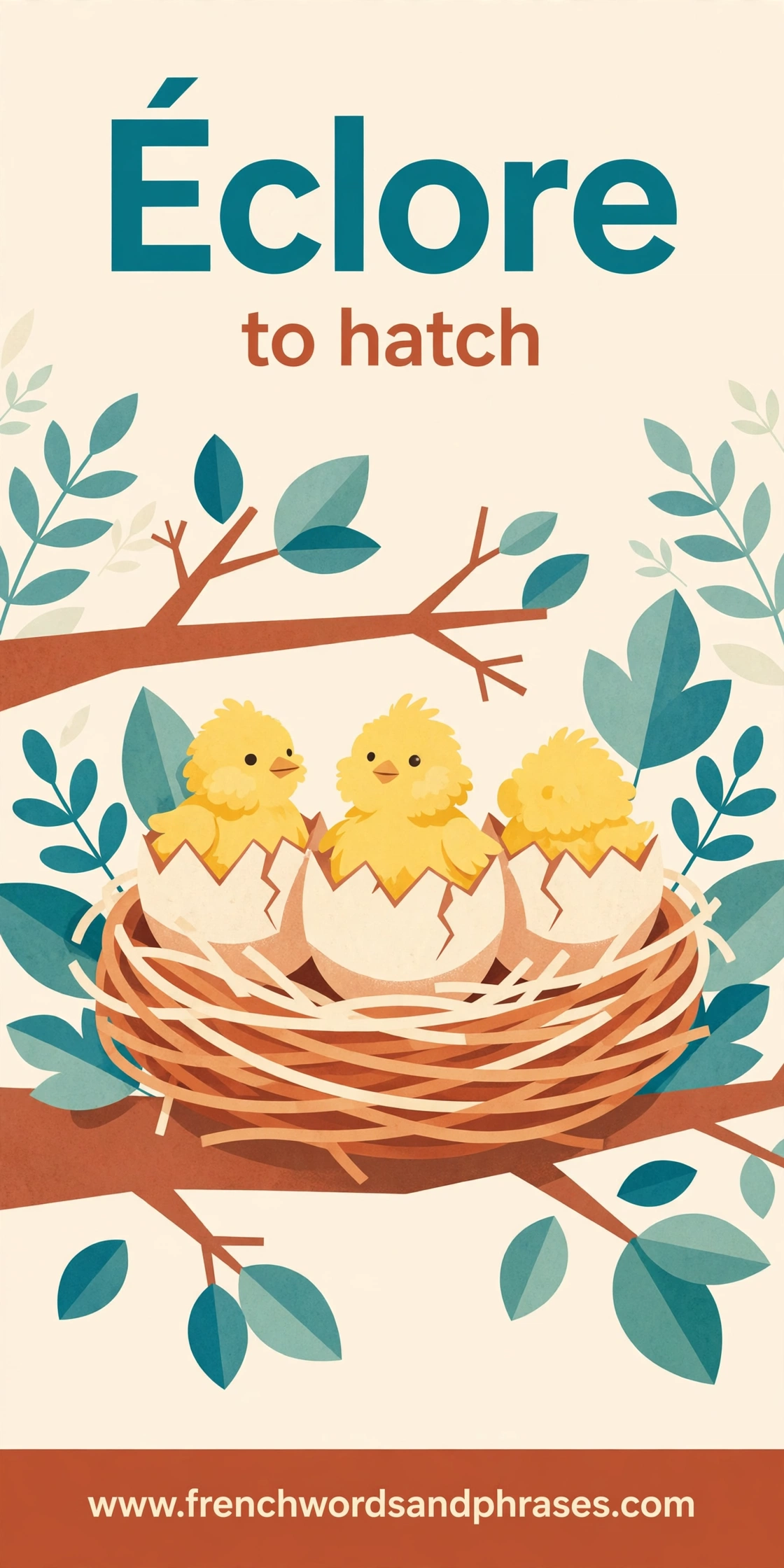
A French Word to Live By
How to Conjugate Éclore in French
/e.klɔʁ/
Éclore means to hatch, or to open (of a flower).
In a warm nest, a shell cracks. In a spring garden, a bud unfolds overnight. Éclore is the quiet verb of things that come out into the world by opening — eggs, cocoons and flowers.
In this guide, you’ll learn how to conjugate éclore in all the major French tenses and moods. Explore complete conjugation tables, French examples, English translations, and practice quizzes.
Understanding the French Verb Éclore
Éclore is an irregular, defective French verb belonging to the third group of verbs, those ending in -re.
It means to hatch, or to open (of a flower). Because only eggs, cocoons, buds and flowers can hatch or open, éclore is used almost only in the third person. Where a missing tense is needed, French often borrows a paraphrase such as faire éclosion, or simply chooses another verb.
Verb classification: Third group (irregular -re verb)
Auxiliary verb: Être or avoir, depending on the construction
Past participle: éclos
Present participle: éclosant
English equivalents: To hatch, to open (of flowers), to bloom.
One important detail: éclore is a defective verb — most of its forms simply do not exist. It lives almost entirely in the third person, because eggs and flowers do the hatching: il éclot, ils éclosent. It has no passé simple, no imperfect subjunctive and no imperative, and the dashes in the tables are honest gaps, not mistakes. Its compound tenses are built with être — les œufs sont éclos — though avoir appears when the action itself is stressed: les œufs ont éclos pendant la nuit.
Experience the Word
Éclore is the verb of the crack in the shell — the first small sound of a life arriving.
Imagine a henhouse at dawn. Twenty eggs have sat warm and silent for three weeks. This morning, one of them rocks, then cracks, and a wet, astonished chick pushes its way out.
Nothing forced the shell. It opened from the inside.
How to Conjugate Éclore: Complete French Conjugation Guide
Let’s explore every major conjugation of éclore, beginning with the indicative mood.
How to Conjugate Éclore in the Indicative Mood
The indicative mood is used to express facts, observations, actions, and events.
How to Conjugate Éclore in the Present Tense (Présent)
Used for actions happening now, habitual actions, and general truths.
| Subject | Conjugation |
|---|---|
| je | — |
| tu | — |
| il / elle | éclot |
| nous | — |
| vous | — |
| ils / elles | éclosent |
Example
Chaque matin, une fleur éclot dans le jardin.
Every morning, a flower opens in the garden.
Quick Quiz 1
Complete the sentence:
Au printemps, les œufs ______ dans le nid.
Reveal the answer
éclosent
Au printemps, les œufs éclosent dans le nid.
In spring, the eggs hatch in the nest.
How to Conjugate Éclore in the Passé Composé
Used for completed actions in the past. Éclore takes the auxiliary verb être or avoir, depending on the construction.
| Subject | Conjugation |
|---|---|
| je | suis éclos / suis éclose |
| tu | es éclos / es éclose |
| il / elle | est éclos / est éclose |
| nous | sommes éclos / sommes écloses |
| vous | êtes éclos / êtes écloses / êtes éclos / êtes éclose |
| ils / elles | sont éclos / sont écloses |
Example
Les œufs sont éclos ce matin.
The eggs hatched this morning.
How to Conjugate Éclore in the Imparfait (Imperfect Tense)
Used for habitual past actions, descriptions, and ongoing situations in the past.
| Subject | Conjugation |
|---|---|
| je | — |
| tu | — |
| il / elle | éclosait |
| nous | — |
| vous | — |
| ils / elles | éclosaient |
Example
Les œufs éclosaient toujours au bout de vingt et un jours.
The eggs always hatched after twenty-one days.
Quick Quiz 2
Choose the correct form:
The chicks have hatched — here they are, out of the shell.
Les poussins ______. (sont éclos / ont éclos)
Reveal the answer
sont éclos
Les poussins sont éclos.
For the finished result, éclore uses être, and éclos agrees with les poussins. Ont éclos would stress the action of hatching itself.
How to Conjugate Éclore in the Plus-que-parfait
Used to describe an action that had already been completed before another past event.
| Subject | Conjugation |
|---|---|
| je | étais éclos / étais éclose |
| tu | étais éclos / étais éclose |
| il / elle | était éclos / était éclose |
| nous | étions éclos / étions écloses |
| vous | étiez éclos / étiez écloses / étiez éclos / étiez éclose |
| ils / elles | étaient éclos / étaient écloses |
Example
Les fleurs étaient déjà écloses quand nous sommes arrivés.
The flowers had already opened when we arrived.
How to Conjugate Éclore in the Passé Simple
Primarily used in formal writing, literature, and historical narratives. It is rarely used in everyday conversation.
| Subject | Conjugation |
|---|---|
| je | — |
| tu | — |
| il / elle | — |
| nous | — |
| vous | — |
| ils / elles | — |
Example
Éclore n’a pas de passé simple.
Éclore has no passé simple.
How to Conjugate Éclore in the Passé Antérieur
A literary tense used to express an action completed immediately before another past action, generally in the passé simple.
| Subject | Conjugation |
|---|---|
| je | fus éclos / fus éclose |
| tu | fus éclos / fus éclose |
| il / elle | fut éclos / fut éclose |
| nous | fûmes éclos / fûmes écloses |
| vous | fûtes éclos / fûtes écloses / fûtes éclos / fûtes éclose |
| ils / elles | furent éclos / furent écloses |
Example
Dès que les œufs furent éclos, les poussins réclamèrent à manger.
As soon as the eggs had hatched, the chicks demanded food.
How to Conjugate Éclore in the Future Tense (Futur Simple)
Used to describe actions that will take place in the future.
| Subject | Conjugation |
|---|---|
| je | — |
| tu | — |
| il / elle | éclora |
| nous | — |
| vous | — |
| ils / elles | écloront |
Example
Les boutons de rose écloront au printemps.
The rosebuds will open in spring.
How to Conjugate Éclore in the Futur Antérieur (Future Perfect)
Used for an action that will have been completed before a particular point in the future.
| Subject | Conjugation |
|---|---|
| je | serai éclos / serai éclose |
| tu | seras éclos / seras éclose |
| il / elle | sera éclos / sera éclose |
| nous | serons éclos / serons écloses |
| vous | serez éclos / serez écloses / serez éclos / serez éclose |
| ils / elles | seront éclos / seront écloses |
Example
Demain matin, les œufs seront éclos.
By tomorrow morning, the eggs will have hatched.
How to Conjugate Éclore in the Near Future (Futur Proche)
Used to describe something that is going to happen soon. Formed with aller + infinitive.
| Subject | Conjugation |
|---|---|
| je | vais éclore |
| tu | vas éclore |
| il / elle | va éclore |
| nous | allons éclore |
| vous | allez éclore |
| ils / elles | vont éclore |
Example
Les œufs vont éclore d’un moment à l’autre.
The eggs are going to hatch at any moment.
How to Conjugate Éclore in the Conditional Mood
The conditional mood expresses what would happen under certain circumstances. It is also frequently used to make polite requests or express wishes.
How to Conjugate Éclore in the Present Conditional
| Subject | Conjugation |
|---|---|
| je | — |
| tu | — |
| il / elle | éclorait |
| nous | — |
| vous | — |
| ils / elles | écloraient |
Example
Avec plus de soleil, les roses écloraient plus tôt.
With more sun, the roses would open earlier.
How to Conjugate Éclore in the Past Conditional
| Subject | Conjugation |
|---|---|
| je | serais éclos / serais éclose |
| tu | serais éclos / serais éclose |
| il / elle | serait éclos / serait éclose |
| nous | serions éclos / serions écloses |
| vous | seriez éclos / seriez écloses / seriez éclos / seriez éclose |
| ils / elles | seraient éclos / seraient écloses |
Example
Sans la chaleur de la lampe, les œufs ne seraient jamais éclos.
Without the warmth of the lamp, the eggs would never have hatched.
Éclore in the Literary Past Conditional Form
This less common literary form uses the imperfect subjunctive of être or avoir, depending on the construction.
| Subject | Conjugation |
|---|---|
| je | fusse éclos / fusse éclose |
| tu | fusses éclos / fusses éclose |
| il / elle | fût éclos / fût éclose |
| nous | fussions éclos / fussions écloses |
| vous | fussiez éclos / fussiez écloses / fussiez éclos / fussiez éclose |
| ils / elles | fussent éclos / fussent écloses |
Example
Les fleurs fussent écloses un mois plus tôt si le printemps avait été doux.
The flowers would have opened a month earlier if spring had been mild.
How to Conjugate Éclore in the Subjunctive Mood
The subjunctive is used to express wishes, emotions, doubts, necessity, and uncertainty. It frequently follows expressions such as il faut que (it is necessary that) or bien que (although).
How to Conjugate Éclore in the Present Subjunctive
| Subject | Conjugation |
|---|---|
| que je | — |
| que tu | — |
| qu’il / qu’elle | éclose |
| que nous | — |
| que vous | — |
| qu’ils / qu’elles | éclosent |
Example
Il se peut que les œufs éclosent demain.
The eggs may hatch tomorrow.
Quick Quiz 3
Complete the sentence using the subjunctive:
Il se peut que les bourgeons ______ demain.
Reveal the answer
éclosent
Il se peut que les bourgeons éclosent demain.
The buds may open tomorrow.
How to Conjugate Éclore in the Imperfect Subjunctive
A literary tense, rarely encountered in modern spoken French.
| Subject | Conjugation |
|---|---|
| que je | — |
| que tu | — |
| qu’il / qu’elle | — |
| que nous | — |
| que vous | — |
| qu’ils / qu’elles | — |
Example
Éclore n’a pas de subjonctif imparfait.
Éclore has no imperfect subjunctive.
How to Conjugate Éclore in the Pluperfect Subjunctive
A literary construction used to express an action completed before another past action.
| Subject | Conjugation |
|---|---|
| que je | fusse éclos / fusse éclose |
| que tu | fusses éclos / fusses éclose |
| qu’il / qu’elle | fût éclos / fût éclose |
| que nous | fussions éclos / fussions écloses |
| que vous | fussiez éclos / fussiez écloses / fussiez éclos / fussiez éclose |
| qu’ils / qu’elles | fussent éclos / fussent écloses |
Example
Le jardinier doutait que les œufs fussent éclos si tôt.
The gardener doubted that the eggs had hatched so early.
How to Conjugate Éclore in the Past Subjunctive
| Subject | Conjugation |
|---|---|
| que je | sois éclos / sois éclose |
| que tu | sois éclos / sois éclose |
| qu’il / qu’elle | soit éclos / soit éclose |
| que nous | soyons éclos / soyons écloses |
| que vous | soyez éclos / soyez écloses / soyez éclos / soyez éclose |
| qu’ils / qu’elles | soient éclos / soient écloses |
Example
Je suis ravi que les tulipes soient écloses.
I am delighted that the tulips have opened.
How to Conjugate Éclore in the Imperative
The imperative is used to give commands, instructions, invitations, or suggestions. Subject pronouns are omitted.
How to Conjugate Éclore in the Present Imperative
| Person | Conjugation |
|---|---|
| (tu) | — |
| (nous) | — |
| (vous) | — |
Example
Éclore n’a pas d’impératif.
Éclore has no imperative.
Quick Quiz 4
Why is there no tu form of éclore?
Reveal the answer
Éclore is defective — it exists only in the third person: il éclot, ils éclosent. Only eggs, cocoons and flowers can hatch or open.
French Participles of Éclore
Participles are verb forms that can be used in compound tenses and other grammatical constructions.
Present Participle of Éclore
éclosant
En éclosant, le poussin brise sa coquille.
As it hatches, the chick breaks its shell.
Past Participle of Éclore
éclos
Les œufs ont éclos pendant la nuit.
The eggs hatched during the night.
Éclore in Everyday French: Real-Life Examples
Now that you know the conjugations, let’s see how éclore appears in everyday French.
Example 1 — Present
Les poussins éclosent au printemps.
The chicks hatch in spring.
Example 2 — Passé composé — être
Les œufs sont éclos ce matin.
The eggs hatched this morning.
Example 3 — Passé composé — avoir
Les œufs ont éclos pendant la nuit.
The eggs hatched during the night.
Example 4 — Imparfait
Les fleurs éclosaient une à une.
The flowers opened one by one.
Example 5 — Future
Les tulipes écloront bientôt.
The tulips will open soon.
Example 6 — Conditional
Avec ce soleil, les bourgeons écloraient vite.
With this sun, the buds would open quickly.
Beyond Translation: The Meaning of Éclore
English needs two verbs — hatch for eggs and open or bloom for flowers. French éclore refuses to choose: a chick and a rose arrive in the world with the same word.
A verb with missing pieces — and that is the lesson.
Éclore is defective: only eggs and flowers can do it, so only the third person survives. The empty cells in its tables are not gaps in your knowledge; they are the true shape of the verb.
How to Remember the French Verb Éclore
Remember it this way: Éclore is about hatching and opening — a third-person verb with être in compound tenses.
- Only third persons exist — il éclot, ils éclosent: eggs and flowers do the hatching, not people.
- Three tenses are missing altogether: no passé simple, no imperfect subjunctive, no imperative.
- Compound tenses take être — les œufs sont éclos — with avoir for the action itself: ils ont éclos pendant la nuit.
The key idea is hatching and opening — a third-person verb with être in compound tenses.
Test Your Knowledge of Éclore
Let’s see how much you’ve learned. Try answering these questions before revealing the answers.
Question 1
Why do the tables of éclore contain dashes, and which auxiliary do its compound tenses use?
Reveal the answer
Éclore is defective: only the third-person forms exist, and it has no passé simple, no imperfect subjunctive and no imperative. Its compound tenses use être — les œufs sont éclos (avoir is possible for the action: ils ont éclos pendant la nuit).
Question 2
How do you say the eggs will hatch in French?
Reveal the answer
Les œufs écloront.
Question 3
Translate: The chicks hatched this morning.
Reveal the answer
Les poussins sont éclos ce matin.
Question 4
What is the past participle of éclore?
Reveal the answer
Éclos (feminine: éclose).
Question 5
Complete the sentence:
Il se peut que les fleurs ______ demain.
Reveal the answer
éclosent
Il se peut que les fleurs éclosent demain.
The flowers may open tomorrow.
Your Final Challenge
Can You Use It?
How would you say this in French?
This morning, the first chicks hatched.
Reveal the answer
Ce matin, les premiers poussins sont éclos.
This morning, the first chicks hatched.
A little French. A little curiosity. A richer everyday life.
LEARN FRENCH ONE WORD AT A TIME




